
What Separates These Two Roles?
Solutions Architects earn $60,000 more than Account Managers at the median US base, but Account Manager roles outnumber SA roles by more than 7 to 1. These are not competing paths to the same job: AMs own customer relationships after the deal closes, while SAs design the technical solutions that make deals possible. About 70% of their skill sets do not overlap.
We analyzed every active posting on the InterviewStack.io job board as of May 2026 (15,969 Account Manager postings and 2,175 Solutions Architect postings) with skills extracted from descriptions and synonyms normalized across both data sources.
Key Findings
- 15,969 Account Manager vs. 2,175 Solutions Architect active postings analyzed in May 2026, a 7.34x volume gap.
- Median US base: $150,000 for SA vs. $90,000 for AM, a $60,000 premium (n=556 SA, n=3,072 AM with salary data).
- Skill overlap is just 30% (Jaccard coefficient): only CRM, Salesforce, and Monitoring appear at meaningful frequency (≥5%) in both roles' top-30 skill lists.
- SA is nearly 3x more senior-weighted: senior and staff postings are 30% of SA vs. 11% for Account Manager.
- Remote share: 31% of SA postings vs. 21% of AM postings.
- 10-18% of SA postings explicitly require AI/ML system skills (Generative AI 10.3%, ML 8.8%, LLMs 7.7%, RAG 7.3%).
- AM entry-level: 2.6% of postings; SA entry-level: 1.1%; neither role is easy to break into without relevant experience.
| Account Manager | Solutions Architect | |
|---|---|---|
| Median US base salary | $90,000 | $150,000 |
| Active postings | 15,969 | 2,175 |
| Top skill | CRM (28%) | AWS (37%) |
| Remote share | 21% | 31% |
| Entry-level share | 2.6% | 1.1% |
| Skill overlap (Jaccard) | 30% shared | n/a |
What Does Each Role Actually Do?
Account Manager: AMs own the ongoing health of a customer relationship after the sale. A typical week involves renewal preparation, executive business reviews, expansion conversations, and escalation calls when something breaks. The output is a retained or grown contract, measured in renewal rate and net revenue retention. Technical depth varies widely by industry, but most AM roles do not ask you to design systems; they ask you to understand them well enough to have credible conversations with the people who do.
Solutions Architect: SAs translate business problems into technical architectures. A week might include a customer discovery call, a whiteboard session on cloud design patterns, and a proof-of-concept build to validate a proposed solution before the deal closes. The output is a technical recommendation the sales team can close on, and a relationship with the customer's engineering leadership that outlasts the initial contract. The title sample tells the story: postings range from "AI Solutions Architect" and "Azure AI Solutions Architect" to "Senior Cloud Solutions Architect" and "Enterprise Solutions Architect." AWS (37%), Azure (32%), and Python (30%) crack the top three for a reason: SA interviews test system design and code, not pipeline management.
What Skills Do Both Roles Require?
The overlap is narrow. Three skills appear at meaningful rates in both roles' top-30 lists.
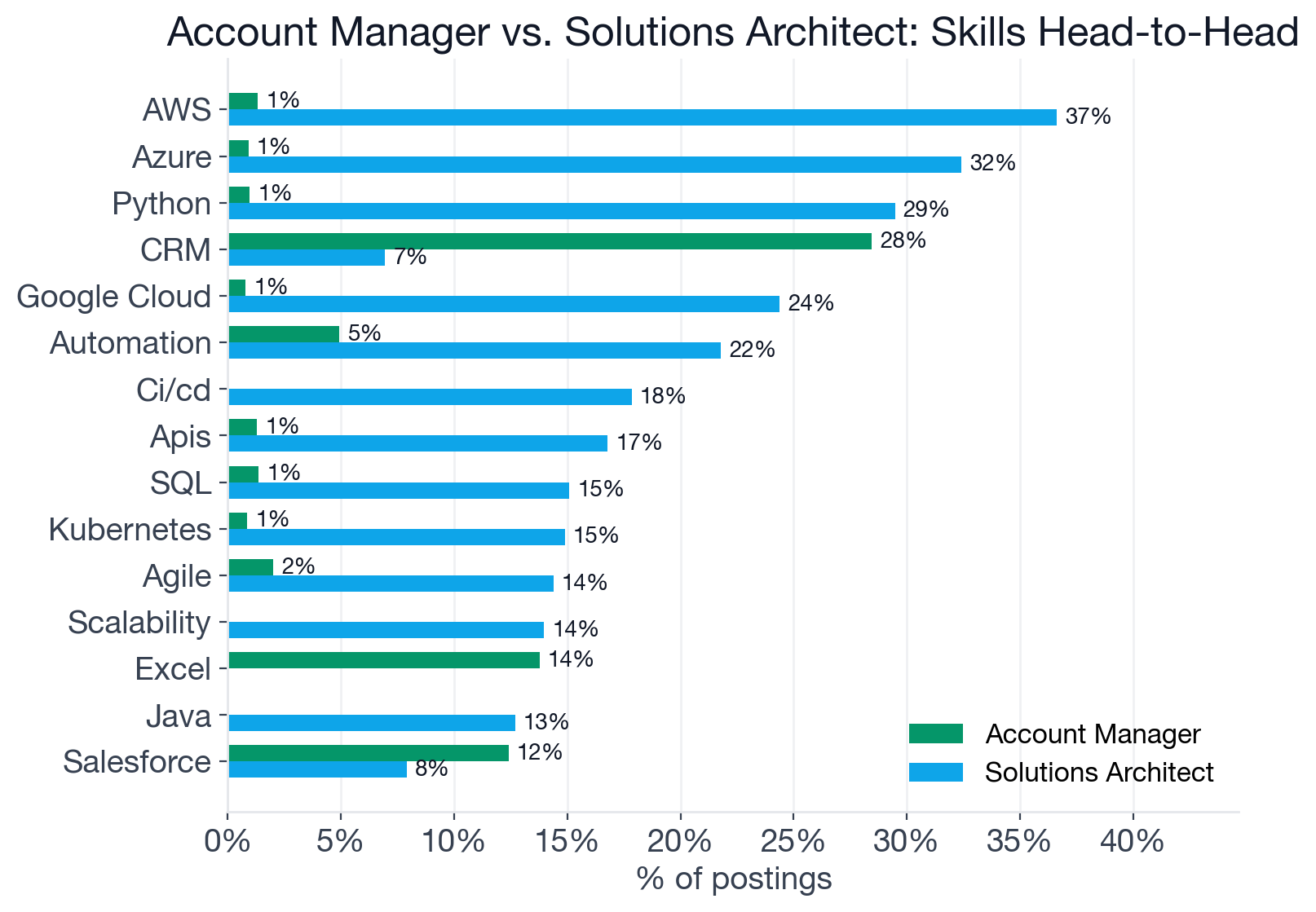
Share of postings that mention each skill for Account Manager (emerald) and Solutions Architect (blue). Grouped bars reflect each skill's share of postings in its respective role.
CRM appears in 28% of AM postings and 6.9% of SA postings. For AMs it's the workflow backbone: tracking deals, contacts, and renewal timelines. For SAs it surfaces as a customer data architecture question or CRM integration requirement rather than a daily operational tool. Salesforce follows the same pattern: central to AM work (12.4%) and present but peripheral for SA (7.9%). Monitoring is the one skill that runs heavier on the SA side (10.5% vs. 5.6% AM), reflecting the SA's responsibility to validate that architected systems actually run reliably in production.
These three skills are the bridge. Someone transitioning from AM to SA won't have to relearn them, but they represent a small fraction of the SA skill set.
Where Do the Roles Diverge?
The divergence is nearly total on the Account Manager side. Just one skill appears exclusively in AM's top-30 above threshold: Excel (13.8% of AM postings). Everything else that makes AM work distinctive (relationship management, territory planning, contract negotiation) lives in behavior and business judgment, not in explicit technical skills that surface in job descriptions.
The Solutions Architect exclusive list runs ten items deep:
- AWS: 37% of SA postings (browse SA + AWS openings)
- Azure: 32%
- Python: 30%
- Google Cloud: 24%
- Automation: 22%
- CI/CD (continuous integration and delivery pipelines): 18%
- APIs: 17%
- SQL: 15%
- Kubernetes (the container orchestration platform most cloud-native deployments use): 15%
- Agile: 14%
That asymmetry is the structural story. SA is defined by a specific, deep technical stack. AM is defined by what it does with relationships, not by a proprietary tool list.
AI in each role: The posting data shows fewer than 1% of AM postings explicitly list AI as a skill, while 10-18% of SA postings require AI system design capabilities (Generative AI 10.3%, LLMs 7.7%, RAG 7.3%; RAG is the retrieval-augmented generation pattern behind AI systems that search internal data). Those percentages measure the explicit bar: roles being hired to build AI systems. They do not capture ambient usage.
For Solutions Architects, that ambient layer is substantial. GitHub Copilot has reached 80% first-week adoption among new GitHub developers, and 90% of Fortune 100 companies have deployed it (per GitHub's published adoption data); any SA writing Python at an enterprise employer almost certainly has Copilot access, whether their posting mentions it or not.
For Account Managers, the ambient layer is equally real but shows up differently. According to ZoomInfo's 2025 sales AI research, 45% of sales professionals now use AI tools at least once a week, driven by features embedded in Salesforce Einstein and HubSpot AI. The 0.7% explicit figure measures how many AM postings require building AI systems. The 45% survey figure measures how many sales professionals already use AI to work. Both are true; they answer different questions.
Which Pays More?
Solutions Architects earn a median US base salary of $150,000 (n=556 postings with salary data). Account Managers earn $90,000 (n=3,072). These are base salaries only: equity, bonus, and sign-on are not disclosed in job postings and not reflected here. Total compensation at top employers runs higher for both roles, particularly for SAs at AI-focused companies where equity can be substantial.
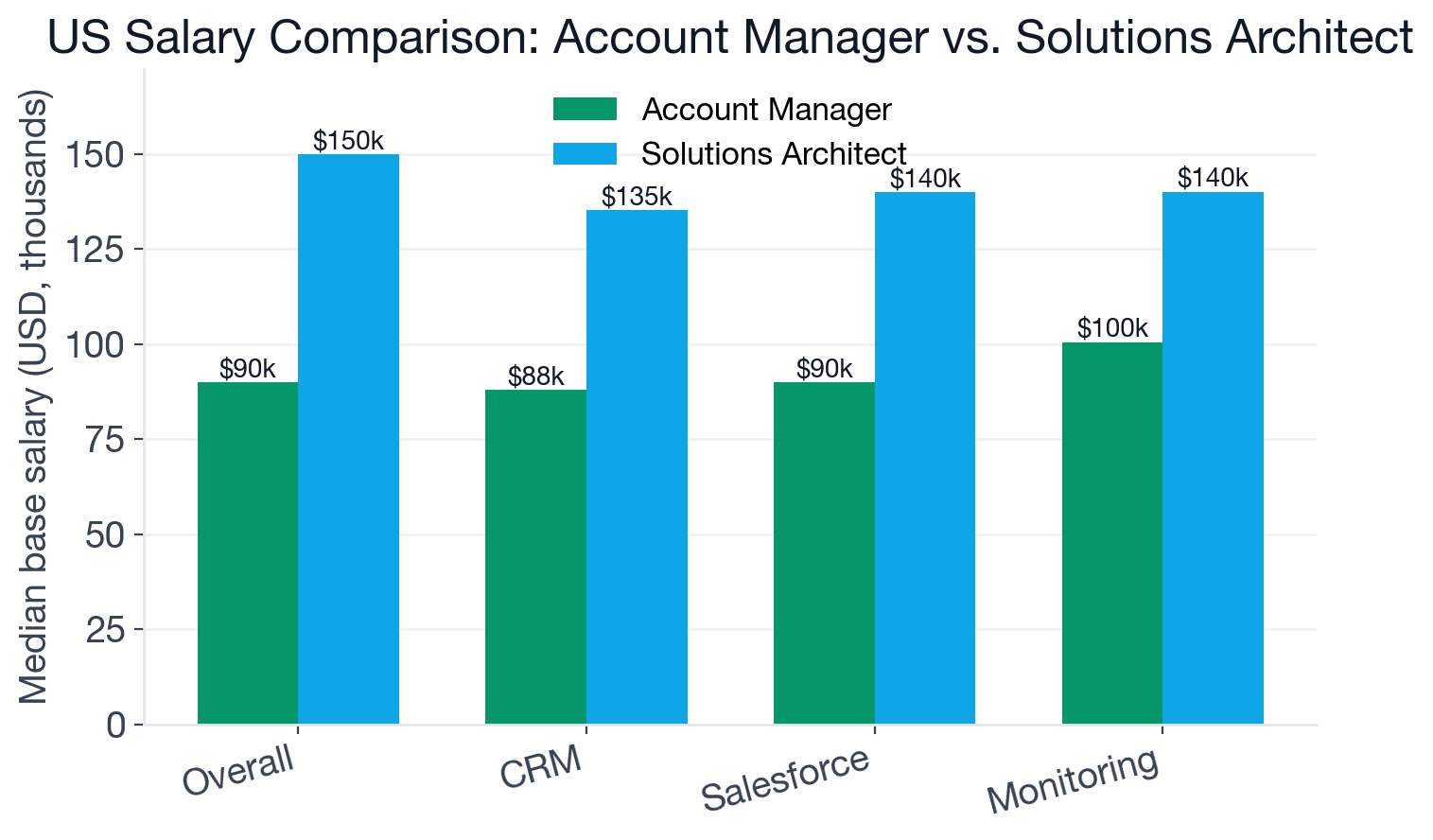
Median US base salary in USD for each role overall and for selected skills. US postings only, base salary only.
The $60,000 gap reflects skill scarcity. Cloud architects with AWS, Python, and systems design experience are harder to hire than relationship managers with CRM experience, and the market prices that accordingly.
SA premium skills (above the $150,000 baseline): Python posts a median of $180,000 (n=202), Apache Spark and Databricks both sit at $180,700 (n=60 and n=80 respectively), and LLMs reach $170,000 (n=60). These are $20,000-$31,000 above baseline, concentrated in data infrastructure and AI system design, the fastest-growing segment of SA demand. Note: Databricks is the largest single employer in this SA dataset at 8.4% of postings; the data-platform salary cluster ($180,700 for Databricks, Apache Spark, and Delta Lake) may partly reflect Databricks' own Bay Area compensation benchmarks rather than representing the broader SA market across all employers.
AM premium skills (above the $90,000 baseline): Cloud skills command large premiums within AM postings but appear in under 2% of AM roles. Google Cloud ($142,000, n=27), Azure ($139,000, n=26), and AWS ($138,700, n=31) are each $48,000-$52,000 above baseline; these are hybrid pre-sales or technical account management roles, not typical AM progression. More attainable within the AM track: Monitoring ($100,500, n=155) and Automation ($100,000, n=165) sit roughly $10,000 above baseline and appear in 5-6% of AM postings.
Which Has More Job Openings?
Account Manager roles outnumber Solutions Architect postings by 7.34 to 1 (15,969 vs. 2,175). That gap is decisive if your primary goal is finding work quickly or building early career runway across a wide market.
The seniority distributions reinforce different access stories. Only 1.1% of SA postings are explicitly entry-level, fewer than 25 openings in the dataset. The role is almost entirely accessed through mid-level experience (68.8% of postings), typically from cloud engineering, pre-sales, or software architecture backgrounds. Senior and staff SAs together make up 30% of the market, versus 11% for AM; solutions architecture skews experienced. Account Manager entry is slightly more accessible at 2.6%, and the sheer volume means there are roughly 400 AM entry openings to target against 24 SA ones.
AM geography spreads more evenly: the US is 39% of AM postings, Germany 7.6%, and the UK 4.8%, reflecting the role's global enterprise footprint. SA demand concentrates in the US (45%) with India at 6.8% and the UK at 6.6%. Remote flexibility tilts slightly toward SA: 31% of SA postings vs. 21% of AM postings, though onsite remains the plurality mode for both (41.5% SA, 48.1% AM).
Which Should You Choose?
Choose Account Manager if you:
- Prefer relationship management, negotiation, and revenue accountability over technical system design
- Want access to 7.34x more job openings, with stronger European market coverage
- Have a background in sales, customer success, or business development and prefer to deepen that track
- Are comfortable with a CRM-centric skill baseline; AI is increasingly embedded in the tools rather than a stated requirement
Choose Solutions Architect if you:
- Have hands-on cloud platform experience (AWS, Azure, or Google Cloud) and can discuss architecture trade-offs at the engineering level
- Write Python at a working level and have system design intuition from prior engineering or technical roles
- Want a $60,000 salary premium and a career track that moves further into AI systems design as demand grows (10-18% of SA postings already require it explicitly)
- Can accept a smaller, more competitive opening pool in exchange for a higher skill and compensation ceiling
If you're on the AM track and considering a pivot, the path typically runs through a Technical Account Manager or Pre-Sales Engineer title first. The Account Manager skills post maps the technical skills that appear in AM postings and command the largest premiums, which are useful signals for planning that transition.
How to Use This in Your Job Search
Both roles reward role-specific preparation. AI mock interviews cover relationship management and negotiation scenarios for AM, and system design and cloud architecture problems for SA. The question bank lets you drill the specific topics that surface in each role's onsite rounds: account planning and stakeholder management for AM, cloud design patterns and distributed systems for SA.
Browse live Account Manager openings or Solutions Architect openings on InterviewStack.io; both boards update daily and support filtering by seniority, work mode, geography, and skill.
FAQ
Q. How much more does a Solutions Architect earn than an Account Manager?
Solutions Architects earn a median US base salary of $150,000 (n=556 postings with disclosed salary) vs. $90,000 for Account Managers (n=3,072). That is a $60,000 premium. The gap widens for SAs with Python, Apache Spark, or Databricks skills, which push medians to $180,000-$181,000.
Q. What skills do Account Managers and Solutions Architects have in common?
Only three skills appear in both roles' top-30 lists at meaningful rates: CRM (28% of AM postings, 6.9% of SA postings), Salesforce (12.4% AM, 7.9% SA), and Monitoring (5.6% AM, 10.5% SA). The Jaccard similarity across both roles' top-30 skill sets is 0.30, meaning roughly 70% of the skill profiles don't overlap.
Q. Which role has more job openings in 2026?
Account Manager roles are far more abundant: 15,969 active postings vs. 2,175 for Solutions Architect, a 7.34x volume gap. Account Manager is also a more global role, with the US at 39% of postings, Germany at 7.6%, and the UK at 4.8%. Solutions Architect is more US-concentrated, with 45% of postings in the United States.
Q. Is it easier to break into Account Manager or Solutions Architect roles?
Account Manager is more accessible at the entry level: 2.6% of AM postings are explicitly entry-level vs. 1.1% for Solutions Architect. The AM role also has 7.34x more total postings, meaning far more openings to target. Solutions Architect entry is primarily through mid-level technical experience, particularly cloud platform or pre-sales engineering backgrounds.
Q. What skills should an Account Manager build to move toward a Solutions Architect role?
The SA skill set is almost entirely technical and does not overlap with the typical AM profile. Key skills to build: AWS (37% of SA postings), Azure (32%), Python (30%), Google Cloud (24%), and CI/CD (18%). CRM and Salesforce transfer directly, but the majority of the investment is in cloud architecture and infrastructure.
Q. How is AI changing the Solutions Architect and Account Manager roles?
Solutions Architects face two AI layers: 10.3% of postings now explicitly require Generative AI skills, with LLMs (7.7%) and RAG (7.3%) also surfacing, meaning roughly 15-18% of SA roles are being hired to architect AI systems. Additionally, 90% of Fortune 100 companies have deployed GitHub Copilot (GitHub Octoverse 2024), so coding SAs are inside the ambient AI tooling layer whether their posting mentions it or not. For Account Managers, 45% of sales professionals report using AI weekly via Salesforce Einstein and HubSpot AI (ZoomInfo 2025), but fewer than 1% of AM postings list AI as an explicit skill. Employers assume CRM-embedded AI; they don't screen for it.
Q. Which role is more remote-friendly?
Solutions Architect roles are moderately more remote-friendly: 30.9% of SA postings are tagged remote vs. 20.7% for Account Manager. Both roles have onsite as the plurality mode (41.5% SA, 48.1% AM). The AM role's heavier onsite bias reflects the client-facing nature of the work, where in-person relationship-building still matters for most enterprise accounts.
Final Thoughts
Account Manager and Solutions Architect sit on opposite ends of the commercial-to-technical spectrum, and the data shows it clearly. The $60,000 salary premium for SA reflects genuine skill scarcity in cloud architecture and system design. The AM market's 7.34x larger volume reflects a different kind of demand: broader, more globally distributed, and less concentrated in the US tech sector. Neither path is better; they reward different strengths and different ambitions. Browse Account Manager openings or Solutions Architect openings to see where the live market stands today.
Topics
Ready to practice?
Put what you've learned into practice with AI mock interviews and structured preparation guides.