
The Applied Scientist Research Collaboration and Stakeholder Management Interview Rewards the Trade, Not the Idea
You are a mid-level Applied Scientist on a three-person research team, with a relevance improvement that could move the needle on a large, customer-facing product. Product wants it live for a seasonal launch in six weeks. Engineering is worried about latency and maintenance. An academic collaborator on the same line of work wants to publish. You do not manage any of them, and the instinct that reads as commitment, defend the research, ask everyone to wait for the full quarter it actually needs, is the instinct that costs the most points once the clock starts.
This walkthrough is built on one real interview blueprint, the same rubric and phase structure InterviewStack.io's AI mock interview uses to score this exact scenario for Applied Scientist candidates. The topic is research collaboration and stakeholder management: not the research itself, but whether you can turn four competing asks into a sequenced plan without waiting for someone to grant you the authority to decide.
Key Findings
- Interviewer Objectives Alignment and Level-Specific Expectations each carry 30 of the interview's 100 points, 60 combined, more than Technical Proficiency and Communication and Problem Solving combined (20 points each).
- Execution strategy and prioritization is the longest phase at 12 minutes (minutes 8 to 20) and carries 5 of the interview's 16 total expectedChecklist items.
- Problem framing runs just 8 minutes, but the checklist already expects 4 distinct stakeholders named individually: product, engineering, leadership, and the academic collaborator.
- The interviewer has 6 scripted follow-ups on deck; this walkthrough dramatizes 4 of them, pulled from the two phases carrying the most decision weight.
- Closing (minutes 27 to 30) is only 3 minutes long but still holds 3 scored checklist items on sequencing, ownership, and measurable checkpoints.
- 4 skill areas are explicitly forbidden in this blueprint, including algorithm implementation and people management, keeping the score entirely on collaboration judgment.
- Across all 4 phases, this interview grades 16 distinct expectedChecklist items inside a single 30-minute session.
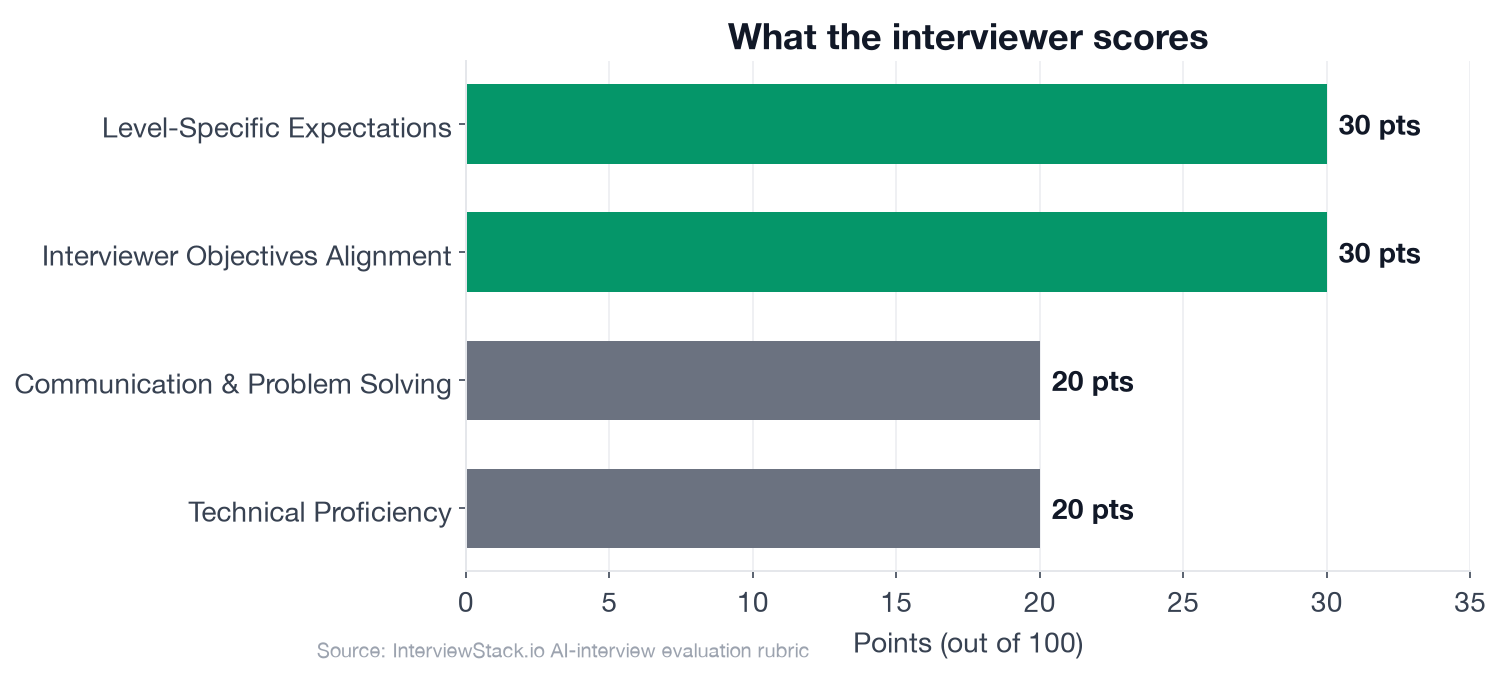
Interviewer Objectives Alignment and Level-Specific Expectations combine for 60 of the 100 points, and both are graded on the plan you build, not the research direction you picked.
What Is the Interviewer Actually Testing With This Retrieval-Ranking Scenario?
Here is the scenario as the interviewer presents it.
The interview question
You are an Applied Scientist on a team building a retrieval and ranking system for a large-scale customer-facing product at a leading tech company. Your team has one engineering manager, six software engineers, two product managers, one designer, and three applied scientists. You are responsible for a research direction that could improve relevance, but deploying it would require changes to the feature pipeline, new offline evaluation support, and a limited online experiment slot.
Product leadership wants a near-term quality improvement for a seasonal launch, engineering is concerned about system complexity and latency, and an academic collaborator wants to publish results from the same line of work. You have moderate credibility on the team but do not manage anyone directly.
How would you drive this effort from initial stakeholder conversations through a decision on what to execute?
What the interviewer's objectives are actually probing: not whether the retrieval work is technically sound, but whether you can turn ambiguous stakeholder pressure into a scoped plan, negotiate trade-offs instead of defending a single bet, and create leverage through communication rather than trying to out-argue the room. Algorithm design, deep model derivation, and people-management scenarios are explicitly off-limits for this blueprint, so nothing about a technical answer earns points here that a scoping decision doesn't.
Where Does This Applied Scientist Lose Points When Stakeholders Pull in Different Directions?
The candidate in this walkthrough, Elena, gives answers that sound reasonable on a first read. Each one has a specific, scored gap. Here are four of the six follow-ups the interviewer can ask, pulled from the two phases carrying the most decision weight.
Turn 1: Defending the Full Quarter
Interviewer: "Suppose product asks for a launch-ready improvement in six weeks, while your preferred research approach likely needs a quarter. How would you re-scope and align everyone?"
Turn 2: Winning the Slot on Conviction
Interviewer: "How would you decide whether to spend the team's only available experiment slot on your research direction versus another request from a partner team?"
Turn 3: Promising the Collaborator Alone
Interviewer: "If the academic collaborator wants openness and publication speed, but product and legal are cautious about disclosure, how would you navigate that?"
Turn 4: Alignment by Informal Update
Interviewer: "What artifacts or communication mechanisms would you use to keep stakeholders aligned as the work progresses?"
Why Doesn't Spotting the Trade-Off on the Page Make It Easy Live?
Every mistake above is obvious with the rubric line sitting right next to it. Live, you don't get the rubric line. The interviewer picks the order, the six-week deadline and the experiment-slot conflict can land back to back, and the pull to defend your own research is strongest exactly when you're being asked to give up the most of it. A blog post can't reproduce that clock or that sequence.
The only preparation that closes the gap is a live rep, with real follow-ups you didn't script, against a scorer that doesn't show you the checklist in advance. That's what the AI mock interview for Applied Scientist is built to give you.
The Complete Blueprint: What a Strong Candidate Hits Across All Four Phases
This is the blueprint a strong candidate hits, phase by phase. It's also exactly what the AI mock interview tracks you against in real time, scoring each expectedChecklist item as the conversation happens instead of waiting until the end.
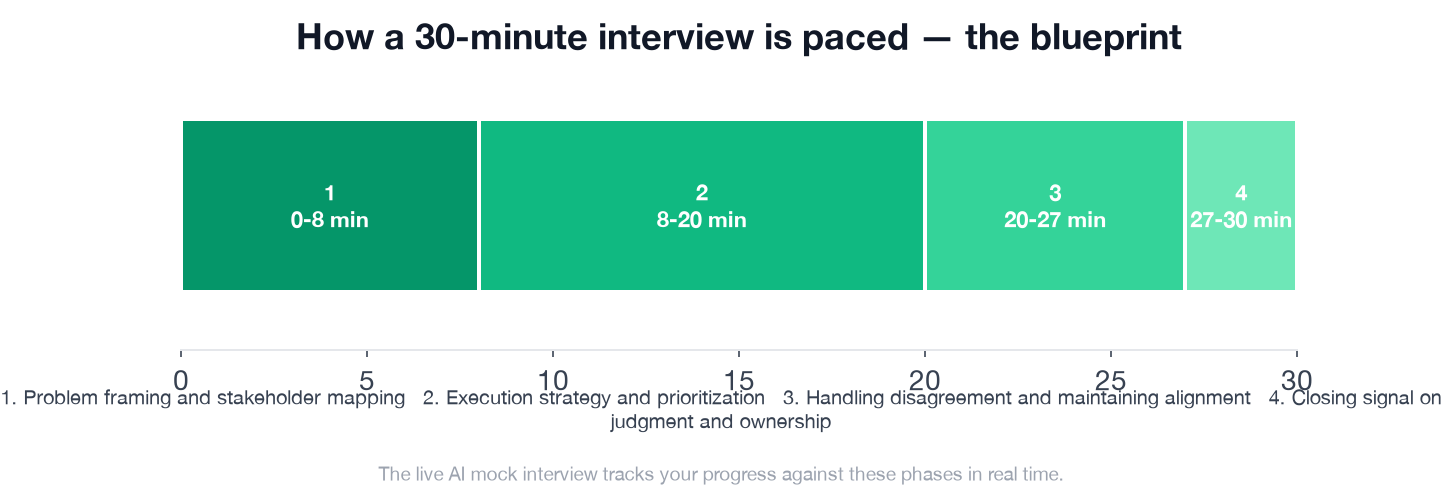
Twelve of the 30 minutes go to execution strategy and prioritization alone, the phase where the six-week trade-off and the experiment-slot decision both live.
- ✓Identifies at least the product manager, engineering team, leadership, and academic collaborator as distinct stakeholders with different incentives
- ✓Clarifies or states assumed success criteria such as relevance lift, latency budget, launch timeline, publication considerations, and experiment availability
- ✓Separates short-term launch pressure from longer-term research investment
- ✓Frames the task as deciding scope and sequencing, not just advocating for one research idea
- ✓Proposes a phased plan such as discovery/alignment, de-risking analysis, minimal viable implementation, and experiment decision
- ✓Uses explicit decision criteria for prioritization, for example expected user impact, engineering effort, latency risk, confidence level, and time-to-value
- ✓Suggests a smaller-scope or fallback path for the seasonal launch if the full research direction is too large
- ✓Addresses how to secure scarce resources such as experiment slots, engineering support, or evaluation tooling through evidence and stakeholder alignment
- ✓Demonstrates practical negotiation language, such as trading scope for timeline or agreeing on guardrails
- ✓Explains how they would respond to engineering or product pushback with data, alternatives, and clarified trade-offs rather than defensiveness
- ✓Describes concrete alignment mechanisms such as a one-pager, design review, experiment proposal, recurring sync, or decision log
- ✓Recognizes when publication goals need coordination with legal, product, or leadership and does not treat external collaboration as independent of company constraints
- ✓Uses escalation selectively for unresolved priority or resource conflicts
- ✓Summarizes a clear recommendation with sequencing and stakeholder buy-in steps
- ✓Makes ownership boundaries explicit, including what they would drive personally versus where they would seek support
- ✓Includes measurable checkpoints that would trigger continuing, re-scoping, or stopping the effort
Run This Scenario Before You're Actually in the Room
Reading four turns and nodding along isn't the same as producing a scoped trade-off out loud, in whatever order the interviewer picks, with a 30-minute clock running and no time to rehearse. The AI mock interview for Applied Scientist: Research Collaboration and Stakeholder Management runs this exact scenario live, asks unscripted follow-ups, and scores you against all four rubric dimensions when you finish, so you know which phase actually cost you points instead of guessing. If you want to drill the underlying judgment calls first, the Research Collaboration and Stakeholder Management question bank breaks the topic into prioritization, negotiation, and alignment, one question at a time. For a broader view of what the role expects in 2026, see what companies actually want from Applied Scientists, or revisit the data pipelines and feature platforms walkthrough for the more technical side of the role.
FAQ
Q. What is this Applied Scientist research collaboration and stakeholder management interview actually testing?
It tests whether you can turn four competing stakeholder demands, a near-term product launch, an engineering complexity concern, a scarce experiment slot, and an academic collaborator's publication timeline, into one sequenced plan without waiting for someone to hand you authority. Interviewer Objectives Alignment and Level-Specific Expectations, each worth 30 of 100 points, are graded on that plan, not on the technical merit of the underlying research.
Q. How much of the score depends on giving something up rather than defending the original plan?
60 of the interview's 100 points sit under Interviewer Objectives Alignment and Level-Specific Expectations, both of which reward scoping, sequencing, and negotiated trade-offs over technical conviction. Technical Proficiency and Communication and Problem Solving each carry 20 points and reward how the trade-off is explained and executed, not whether the research idea was the strongest one in the room.
Q. What is the most common mistake mid-level Applied Scientist candidates make in this interview?
The most common mistake is defending the full research plan against every incoming request, a six-week product deadline, a shared experiment slot, instead of naming a smaller-scope or fallback option. It reads as commitment, but it directly misses the execution phase's expectedChecklist item calling for a phased plan with a scoped-down path for the near-term ask.
Q. How should a candidate respond when engineering pushes back that a research direction will increase latency and maintenance burden?
A strong answer treats the pushback as new information, not an attack, responding with data, named alternatives, and an explicit trade-off rather than defensiveness. That maps directly to a handling-disagreement phase expectedChecklist item, and skipping it costs points under Communication and Problem Solving even when the underlying research judgment is sound.
Q. What should a candidate do if offline metrics look strong but the product manager is unconvinced about the user-facing impact?
A strong answer does not restate the offline numbers louder. It proposes a concrete way to make the impact visible, a small online experiment, a qualitative review, or a narrower pilot scoped to what the product manager actually cares about, and ties that back to the interview's measurable-checkpoint expectation for deciding whether to continue, re-scope, or stop.
Q. How long is the interview and how is the time split across phases?
The interview runs 30 minutes across four phases: problem framing and stakeholder mapping (0 to 8 minutes, 4 checklist items), execution strategy and prioritization (8 to 20 minutes, 5 checklist items), handling disagreement and maintaining alignment (20 to 27 minutes, 4 checklist items), and closing signal on judgment and ownership (27 to 30 minutes, 3 checklist items).
Q. How can I practice this exact interview before the real one?
The AI mock interview for Applied Scientist on Research Collaboration and Stakeholder Management runs this scenario live, asks unscripted follow-ups in whatever order it chooses, and scores you against all four rubric dimensions when you finish, so you find out which phase actually cost you points instead of guessing.
The Trade Is the Deliverable
Nothing in this scenario asks you to prove your research is right. It asks whether you can turn a research direction, a six-week deadline, a scarce experiment slot, and an academic collaborator's timeline into one sequenced plan that survives contact with people who don't report to you. The candidates who score well aren't the ones with the boldest technical bet. They're the ones willing to trade part of it away, on purpose, and say so out loud.
Topics
Ready to practice?
Put what you've learned into practice with AI mock interviews and structured preparation guides.