
Almost All of This Certification's Demand Traces to One Employer and Two Job Titles
AWS Certified Developer - Associate is a widely available credential, but almost nobody asks for it by name, and when they do, the ask is unusually lopsided. Across seven cloud and software engineering roles on the InterviewStack.io job board over the last 90 days, only 98 of 49,918 active postings mention it, about 0.2%, roughly 1 in 500. Cloud Engineer and Software Engineer postings account for 93.9% of every one of those mentions, and a single employer, Peraton, accounts for more than a third of them on its own.
That concentration carries into pay, too, and it's easy to misread. Postings that mention this certification advertise a median US base salary of $175,500, about 3.8% above the $169,050 median for postings in the same seven roles that don't mention it. This compares advertised base pay only: equity, bonus, and other compensation aren't disclosed in job postings and aren't part of this comparison. Read on its own, that 3.8% gap looks modest, almost like the certification barely correlates with pay at all. It understates what's actually happening: cert-mentioning postings skew younger in seniority than the comparison group, and the one band with enough data to check on its own, mid-level, shows a gap more than three times as large.
Key Findings
- AWS Certified Developer - Associate is named in just 0.20% of postings across seven roles (98 of 49,918 analyzed over 90 days), roughly 1 in 500.
- Cloud Engineer and Software Engineer postings carry 93.9% of every mention (92 of 98); Backend Developer, the role whose title most literally matches "Developer," has zero.
- Of the 63 mentions specific enough to classify, 38.1% (24) require the certification outright and 61.9% (39) call it preferred; 35 more mentions don't specify either way.
- Postings that mention it advertise a median US base salary of $175,500 versus $169,050 for postings in the same seven roles that don't, a 3.8% aggregate gap.
- At mid-level, the only band with enough with-cert data to check (n=47), the gap widens to 13.9% ($175,500 versus $154,150); entry, senior, and staff samples are all too thin to report.
- Cert-mentioning postings skew notably less senior (mean level 1.24) than non-mentioning postings in the same roles (mean level 1.56), which compresses the aggregate salary comparison.
- One employer, Peraton, accounts for 36 of the 98 mentions, more than a third, and more than the next five employers on the list combined (25).
- CKAD (Certified Kubernetes Application Developer) is the most common co-occurring credential, appearing alongside 45.9% of these postings, ahead of AWS's own Solutions Architect Associate certification (30.6%).
Where Does the Demand for This Certification Actually Concentrate?
Demand isn't spread evenly across the seven roles in this scope, and it doesn't track posting volume. Cloud Engineer mentions the certification at nearly five times the rate of Software Engineer (0.94% of its own postings versus 0.20%), but Software Engineer, simply because it's by far the largest role in this scope, still contributes the most raw mentions: 68 of the 98, or 69.4%. Between them, Cloud Engineer and Software Engineer account for 93.9% of every mention (92 of 98), even though they make up only 71.8% of postings in scope.
The other roles barely register. Solutions Architect, the role whose name most closely echoes the "architect" family of AWS certifications, makes up 8.5% of postings but only 1.0% of mentions (1 of 98). DevOps Engineer and Cloud Architect are similarly underrepresented. Backend Developer, arguably the most literal match for a certification called "Developer," had zero mentions across 3,202 postings in this window.
| Role | Active postings | Mentioning | Rate |
|---|---|---|---|
| Cloud Engineer | 2,563 | 24 | 0.94% |
| Software Engineer | 33,274 | 68 | 0.20% |
| DevOps Engineer | 5,095 | 4 | 0.08% |
| Cloud Architect | 1,543 | 1 | 0.06% |
| Solutions Architect | 4,241 | 1 | 0.02% |
| Backend Developer | 3,202 | 0 | 0.00% |
Site Reliability Engineer, the seventh role in this scope, isn't broken out above: across this 90-day window it didn't add any postings or mentions beyond what's already counted in the other six roles, so there's nothing distinct to report for it here.
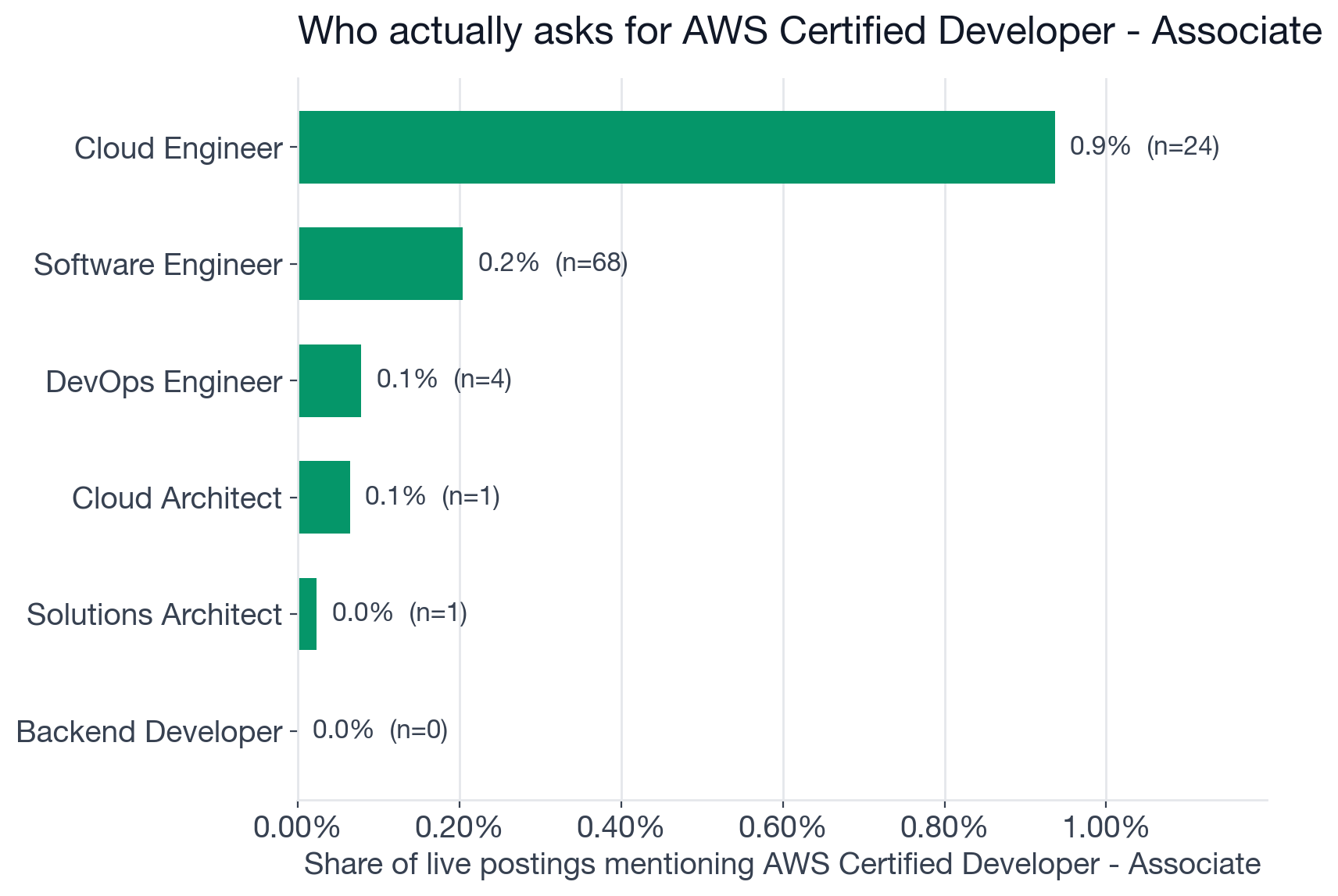 Cloud Engineer mentions the certification at roughly 4.6 times the per-posting rate of Software Engineer, even though Software Engineer supplies more raw mentions simply from its size.
38% of Classified Mentions Require the Certification Outright
Of the 98 total mentions, 63 (64.3%) use language specific enough to classify as required or preferred; the remaining 35 (35.7%) use open-ended phrasing, certification lists, "or equivalent" clauses, that doesn't resolve either way. Within the classified set, 24 mentions (38.1%) require the certification outright, and 39 (61.9%) list it as preferred.
That required-rate is notably high for this series, roughly 4.6 times the 8.3% required-rate we measured for its sibling credential, AWS Solutions Architect Associate. The two role scopes overlap but aren't identical: the Solutions Architect post covers five cloud and infrastructure roles (Cloud Architect, Cloud Engineer, Solutions Architect, DevOps Engineer, SRE), while this one adds Software Engineer and Backend Developer, so part of the gap could reflect the broader scope rather than the certification itself. Given how concentrated this certification's demand already is in a small number of employers, one plausible explanation is that a handful of contractors writing repeatable labor-category requirements produce consistent "required" language across many similar postings, rather than a market-wide shift toward treating this certification as mandatory. The data doesn't isolate that by employer, so treat it as a plausible read rather than a proven one.
Does This Certification Actually Pay More?
All salary figures here are advertised US base pay only, on the subset of postings that disclose it; equity, bonus, and other compensation aren't part of job-posting data. The comparison baseline throughout is other postings in the same seven-role scope that don't mention the certification, not the broader market.
Postings that mention AWS Certified Developer - Associate show a median US base salary of $175,500 (n=62) against $169,050 for postings that don't (n=15,024), a 3.8% gap. That aggregate number is real, but it's also the least useful one here, because it pools a with-cert group that's unusually concentrated at mid-level against a without-cert group with a much larger share of higher-paying senior and staff postings.
| Level | With the cert (median) | Without the cert (median) | Gap |
|---|---|---|---|
| Entry | Not reportable (n=3) | $95,000 (n=533) | N/A |
| Mid-level | $175,500 (n=47) | $154,150 (n=7,149) | +13.9% |
| Senior | Not reportable (n=9) | $180,700 (n=4,516) | N/A |
| Staff | Not reportable (n=3) | $210,000 (n=2,826) | N/A |
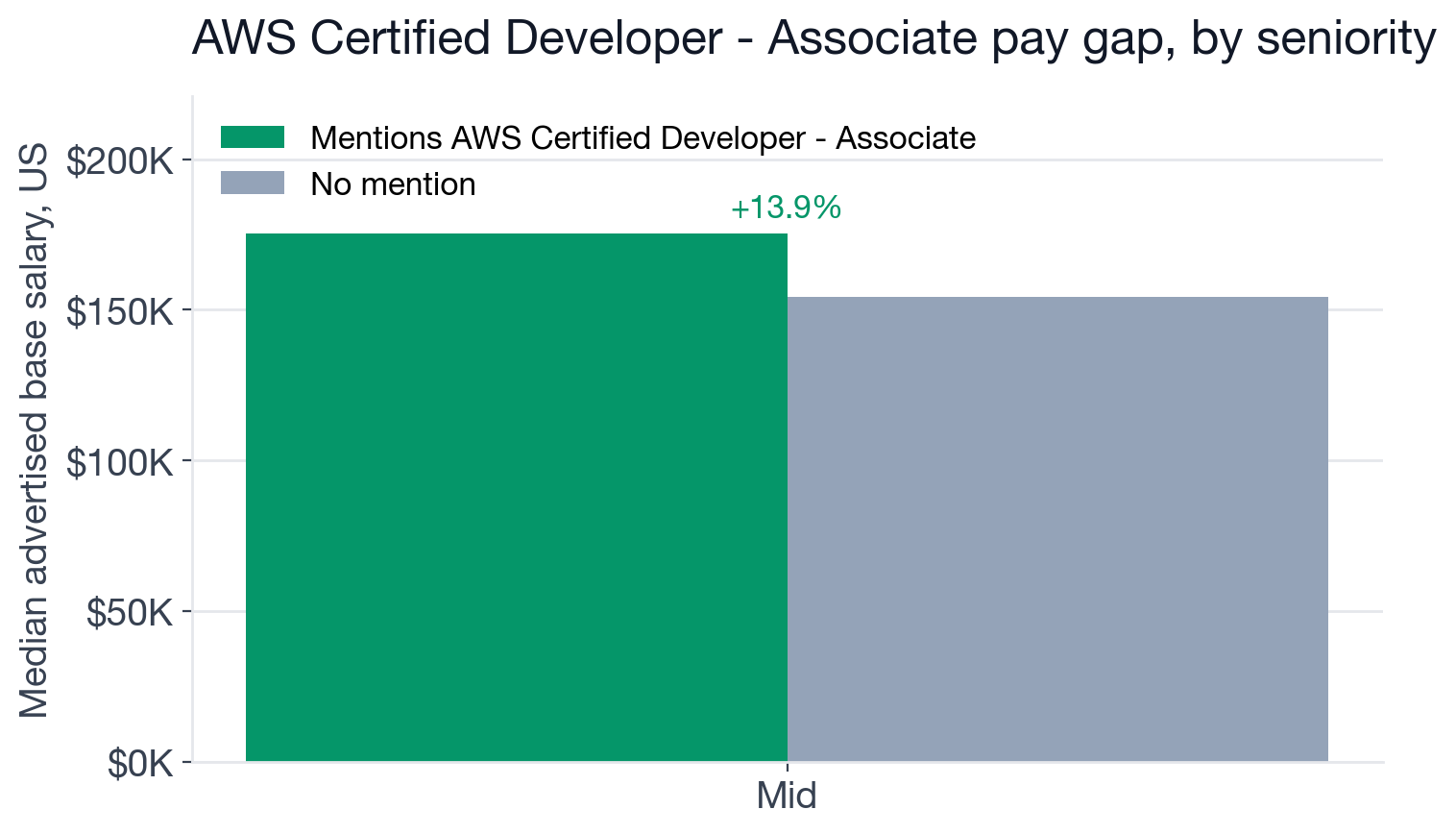 Mid-level is the only band with enough with-cert data to report on its own, and the gap there, +13.9%, is more than three times the raw aggregate.
Mid-level is the only band with enough with-cert salary data to check on its own (n=47), and there the gap is +13.9%, well above the 3.8% aggregate. Entry, senior, and staff postings that mention the certification are all too thin (n=3, 9, and 3) to report separately, so we can't say whether the premium holds, grows, or disappears at those levels.
The gap between the two numbers is explained by seniority mix, not by the certification suddenly mattering more or less. Cert-mentioning postings run notably less senior overall (mean level 1.24 on our internal scale) than non-mentioning postings in the same seven roles (mean level 1.56): 74.5% of cert mentions are mid-level, versus 50.9% of non-mentioning postings, and cert mentions are underrepresented at senior (14.3% versus 29.4%) and especially staff (7.1% versus 15.6%), where non-cert pay is highest. Pooling a group that's three-quarters mid-level against a group with a much bigger senior-and-staff tail drags the aggregate comparison down, even though the one apples-to-apples comparison we can measure, mid-level to mid-level, is a real and sizable premium. This is a correlation between the certification and how a specific set of employers price a specific band of role, not evidence that the credential itself adds anything to a paycheck.
Peraton Alone Explains More Than a Third of the Demand
Among employers with enough mentions to rank, demand for this certification is dominated by one company. Peraton accounts for 36 of the 98 total mentions, more than a third, and more than the next five employers on this list combined (25).
| Employer | Postings mentioning the cert |
|---|---|
| Peraton | 36 |
| Booz Allen Hamilton | 8 |
| NCS Group | 6 |
| Wyetech LLC | 5 |
| Leidos | 3 |
| Visionist, Inc. | 3 |
| Logicalis Spain | 2 |
| Brillio | 2 |
| DecisionPoint Corporation | 2 |
| ECPI University | 2 |
| CI&T | 2 |
Peraton, Booz Allen Hamilton, Wyetech, Leidos, Visionist, and DecisionPoint Corporation, six of the eleven employers above, are defense and intelligence contractors, and together they account for 58.2% of every mention (57 of 98). That lines up with the job titles in this dataset: several of the postings that mention this certification also carry "TS/SCI" or "with Poly" in the title, shorthand for a Top Secret/Sensitive Compartmented Information clearance with polygraph, a requirement that shows up almost exclusively in US government and intelligence contracting. This is a much narrower story than "cloud certifications sell well at federal contractors" in general: one company is doing more than a third of the asking on its own.
Does This Certification Travel Alone, or With a Container Credential?
Postings that name this certification rarely name it alone. CKAD (Certified Kubernetes Application Developer), the Kubernetes ecosystem's own developer credential, is the most common co-occurring certification, appearing in 45.9% of these postings (45 of 98), ahead of AWS's own Solutions Architect Associate credential (30.6%, 30 of 98). Security-adjacent certifications show up too, tying back to the employer concentration above, though at a much lower rate than the two cloud and container credentials.
| Certification | Co-occurs with this cert |
|---|---|
| CKAD (Certified Kubernetes Application Developer) | 45.9% |
| AWS Solutions Architect Associate | 30.6% |
| CompTIA Security+ | 11.2% |
| CISSP | 5.1% |
| RHCE (Red Hat Certified Engineer) | 2.0% |
| CKA (Certified Kubernetes Administrator) | 2.0% |
The skill stack around this certification tells a similar story: postings that mention it lean heavily on container and infrastructure tooling, not just AWS itself. Kubernetes appears in 70.4% of these postings, CI/CD in 59.2%, and Terraform, Docker, and infrastructure-as-code each in roughly half. That's a container-and-automation profile more than a pure application-development one, which fits a certification that, in practice, gets asked for inside cloud engineering titles more than the software-engineering-only roles its name might suggest.
Putting This Data to Work in Your Job Search
This data says more about where demand for this specific credential clusters than about whether you personally should earn it. If you're targeting Cloud Engineer roles, especially ones that carry a security clearance, this certification shows up often enough to be worth having on a resume, and it's more likely to function as a hard requirement here than most certifications in this series. If you're targeting Software Engineer, Solutions Architect, or DevOps Engineer roles outside that concentrated employer set, the underlying skills, Kubernetes, CI/CD, infrastructure as code, matter far more consistently than the credential's name does.
Drill the topics that actually recur in these postings, container orchestration, CI/CD pipelines, infrastructure as code, with InterviewStack's Question Bank, or build the underlying AWS and Kubernetes foundations through InterviewStack's interactive courses if you're newer to the stack. For a broader look at what a competitive Cloud Engineer or Software Engineer skill stack looks like beyond this one certification, those posts break down the full picture. Once you have a specific role targeted, run a mock interview against it to see where your real gaps sit.
To see current openings, browse active postings across all seven roles in this scope.
FAQ
Q. How often do employers ask for AWS Certified Developer - Associate by name?
It shows up in just 0.20% of active postings across seven cloud and software engineering roles (98 of 49,918 analyzed over a 90-day window on the InterviewStack.io job board), roughly 1 in 500 postings.
Q. Which roles actually mention this certification?
Cloud Engineer and Software Engineer together account for 93.9% of every mention (92 of 98). Cloud Engineer has the highest mention rate within its own postings (0.94%, 24 of 2,563), while Solutions Architect, Cloud Architect, and DevOps Engineer mention it rarely, and Backend Developer had zero mentions across 3,202 postings.
Q. Is AWS Certified Developer - Associate usually required or just preferred?
When the language is specific enough to classify, it leans required more than most certifications in this series: 38.1% of the 63 classified mentions (24) require it outright, and 61.9% (39) list it as preferred. A further 35 mentions use open-ended phrasing that doesn't resolve either way.
Q. Do postings that mention it pay more?
Yes, though the honest number depends on which comparison you use. The aggregate advertised US base salary is $175,500 with the cert versus $169,050 without it (a 3.8% gap), but that pools very different seniority mixes. At mid-level, the only band with enough with-cert data to report (n=47), the gap is $175,500 versus $154,150, a 13.9% premium.
Q. Why is the aggregate salary gap so much smaller than the mid-level gap?
Postings that mention this certification skew heavily toward mid-level work (74.5% of mentions, versus 50.9% for non-mentioning postings in the same roles) and are underrepresented at senior and staff level, where non-cert pay is highest. Pooling a mostly mid-level group against a comparison group with a much larger senior and staff tail pulls the aggregate gap down, even though the mid-level premium itself is real.
Q. Who's actually hiring for this certification?
Demand is unusually concentrated in one employer: Peraton accounts for 36 of the 98 total mentions, more than a third, and more than the next five employers on the list combined (25). Defense and intelligence contractors make up the majority of demand overall.
Q. What else shows up alongside this certification?
CKAD (Certified Kubernetes Application Developer) is the most common co-occurring credential, present in 45.9% of these postings, ahead of AWS's own Solutions Architect Associate certification (30.6%). Kubernetes itself appears as a skill in 70.4% of postings that mention this certification.
One Employer's Hiring Pattern Explains Most of What's Here
AWS Certified Developer - Associate is common to earn and rare to be named in a posting, and where it is named, the ask is unusually concentrated: in two job titles, in a handful of defense and intelligence contractors, and largely in one company. The salary and requirement patterns above aren't a verdict on the exam itself; they're a description of how a narrow set of employers currently use this credential inside cleared cloud-engineering roles. Outside that specific lane, the skills behind it, not the badge, are what's actually being asked for.
Topics
Ready to practice?
Put what you've learned into practice with AI mock interviews and structured preparation guides.