
AZ-305 Is Azure's Expert Credential, and Employers Treat It as a Nice-to-Have
Roughly 1 in 70 cloud postings (200 of 14,084, or 1.42%) mentions the Azure Solutions Architect Expert certification, AZ-305, and when it does, 92.8% of the mentions clear enough to classify call it preferred rather than required. For a credential Microsoft positions at the top of its Azure role-based track, that is a modest footprint in actual hiring.
We looked at every active posting on the InterviewStack.io job board for Cloud Architect, Cloud Engineer, Solutions Architect, DevOps Engineer, and SRE roles over a trailing 90-day window, and searched the description text for AZ-305 and its full name. Every comparison below uses other postings in that same role scope as the baseline, not the whole job market.
The salary picture runs against the intuition the title invites. Postings that name AZ-305 advertise slightly less than their peers, not more, and the seniority mix is nearly identical on both sides, so the usual explanation does not apply. This is a post about what employers ask for. It says nothing about what passing the exam would pay you.
Key Findings
- 200 of 14,084 active cloud postings (1.42%) mention AZ-305, about 1 in every 70.
- Of the 97 mentions clear enough to classify, 92.8% call AZ-305 preferred and only 7.2% (7 postings) call it required; 103 mentions (51.5%) don't say either way.
- Cloud Architect and Cloud Engineer postings are 31.6% of the scope but 70.5% of all AZ-305 mentions (141 of 200).
- Among US postings that disclose base salary, those naming AZ-305 advertise a $159,000 median (n=75) versus $164,000 (n=3,853) for other postings in the same roles, 3.0% lower.
- At mid-level, the only seniority band with enough data, the gap is $145,000 versus $152,000 (n=52 versus n=2,122), 4.6% lower.
- Seniority mix is almost the same either way: 61.5% mid-level, 27.0% senior, 11.0% staff for AZ-305 postings, versus 58.3%, 27.0%, 12.6% for the rest.
- Terraform appears in 65.0% of AZ-305 postings and AWS in 52.0%, so this is hands-on, often multi-cloud work.
- AZ-104, the Azure Administrator certification, is named in 33.0% of AZ-305 postings, the most common certification pairing.
Only 7 of 97 Classifiable Mentions Make AZ-305 a Condition of Hire
Employers list AZ-305 as a plus far more often than as a gate. Of the 200 mentions, 97 have required or preferred wording close enough to the certification name to classify. In that set, 90 (92.8%) say preferred and 7 (7.2%) say required, which works out to roughly 13 preferred mentions for every required one.
The other 103 mentions (51.5%) sit inside certification lists or "or equivalent" phrasing that does not resolve either way. We leave them out of the ratio, so the required-versus-preferred split describes only the mentions where an employer took a position. The practical reading: nearly nobody screens a candidate out for lacking AZ-305, and the few who do are a rounding error against the 14,084 postings in scope.
Cloud Architect and Cloud Engineer Carry 7 in 10 Mentions
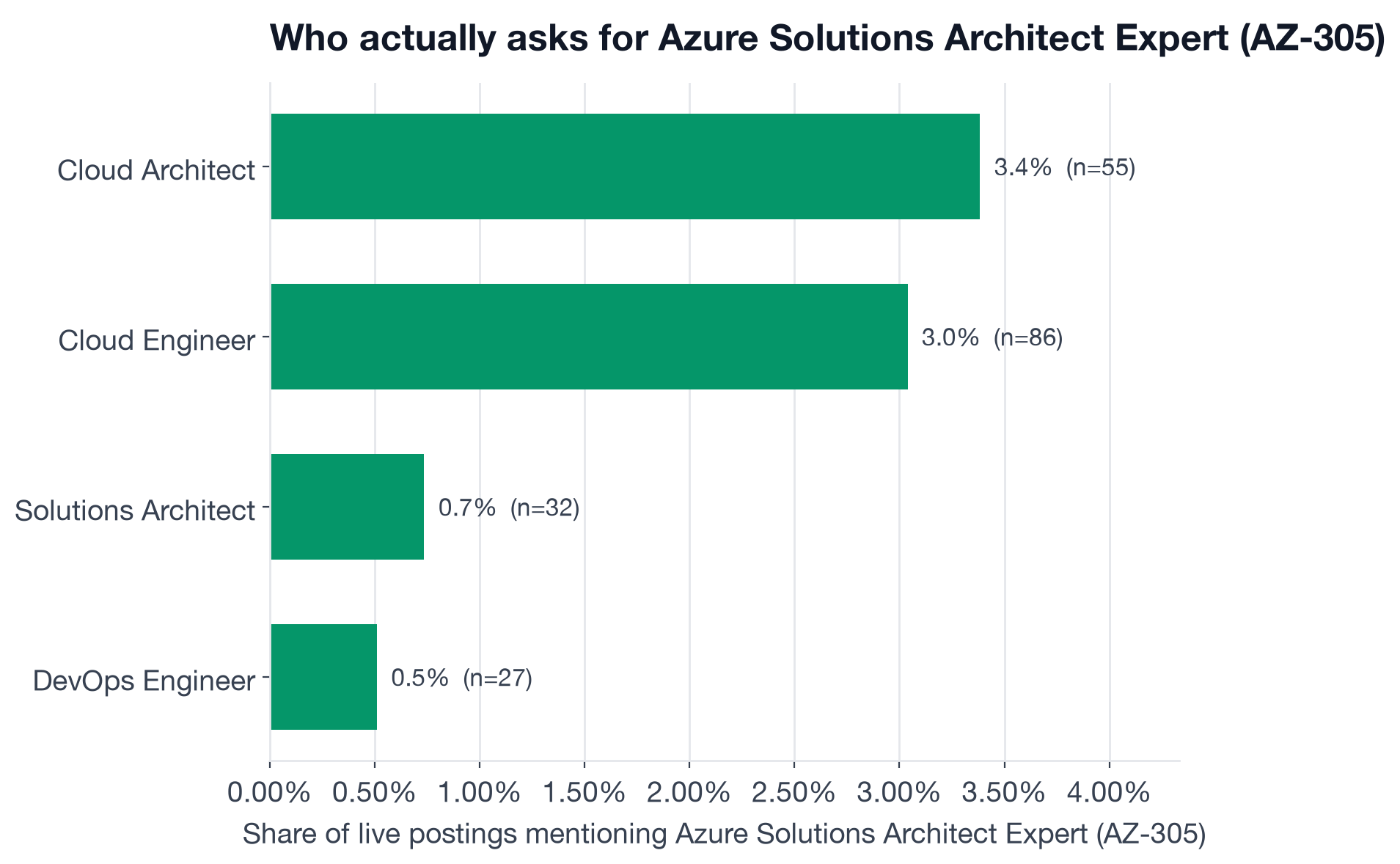
The role titles that sound closest to the certification are not where most of the mentions are. Cloud Architect has the highest mention rate (3.38%), and Cloud Engineer is close behind (3.04%) while contributing the most mentions in absolute terms. Solutions Architect, the title that shares the certification's name, mentions it in only 0.74% of postings.
| Role | Postings in scope | Mention AZ-305 | Rate | Share of all mentions |
|---|---|---|---|---|
| Cloud Architect | 1,625 | 55 | 3.38% | 27.5% |
| Cloud Engineer | 2,830 | 86 | 3.04% | 43.0% |
| Solutions Architect | 4,346 | 32 | 0.74% | 16.0% |
| DevOps Engineer | 5,283 | 27 | 0.51% | 13.5% |
Site Reliability Engineer postings were part of the search scope but add no separate row here: the four roles above account for all 14,084 postings and all 200 mentions.
Demand for the credential concentrates in the two roles most tied to Azure-specific infrastructure work, where Cloud Architect postings name it about 6.6 times as often as DevOps Engineer postings. Solutions Architect is the second-largest role in scope by postings, yet it mentions the credential only about a fifth as often as Cloud Architect, so the title match alone tells you little. If you want to see where the cert is actually requested, browse current Cloud Architect openings and Cloud Engineer openings first.
What Do AZ-305 Postings Advertise Compared With Their Peers?
US-only, base-only: among US postings that disclose a salary, the figures below are advertised base pay. Equity, bonus, and sign-on are not in posting data, so total compensation at larger employers runs higher. Only a subset of postings disclose pay, and that subset is not a random sample.
Postings that name AZ-305 advertise a median base of $159,000 (n=75), against $164,000 (n=3,853) for other postings in the same five roles, a gap of 3.0%. The cert-mentioning side is a small sample, so treat the aggregate as indicative rather than precise.
The seniority split is where most certification posts find their explanation, and here it does not hold. AZ-305 postings are not noticeably more junior or senior than the rest (mean level 1.49 versus 1.50 on a four-step scale, with the shares at each level shown in the findings above). Seniority here is inferred from title keywords, and postings with no explicit level word (many bare "Cloud Architect" or "Solution Architect" titles) default to mid-level, which likely compresses the measured spread on both sides, so read the near-identical mix as approximate. Within mid-level, the one band where both sides clear the 25-posting reporting floor, the gap is still there.
| Seniority | AZ-305 postings (US base median) | Other postings (US base median) | Gap |
|---|---|---|---|
| Entry | Not reportable (n=0) | $90,030 (n=44) | N/A |
| Mid-level | $145,000 (n=52) | $152,000 (n=2,122) | 4.6% lower |
| Senior | Not reportable (n=15) | $177,500 (n=1,062) | N/A |
| Staff | Not reportable (n=8) | $184,900 (n=625) | N/A |
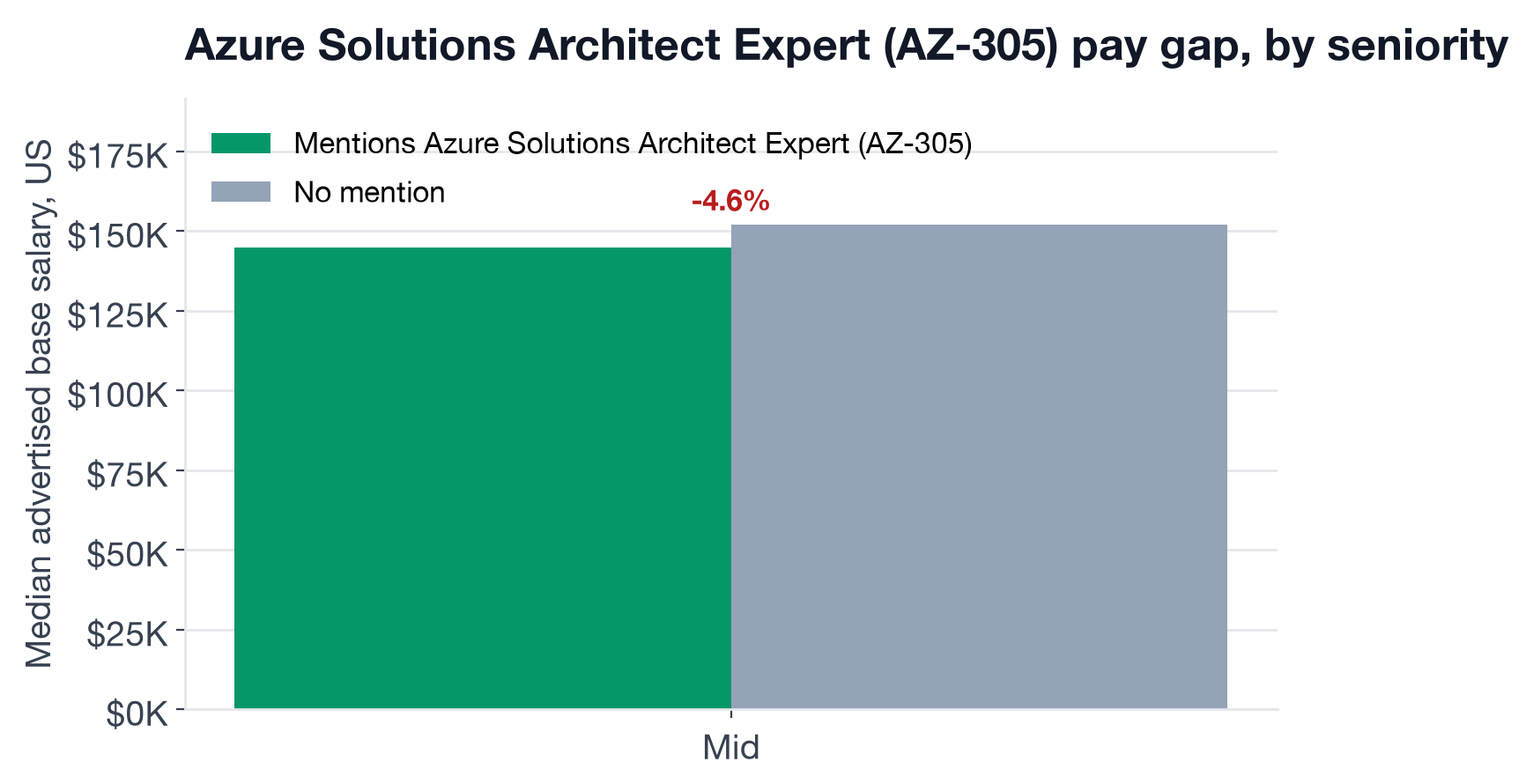
The chart shows only mid-level because it is the only band with enough AZ-305 salary disclosures to report; senior and staff cannot be compared. So what explains the gap? Seniority does not, but role mix plausibly does. Cloud Engineer is the largest source of mentions (43.0% of them against 20.1% of postings), and Cloud Engineer postings without the cert advertise a median of $150,000, compared with about $174,000 for Cloud Architect and $177,650 for Solutions Architect. Postings that name AZ-305 lean toward the lower-priced role. We cannot isolate that from the data, so we describe it as a likely contributor rather than a finding. What the numbers do rule out is any claim that asking for AZ-305 signals a higher-paying job.
Why Do AZ-305 Postings Ask for Terraform More Than Cloud Architecture?
The word "Architect" in the certification name suggests whiteboard design work. The skill lists say something more operational. Terraform (a tool for defining cloud infrastructure as code) appears in 65.0% of AZ-305 postings, Automation in 67.5%, and CI/CD in 60.0%, while Cloud Architecture as a named skill shows up in just 33.0%. Kubernetes (46.5%) and PowerShell (40.0%) sit between them.
AWS appears in 52.0% of these postings and Google Cloud in 31.0%, so about half of the employers asking for the Azure credential also expect you to work outside Azure. If you hold AZ-305 but cannot write infrastructure code, the postings that mention it are unlikely to be a clean fit. Cloud Architect postings that ask for Terraform are the closest match to the profile in this data.
Among certifications named alongside AZ-305, the Azure ladder shows up first: AZ-104 in 33.0% (66 postings) and AZ-500 in 13.0% (26). AWS Certified Solutions Architect - Associate appears in 25.0% (50), CKA in 11.0%, and CISSP in 9.5%. Our write-ups on AZ-104 demand and AWS Solutions Architect Associate demand cover the two most common neighbors.
Booz Allen Leads a Roster of Contractors and Consultancies
The employer list is mixed, with a visible lean toward firms that deliver cloud work for clients or agencies. After merging duplicate labels for the same company (General Dynamics Information Technology appeared under two names), the busiest employers by mentions are below.
| Employer | Postings mentioning AZ-305 |
|---|---|
| Booz Allen Hamilton | 11 |
| General Dynamics Information Technology | 8 |
| PricewaterhouseCoopers | 7 |
| Datamatics Technologies | 7 |
| Leidos | 6 |
| Peraton | 6 |
| Accenture | 3 |
| Fisher Investments | 3 |
| Databricks | 3 |
| Arhs | 3 |
Four federal contractors (Booz Allen, GDIT, Leidos, Peraton) account for 31 of the 200 mentions, 15.5%. Add PwC and Accenture and the contractor-plus-consultancy group reaches 41 mentions, about one in five. That is a real cluster, but not a dominant one: the busiest single employer, Booz Allen, accounts for 5.5% of mentions, and the list also includes a data platform vendor and an investment manager. Employer counts are approximate because company names in postings are inconsistent.
What to Do With a 1.4% Signal
If you are deciding whether to sit AZ-305, the hiring data says it is a supporting credential. It will rarely be what gets a resume rejected, and it does not mark out a higher-paying posting. If you are already working in Azure, the data points to the hands-on stack (infrastructure as code, pipelines, Kubernetes) as the thing employers actually screen for in these postings.
Three practical moves follow:
- Check the role first. Cloud Architect and Cloud Engineer are where the cert is named; open the combined board view and read ten postings in your target role before paying for a voucher.
- Drill the design conversation. Architect interviews test trade-offs more than service names. Use AI mock interviews to rehearse a design walkthrough out loud, and the Question Bank for cloud architecture and infrastructure-as-code topics.
- Build the foundations behind the badge. Our interactive courses cover the system design and infrastructure concepts that these postings assume.
FAQ
Q. How many cloud job postings mention Azure Solutions Architect Expert (AZ-305)?
200 of 14,084 active postings (1.42%) across Cloud Architect, Cloud Engineer, Solutions Architect, and DevOps Engineer roles on the InterviewStack.io job board over a 90-day window, about 1 in every 70.
Q. Is AZ-305 required or just preferred in job postings?
Preferred, overwhelmingly. Of the 97 mentions clear enough to classify, 92.8% (90) call it preferred and 7.2% (7) call it required. Another 103 mentions, 51.5% of all 200, don't say either way and are excluded from that ratio.
Q. Which roles ask for AZ-305 the most?
Cloud Architect postings mention it at the highest rate, 3.38% (55 of 1,625), with Cloud Engineer close behind at 3.04% (86 of 2,830). Those two roles are 31.6% of the postings analyzed but 70.5% of every AZ-305 mention. Solutions Architect (0.74%) and DevOps Engineer (0.51%) mention it far less often.
Q. Do postings that mention AZ-305 pay more?
No. Among US postings that disclose base salary, those naming AZ-305 advertise a median of $159,000 (n=75) against $164,000 (n=3,853) for other postings in the same roles, 3.0% lower. At mid-level, the only seniority band with enough data, the gap is $145,000 versus $152,000 (4.6% lower). That is a comparison of advertised postings, not the cash value of the exam.
Q. What else do AZ-305 postings ask for?
Hands-on infrastructure skills lead: Terraform appears in 65.0% of these postings, CI/CD in 60.0%, and Kubernetes in 46.5%. The most common certification named alongside AZ-305 is Azure Administrator AZ-104 (33.0%), followed by AWS Certified Solutions Architect - Associate (25.0%).
Q. Which employers post the most AZ-305 openings?
After merging duplicate company labels, Booz Allen Hamilton leads with 11 mentions, followed by General Dynamics Information Technology (8), then PricewaterhouseCoopers and Datamatics Technologies (7 each). Four federal contractors together account for 31 of the 200 mentions (15.5%), but no single sector dominates.
An Expert Badge Doesn't Replace the Hands-On Work
AZ-305 is a credible way to organize what you know about Azure design, and a modest tiebreaker in the postings that name it. The market is asking for engineers who can automate, deploy, and operate cloud infrastructure, and it asks for the certificate as an extra.
Topics
Ready to practice?
Put what you've learned into practice with AI mock interviews and structured preparation guides.