
Machine Learning Pays Off for the Analyst Who Rarely Uses It
Business Intelligence Analyst postings ask for Machine Learning just 9.5% of the time, yet among the skills a BI Analyst can actually list, it's one of the best paid: postings that mention it carry a $23,600 premium over the role's own median. Research Scientist postings ask for Machine Learning 60.7% of the time, and it adds exactly nothing to that role's own median pay. Same skill, same job board, a scarcity premium in one role and table stakes in the other.
We compared every active Business Intelligence Analyst posting (2,680) against every active Research Scientist posting (1,339) on the InterviewStack.io job board as of August 2026. All salary figures here are US-only base pay; postings don't disclose equity or bonus, so total compensation at top employers runs higher for both roles than these numbers show. The two roles also share almost no skill DNA: a 0.13 Jaccard similarity across their top-30 skill lists, one of the lowest overlap scores we've measured between any two roles on the board.
Job-board role classification isn't perfect: a manual read of the underlying title sample found roughly a fifth of postings on each side sitting outside a strict definition of the role, generic "Analyst" and "Specialist" titles in logistics, quality, and packaging engineering on the Business Intelligence Analyst side, and adjacent-but-distinct research titles (quantitative finance, biotech, physics, a few AI-training contractor gigs) on the Research Scientist side. Neither role's top-20 skill list shows that same noise, both read as squarely on-topic, and that's what the skill and salary figures below are built from.
| Business Intelligence Analyst | Research Scientist | |
|---|---|---|
| Median US base salary | $129,800 | $192,000 |
| Active postings | 2,680 | 1,339 |
| Top skill | Data Visualization (68.8%) | Machine Learning (60.7%) |
| Remote share | 14.9% | 14.3% |
| Entry-level share | 5.1% | 6.0% |
Key Findings
- Research Scientist's median US base salary is $192,000 versus Business Intelligence Analyst's $129,800, a $62,200 gap; Business Intelligence Analyst's pay sits 32.4% lower (n=547 and n=549).
- The two skill stacks overlap by just 0.13 Jaccard similarity, one of the lowest overlap scores among any two roles on the InterviewStack.io job board.
- Machine Learning appears in only 9.5% of Business Intelligence Analyst postings, but it's a $23,600 premium over that role's own baseline (n=73).
- The same Machine Learning skill appears in 60.7% of Research Scientist postings and adds $0 to that role's own baseline (n=353), it's the assumed job, not a differentiator.
- Data Pipelines is nominally shared by both roles (28.8% Business Intelligence Analyst, 7.0% Research Scientist) but prices in opposite directions: -$2,500 for Business Intelligence Analyst, +$46,500 for Research Scientist.
- Business Intelligence Analyst postings outnumber Research Scientist postings roughly 2 to 1 (2,680 vs 1,339).
- Entry-level share is thin for both roles: 5.1% for Business Intelligence Analyst, 6.0% for Research Scientist.
- Research Scientist postings are far more US-concentrated (63.6%) than Business Intelligence Analyst (34.2%), and more onsite (61.8% vs 51.4%).
Two Jobs That Don't Share a Daily Routine
A Business Intelligence Analyst spends the week turning operational data into something a VP can act on: building dashboards in Power BI or Tableau, writing the SQL that feeds them, and explaining what a metric move means to a room that doesn't want to see the query. The output is a decision, not a model.
A Research Scientist spends the week testing whether a modeling idea works: training or fine-tuning something in PyTorch, running the experiment that tells you whether it moved the metric, and writing up results an engineering team will eventually productionize. PyTorch, Algorithms, Deep Learning, and Reinforcement Learning back this up as exclusive skills, showing up throughout Research Scientist postings and nowhere near Business Intelligence Analyst's top 30.
Python Is the Only Real Bridge Between These Stacks
Both roles ask for exactly seven skills at a meaningful frequency, and only Python functions as a real bridge: 39.6% of Business Intelligence Analyst postings and 55.8% of Research Scientist postings, common enough on both sides that switching over doesn't mean learning a new language.
| Skill | Business Intelligence Analyst | Research Scientist |
|---|---|---|
| Python | 39.6% | 55.8% |
| Machine Learning | 9.5% | 60.7% |
| Statistics | 19.5% | 19.0% |
| Data Pipelines | 28.8% | 7.0% |
| Data Science | 18.2% | 10.8% |
| Automation | 21.5% | 6.0% |
| Monitoring | 12.2% | 7.1% |
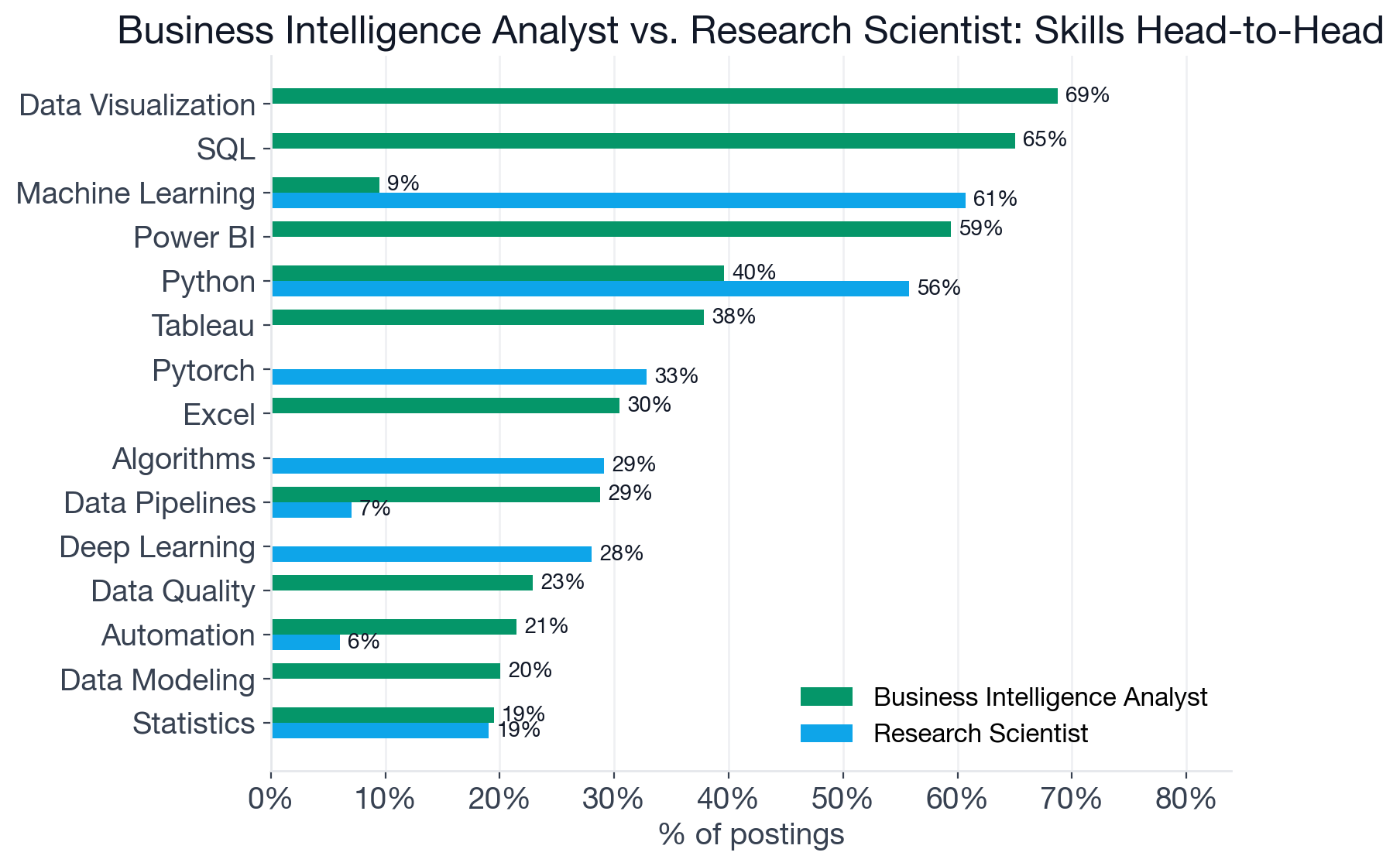 Python is the only skill with comparable demand on both sides; everything else skews hard toward one role.
Statistics is the one true coin flip: 19.5% Business Intelligence Analyst versus 19.0% Research Scientist, a skill both roles list but neither treats as central. The rest, Machine Learning, Data Pipelines, Data Science, Automation, and Monitoring, are nominally shared but skew hard toward one role, and how each prices them matters more than whether they're shared at all.
What Does Each Role Ask For That the Other Never Does?
Business Intelligence Analyst's top exclusive skills are entirely presentation and pipeline layer: Data Visualization (68.8%), SQL (65.0%), Power BI (59.4%), Tableau (37.8%), and Excel (30.4%) lead the list, tools for getting data in front of a decision-maker, not for building the thing the decision-maker is asking about.
Research Scientist's exclusive list is the model-building layer: PyTorch (32.9%), Algorithms (29.1%), Deep Learning (28.0%), LLMs (18.7%), and Reinforcement Learning (17.8%). Nothing on this list touches a dashboard. If Business Intelligence Analyst's stack answers "what happened and what should we do about it," Research Scientist's stack answers "does this technique actually work."
That split matters for reading the AI numbers correctly. Research Scientist's Machine Learning, Generative AI (14.3%), and Reinforcement Learning (17.8%) figures reflect a role explicitly hired to build AI systems, not just use them. Business Intelligence Analyst's low Machine Learning number (9.5%) doesn't mean AI is absent, it means the job doesn't require you to build it: Power BI Copilot, Excel Copilot, and ChatGPT's data-analysis tools are common enough in BI work that a 2025 Alteryx survey of 1,400 data analysts found 97% say AI tools accelerate their daily tasks. The same split runs in reverse for Research Scientists: a 2025 Nature survey found 57% of researchers had sought AI help writing papers in the two years prior, an ambient layer sitting on top of the explicit, job-defining kind.
The $62,200 Gap Between Business Intelligence Analyst and Research Scientist
Research Scientist's median US base salary is $192,000 (n=547) against Business Intelligence Analyst's $129,800 (n=549), a $62,200 gap; Business Intelligence Analyst sits 32.4% lower. That premium isn't evenly distributed inside either role's own skill stack, though.
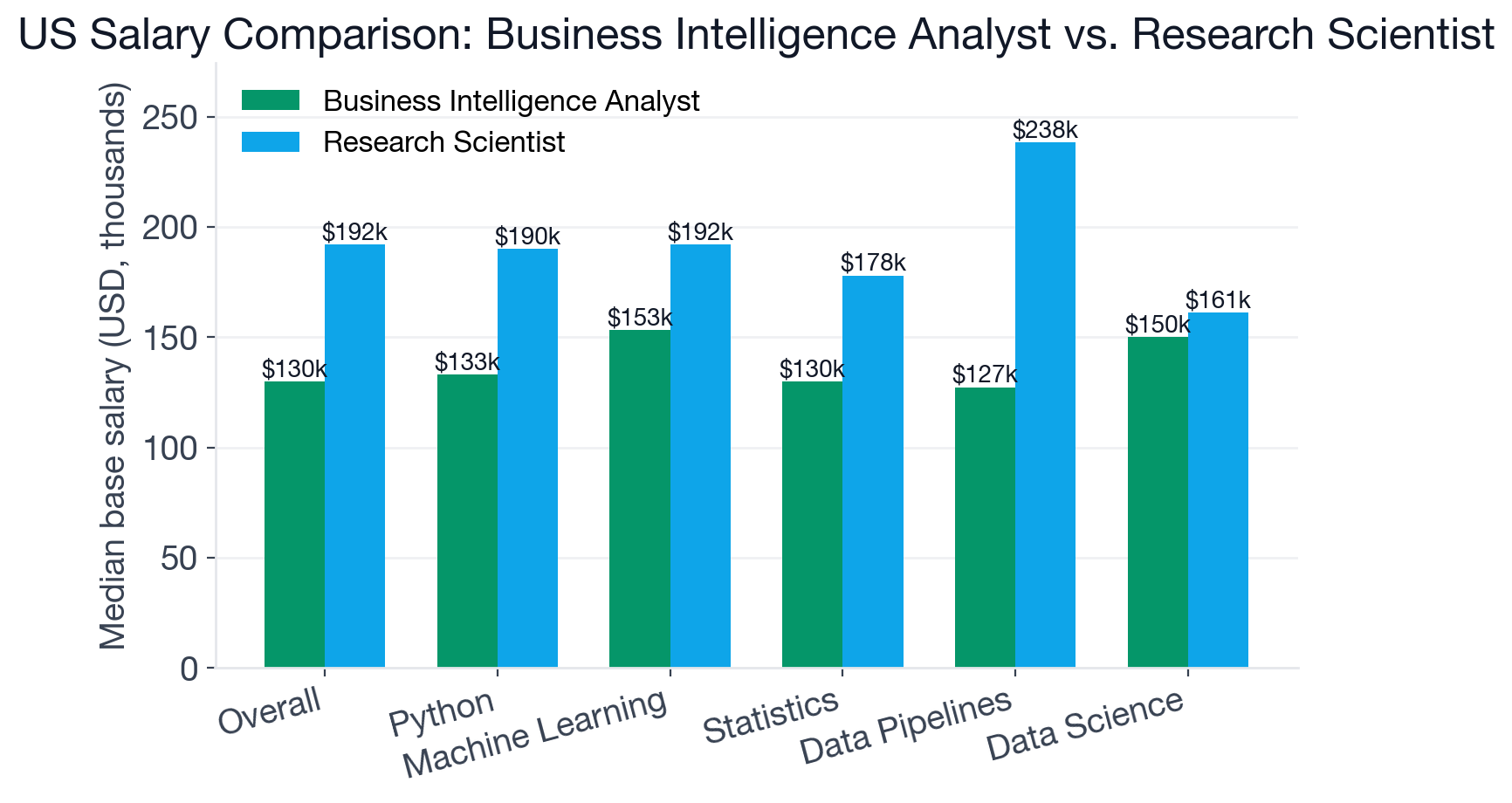 Research Scientist's overall bar sits well above Business Intelligence Analyst's, but the shared-skill bars show the premium isn't uniform.
Among the modern-data-stack and ML-adjacent skills that clear Business Intelligence Analyst's own baseline (dozens do; this is a representative slice, not the full list), a recognizable cluster stands out: dbt (+$29,400, n=70), Machine Learning (+$23,600, n=73), Data Science (+$20,200, n=135), Databricks (+$19,200, n=55), Forecasting (+$18,200, n=83), and Snowflake (+$10,200, n=105). Notice what's missing: SQL (+$5,200), Power BI (-$4,900), and Excel (-$14,800), the tools that define the role by frequency, don't pay extra for having them. The premium sits in the modern-data-stack and ML-adjacent layer, not the presentation layer the job is named for.
Research Scientist's own baseline is already so high that most of its core skills price at or below it: PyTorch, Deep Learning, and Machine Learning itself all add $0, and Statistics actually costs $14,000 below baseline. Among the skills that do clear it, a tight cluster of generative-AI specialization stands out: LLMs, Fine Tuning, Natural Language Processing, and Distributed Training all add exactly the same amount, $21,000 (n=36 to 102), over Research Scientist's own baseline. Reinforcement Learning adds $8,000, and a systems-adjacent cluster, Distributed Systems (+$15,700, n=26), Prototyping (+$13,300, n=84), and Systems Engineering (+$10,200, n=28), clears baseline too, by a smaller margin than the generative-AI group. (One high-paying outlier, "Compensation and Benefits" at +$32,000, is excluded here: it's a recurring artifact in this role's data, a small cluster of HR-analytics postings misclassified as Research Scientist, not a genuine research skill.) And Data Pipelines, nominally a skill both roles list, produces the largest premium found among the genuinely role-relevant skills in either role's own salary table: +$46,500 (n=44) on Research Scientist's own baseline, far above Business Intelligence Analyst's own largest premium (dbt, +$29,400), and the mirror image of the -$2,500 it costs on Business Intelligence Analyst's own baseline.
More Openings, Not an Easier Bar to Clear
Business Intelligence Analyst has roughly twice the open positions (2,680 vs 1,339), so more listings mean more shots at landing one. But neither role is beginner-friendly by entry-level share: 5.1% of Business Intelligence Analyst postings and 6.0% of Research Scientist postings are explicitly entry-level, both under 1 in 16.
Seniority runs counter to what each role's reputation would predict. Research Scientist has a PhD-heavy reputation, but its senior-plus-staff share (26.8%) is actually lower than Business Intelligence Analyst's (31.7%) by title-keyword measure, credential requirements don't always surface as a title-seniority signal the way years-of-experience language does.
Geography and work mode diverge more than seniority does. Research Scientist postings concentrate in the US (63.6%) around frontier AI labs and quant trading desks; Business Intelligence Analyst postings spread globally (34.2% US, with meaningful India, Brazil, and Philippines volume). Remote share is nearly identical (14.9% vs 14.3%); the real gap is onsite, 61.8% for Research Scientist against 51.4% for Business Intelligence Analyst, coming out of hybrid, not remote.
Which Role Should You Actually Choose?
Choose Business Intelligence Analyst if you:
- Want to work in the presentation and decision-support layer, turning SQL queries and Power BI dashboards into calls executives actually make, not building the models behind them.
- Are switching from an adjacent analytics, reporting, or finance background; SQL, Excel, and dashboard tools transfer directly and don't require a machine learning foundation first.
- Want more open roles to apply to right now (2,680 active postings, roughly 2x Research Scientist's) and are comfortable with a global, geographically distributed hiring market.
Choose Research Scientist if you:
- Want to spend your week testing whether a modeling idea works, in PyTorch or a similar framework, rather than presenting results someone else already decided on.
- Have or are building toward a machine learning, deep learning, or applied research background; Algorithms, Deep Learning, and Machine Learning are the actual entry bar, not SQL.
- Want the higher pay ceiling ($192,000 median vs $129,800) and can compete for a smaller, more US-concentrated, more onsite pool of openings.
For a full skills breakdown of either role on its own, see Business Intelligence Analyst skills companies want in 2026 and Research Scientist skills companies want in 2026. If Applied Scientist is also on your shortlist, we've compared it against Business Intelligence Analyst directly in Business Intelligence Analyst vs Applied Scientist.
FAQ
Q. Which pays more, Business Intelligence Analyst or Research Scientist?
Research Scientist. Its median US base salary is $192,000 versus Business Intelligence Analyst's $129,800, a $62,200 gap; Business Intelligence Analyst's salary sits 32.4% lower, based on 547 and 549 US postings with salary disclosed. These are base-pay figures only; equity and bonus aren't disclosed in job postings, so total compensation at top employers runs higher for both roles.
Q. How much skill overlap is there between Business Intelligence Analyst and Research Scientist jobs?
Very little. The two roles share a Jaccard similarity of just 0.13 across their top-30 skill lists, and only seven skills clear the 5% frequency threshold in both. Python is the only skill common enough on both sides (39.6% BI Analyst, 55.8% Research Scientist) to count as a real bridge.
Q. Is Machine Learning a required skill for Business Intelligence Analyst jobs?
Not usually. Machine Learning appears in just 9.5% of Business Intelligence Analyst postings, but among the skills a BI Analyst can list, it's one of the best paid: postings that mention it carry a $23,600 premium over the role's own median base salary (n=73).
Q. Do Business Intelligence Analyst and Research Scientist jobs require the same technical tools?
No. Business Intelligence Analyst's top exclusive skills are Data Visualization (68.8%), SQL (65.0%), and Power BI (59.4%), presentation and reporting tools. Research Scientist's top exclusive skills are PyTorch (32.9%), Algorithms (29.1%), and Deep Learning (28.0%), model-building tools. Neither role's top exclusive skill shows up in the other's top 30.
Q. Is Research Scientist harder to break into than Business Intelligence Analyst?
Not by entry-level hiring share, both roles are similarly thin at entry level (5.1% Business Intelligence Analyst, 6.0% Research Scientist). Research Scientist actually shows a lower senior-plus-staff share (26.8%) than Business Intelligence Analyst (31.7%) by title-keyword measure, despite its PhD-heavy reputation.
Q. Which role has more remote job opportunities?
Neither has a meaningful edge. Remote share is nearly identical, 14.9% for Business Intelligence Analyst and 14.3% for Research Scientist. The real work-mode gap is onsite work: Research Scientist runs 61.8% onsite versus 51.4% for Business Intelligence Analyst.
Q. Do Research Scientists use AI tools beyond the models they build?
Yes. Machine Learning, Generative AI, and Reinforcement Learning are the explicit job (Machine Learning alone appears in 60.7% of postings), but a separate ambient layer sits on top of that: a 2025 Nature survey found 57% of researchers had sought AI help writing papers in the two years prior, work the job posting never lists as a requirement.
Scarcity Sets the Price, Not the Job Title
Both roles are healthy, and both are hiring. The $62,200 gap isn't really a Business-Intelligence-Analyst-versus-Research-Scientist story, it's a story about what an AI skill means on a job posting: when almost every posting lists it, it becomes the price of entry; when almost none do, the postings that ask for it pay extra for the scarcity. Business Intelligence Analyst's biggest premiums (dbt, Machine Learning, Data Science) are exceptions to what the role normally asks for. Research Scientist's baseline already assumes Machine Learning, so its premiums (LLMs, Fine Tuning, Distributed Training) sit one specialization further out.
If you're deciding between the two, practice with AI mock interviews for the specific role you're leaning toward, the two interviews test almost nothing in common. Drill SQL and dashboard-design questions in the Question Bank for Business Intelligence Analyst, or build the statistics and ML foundations Research Scientist postings assume in our interactive courses. Then browse live Business Intelligence Analyst openings or Research Scientist openings to see what today's postings actually ask for.
Topics
Ready to practice?
Put what you've learned into practice with AI mock interviews and structured preparation guides.