
The Headline CCIE Premium Is Almost Entirely Seniority Mix
CCIE, Cisco's Certified Internetwork Expert certification, looks like it pays off. Postings that mention it advertise a median US base salary of $148,550, about 10% above postings in the same roles that don't. But run that same comparison inside a single seniority level, mid-level or senior, and the premium almost disappears.
We looked at 6,112 active Network Engineer and Systems Engineer postings on the InterviewStack.io job board over a 90-day window. CCIE shows up in just 4.6% of them, 280 postings, and the postings that do mention it skew so much more senior than the ones that don't that seniority, not the certification, explains almost the entire pay gap.
Two scope notes before the numbers. First, every salary figure here is advertised US base pay on the postings that disclose it, not total compensation, equity, or bonus, so actual pay at top employers likely runs higher than these numbers. Second, every comparison is against other postings in the same Network Engineer and Systems Engineer scope, never the broader job market. CCIE isn't being measured against every tech job; it's being measured against the roles that would plausibly ask for it.
Key Findings
- CCIE appears in 4.6% of active Network Engineer and Systems Engineer postings (280 of 6,112 analyzed over a 90-day window).
- Postings mentioning CCIE advertise a median US base salary of $148,550, about 10% ($13,550) above postings in the same roles that don't mention it.
- That gap nearly disappears within a single seniority level: +0.3% at mid-level and +2.4% at senior, both far short of the 10% aggregate.
- CCIE-mentioning postings skew far more senior: 53.9% are senior or staff level, versus 34.3% of postings that don't mention CCIE.
- Only 16.0% of classified mentions treat CCIE as a hard requirement; 84.0% list it as preferred.
- Network Engineer postings name CCIE 9.4 times as often as Systems Engineer postings (9.4% versus 1.0%).
- CCNP appears alongside CCIE in 74.3% of CCIE-mentioning postings, more than any other certification.
Control for Level, and the Premium Nearly Vanishes
Pool every seniority level together and CCIE postings show a real $13,550 edge, 10.0% above the non-CCIE median. Split that comparison by level and the edge is mostly gone.
| Seniority level | With CCIE (median US base) | Without CCIE (median US base) | Gap |
|---|---|---|---|
| Entry | N/A (n=0) | $79,172 (n=54) | N/A |
| Mid-level | $130,000 (n=51) | $129,575 (n=1,454) | +0.3% |
| Senior | $148,550 (n=39) | $145,000 (n=552) | +2.4% |
| Staff | N/A (n=21, below reporting floor) | $162,000 (n=299) | N/A |
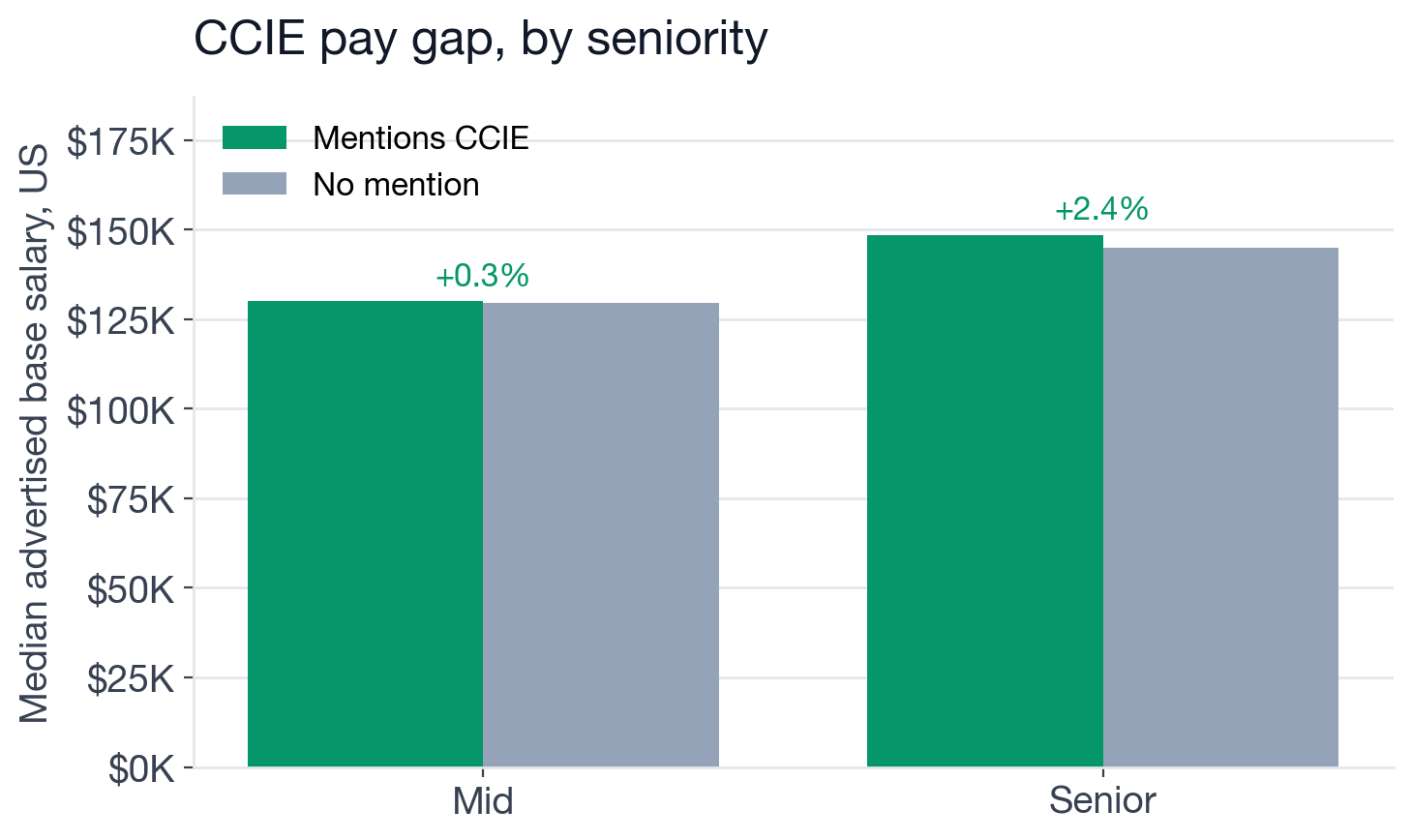 At every level where the comparison is reportable, the CCIE gap is a few percentage points, not ten.
At mid-level, the gap is 0.3%, functionally noise on a $130,000 base. At senior, it's 2.4%. There's no reportable comparison at entry (zero CCIE-mentioning postings met our 25-posting salary-disclosure floor there) or at staff (21 CCIE-mentioning postings disclosed pay, four short of the floor).
The reason the pooled 10% number looks so much bigger than either real level-by-level gap is composition, not compensation. CCIE-mentioning postings skew dramatically more senior: 53.9% of them are senior or staff level, versus 34.3% of postings that don't mention CCIE, a 19.6-point gap. Senior and staff roles pay more regardless of certification, so pooling every level together quietly credits CCIE with a chunk of salary that actually belongs to seniority.
One methodology note on those level buckets: seniority is inferred from title keywords (Senior, Staff, Lead, Principal, and so on), and a posting with no such signal defaults to mid-level, which compresses the measured spread between levels. That means the mid-level and senior gaps above could shift somewhat under a manual audit. It's unlikely to erase the seniority story itself, though, since most CCIE-mentioning titles in this dataset carry an explicit level word rather than sitting in the ambiguous, default-to-mid bucket.
One thing seniority mix does not explain is role mix, and it runs the other way. CCIE mentions concentrate heavily in Network Engineer postings (more on that below), and Network Engineer is the lower-paying of the two roles in this scope: postings that don't mention CCIE have a $130,383 median in Network Engineer versus $140,325 in Systems Engineer, about 7% higher in Systems Engineer's favor. If role mix were doing the work, pooling would pull the aggregate CCIE premium down, not up. Seniority is carrying the entire 10% aggregate gap on its own, against a slight headwind from role mix.
How Often Is CCIE Actually a Hard Requirement?
Rarely, and that's worth knowing before you read anything else here as a mandate. Of the 280 postings that mention CCIE, 188 use language clear enough to classify as required or preferred; the other 92, roughly a third of all mentions, don't specify clearly enough either way.
Within that classified group, CCIE is preferred in 84.0% of postings and required in only 16.0%, about 1 in 6. That fits a certification employers use to signal what an ideal candidate looks like rather than a gate they enforce. If you don't hold it, you're very rarely disqualified outright; you're more often competing against a preference, not a requirement.
How Much Does CCIE Even Register in Systems Engineer Postings?
Barely. CCIE is close to a Network Engineer-only signal in this scope.
| Role | Postings scanned | CCIE mentions | Mention rate | Share of all CCIE mentions |
|---|---|---|---|---|
| Network Engineer | 2,615 | 245 | 9.4% | 87.5% |
| Systems Engineer | 3,497 | 35 | 1.0% | 12.5% |
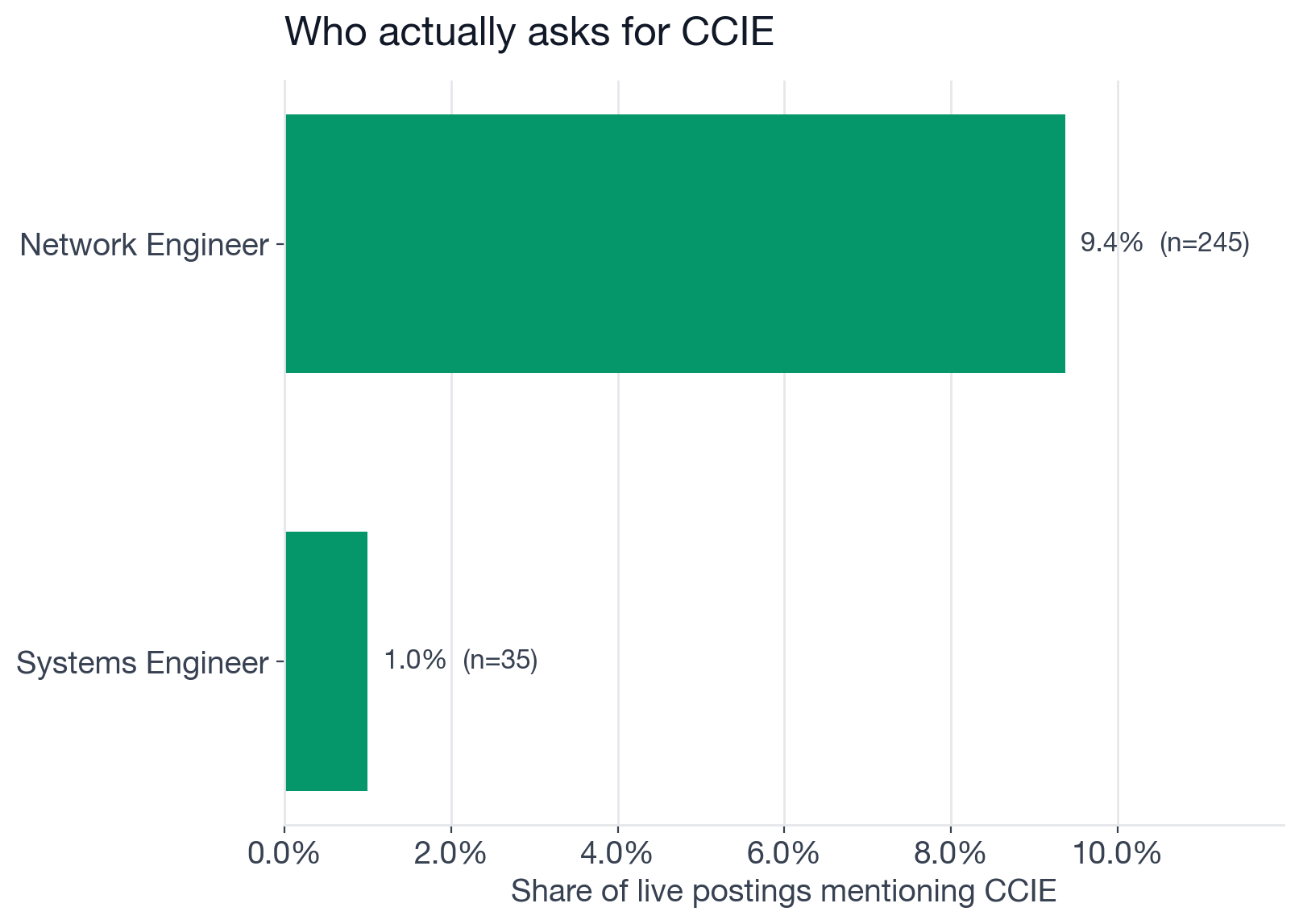 Network Engineer postings name CCIE at roughly nine times the rate Systems Engineer postings do.
Network Engineer is 42.8% of the combined posting pool but supplies 87.5% of every CCIE mention, a 2.05x over-index. Systems Engineer is 57.2% of postings but only 12.5% of mentions, an under-index to about a fifth of its expected share. Systems Engineer's own CCIE-mentioning sample with disclosed US salary is just 7 postings, too small to report a median at all, which is itself informative: there simply aren't enough CCIE-mentioning Systems Engineer postings with disclosed pay to say anything meaningful about them. If you're evaluating CCIE for a Systems Engineer track specifically, the data has almost nothing to tell you either way.
NVIDIA and Arista Sit Alongside the Government Contractors Hiring for CCIE
Federal contracting shows up here the way it does across most Cisco-track certifications, but it doesn't dominate the roster the way it does for some other credentials.
| Employer | CCIE-mentioning postings |
|---|---|
| CACI International | 18 |
| General Dynamics Information Technology | 14 |
| NVIDIA | 13 |
| Peraton | 11 |
| Leidos | 11 |
| Arista Networks | 10 |
| Arganteal | 10 |
| ECI | 6 |
| Mirantis | 6 |
| Ntt Limited | 5 |
| Booz Allen Hamilton | 4 |
| Meta | 4 |
Four contractors, CACI International, General Dynamics Information Technology, Peraton, and Leidos, account for 45% of every mention across the employers we can identify, just under half. That's a real cluster, but not an overwhelming one.
NVIDIA is the third-most-frequent employer overall, ahead of Peraton and Leidos individually, which lines up with how much large-scale AI data center networking now resembles carrier-grade infrastructure work. Arista Networks, a direct hardware competitor to Cisco, ties for sixth alongside Arganteal, a government-facing IT automation and deployment firm; Arista hiring CCIE-credentialed engineers is a reminder that most real-world networks run mixed-vendor gear, so a Cisco expert credential still travels to a shop that also sells competing hardware. Networking vendor Mirantis and telecom equipment maker ECI round out a list that reaches well past government IT.
Which Certifications and Skills Actually Pair With CCIE?
CCNP is close to a prerequisite in this data, not just a related credential: 74.3% of postings that mention CCIE also mention CCNP. That tracks how Cisco structures its own certification path, CCNP is the professional tier directly below CCIE, so a posting listing both reads less like "pick one" and more like a ladder. CCNA follows at 23.6%, with security-adjacent credentials trailing well behind: CISSP at 12.5%, CompTIA Security+ at 11.4%, Palo Alto's PCNSE at 9.6%.
On raw skills, the postings read like Cisco's own CCIE Enterprise Infrastructure blueprint. BGP (60.7%) and OSPF (52.9%), the two routing protocols the exam is built around, are the two most common mentions by a wide margin. But automation shows up almost as often: Automation itself in 51.1% of postings, Python in 37.5%, and Ansible in 34.6%, reflecting Cisco's own shift toward treating programmability as core CCIE material rather than an elective add-on. Cloud platforms make an appearance too (AWS 28.9%, Azure 23.9%), evidence that even expert-level routing and switching work increasingly touches hybrid infrastructure.
Putting This Data to Work Before You Register for the Lab
If you're deciding whether CCIE is worth the study time, the data says check your target role first. Network Engineer openings are where the credential actually shows up; Systems Engineer roles barely reference it at all, so let the role decide the ROI question before the certification does.
For the exam-adjacent material itself, BGP and OSPF are also the backbone of most network-engineering interview loops. Practicing them with AI mock interviews or drilling routing and automation topics in the question bank builds the same muscle the exam tests, without the exam fee attached. If Python- and Ansible-based network automation is new territory, interactive courses cover the programmability fundamentals that show up in half of these postings, worth having before you commit study time to the CCIE lab specifically. Our breakdown of Network Engineer skills companies want in 2026 covers the fuller skill stack beyond this one certification, and our analyses of CCNP demand and pay and CCNA demand and pay cover the two tiers most CCIE postings also mention.
When you're ready to see what's actually open, browse the full Network Engineer and Systems Engineer board this analysis is built on.
FAQ
Q. Does CCIE increase your salary as a Network Engineer or Systems Engineer?
Postings that mention CCIE advertise a median US base salary of $148,550, about 10% ($13,550) above postings in the same Network Engineer and Systems Engineer scope that don't mention it. But most of that gap is a seniority effect: CCIE-mentioning postings skew far more senior (53.9% are senior or staff level, versus 34.3% of postings without it), and within a single level the premium nearly disappears, +0.3% at mid-level and +2.4% at senior. The honest read is that CCIE correlates with more senior postings, not with a level-for-level pay bump.
Q. How common is CCIE in job postings?
CCIE appears in 4.6% of active Network Engineer and Systems Engineer postings on the InterviewStack.io job board, 280 of 6,112 postings analyzed over a 90-day window. That's a niche presence, consistent with CCIE's reputation as Cisco's expert-level credential rather than a baseline hiring requirement.
Q. Is CCIE usually required, or just preferred?
Among the 188 mentions clear enough to classify, CCIE is listed as preferred in 84.0% of postings and required in only 16.0%, about 1 in 6. Another 92 mentions, roughly a third of all 280, don't specify clearly enough either way to classify.
Q. Does CCIE matter more for Network Engineer or Systems Engineer roles?
Overwhelmingly for Network Engineer. CCIE appears in 9.4% of Network Engineer postings versus 1.0% of Systems Engineer postings, a 9.4x rate gap. Network Engineer postings alone account for 87.5% of every CCIE mention despite being only 42.8% of the combined posting pool.
Q. What other certifications typically appear alongside CCIE?
CCNP is by far the most common: 74.3% of postings that mention CCIE also mention CCNP, which tracks how Cisco structures its own certification path, CCNP is the professional tier directly below CCIE. CCNA follows at 23.6%, with CISSP (12.5%) and CompTIA Security+ (11.4%) well behind both.
Q. Who is hiring for CCIE-credentialed engineers?
The employer list mixes federal contractors with networking-focused tech. Four contractors, CACI International, General Dynamics Information Technology, Peraton, and Leidos, account for 45% of every mention across the employers we can identify, just under half. NVIDIA is the third-most-frequent employer overall, and Arista Networks, a direct hardware competitor to Cisco, appears in the top ranks as well.
Q. What's the difference between CCIE and CCNP?
CCIE is Cisco's expert-level certification, the top tier of its certification track; CCNP is the professional-level tier directly below it, and the two share the same core exam in Cisco's current certification structure. In this dataset they are closely linked rather than competing signals: nearly three-quarters of CCIE-mentioning postings also name CCNP.
The Real Signal Behind CCIE's Salary Number
CCIE is not the reason a posting pays 10% more. It's a marker that the posting is more likely senior or staff level, roles that pay more with or without any certification attached. Control for level and the credential's own contribution to base pay is small: real at senior (+2.4%), essentially flat at mid-level (+0.3%), and unmeasurable at the two levels where too few CCIE-mentioning postings disclose salary. What the data does support clearly is demand concentration: this is a Network Engineer credential, rarely a hard requirement, that shows up alongside CCNP almost everywhere it appears. Read a CCIE mention as a signal you're being considered for senior infrastructure work, not as a guaranteed raise.
Topics
Ready to practice?
Put what you've learned into practice with AI mock interviews and structured preparation guides.