
A Senior-Heavy CKAD Pool Still Pays an Even Median
CKAD, the Certified Kubernetes Application Developer exam from the Cloud Native Computing Foundation (CNCF), shows up in postings that skew unmistakably senior: senior and staff levels together make up 52.6% of CKAD-mentioning postings, more than 13 percentage points above the rest of the scope. That kind of skew usually pulls a pay comparison upward, since senior and staff work pays more almost everywhere in this data. It doesn't happen here. Postings that mention CKAD carry the exact same median US base salary as postings that don't: $146,300 either way, based on the subset of postings that disclose pay (39 with CKAD, 3,231 without). Equity, bonus, and non-US pay aren't part of that figure, so total compensation at senior levels runs higher than the median alone suggests.
One methodology note on that seniority figure: level is inferred from job-title keywords, and a posting with no explicit level word (several CKAD-mentioning titles in this dataset, like bare "Systems Engineer" or "Platform Engineer" listings, carry none) defaults to mid-level, which compresses the measured spread in both populations being compared. That means 52.6% is closer to a floor than a precise reading of how senior the CKAD pool actually is. If anything, correcting for that bias would push the true senior/staff share higher, which would sharpen this section's point rather than undercut it, but the exact percentage-point gap should be read as approximate.
That comparison covers 95 CKAD mentions found across 10,951 active postings in DevOps Engineer, Cloud Engineer, and Systems Engineer roles on the InterviewStack.io job board over a trailing 90-day window, a mention rate of 0.87%, under 1 in 100. Site Reliability Engineer (SRE) was part of the intended four-role query, but the scan captured zero SRE postings in this window under the current role filter, a capture gap for that role rather than a finding about CKAD, so it isn't part of the 10,951 total. Every comparison below is measured against the three roles that returned usable data, not the whole job market.
What CKAD lacks in raw frequency, it makes up in specificity: when it does show up, it clusters hard in one role, rarely reads as a hard requirement, and travels with a predictable platform-engineering stack. The sections below work through each of those in turn.
Key Findings
- CKAD appears in 95 of 10,951 active DevOps Engineer, Cloud Engineer, and Systems Engineer postings: 0.87%, or under 1 in 100.
- Postings that mention CKAD carry a $146,300 median US base salary, identical to postings that don't (n=39 vs. n=3,231).
- CKAD-mentioning postings are 52.6% senior or staff level, versus 39.3% for the rest of the scope, a 13-point gap.
- Only 9.1% of classified mentions (4 of 44) treat CKAD as a hard requirement; 90.9% call it preferred.
- DevOps Engineer postings mention CKAD at 1.17%, nearly three times Systems Engineer's 0.39% rate.
- 91.6% of CKAD mentions (87 of 95) also mention CKA, the companion cluster-administration exam.
- 5 of the top 12 employers by mention count are federal contractors; the rest span cloud infrastructure, banking, telecom, and software.
Why the Math Doesn't Add Up to a Premium
The non-cert baseline pay in this scope climbs steadily with level: $105,000 at entry, $134,264 at mid, $156,000 at senior, $177,800 at staff, a staff posting pays roughly 1.7 times what an entry posting does. CKAD-mentioning postings have zero entry-level representation and put more than half their volume (52.6%) at senior or staff, against 39.3% for the rest of the scope. A population shaped like that, if it behaved like the rest of the market, would be expected to land above the market's own blended median, not level with it.
Instead it lands exactly even, at $146,300, whether or not CKAD is mentioned:
| Level | Non-CKAD median (US) | CKAD median (US) | CKAD sample |
|---|---|---|---|
| Entry | $105,000 | Not reportable | n=0 |
| Mid-level | $134,264 | Not reportable | n=22 |
| Senior | $156,000 | Not reportable | n=14 |
| Staff | $177,800 | Not reportable | n=3 |
| All levels (aggregate) | $146,300 (n=3,231) | $146,300 (n=39) | n=39 |
None of the four individual levels clear the minimum sample size this analysis requires to report a median (25 postings with disclosed CKAD-and-salary data); the largest, mid-level, has 22. That means the flat 0% aggregate can't be broken into a clean level-by-level story the way some other certifications' numbers can. But the arithmetic direction is worth stating plainly: a mix skewed this hard toward higher-paying levels landing at an exactly flat median is not what "no relationship at all" usually looks like. It's more consistent with CKAD carrying a small pay shortfall at matched levels that the seniority shift is masking, though the sample can't isolate that directly. Treat the flat aggregate as the honest number to report, and the composition as a reason not to read "flat" as "no story here."
Where Does CKAD Demand Actually Concentrate?
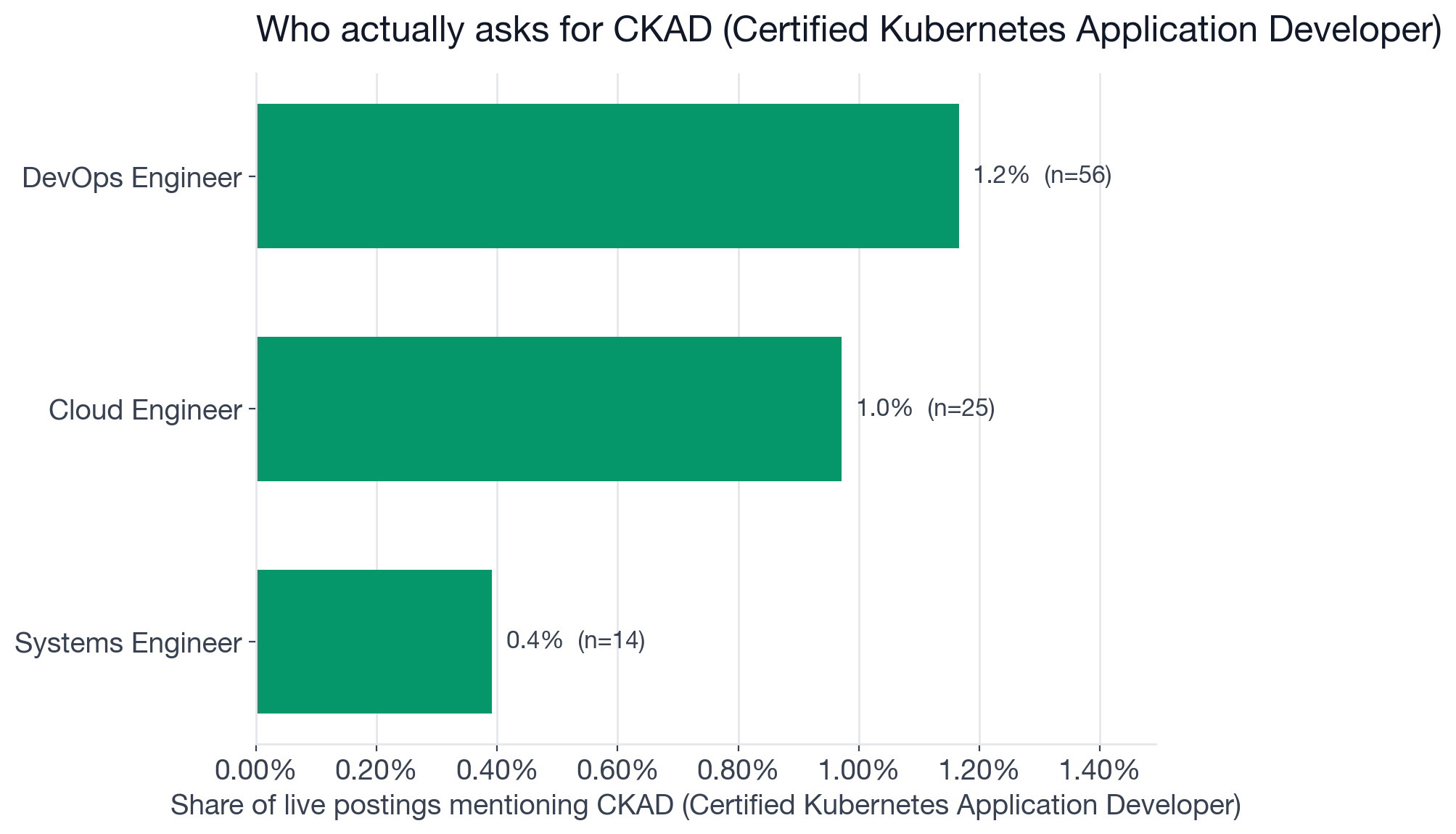 DevOps Engineer postings mention CKAD nearly three times as often as Systems Engineer postings, with Cloud Engineer sitting in between.
CKAD demand is not evenly spread across the three roles that returned data in this scan. DevOps Engineer postings mention it at 1.17%, the highest rate of any role, and account for 59% of every CKAD mention despite being 44% of the postings scanned, an over-index of 1.34x. Cloud Engineer runs close behind at 0.97% (over-index 1.12x). Systems Engineer trails well behind both at 0.39%, an under-index of 0.45x, meaning it mentions CKAD at less than half the rate its share of postings would predict.
| Role | Postings scanned | CKAD mentions | Mention rate |
|---|---|---|---|
| DevOps Engineer | 4,803 | 56 | 1.17% |
| Cloud Engineer | 2,573 | 25 | 0.97% |
| Systems Engineer | 3,575 | 14 | 0.39% |
This doesn't track pay tier. DevOps Engineer, the role that mentions CKAD most, also has the highest non-cert baseline pay of the three ($149,796), and Systems Engineer, the role that mentions it least, has the lowest ($142,500), a spread of only about 5% across all three roles, too narrow to explain a 3x gap in mention rate on its own. A more plausible read (though not something this dataset can prove directly) is that CKAD's actual exam content, packaging, deploying, and troubleshooting applications inside a Kubernetes cluster, maps more directly onto DevOps Engineer work than onto Systems Engineer work, which more often centers on infrastructure and OS-level operations rather than what's running inside the cluster. For the fuller skill picture behind that role, see our DevOps Engineer skills breakdown. Site Reliability Engineer returned zero postings in this 90-day window under the current role filter (a capture gap for that role, not a result specific to CKAD), so this comparison covers the three roles that returned data, not all four in the query scope.
Do Employers Actually Require CKAD, or Just Prefer It?
CKAD reads as a nice-to-have almost everywhere it appears. Of the 44 mentions specific enough to classify as required or preferred (46% of all 95 mentions), 40 (90.9%) call it preferred and just 4 (9.1%, exactly 1 in 11) treat it as a hard requirement. The other 51 mentions, 54% of the total, use language too ambiguous to classify either way, so that 9.1% required rate is a floor on the true rate, not a precise measurement: it's possible some of that unclassified majority is effectively mandatory, and the data can't rule that out.
Practically, that means a CKAD-less resume rarely gets filtered out before a recruiter even looks at it. It's a credential that signals hands-on comfort with the platform, not a gate an application has to clear.
CKAD Hiring Spans Federal Contractors and Cloud-Native Companies Alike
CKAD's employer roster doesn't cluster into a single sector the way some compliance-driven certifications do. 5 of the top 12 employers by mention count are federal contractors (CACI International, Booz Allen Hamilton, Northrop Grumman, Peraton, and Accenture Federal Services), while the remaining 7 run across a genuinely different set of industries.
| Employer | CKAD mentions |
|---|---|
| CACI International Inc | 7 |
| Crusoe Energy Systems | 5 |
| Booz Allen Hamilton | 5 |
| BETSOL | 4 |
| Northrop Grumman Corporation | 4 |
| HSBC | 3 |
| Peraton | 3 |
| Vodafone | 3 |
| Accenture Federal Services | 3 |
| StoneX Group | 3 |
| Flo Health | 2 |
| Collibra | 2 |
Outside the federal-contractor cluster sit a cloud-compute company (Crusoe Energy Systems), a data-protection software vendor (BETSOL), a global bank (HSBC), a telecom carrier (Vodafone), a financial-services firm (StoneX Group), a health-tech company (Flo Health), and a data-governance software vendor (Collibra). That's a materially different shape than a defense-contractor-dominated roster: it reads as whoever is actually operating Kubernetes in production, across sectors, rather than a credential a single industry mandates for compliance.
What Else Do CKAD Postings Expect From Candidates?
A CKAD requirement rarely shows up alone. The single most common companion is CKA (Certified Kubernetes Administrator), the cluster-operations counterpart to CKAD's application-development focus: 87 of the 95 CKAD mentions, 91.6%, also mention CKA. Employers evaluating Kubernetes fluency tend to want both halves of the certification track at once, not just the exam that most closely matches the job title on the posting.
| Co-occurring certification | Share of CKAD mentions |
|---|---|
| CKA (Certified Kubernetes Administrator) | 91.6% |
| CompTIA Security+ | 18.9% |
| CISSP | 8.4% |
| Azure Administrator Associate (AZ-104) | 5.3% |
| AWS Certified Solutions Architect - Associate | 4.2% |
The skill list around CKAD tells a similar story: it's not a Kubernetes-only requirement, it comes bundled with a full platform-engineering stack. Kubernetes itself is nearly universal at 98.9% of CKAD-mentioning postings, unsurprising given it's the exam's subject, but Terraform shows up in 80% of them, Automation in 71.6%, AWS in 70.5%, and CI/CD and Infrastructure as Code both in 67.4%.
| Skill | Share of CKAD-mentioning postings |
|---|---|
| Kubernetes | 98.9% |
| Terraform | 80.0% |
| Automation | 71.6% |
| AWS | 70.5% |
| CI/CD | 67.4% |
| Infrastructure as Code | 67.4% |
| Monitoring | 57.9% |
| Python | 57.9% |
Turning This Into a Kubernetes Job-Search Plan
If CKAD shows up on a posting you're targeting, treat it as a signal to prepare for, not a wall to clear. The data above says it's preferred nine times out of ten, so lacking the certification itself won't usually disqualify an application, but the skills it travels with (Terraform, CI/CD, Infrastructure as Code, and general automation fluency) are worth being fluent in regardless of whether you sit the exam.
Start by browsing current openings in the roles that actually ask for CKAD to see how the requirement is worded in live postings, since 54% of the mentions in this dataset didn't use clean required-or-preferred language, and reading a handful directly tells you more than any aggregate can. From there, practicing with AI mock interviews is a fast way to rehearse how you'd talk through a Kubernetes deployment or troubleshooting scenario out loud, and the question bank is a focused way to drill the CI/CD and infrastructure-as-code topics that show up alongside CKAD far more often than Kubernetes trivia does. If the fundamentals need shoring up first, InterviewStack.io's interactive courses cover the platform-engineering foundations this data says actually matter.
FAQ
Q. What share of DevOps, Cloud Engineer, and Systems Engineer postings mention CKAD?
CKAD appears in 95 of 10,951 active postings analyzed across DevOps Engineer, Cloud Engineer, and Systems Engineer roles on the InterviewStack.io job board over a trailing 90-day window, a rate of 0.87%, or under 1 in 100. Site Reliability Engineer (SRE) was part of the intended role scope for this analysis, but the scan captured zero SRE postings in this window under the current role filter, a gap in what got captured for that role rather than a finding about CKAD mentions specifically, so SRE contributes nothing to the 10,951-posting total or to any comparison in this post.
Q. Does CKAD come with a salary premium?
Not in the aggregate. Postings that mention CKAD carry the same median US base salary as postings in the same role scope that don't: $146,300 either way (n=39 with the cert disclosed, n=3,231 without), a 0% difference. CKAD-mentioning postings also skew notably more senior (52.6% at senior or staff level versus 39.3% for the rest of the scope, though seniority is inferred from title keywords and defaults to mid-level when a title has none, so that figure is closer to a floor than a precise read), a mix that would normally be expected to push the median up rather than hold it flat, though sample sizes at each individual level are too thin to confirm a within-level gap directly.
Q. Is CKAD usually required or just preferred?
Preferred, by a wide margin. Among the 44 CKAD mentions specific enough to classify (46% of all 95), 40 (90.9%) list it as preferred and only 4 (9.1%, or 1 in 11) treat it as a hard requirement. The other 51 mentions (54% of all CKAD mentions) don't use clear enough language to classify either way.
Q. Which roles ask for CKAD the most?
DevOps Engineer postings mention CKAD at the highest rate, 1.17% of postings, followed by Cloud Engineer at 0.97%. Systems Engineer trails at 0.39%, just over a third of DevOps Engineer's rate. DevOps Engineer alone accounts for 59% of every CKAD mention despite being 44% of the postings scanned.
Q. Do employers that ask for CKAD also ask for CKA?
Yes, almost always. 87 of the 95 CKAD mentions (91.6%) also mention CKA (Certified Kubernetes Administrator), the cluster-operations counterpart exam. It's the single most common co-occurring credential by a wide margin; the next closest, CompTIA Security+, appears in only 18.9% of CKAD mentions.
Q. Who is hiring for CKAD?
A mix, not one sector. 5 of the top 12 employers by mention count are federal contractors (CACI International, Booz Allen Hamilton, Northrop Grumman, Peraton, and Accenture Federal Services), and the remaining 7 span a cloud-compute company, a data-protection software vendor, a global bank, a telecom carrier, a financial-services firm, a health-tech company, and a data-governance software company. It reads as whoever runs production Kubernetes, not a single-industry compliance credential.
Q. What other skills come with a CKAD requirement?
A full platform-engineering stack, not just Kubernetes basics. Terraform appears in 80% of CKAD-mentioning postings, Automation in 71.6%, AWS in 70.5%, and both CI/CD and Infrastructure as Code in 67.4%. Kubernetes itself is nearly universal at 98.9%, unsurprising given it's the exam's subject.
What CKAD Actually Signals to a Hiring Manager
CKAD's numbers point in one direction: this is a skills credential, not a pay lever. It's rarely a gate (9.1% required), it doesn't move the median even when the population holding it skews senior, and it clusters most heavily in the role where its curriculum, application packaging and deployment on Kubernetes, maps most directly onto the daily work. Studying for it is a reasonable way to prove hands-on platform fluency, especially paired with CKA, but going in expecting a raise attached to the certificate itself isn't what this data supports.
Topics
Ready to practice?
Put what you've learned into practice with AI mock interviews and structured preparation guides.