
The Two Closest Titles in Cloud Still Split $29,400
Cloud Engineer and Cloud Architect share more of their skill set than any other pair of roles we've compared in this series: a 62% overlap across each role's top 30 skills, drawn from every active posting on the InterviewStack.io job board that passes the site's own quality filter (3,737 for Cloud Engineer and 2,341 for Cloud Architect, as of August 2026). That kind of overlap should mean the jump from one title to the other is mostly a formality. It isn't. Cloud Architect still pays $29,400 more at the median US base salary, a gap equal to 16.8% of Cloud Architect's own $175,000 median (equity, bonus, and sign-on aren't disclosed in postings and aren't reflected in either figure).
The overlap isn't evenly shared, either. Of the fifteen skills both roles ask for at meaningful frequency, Cloud Engineer postings name twelve more often, in some cases by a wide margin. Only three skew toward Cloud Architect, and none are tools: Cloud Architecture, Agile, and Scalability, the vocabulary of designing and running a program rather than building infrastructure. That split, more than the raw overlap number, is the real story here.
| Cloud Engineer | Cloud Architect | |
|---|---|---|
| Median US base salary | $145,600 | $175,000 |
| Active postings | 3,737 | 2,341 |
| Top skill | Azure (47.9%) | Azure (41.6%) |
| Senior + staff share | 35.2% | 35.7% |
| Remote share | 14.4% | 19.4% |
| Entry-level share | 2.9% | 1.3% |
Salary is median US base pay only; equity, bonus, and sign-on aren't disclosed in postings. The two roles also share a 62% Jaccard overlap on their top-30 skill sets, a single symmetric figure rather than a per-role one, so it isn't broken out by column above.
A note on data quality: seniority above is inferred from title keywords and defaults to mid-level when a posting carries no explicit level word. A large share of this dataset's Cloud Architect titles are bare ("Cloud Architect," "Platform Architect," "Technical Architect") without one, so Cloud Architect's senior-plus-staff share is likely a floor rather than the true figure. Separately, because the classifier matches any title containing "Architect," a meaningful slice of Cloud Architect's postings are non-cloud roles entirely (Mainframe Architect, RF Systems Architect, robotics-safety and electronic-testing architects) that dilute its skill and salary figures somewhat. Cloud Engineer's title match runs cleaner, though not perfectly so.
Key Findings
- Cloud Engineer and Cloud Architect share a 62% skill overlap (Jaccard similarity), the highest either role shows against any other role in this comparison series.
- Cloud Architect pays $175,000 at the median US base salary versus $145,600 for Cloud Engineer, a $29,400 (16.8%) gap.
- Seniority mix looks close by title keyword: 35.2% of Cloud Engineer postings are senior or staff level versus 35.7% for Cloud Architect, though Cloud Architect's figure is likely a floor (see data-quality note above).
- Cloud Architecture, the skill literally named for the Cloud Architect title, prices $12,600 below Cloud Architect's own median (n=122).
- Stakeholder Management is Cloud Architect's clearest new signal: 9.8% of postings, and it doesn't crack Cloud Engineer's top 30 skills at all.
- Cloud Engineer carries 1.6x Cloud Architect's posting volume (3,737 vs. 2,341) and more than double the entry-level share (2.9% vs. 1.3%).
- Cloud Architect postings are more remote-friendly despite paying more: 19.4% remote versus 14.4% for Cloud Engineer.
- In 12 of the 15 skills both roles share, Cloud Engineer postings name the skill more often; only Cloud Architecture, Agile, and Scalability skew toward Cloud Architect.
What Does a Cloud Engineer Do That an Architect Doesn't?
Cloud Engineer builds and runs infrastructure someone else already decided on: provisioning through Terraform or CloudFormation, wiring CI/CD pipelines, keeping monitoring and IAM policies current, and being the one paged when a deploy breaks something. The scoreboard is uptime on a system someone else specified.
Cloud Architect works one layer up: deciding which services get used, how workloads split across accounts and regions, and what the disaster-recovery and cost-control story looks like, then defending those tradeoffs to engineering leads and, sometimes, finance. The output is usually a design doc that a Cloud Engineer has to build and keep running, which is part of why the two roles overlap so heavily on tools: an architect who can't speak the engineer's language can't write a design the team can execute.
Which Pays More, Cloud Engineer or Cloud Architect?
Cloud Architect, by $29,400 (16.8%) at the median: $175,000 versus $145,600. We've already shown that Cloud Engineer's own core skills price at or below its median and that Azure, Cloud Architect's top skill, doesn't top its pay table either; this comparison sharpens that pattern rather than repeating it. Every one of Cloud Architect's core cloud skills prices below its own baseline, including Cloud Architecture itself: postings that name that exact skill pay a median $162,400 (n=122), $12,600 less than the role's overall median. Azure, AWS, Automation, Terraform, Kubernetes, Monitoring, and CI/CD all sit $5,000 to $10,000 under Cloud Architect's baseline. Cloud Engineer's version is milder (Azure dips $6,900 below its $145,600 median and Monitoring dips $3,200; Terraform lands exactly on it), but the direction repeats.
The real premiums for both roles sit in adjacent, less-common skills instead. For Cloud Engineer, the top-ranked are Debugging ($174,500, n=55, +$28,900), Product Management ($172,800, n=26, +$27,200), and Data Science ($168,600, n=26, +$23,000). For Cloud Architect, once the hardware-contaminated entries are excluded, the top-ranked are Product Management ($199,500, n=29, +$24,500), NodeJS ($195,000, n=29, +$20,000), and a tie between Distributed Systems and Machine Learning at $192,500 (n=35 each, +$17,500). Product Management is the standout: it's a top-two adjacent-skill premium for both roles despite not appearing in either role's own top-30 skill list. Neither role gets paid extra for the tools in its own job title. Both get paid extra for skills that sit outside it. (Cloud Architect's raw skill-salary data also includes a few higher-paying entries, Embedded Systems, PCIe, and Firmware, that reflect hardware and chip postings sharing the "Architect" title keyword rather than genuine cloud-architecture pay; they're excluded here as unrepresentative of the role.)
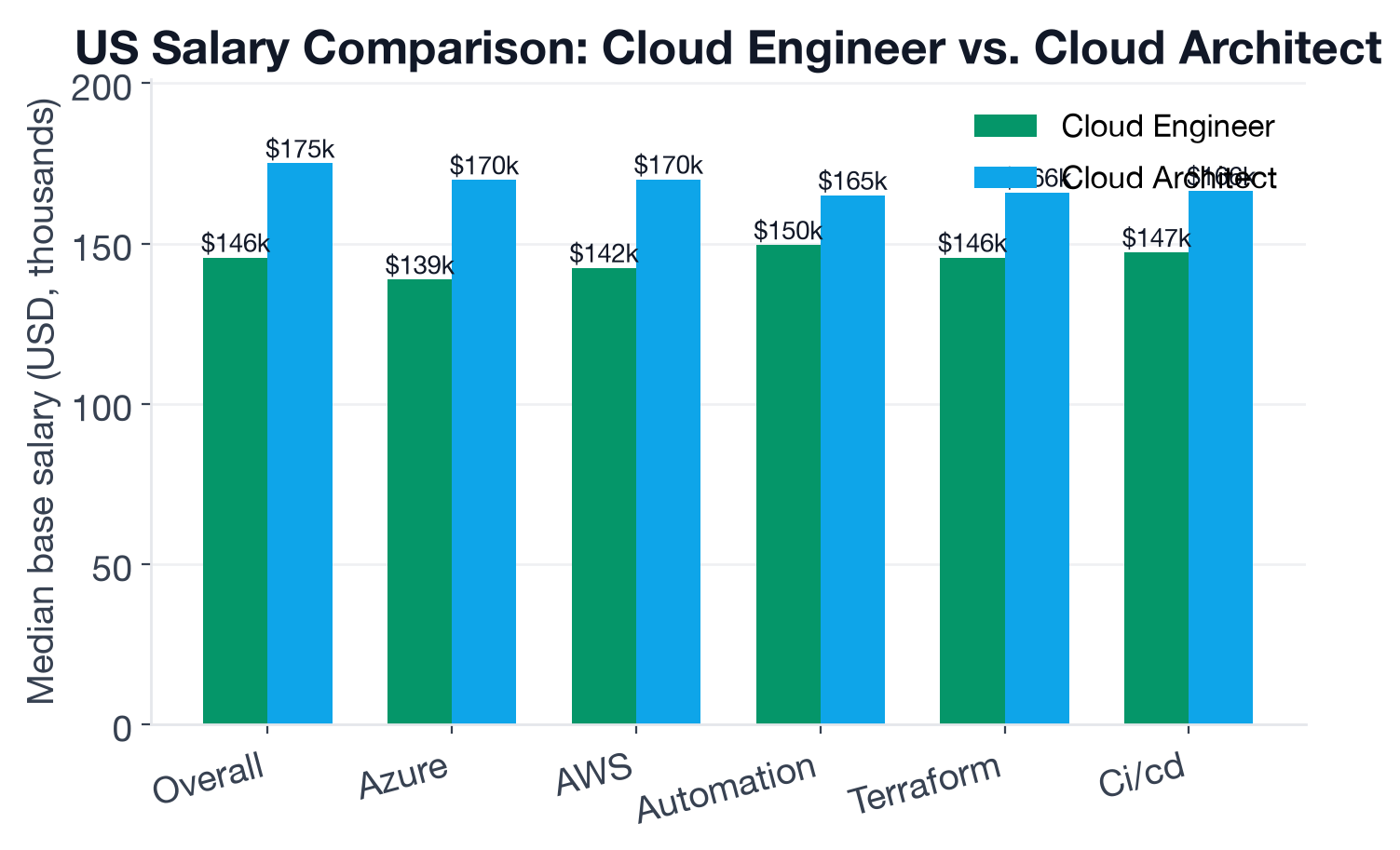 Cloud Architect's $175,000 median sits well above Cloud Engineer's $145,600, but neither role's own core cloud skills explain the gap.
Where the Toolkits Actually Overlap
Azure, AWS, and Automation top both lists, but at very different intensity.
| Skill | Cloud Engineer | Cloud Architect |
|---|---|---|
| Azure | 47.9% | 41.6% |
| AWS | 47.4% | 39.1% |
| Automation | 47.4% | 29.8% |
| Terraform | 40.5% | 20.8% |
| Monitoring | 39.7% | 20.1% |
| CI/CD | 34.9% | 25.3% |
| Python | 34.7% | 22.3% |
| Kubernetes | 33.0% | 22.4% |
Every skill in that table shows up more often in Cloud Engineer postings, in some cases nearly double (Automation: 47.4% vs. 29.8%; Monitoring: 39.7% vs. 20.1%). That's not because Cloud Architects don't need these tools. Cloud Engineer postings tend to spell out the full stack a candidate needs hands-on fluency in, while Cloud Architect postings assume that fluency and spend more of their word count on scope instead. If you already have the Cloud Engineer toolkit, you're not relearning it for an architect posting; you're being asked to apply it differently.
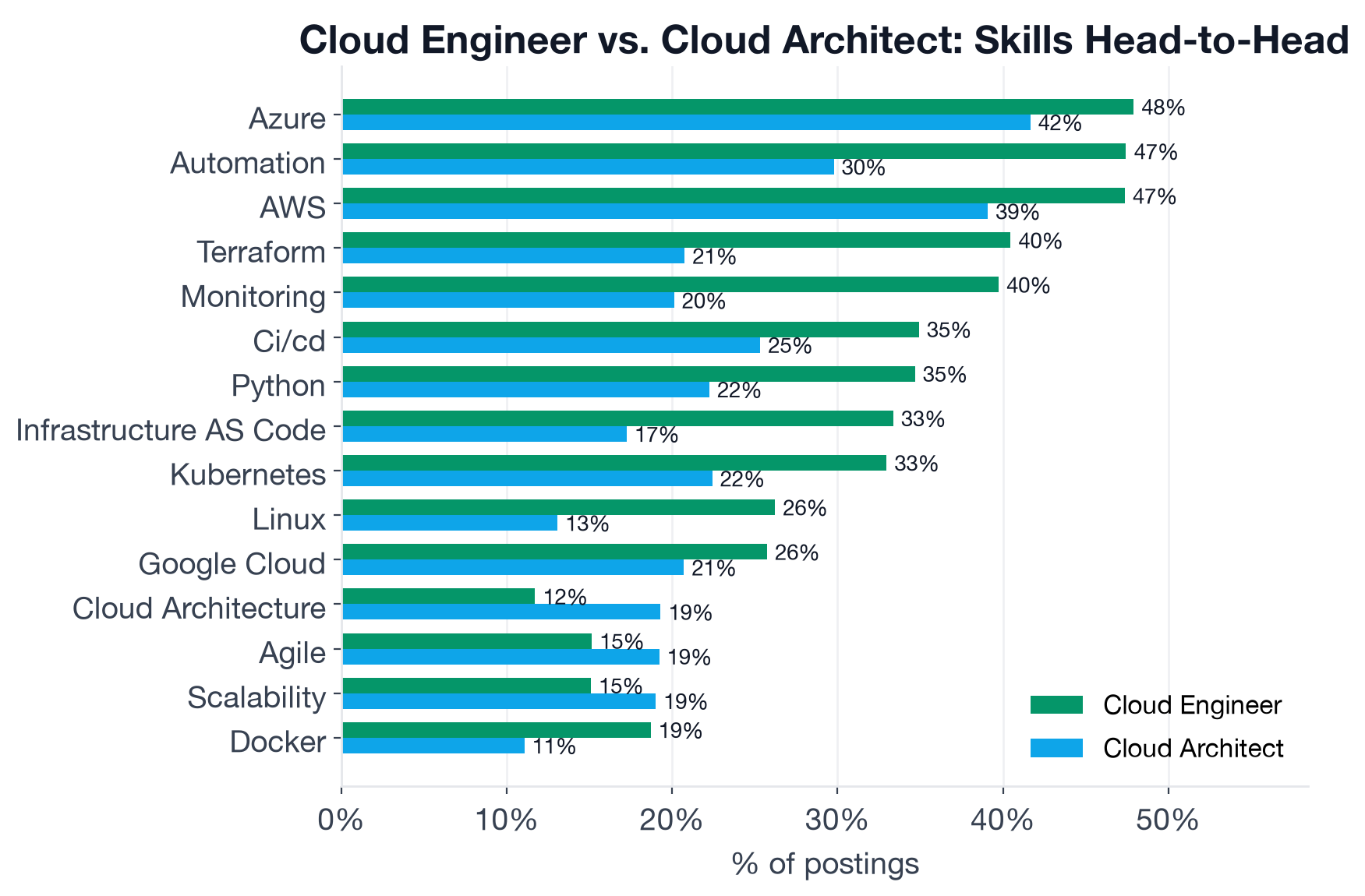 Cloud Engineer names nearly every shared skill more often than Cloud Architect does; only Cloud Architecture, Agile, and Scalability run the other way.
Where the Two Roles Actually Split
Cloud Engineer's seven exclusive skills are all operational: scripting and OS administration (Bash at 18.5%, PowerShell at 18.3%, Windows at 13.8%), DNS, a CI tool (Jenkins), a monitoring dashboard (Grafana), and Root Cause Analysis, the skill of figuring out what broke after it already did.
Cloud Architect's four exclusives split differently. Three, APIs, Java, and Microservices, are development skills that surface when the architecture work overlaps with actual software design. The fourth is the one worth paying attention to: Stakeholder Management, at 9.8% of postings and absent from Cloud Engineer's top 30 skills entirely, is the only skill in either exclusive list that isn't a tool at all. If there's a single line between these two roles, it's that one. Cloud Architect adds the expectation that you can defend a technical decision to people who aren't engineers.
Neither role's top 30 skills name an AI or ML skill outright. Generative AI and LLMs surface only in Cloud Engineer's long-tail salary data (43 and 27 of 776 US salary-sampled postings, at $142,500 and $153,000) and don't appear in Cloud Architect's salary data at all. Treat that as a floor, not a ceiling: Google's 2025 DORA report found 90% of software delivery and infrastructure professionals, the population both roles sit inside, already use AI tools daily, far beyond what either role's postings state outright. What likely differs is how each role applies that layer, Cloud Engineers for IaC generation and script debugging, Cloud Architects for design review and documentation, though no survey breaks adoption out that finely. For more, see our coverage of AI and Cloud Engineer work and AI and Cloud Architect work.
Who Has an Easier Path In?
Cloud Engineer, on raw volume: 3,737 active postings versus 2,341 for Cloud Architect, a 1.6x difference. Entry-level share tells a similar story: 2.9% of Cloud Engineer postings are explicitly entry-level versus 1.3% for Cloud Architect, more than double. Neither is a realistic first job, both default to mid-level or higher, but Cloud Engineer leaves more doors open.
Geography follows a related pattern: Cloud Architect is more US-concentrated (40.1% vs. 32.3%) and, despite paying more, more remote-friendly (19.4% remote versus 14.4%). India is the second-largest market for both, at a similar share (12.6% Cloud Engineer, 11.1% Cloud Architect).
Should You Target Cloud Engineer or Cloud Architect Next?
Choose Cloud Engineer if you:
- Want to stay hands-on with the infrastructure itself, not just decide how it should look. Bash, PowerShell, Jenkins, Grafana, and Root Cause Analysis are core to the role, not optional extras.
- Want more open positions to apply to (1.6x the volume) and a better entry-level foot in the door (2.9% vs. 1.3%).
- Are comfortable with a lower remote share (14.4%) in exchange for a much larger pool of roles overall.
Choose Cloud Architect if you:
- Already do the Cloud Engineer job and want to move from building to designing. The tool overlap means you won't be starting over.
- Can defend a technical tradeoff to a non-technical stakeholder. Stakeholder Management is the one skill that most clearly separates the two postings lists.
- Want the $29,400 premium and are willing to accept a smaller pool of open roles (2,341 vs. 3,737) to get it.
Turning This Into an Interview Prep Plan
Whichever direction you're headed, the skill overlap means most of your prep carries over. Practice with AI mock interviews built around the scenario that matters, a Terraform module for a Cloud Engineer screen, a multi-region design defense for a Cloud Architect one. Drill the skills that actually separate the two roles, not just the shared ones, with a focused pass through the Question Bank, and if Stakeholder Management or system-design tradeoffs are new territory, our interactive courses cover the fundamentals first. If a related pair is on your shortlist too, see how each role stacks up against Site Reliability Engineer. Then check what's actually open: Cloud Engineer and Cloud Architect postings are both live now.
FAQ
Q. Is Cloud Architect just a senior Cloud Engineer?
Not exactly. The two roles share the highest skill overlap of any Cloud Engineer or Cloud Architect pairing in this comparison series (62% Jaccard similarity across each role's top 30 skills), and their measured seniority mix by title keyword is close: 35.2% senior or staff for Cloud Engineer versus 35.7% for Cloud Architect. Treat that seniority figure as a floor for Cloud Architect specifically: postings without an explicit level word default to mid-level, and a large share of this dataset's Cloud Architect titles are bare ("Cloud Architect," "Platform Architect") with no seniority qualifier, so its true senior-plus-staff share is likely higher than measured. What's clearer is the scope difference: Cloud Architect postings add Stakeholder Management (9.8% of postings, not among Cloud Engineer's top 30 skills at all) and design-facing skills like APIs and Microservices, while Cloud Engineer keeps the hands-on operational tools: Bash, PowerShell, DNS, Jenkins.
Q. Which pays more, Cloud Engineer or Cloud Architect?
Cloud Architect. The median US base salary is $175,000 for Cloud Architect versus $145,600 for Cloud Engineer, a $29,400 gap (16.8% of Cloud Architect's median). Both figures are base salary only; postings don't disclose equity, bonus, or sign-on.
Q. How much skill overlap is there between Cloud Engineer and Cloud Architect?
62% (Jaccard similarity, a 0-to-1 measure of how much two skill sets overlap, across each role's top 30 skills), the highest overlap either role shows against any other role in this comparison series. Azure, AWS, and Automation are the three most common skills for both, though Cloud Engineer postings name nearly every shared skill more often. Only Cloud Architecture, Agile, and Scalability skew toward Cloud Architect.
Q. What skills are exclusive to Cloud Architect versus Cloud Engineer?
Cloud Architect's top exclusives are APIs (12.0%), Java (10.1%), Microservices (9.9%), and Stakeholder Management (9.8%), a mix of design-adjacent development skills and one clear non-technical signal. Cloud Engineer's exclusives are entirely operational: Bash (18.5%), PowerShell (18.3%), Windows (13.8%), DNS (12.5%), Jenkins (10.7%), Grafana (9.5%), and Root Cause Analysis (9.5%).
Q. Do the highest-paying skills match what each role is actually titled for?
No, in both cases. Cloud Engineer's own core stack, Azure, AWS, Monitoring, Linux, and Docker, prices at or below its own $145,600 median. Cloud Architect's pattern is more pronounced: every one of its core cloud skills, including Cloud Architecture itself ($162,400, n=122, $12,600 below its own baseline), prices below the role's $175,000 median. The real premiums for both roles sit in adjacent skills instead, and Product Management is the standout: it ranks among the top two highest-paying adjacent skills for both roles, $172,800 for Cloud Engineer (n=26) and $199,500 for Cloud Architect (n=29), despite not appearing in either role's own top-30 skill list.
Q. Is it easier to get hired as a Cloud Engineer or a Cloud Architect?
Cloud Engineer, on volume. There are 3,737 active Cloud Engineer postings versus 2,341 for Cloud Architect, a 1.6x difference, and entry-level share is more than double, 2.9% versus 1.3%. Neither role is a realistic entry-level target; both concentrate in mid-level and above.
Q. Do Cloud Engineer and Cloud Architect postings require AI skills?
Rarely, in explicit terms. Neither role's top 30 skills include an AI or ML skill by name. Generative AI and LLMs appear only in Cloud Engineer's long-tail salary data (70 of 776 US salary-sampled postings combined) and don't appear at all in Cloud Architect's. That's a floor, not a ceiling: Google's 2025 DORA report puts AI-tool adoption at 90% among software delivery and infrastructure professionals, the population both roles sit inside, regardless of what any individual posting states.
What the Architect Title Is Actually Paying For
Strip away the title and the day-to-day toolkit barely moves; that's what a 62% skill overlap actually means in practice. What moves is scope. Cloud Architect trades a slice of the hands-on work for the responsibility of deciding how the whole system should be built, and the ability to explain that decision to someone who isn't going to read the Terraform. That's a learnable skill, not a title-only distinction, though the measured seniority mix between the two roles (which likely undercounts Cloud Architect, given how many of its postings carry no explicit level word) shouldn't be read as proof they're staffed at the same career stage. If you already have the Cloud Engineer toolkit, Stakeholder Management is the clearest scope signal you can point to, not a shortcut to the $29,400 gap on its own: postings that name it actually pay a bit below Cloud Architect's own median ($153,500 vs. $175,000), because it's a marker of the job you're being evaluated for rather than a line item that gets priced separately.
Topics
Ready to practice?
Put what you've learned into practice with AI mock interviews and structured preparation guides.