
Seniority Doesn't Explain the $23,000 Gap
"Architect" reads as the senior title and "Engineer" reads as the hands-on one, so the pay data should follow the titles. It doesn't, at least not on the numbers below. Site Reliability Engineer (SRE) postings skew more senior than Cloud Architect's, 48.4% are senior or staff level versus 36.2%, yet Cloud Architect still pays $23,000 more at the median. We pulled every active posting on the InterviewStack.io job board that passes the same quality filter used on the job board itself, 3,566 for Site Reliability Engineer and 2,354 for Cloud Architect, as of August 2026.
Two data caveats matter before trusting that seniority comparison. First, "Reliability Engineer" and "Architect" are both keywords with a life outside software: SRE's sample includes hardware- and manufacturing-reliability titles ("Staff Hardware Reliability Engineer," "Board Reliability Simulation Engineer," "Reliability and Maintainability Engineer") that are reliability engineering in the mechanical or electrical sense, not software SRE, while Cloud Architect's sample includes semiconductor and chip-industry "Architect" titles ("MCU Architect," "CPU Micro-Architect RTL Engineer," "GPU/NPU AI System Architect") that inflate a handful of its long-tail salary figures. We've excluded the latter from every skill-level claim below; none of the flagged SRE titles anchor a cited skill premium, so they don't move SRE's skill or salary numbers, but they do add noise to its posting volume and employer mix (more on that below). Second, seniority is inferred from title keywords, and a posting without an explicit level word (Senior, Staff, Principal, Lead) defaults to mid-level. Bare titles like "Cloud Architect," "Systems Architect," and "OCI Architect" carry no such word far more often than the SRE titles in this dataset do, even though a bare Architect posting is rarely an entry-or-junior-scoped role in practice. That means Cloud Architect's 36.2% senior-or-staff share is likely understated by more than SRE's 48.4% is, which narrows the gap this section leads with, though the direction, SRE trending more senior, holds up consistently enough across the sample that we're not discarding it outright.
The two roles share a 40% Jaccard overlap across each role's top 30 skills (Jaccard is a 0-to-1 measure of how much two sets overlap), closer than most infrastructure-title pairings. But the shared skills, the exclusive skills, and the pay all point in directions that don't match the job titles.
| Site Reliability Engineer | Cloud Architect | |
|---|---|---|
| Median US base salary | $152,000 | $175,000 |
| Active postings | 3,566 | 2,354 |
| Top skill | Monitoring (56.9%) | Azure (41.4%) |
| Senior + staff share | 48.4% | 36.2% |
| Remote + hybrid share | 41.9% | 52.6% |
Salary is median US base pay only; postings don't disclose equity, bonus, or sign-on. The two roles also share a 40% Jaccard overlap on their top-30 skill sets, a single symmetric figure rather than a per-role one, so it isn't broken out by column above.
Key Findings
- SRE postings skew more senior than Cloud Architect's on this dataset's title-keyword method: 48.4% are senior or staff level, versus 36.2% for Cloud Architect, though bare "Architect" titles default to mid-level more often, so Cloud Architect's share is likely understated (see caveat above).
- Cloud Architect still pays more despite that: $175,000 median US base salary versus $152,000 for SRE, a $23,000 gap (13.1% of Cloud Architect's median).
- The two roles share a 40% Jaccard skill overlap on their top 30 skills, but the shared skills price in opposite directions against each role's own baseline.
- Site Reliability Engineering itself is the top-paying skill in SRE's own top-30 list: $178,500 (n=194), a $26,500 premium.
- SRE carries 1.51x Cloud Architect's posting volume (3,566 vs. 2,354), but only 41.9% of its postings are remote or hybrid, versus 52.6% for Cloud Architect.
- Entry-level openings are scarce for both: 1.6% for SRE, 1.0% for Cloud Architect.
- Machine Learning, a long-tail skill for both roles, prices at $185,000 (n=49) for SRE, ahead of every skill in the role's own top-30 list.
Running the System Versus Designing It
SRE owns the reliability of systems already in production: monitoring and alerting, on-call rotations, incident triage, postmortems, and automating away the pages that keep recurring. The scoreboard is uptime and the error budget.
Cloud Architect works earlier in the lifecycle, before most of that infrastructure exists: deciding which services to use, how identity and cost controls get enforced, and how workloads split across accounts and regions. The output is usually a blueprint that platform and SRE teams then have to build, run, and defend.
What Skills Transfer Between the Two Roles?
AWS is the one skill both roles ask for at close to the same rate, 43.4% of SRE postings versus 38.5% of Cloud Architect postings. Past that, the shared list splits hard by role: Monitoring, Automation, Python, and Kubernetes all lean SRE by 1.75x to 2.75x; Azure leans Cloud Architect by about 1.55x.
| Skill | SRE | Cloud Architect |
|---|---|---|
| Monitoring | 56.9% | 20.7% |
| Automation | 53.1% | 30.3% |
| Python | 50.7% | 22.3% |
| AWS | 43.4% | 38.5% |
| Azure | 26.7% | 41.4% |
| Kubernetes | 41.7% | 22.4% |
| Terraform | 35.5% | 20.4% |
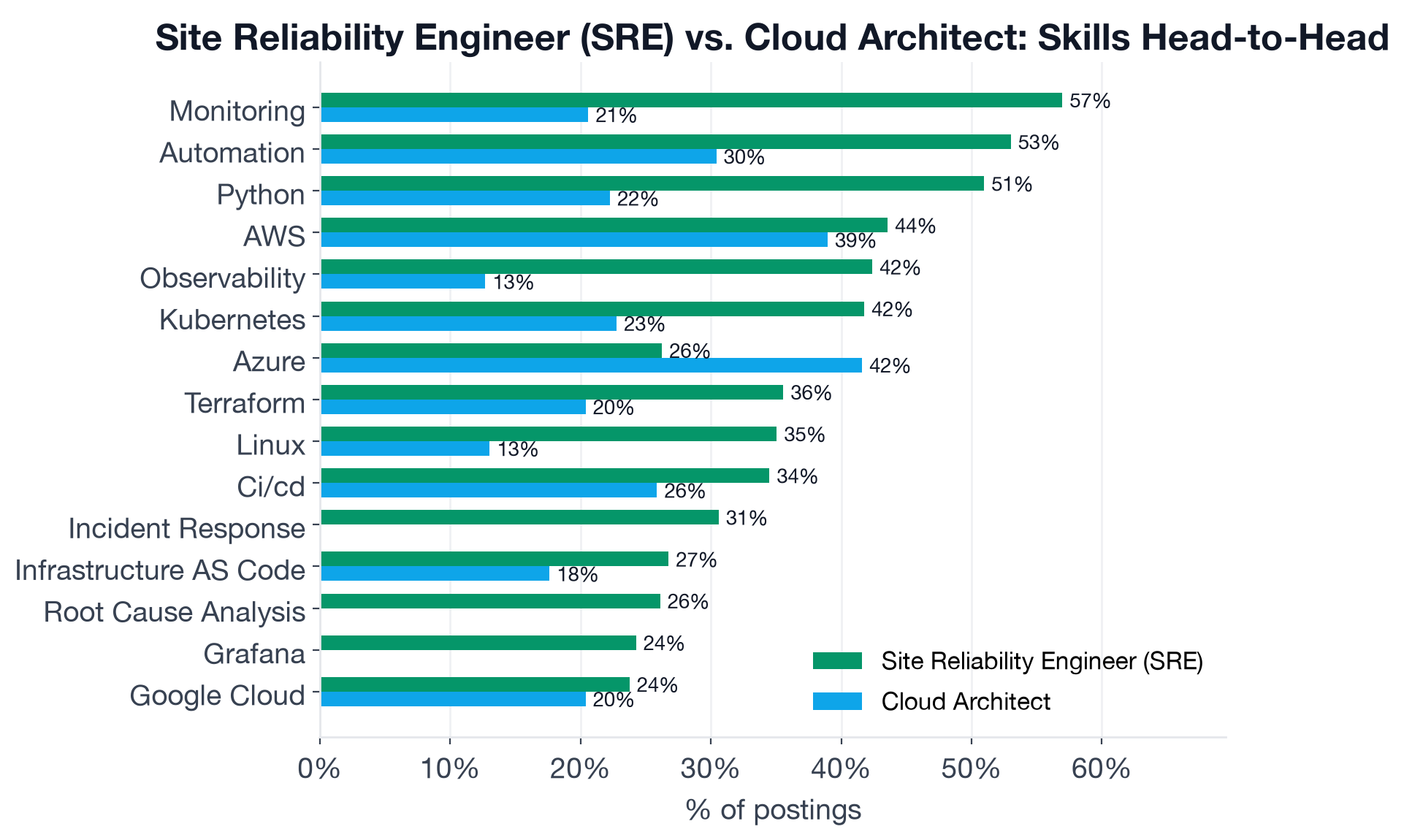 Monitoring, Automation, and Python lean SRE; Azure leans Cloud Architect; AWS is the closest thing to a balanced skill between them.
None of this list needs relearning to move between the two roles; what changes is framing. An SRE posting wants Kubernetes for keeping a cluster healthy under load. A Cloud Architect posting wants it for designing which workloads belong on it in the first place.
Which Skills Belong to Only One Role?
Past the shared list, the two roles stop looking like variations on the same job. SRE's top exclusives, common in its postings but rare in Cloud Architect's, are Incident Response (30.6%), Root Cause Analysis (26.1%), Grafana (24.3%), Prometheus (22.5%), Bash (21.6%), and Incident Management (20.6%). That's the detect-and-respond toolkit: the instrumentation and process for noticing something broke and fixing it fast.
Cloud Architect's exclusives are Cloud Architecture (19.9%), APIs (12.1%), SQL (11.2%), Microservices (10.6%), IAM (10.2%), Stakeholder Management (10.2%), and Cloud Security (8.1%), the earlier, more abstract layer of the job: defining what should exist and negotiating trade-offs with the people who'll pay for it. Stakeholder Management clearing the top-30 list at all is itself a signal; it never surfaces for SRE. Cloud Architect postings that ask for stakeholder management read closer to a hybrid technical-and-business role than a pure engineering one.
Who Earns More, Site Reliability Engineer or Cloud Architect?
Cloud Architect earns more, $175,000 versus $152,000, a $23,000 gap (13.1% of Cloud Architect's median), across US postings with disclosed compensation (n=904 for SRE, n=636 for Cloud Architect). But the seniority mix runs the other way, at least as measured: 48.4% of SRE postings are senior or staff level versus 36.2% for Cloud Architect. As noted above, that gap is probably narrower than it looks, bare "Architect" titles default to mid-level under this dataset's title-keyword method far more often than SRE titles do, but the direction, Cloud Architect paying more despite trending less senior by title, holds regardless.
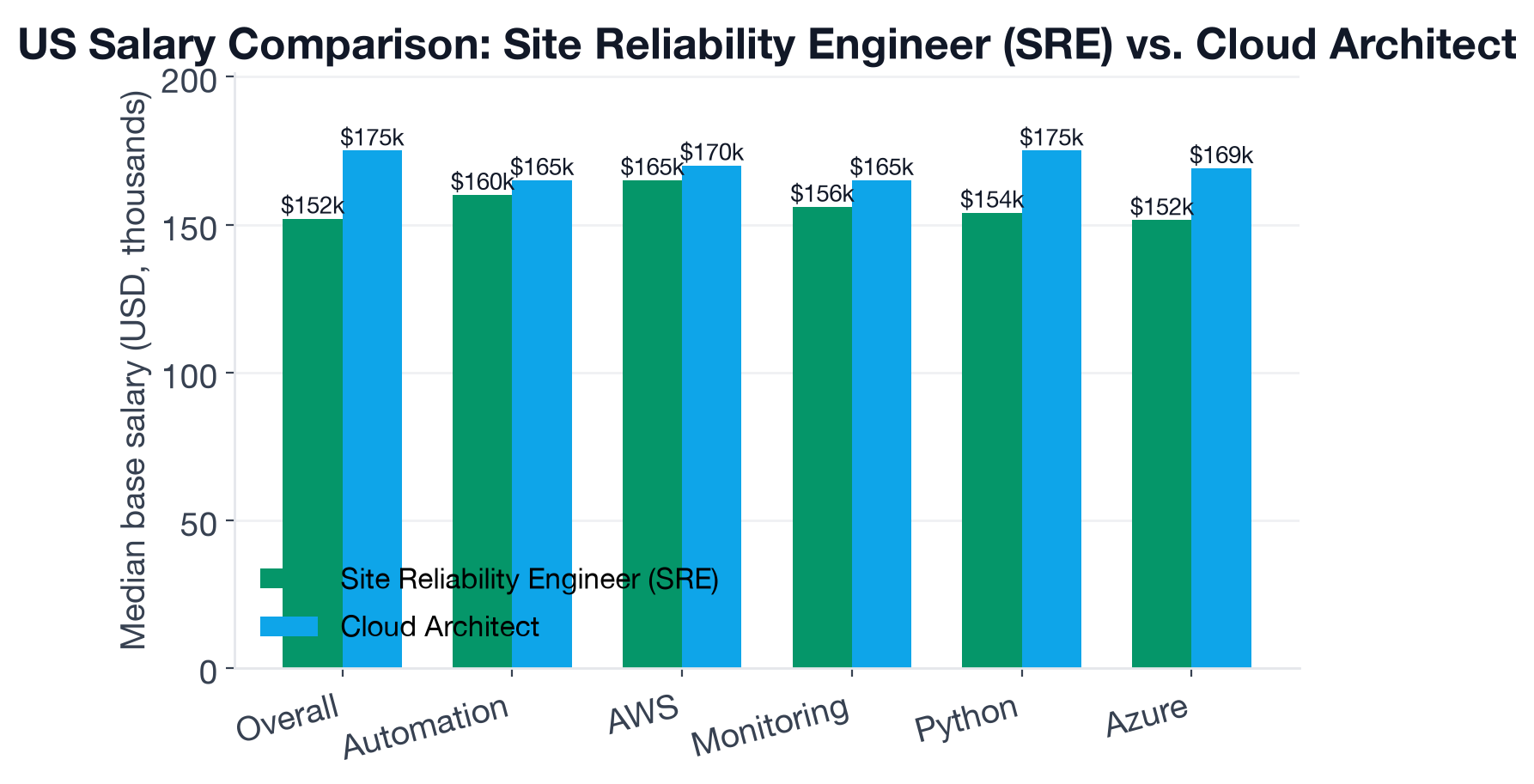 Cloud Architect's $175,000 median outpaces SRE's $152,000 by $23,000, even though SRE's own shared and exclusive skills price higher against its own baseline than Cloud Architect's do against its own.
The skill-level pricing explains part of the gap. Against SRE's own $152,000 baseline, Terraform, Infrastructure as Code, Distributed Systems, and Site Reliability Engineering itself all add between $19,000 and $26,500, and even a long-tail skill like Machine Learning (n=49) prices at $185,000, ahead of every skill in SRE's own top-30 list. Root Cause Analysis is the exception, pricing $9,800 below SRE's baseline despite being one of its most common exclusive skills; not every defining skill pays.
Against Cloud Architect's own $175,000 baseline, almost nothing in its shared or exclusive skill list clears it. Cloud Architecture itself prices $10,500 below baseline (n=131), and Stakeholder Management prices $19,000 below it (n=50). A cluster of seven skills posts premiums from $17,600 to $75,000 (embedded systems, PCIe, firmware, distributed systems, product management, nodejs, product roadmap; n=27-50), a jump too large and too inconsistent with the rest of the list to trust. Four of those trace to the chip-industry title contamination noted above (embedded systems, PCIe, firmware, distributed systems); the other three (product management, nodejs, product roadmap) don't share that explanation and are more likely small-sample noise or a PM-leaning subset of the role. Excluding that whole group, the premiums that remain form a wider, more gradual band than a couple of tightly clustered figures would suggest, but every one of them still sits far below the excluded cluster's $17,600 floor:
| Skill | US median | Premium | n |
|---|---|---|---|
| EKS (Elastic Kubernetes Service) | $185,000 | +$10,000 | 25 |
| System Design | $185,000 | +$10,000 | 51 |
| Systems Engineering | $184,000 | +$9,000 | 58 |
| C++ | $184,000 | +$9,000 | 47 |
| Debugging | $184,000 | +$9,000 | 38 |
| System Integration | $182,500 | +$7,500 | 25 |
| Identity and Access Management | $182,500 | +$7,500 | 27 |
| TypeScript | $182,000 | +$7,000 | 74 |
| Java | $179,800 | +$4,800 | 58 |
US base salary median and premium over Cloud Architect's $175,000 baseline; skills pricing below a $4,500 premium aren't shown. Cloud Architect postings that ask for system design are the closer read on where Cloud Architect's real pay ceiling sits.
More Openings, Less Flexibility
SRE has more job openings; Cloud Architect offers more flexibility about where you do them. SRE carries 1.51x Cloud Architect's volume (3,566 versus 2,354), driven partly by Amazon and Google, though a real share of that volume comes from hardware and defense employers like SpaceX, Anduril Industries, and TE Connectivity, where at least some "Reliability Engineer" openings are the mechanical or electronics kind flagged above rather than software SRE roles. Cloud Architect's other notable employers skew enterprise and consulting, Microsoft, Kyndryl, Booz Allen Hamilton, alongside a chip-industry cluster (NVIDIA, Micron, Qualcomm, AMD) that lines up with the hardware "Architect" titles excluded from the salary claims above. Geography looks similar for both, the US sits near 40% of postings and India near 11% for each, but work mode doesn't: 52.6% of Cloud Architect postings are remote or hybrid versus 41.9% for SRE, which runs 52.7% onsite. Entry-level access is thin on both sides, 1.6% for SRE and 1.0% for Cloud Architect, so neither role is a realistic first job.
Neither Role Is Hired to Build AI, Yet
Neither role's top 30 skills name an AI or ML skill explicitly, which isn't the same as saying AI is absent from the job. Gartner's Market Guide for AI SRE Tooling projects 85% of enterprises will use AI SRE tooling by 2029, up from under 5% in 2025. As InfoWorld puts it, companies aren't mostly hiring SREs to use AI tools faster, they're hiring SREs to keep autonomous AI systems from falling over in production: the same reliability discipline SRE already applies to conventional infrastructure, now aimed at a workload category that fails in less predictable ways. That shows up in the salary data too: Machine Learning is a long-tail listing (n=49) that prices at $185,000, a $33,000 premium over SRE's baseline and ahead of every skill in SRE's own top-30 list. Cloud Architect's version is more muted but not by as much as the baseline gap alone would suggest: Machine Learning is also a long-tail listing there (n=36) but prices at $193,500, an $18,500 premium over Cloud Architect's higher baseline, versus SRE's $33,000 premium over its own lower baseline, and cloud platforms, Python, and observability, already core to the role's own top-30 list, look like the more likely on-ramp for whatever AI-infrastructure work shows up under the Cloud Architect title rather than a distinct specialization visible in this data.
Neither number captures ambient use, the AI tools people already reach for without a posting requiring it. General developer surveys put AI-tool adoption at 84-85% across roles (Stack Overflow 2025; JetBrains 2025), a floor that applies to both roles regardless of what any individual posting states.
Which Path Fits Your Working Style?
Choose Site Reliability Engineer if you:
- Want to own something in production: on-call, incident response, and closing the loop after something breaks.
- Already have, or want to build, hands-on skills in Terraform, Kubernetes, and observability tooling; each prices above SRE's own baseline.
- Are fine trading flexibility for volume: more open postings (3,566 vs. 2,354), but 52.7% onsite.
Choose Cloud Architect if you:
- Want to work earlier in the lifecycle: deciding what should get built before anyone builds it, and defending that decision to stakeholders.
- Are comfortable that the title's pay ceiling comes from system-design depth and cross-functional scope, not from the cloud-platform skills that are now table stakes for the role.
- Want more remote and hybrid options: 52.6% of postings versus 41.9% for SRE.
Whichever direction you're headed, Question Bank has focused drilling for incident-response and system-design fundamentals, and the Site Reliability Engineer skills breakdown and Cloud Architect skills breakdown go deeper on each role individually. If Cloud Architect is on your shortlist against a third option, Network Engineer vs Cloud Architect covers a wider skill fork than this one.
FAQ
Q. Which pays more, Site Reliability Engineer or Cloud Architect?
Cloud Architect pays more. The median US base salary is $175,000 for Cloud Architect versus $152,000 for Site Reliability Engineer, a $23,000 gap (13.1% of Cloud Architect's median). Both figures are base salary only; postings don't disclose equity, bonus, or sign-on.
Q. Which role is more senior, Site Reliability Engineer or Cloud Architect?
Site Reliability Engineer, by the data, though treat the gap as directional rather than precise. 48.4% of Site Reliability Engineer postings are senior or staff level versus 36.2% for Cloud Architect. Seniority here is inferred from title keywords, and postings without an explicit signal default to mid-level; bare "Architect" titles (Cloud Architect, Systems Architect, OCI Architect) carry that signal far less often than Site Reliability Engineer titles do in this dataset, even though a bare Architect posting is rarely an entry-level role in practice, so Cloud Architect's true senior/staff share is probably understated by more than SRE's is.
Q. How much skill overlap is there between Site Reliability Engineer and Cloud Architect?
40% (Jaccard similarity, a 0-to-1 measure of how much two skill sets overlap, across each role's top 30 skills). AWS is the closest to balanced (43.4% of Site Reliability Engineer postings versus 38.5% of Cloud Architect postings); Monitoring, Automation, Python, and Kubernetes all lean toward Site Reliability Engineer, while Azure leans toward Cloud Architect.
Q. What skills are exclusive to each role?
Site Reliability Engineer's top exclusives are operational: Incident Response (30.6%), Root Cause Analysis (26.1%), Grafana (24.3%), Prometheus (22.5%), and Incident Management (20.6%). Cloud Architect's are design and stakeholder facing: Cloud Architecture (19.9%), APIs (12.1%), SQL (11.2%), Microservices (10.6%), and Stakeholder Management (10.2%).
Q. Which skills pay the highest premium for each role?
For Site Reliability Engineer, Site Reliability Engineering itself is the top-paying skill among the role's own top-30 list ($178,500, n=194, a $26,500 premium), followed by Distributed Systems ($175,800, n=164, +$23,800) and Infrastructure as Code ($174,800, n=189, +$22,800); a long-tail skill outside that top-30 list, Machine Learning, prices even higher (see below). For Cloud Architect, the largest credible premiums span a wider band, from Java at the bottom (+$4,800) through TypeScript, Identity and Access Management, System Integration, Debugging, C++, and Systems Engineering, up to EKS and System Design tied at the top (+$10,000); most of Cloud Architect's own defining skills, including Cloud Architecture itself, price at or below its own baseline.
Q. Do Site Reliability Engineer or Cloud Architect postings require AI skills?
Rarely, in explicit terms. Neither role's top 30 skills name an AI or ML skill. Machine Learning is a long-tail listing for both: it prices at $185,000 (n=49, a $33,000 premium) for Site Reliability Engineer, ahead of every skill in the role's own top-30 list, and at $193,500 (n=36, an $18,500 premium) for Cloud Architect. General developer-survey data puts AI-tool adoption at 84-85% across roles, a floor that applies to both regardless of what any individual posting states.
Q. Which role has more job openings, and where are they?
Site Reliability Engineer, by 1.51x (3,566 postings versus 2,354 for Cloud Architect). Both roles concentrate similarly by country, the US near 40% and India near 11% for each, but Cloud Architect is meaningfully more remote-and-hybrid-friendly: 52.6% of its postings are remote or hybrid versus 41.9% for Site Reliability Engineer.
Match the Level You're Actually Being Hired For
The title on the job posting is a worse guide here than usual. "Architect" reads senior; "Engineer" reads hands-on; the actual seniority mix runs opposite that, and the pay gap runs in Cloud Architect's favor anyway. What predicts fit better than the title is the work: SRE if you want to own production and get paid more for deep infrastructure skill, Cloud Architect if you want to design the system before it exists and are building toward a role where system-design and cross-functional scope, not tooling, drive the ceiling. Browse live Site Reliability Engineer postings or Cloud Architect postings on InterviewStack.io, or practice the incident-response and system-design interview before you decide.
Topics
Ready to practice?
Put what you've learned into practice with AI mock interviews and structured preparation guides.