
The Skills That Look Shared Aren't Shared Evenly
Network Engineer and Cloud Architect are easy to confuse: both titles sit on infrastructure teams, both touch AWS and Azure, and both get lumped into "networking" conversations. But their top-30 skill sets overlap by just 20% (Jaccard similarity), and even the skills that clear the "shared" threshold aren't shared at an even rate. We compared every active posting for both roles on the InterviewStack.io job board as of August 2026, 3,949 for Network Engineer and 2,367 for Cloud Architect, the same filtered sets visible on the job board itself.
Monitoring is Network Engineer's single most common skill (43.7% of postings) and appears in barely half as many Cloud Architect postings (20.5%). AWS runs the opposite direction, nearly twice as common for Cloud Architect. Only two skills land close to balanced, and neither is cloud-specific.
| Network Engineer | Cloud Architect | |
|---|---|---|
| Median US base salary | $130,000 | $175,000 |
| Active postings | 3,949 | 2,367 |
| Top skill | Monitoring (43.7%) | Azure (41.3%) |
| Hybrid + remote share | 36.6% | 59.4% |
| Entry-level share | 2.7% | 1.0% |
Salary is median US base pay only; postings don't disclose equity, bonus, or sign-on.
Key Findings
- Network Engineer and Cloud Architect share only 20% of their top-30 skills (Jaccard overlap).
- Cloud Architect's median US base salary is $175,000 versus $130,000 for Network Engineer, a $45,000 gap (25.7%).
- Network Engineer carries 1.67x the posting volume: 3,949 active listings versus 2,367.
- Even "shared" skills split unevenly: AWS is 2.0x more common in Cloud Architect postings (38.6% vs. 19.8%), and Monitoring runs the other way, 2.1x more common for Network Engineer (43.7% vs. 20.5%).
- Every core cloud-platform skill (AWS, Azure, Kubernetes, Terraform, CI/CD) prices below Cloud Architect's own $175,000 baseline; on the Network Engineer side most of them carry a real premium, $8,500 (AWS) to $24,600 (CI/CD), except Azure, which prices almost exactly at the Network Engineer baseline (+$800, n=184) despite being Cloud Architect's single most common skill.
- Entry-level share is thin on both sides: 2.7% for Network Engineer, 1.0% for Cloud Architect.
- Cloud Architect offers far more remote and hybrid flexibility, 59.4% combined versus 36.6% for Network Engineer, which is 65.6% onsite.
What Network Engineers and Cloud Architects Actually Do
Network Engineers own the physical and logical network: routing (BGP, OSPF), firewalls, VPNs, DNS and DHCP, and the on-call rotation that comes with keeping it all up. The job is reactive by design; a router flaps or a firewall rule breaks, and someone has to find it and fix it before the business notices. Their exclusive skills, firewalls, BGP, network security, OSPF, VPN, all describe hands-on operation of infrastructure that already exists.
Cloud Architects design the environment other engineers build inside: how compute, storage, identity, and networking fit together across AWS, Azure, or Google Cloud, and the patterns (infrastructure as code, CI/CD pipelines, scalability targets) implemented downstream. The output is a blueprint and a set of standards, not a fix, a more senior, more design-heavy role, which is part of why it pays more and hires fewer entry-level candidates.
One data-quality note: "Architect" is a broader, noisier job-title keyword than "Network Engineer." A sample of the postings behind this dataset turns up adjacent titles, enterprise-applications architects, business-systems architects, and hardware/platform architects, that use the word without doing cloud-infrastructure design. The skill list itself still reads as clean and cloud-specific (Azure, AWS, Kubernetes, and Terraform lead every list), so the skill and salary comparisons below hold up; treat the Cloud Architect posting count and any title-level framing as the noisier side of this comparison.
How Much of the Skill Set Actually Transfers?
Python and Automation land within a few points of even. Disaster Recovery is close behind, a 1.2x tilt toward Network Engineer, and Linux follows at 1.3x. Past that handful, the shared list splits hard toward one role or the other: Ansible (1.7x) and Monitoring (2.1x) lean Network Engineer, while AWS (2.0x), Scalability (2.5x), Terraform (2.6x), and Azure (2.6x) all lean Cloud Architect.
| Shared skill | Network Engineer | Cloud Architect | Skews toward |
|---|---|---|---|
| Python | 22.2% | 22.5% | Even |
| Automation | 31.8% | 30.0% | Even |
| Disaster Recovery | 8.4% | 7.2% | Network Engineer, 1.2x |
| Linux | 16.6% | 12.8% | Network Engineer, 1.3x |
| Ansible | 15.0% | 8.6% | Network Engineer, 1.7x |
| Monitoring | 43.7% | 20.5% | Network Engineer, 2.1x |
| AWS | 19.8% | 38.6% | Cloud Architect, 2.0x |
| Scalability | 7.7% | 19.1% | Cloud Architect, 2.5x |
| Terraform | 8.0% | 20.4% | Cloud Architect, 2.6x |
| Azure | 16.1% | 41.3% | Cloud Architect, 2.6x |
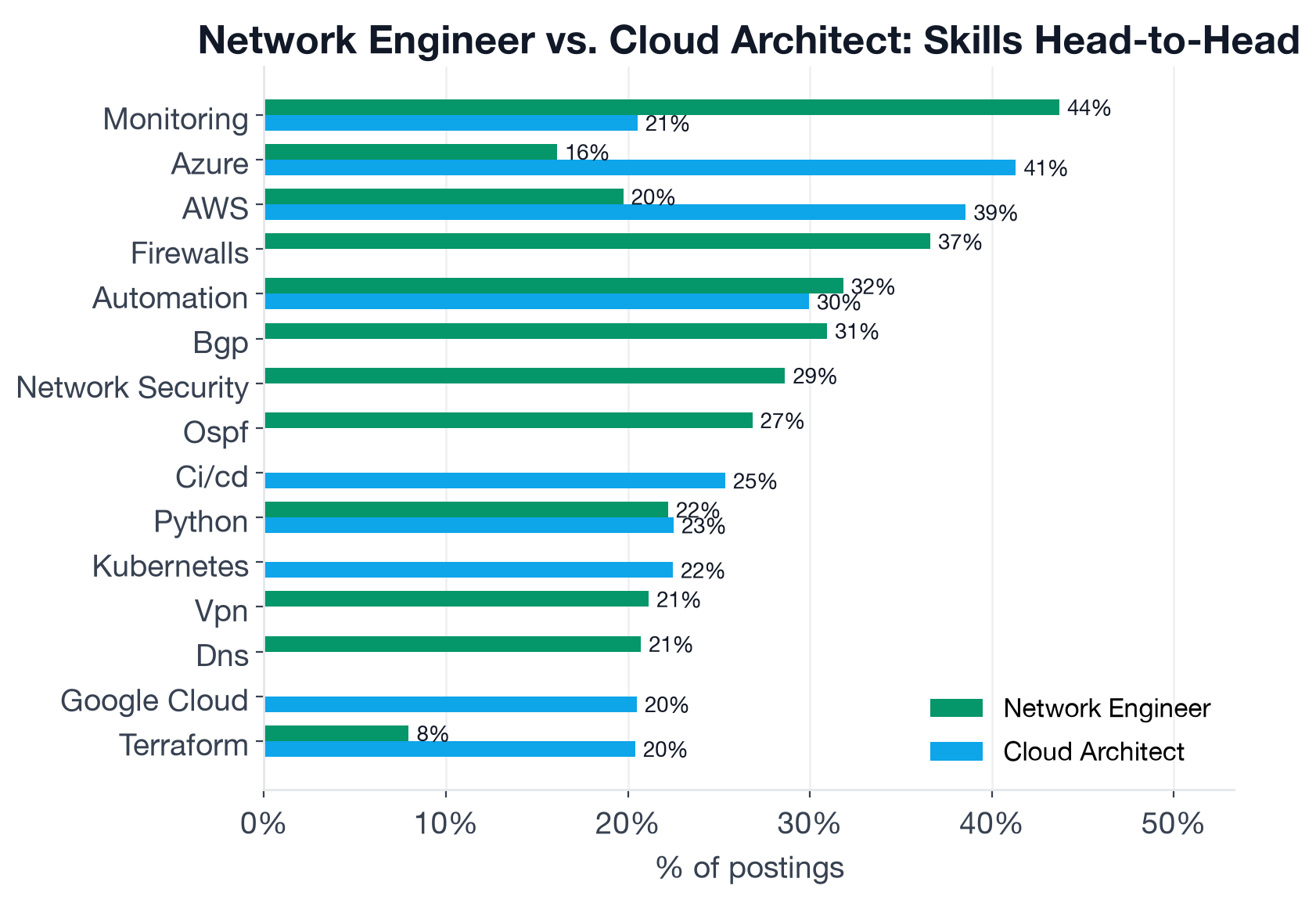
Top skills from the combined top-30 lists of both roles, by share of postings.
If you already know Python and can automate a workflow, that transfers directly; those are the two closest things to a genuine bridge skill, with Disaster Recovery and Linux not far behind. Cloud-platform familiarity at a Network Engineer level, roughly 1 in 5 postings for AWS or Azure, is a starting point, not a finish line: Cloud Architect postings expect it in 2 out of 5. Monitoring runs the other way; it's more central to keeping an existing network alive than to designing a new cloud environment.
The Skills That Define Each Role Don't Cross Over
Past the shared list, the two roles pull from almost entirely different vocabularies. Network Engineer's exclusive skills are perimeter-and-protocol work: Firewalls (36.6%), BGP (30.9%), Network Security (28.6%), OSPF (26.8%), and VPN (21.1%). None of these appear at meaningful frequency in Cloud Architect postings at all.
Cloud Architect's exclusive skills describe a delivery pipeline, not a perimeter: CI/CD (25.3%), Kubernetes (22.5%), Google Cloud (20.5%), Cloud Architecture (19.9%), and Agile (19.3%). Someone fluent in Network Engineer's exclusive list could walk into most Cloud Architect interviews without recognizing half the vocabulary, and the reverse is just as true.
Where Does the Higher Paycheck Actually Come From?
Cloud Architect's $175,000 median US base salary sits $45,000 above Network Engineer's $130,000, a 25.7% gap measured against Cloud Architect's own baseline. Both figures are base salary only; postings don't disclose equity, bonus, or sign-on, so total compensation at senior levels runs higher than either number alone.
The more useful finding sits underneath that headline number: cloud-platform skills price as a genuine differentiator for Network Engineer and as table stakes for Cloud Architect. Kubernetes adds $15,000 to the Network Engineer baseline (n=53) and Terraform adds $13,800 (n=94); inside Cloud Architect's own postings, both skills price $10,000 below the role's $175,000 median, and the pattern holds across AWS, Azure, Google Cloud, and CI/CD. Even Cloud Architecture itself, the skill sharing the role's name, prices $13,300 below the role's own baseline (n=131): once cloud design is the job title, naming the skill on a resume doesn't move the number. Network Engineer's single largest reported premiums sit in a handful of thin-sample skills, C++, Perl, Grafana, and Quality Improvement, each under 35 data points, adding $33,000 to $53,500 over baseline; too small a sample to generalize from. Among the more substantially-sampled skills, the standout premiums are security- and risk-adjacent, not cloud-adjacent: Risk Assessment adds $34,200 (n=44), and Penetration Testing and Vulnerability Assessment each add roughly $29,800 (n=36-44), all well ahead of any routing protocol.
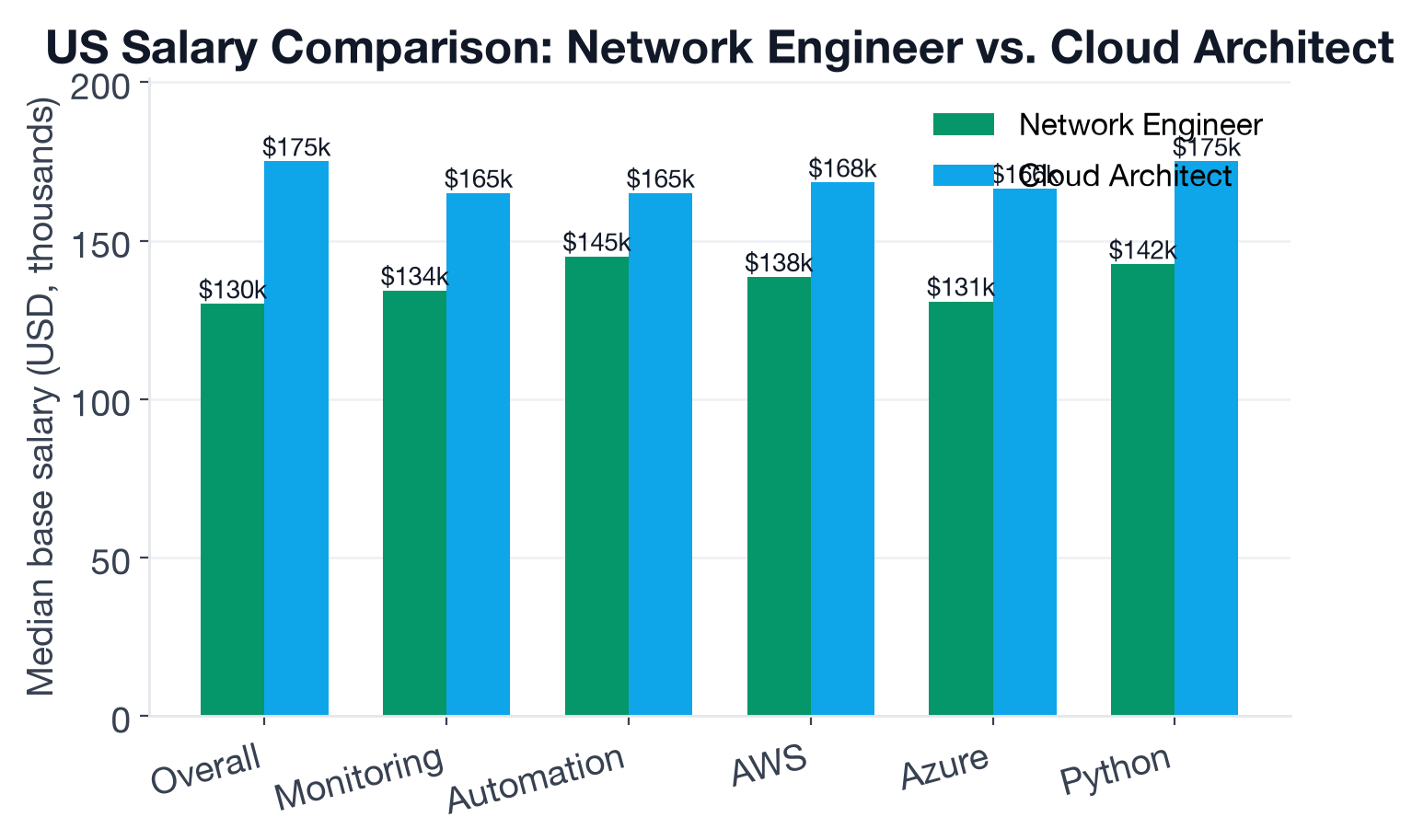
Median US base salary, overall and by shared skill, for each role.
Neither role's top-30 list carries an explicit AI or ML entry, but AI prices a real premium at the margins for both: Generative AI in Cloud Architect postings (n=27) carries a $205,800 median, 17.6% above baseline, and Machine Learning in Network Engineer postings (n=60) carries $150,500, 15.8% above baseline. That's still a minority of postings, not the mainstream bar, and it understates real exposure: general developer-survey data puts AI-tool usage at 84-85% and daily use above 50% (Stack Overflow 2025 Developer Survey; JetBrains State of Developer Ecosystem 2025), a floor that applies whether or not a posting mentions it. Cloud Architects are more likely to meet AI as infrastructure they design and govern; Network Engineers are more likely to meet it as a productivity layer, config generation, log triage, on an existing job. More on either role's exposure: Network Engineer, Cloud Architect.
Which Role Is Actually Easier to Get Hired Into?
Network Engineer carries 1.67x Cloud Architect's posting volume, 3,949 active listings against 2,367, a real edge for anyone job-hunting today. It doesn't translate into an easier bar: entry-level share is thin on both sides, 2.7% for Network Engineer versus 1.0% for Cloud Architect, which functions as a near-zero-entry title. Combined senior-and-staff share is close between the two (32.0% Network Engineer, 36.1% Cloud Architect), so the hiring bar is similarly senior-skewed even though only one side pays a premium for it.
Work mode is where the roles actually separate. Cloud Architect offers 59.4% combined hybrid and remote work; Network Engineer offers 36.6% and is 65.6% onsite (work-mode tags aren't mutually exclusive on every posting, so the two figures don't sum to a clean 100%). Part of that traces to who's hiring: Network Engineer's top employers here lean heavily toward US defense and government-services contractors, work that typically comes with onsite and clearance requirements attached. Geography follows suit: Network Engineer postings are 54.7% US-based versus Cloud Architect's 40.1%, and Cloud Architect draws roughly twice the India share (11.4% vs. 5.6%), consistent with cloud work being more globally distributed than on-premises network operations.
Which Path Fits You Better?
Choose Network Engineer if you:
- Want to stay hands-on with the physical and logical network, routing, firewalls, VPNs, rather than move into upfront design and governance work.
- Want the larger pool of open roles right now (1.67x the postings) and can work within a mostly onsite, often clearance-eligible environment.
- Want to build toward the role's real premiums, security- and risk-adjacent skills like risk assessment, penetration testing, and vulnerability assessment, rather than assuming protocol depth alone will raise your pay.
Choose Cloud Architect if you:
- Want the higher pay ceiling ($45,000 above Network Engineer at the median) and are ready to clear a steeper, more senior-skewed hiring bar.
- Want to design systems and set the patterns other engineers implement, rather than operate a network hands-on day to day.
- Want meaningfully more remote and hybrid flexibility (59.4% versus 36.6%).
If you're weighing a third option, Systems Engineer vs Network Engineer, Network Engineer vs Cloud Engineer, and Systems Administrator vs Cloud Architect cover adjacent pairings with the same methodology.
How to Use This in Your Job Search
Whichever direction you're leaning, practice the specific interview gap with AI mock interviews: Cloud Architect interviews probe system-design tradeoffs and cost/scalability reasoning; Network Engineer interviews lean on troubleshooting and protocol depth. Drill the underlying topics in the question bank, whether that's BGP path selection or a cloud well-architected framework. Bridging from Network Engineer toward Cloud Architect, our interactive courses can build the infrastructure-as-code and cloud-design foundations the exclusive-skill data above shows you're missing. Full per-role breakdowns: Network Engineer skills, Cloud Architect skills.
FAQ
Q. Which pays more, Network Engineer or Cloud Architect?
Cloud Architect pays more. The median US base salary is $175,000 for Cloud Architect versus $130,000 for Network Engineer, a $45,000 gap (25.7%). Both figures are base salary only; postings don't disclose equity or bonus.
Q. How much skill overlap is there between Network Engineer and Cloud Architect?
20% (Jaccard similarity across each role's top 30 skills). The overlap that does exist is uneven: Python (22.2% vs. 22.5%) and Automation (31.8% vs. 30.0%) are close to balanced, but AWS is twice as common in Cloud Architect postings, Azure and Terraform are about 2.6 times as common, and Monitoring runs the other way, 2.1 times more common for Network Engineer.
Q. Do cloud skills pay more for Network Engineers or Cloud Architects?
For Network Engineers. Kubernetes adds a $15,000 premium over the Network Engineer baseline (n=53) and Terraform adds $13,800 (n=94), while both skills price $10,000 below Cloud Architect's own $175,000 baseline. Even Cloud Architecture itself, the skill sharing the role's name, prices $13,300 below the role's own median (n=131). Cloud-platform skills are a differentiator on one side of this comparison and table stakes on the other.
Q. Is Network Engineer or Cloud Architect easier to break into?
Neither is easy, but Network Engineer has more raw opportunity. Entry-level share is thin on both sides, 2.7% for Network Engineer versus 1.0% for Cloud Architect, and Network Engineer carries 1.67x the posting volume (3,949 vs. 2,367). Cloud Architect functions as a near-zero-entry title in this dataset.
Q. Which role offers more remote or hybrid work?
Cloud Architect, by a wide margin. 59.4% of Cloud Architect postings are hybrid or remote versus 36.6% for Network Engineer, which is 65.6% onsite. Network Engineer's heavier concentration of US defense and government-services employers in this dataset likely explains part of the gap, since onsite and clearance requirements are common in that segment.
Q. Do Network Engineer or Cloud Architect postings require AI skills?
Rarely as an explicit requirement. Neither role's top-30 skill list contains an AI or ML entry. Generative AI is a thin but well-paid signal in Cloud Architect postings (n=27, a $30,800 premium, 17.6% above baseline), and Machine Learning plays the same role for Network Engineer (n=60, a $20,500 premium, 15.8% above baseline). That's a minority of postings for both roles, not the mainstream bar. General developer-survey data puts AI-tool usage at 84-85% and daily use above 50% (Stack Overflow 2025 Developer Survey; JetBrains State of Developer Ecosystem 2025), a floor that applies regardless of what any single posting states.
The Overlap Is a Starting Point, Not a Shortcut
A 20% skill overlap means these are two different jobs that happen to share an infrastructure label, not two rungs on the same ladder. Network Engineer offers more open roles today and a real path to a higher paycheck through security depth, not cloud fluency alone. Cloud Architect pays more, but the cloud skills that would seem like the obvious bridge are already table stakes on that side, worth nothing extra once you've made the jump. Python and automation are the honest starting point; everything past that has to be built deliberately, not assumed.
Topics
Ready to practice?
Put what you've learned into practice with AI mock interviews and structured preparation guides.