
There's No Skills Ladder Between These Two Roles
Systems Administrator and Cloud Architect show up next to each other on almost every "IT career path" chart online: admin today, architect tomorrow. The job-posting data doesn't back that story. The two roles share just 22% of their top skills (Jaccard similarity across each role's top 30), and their most frequently required skills point in opposite directions, Windows, Active Directory, and VMware for Systems Administrator; Azure, CI/CD, and Terraform for Cloud Architect. We pulled every active posting on the InterviewStack.io job board that passes the same quality filter used on the job board itself, 4,295 for Systems Administrator and 2,351 for Cloud Architect, as of August 2026. Job-board classification runs on title and description keywords, not a strict occupational taxonomy, so each dataset carries some edge cases: a handful of IT-leadership and general-support titles ("IT Director of Architecture," "1st Line Support Administrator") on the Systems Administrator side, and hardware, domain, and non-cloud "Architect" titles ("MCU Architect," "Physicist … Systems Architect," "HR System Solution Architect," "ESOP Feasibility Solution Architect") on the Cloud Architect side. Those are a minority of each sample, and the patterns below hold at the aggregate level, but treat the percentages as directional rather than exact.
Read side by side, the two roles look less like two rungs on one ladder and more like two different jobs that happen to share an IT org chart.
| Systems Administrator | Cloud Architect | |
|---|---|---|
| Median US base salary | $115,000 | $173,100 |
| Active postings | 4,295 | 2,351 |
| Top skill | Monitoring (40.3%) | Azure (41.0%) |
| Remote + hybrid share | 35.6% | 58.9% |
| Entry-level share | 3.2% | 1.0% |
| Skill overlap (Jaccard) | 22% (pairwise) | 22% (pairwise) |
Key Findings
- Systems Administrator and Cloud Architect share just 22% of their top skills (Jaccard similarity), with zero keyword overlap between each role's top 10 exclusive skills.
- Cloud Architect's median US base salary is $173,100 versus $115,000 for Systems Administrator, a $58,100 gap; Systems Administrator sits 33.6% below Cloud Architect.
- Systems Administrator has 83% more active postings (4,295 versus 2,351), but Cloud Architect is the far more senior role: 36.2% of its postings are senior or staff level versus 21.8% for Systems Administrator.
- Entry-level openings are rare for both, but rarer for Cloud Architect: 1.0% of postings versus 3.2% for Systems Administrator.
- Cloud Architect offers more flexibility: 58.9% of postings are remote or hybrid versus 35.6% for Systems Administrator, which is 65.3% onsite.
- Systems Administrator postings that ask for AWS, Terraform, Kubernetes, Docker, or CI/CD pay $18,000 to $23,500 above the role's own $115,000 median, a documented bridge toward Cloud Architect pay.
- Neither role's top 30 skills name an AI or ML skill explicitly, but Cloud Architect's Generative AI ($198,800, n=27) and Machine Learning ($184,900, n=41) both price well above its $173,100 baseline; Systems Administrator's data has no AI or ML skill anywhere.
What Does Each Role Actually Do?
Systems Administrator is an operations role. The job is keeping an existing Windows, Linux, and virtualized environment running: patching servers, managing Active Directory accounts and permissions, running backups, and responding when something breaks. Success usually looks like invisibility, nothing goes down, nobody notices the infrastructure at all.
Cloud Architect is a design role. The job is deciding what the target cloud environment should look like: which services to use, how workloads split across accounts and regions, how identity and cost controls get enforced, and how the system scales under load. The output is a blueprint or an infrastructure-as-code template that platform and DevOps engineers then build. It's proactive and forward-looking, closer to technical strategy than day-to-day operations.
Which Skills Do Both Roles Actually Require?
Both roles converge on operational cloud fundamentals, with the emphasis reversed. Automation appears in 30.52% of Systems Administrator postings and 30.46% of Cloud Architect postings, effectively identical. Beyond that, the weighting flips: Monitoring is Systems Administrator's top skill (40.3%) but only Cloud Architect's ninth (20.5%), while Azure and AWS run the opposite direction, Cloud Architect's top two skills (41.0%, 39.2%) versus Systems Administrator's seventh and fourteenth (21.3%, 16.7%).
| Skill | Systems Administrator | Cloud Architect |
|---|---|---|
| Automation | 30.5% | 30.5% |
| Monitoring | 40.3% | 20.5% |
| Azure | 21.3% | 41.0% |
| AWS | 16.7% | 39.2% |
| Linux | 36.3% | 13.0% |
| Python | 15.6% | 22.8% |
| Kubernetes | 7.4% | 22.9% |
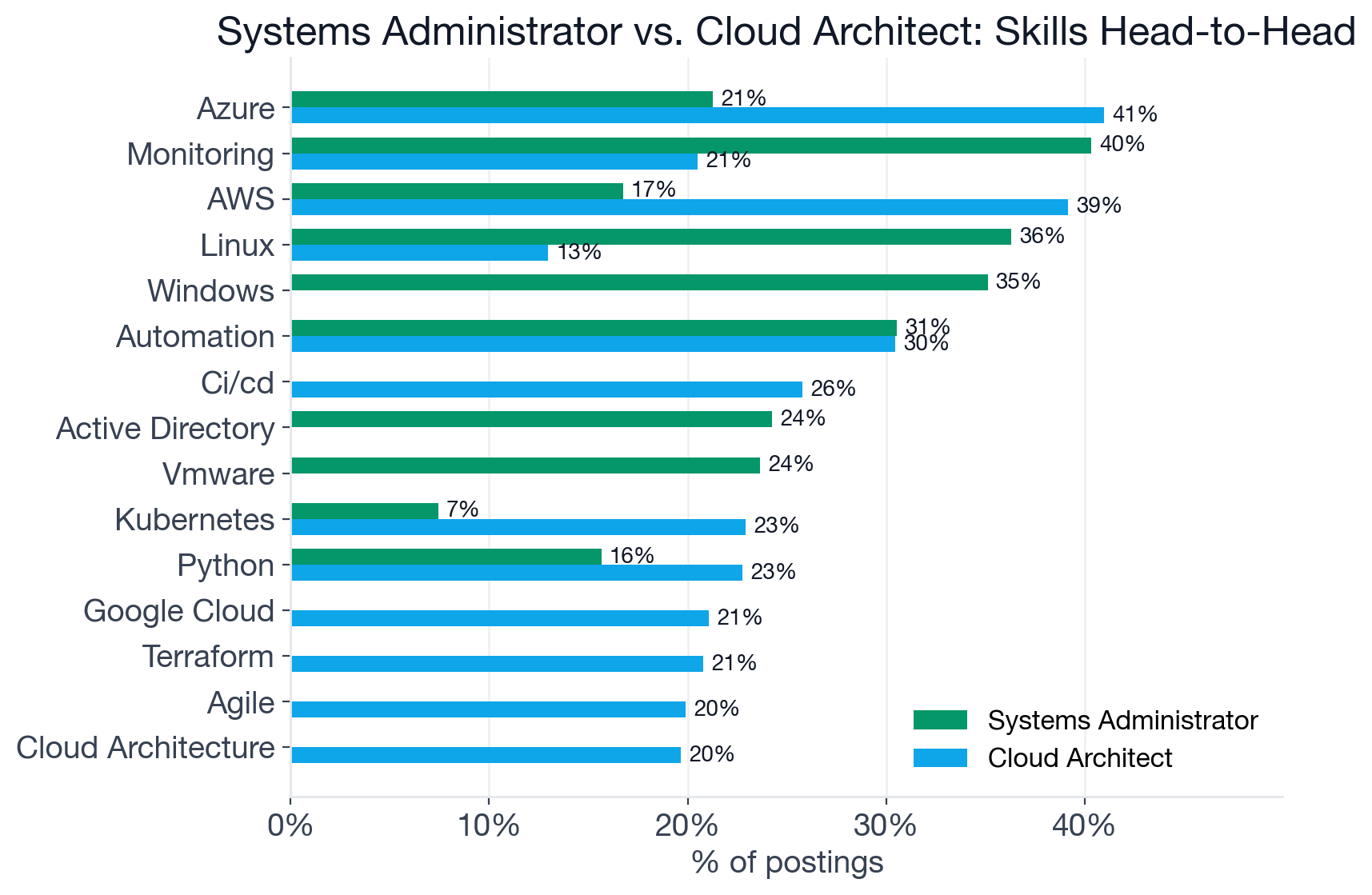 Systems Administrator's strength runs through on-prem and Windows-domain administration; Cloud Architect's runs through cloud-native and infrastructure-as-code tooling.
The rest of the shared list follows the same pattern: SQL, Ansible, and Disaster Recovery skew Systems Administrator. If you already have this foundation, the real question isn't whether you know these tools, it's which direction you've been pointing them.
The Exclusive Skills Share Zero Overlap
Look past the shared list and the two roles stop resembling each other. Systems Administrator's top 10 exclusive skills, ones common in its postings but rare in Cloud Architect's, are Windows (35.1%), Active Directory (24.2%), VMware (23.6%), System Administration (18.5%), PowerShell (18.3%), DNS (18.0%), Technical Support (17.6%), Windows Server (17.0%), Bash (14.0%), and TypeScript (14.0%). That's the on-premises, Windows-domain world: managing an environment that already exists. TypeScript this high on a Systems Administrator list is a recurring pattern in this dataset, more likely a signal of web-based admin consoles and internal tooling built with it than sysadmins writing frontend code day to day.
Cloud Architect's exclusives are CI/CD (25.8%), Google Cloud (21.1%), Terraform (20.8%), Agile (19.9%), Cloud Architecture (19.7%), Scalability (19.1%), Infrastructure as Code (17.7%), Observability (13.0%), APIs (12.1%), and Docker (11.1%). That's the cloud-native, build-it-from-scratch world.
Not one keyword repeats between the two lists. Systems Administrator Skills Companies Want in 2026 and Cloud Architect Skills Companies Want in 2026 break these down further, but the headline holds: the skills that define each role, not the skills they share, are what makes "promotion" the wrong word here. Cloud Architect postings that ask for Terraform make the gap concrete fast.
Which Role Pays More, and Why?
Cloud Architect. Its median US base salary is $173,100 versus $115,000 for Systems Administrator, a $58,100 gap; Systems Administrator's median sits 33.6% below Cloud Architect's. Both figures are base salary only, drawn from US postings with disclosed compensation (n=1,347 for Systems Administrator, n=634 for Cloud Architect); equity, bonus, and sign-on aren't captured in posting data, so total compensation at senior levels runs higher than either number shown here.
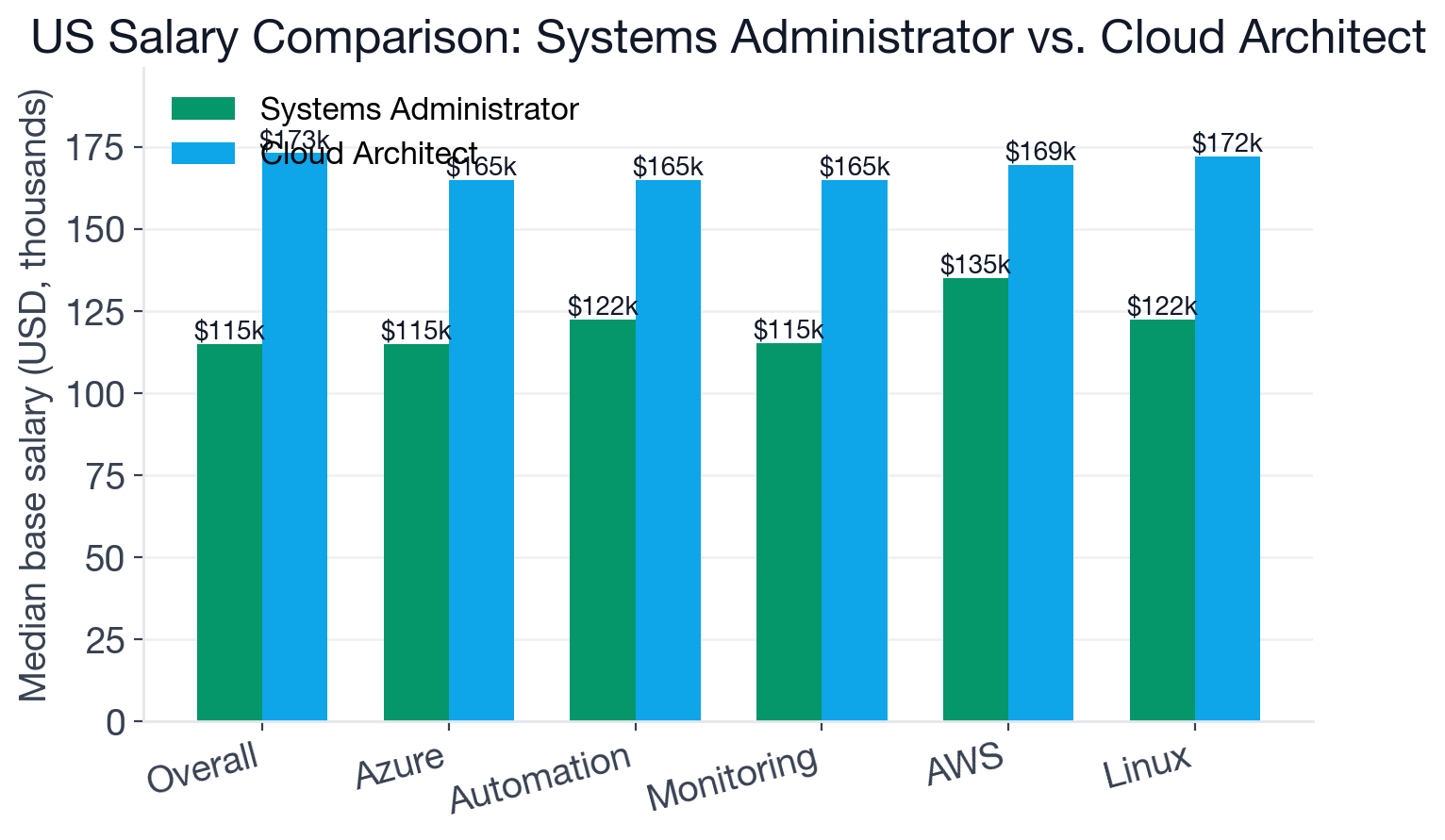 Cloud Architect's $173,100 median outpaces Systems Administrator's $115,000 by $58,100; shared skills like AWS and Kubernetes price differently depending on which role's postings ask for them.
The more interesting pattern is what doesn't drive the gap. Each role's own defining skills mostly price at or below its own baseline: for Systems Administrator, Windows (-$5,000), Active Directory (-$7,500), Windows Server (-$7,600), and Technical Support (-$17,600), with System Administration (+$2,500), Bash (+$8,600), and TypeScript (+$14,600) the only three of its ten defining skills clearing the $115,000 median; for Cloud Architect, CI/CD (-$7,600), Terraform (-$8,100), Cloud Architecture itself (-$9,200), and Infrastructure as Code (-$8,100), with only Scalability (+$4,700) clearing the $173,100 median. Almost none of either role's identity skills carry a real premium; what little exists is small next to the AWS/Terraform/Kubernetes and Distributed Systems/Generative AI premiums above, which is where the real money sits.
| Skill (Systems Administrator postings) | US median | Premium over baseline |
|---|---|---|
| CI/CD | $138,500 | +$23,500 (n=62) |
| Infrastructure as Code | $137,000 | +$22,000 (n=52) |
| AWS | $135,000 | +$20,000 (n=295) |
| Ansible | $134,200 | +$19,200 (n=225) |
| Terraform | $134,200 | +$19,200 (n=89) |
| Docker | $134,200 | +$19,200 (n=104) |
| Kubernetes | $133,000 | +$18,000 (n=105) |
AWS carries the largest sample behind that table (n=295); browse Systems Administrator postings that ask for AWS directly. For Cloud Architect, the premiums run through systems-design depth and, cautiously, AI: Distributed Systems (+$32,500, n=36), Generative AI (+$25,700, n=27), Machine Learning (+$11,800, n=41), and System Design (+$11,600, n=52) all sit above its $173,100 baseline.
Which Role Is Easier to Break Into?
Systems Administrator, on volume and on entry access. It has 83% more active postings than Cloud Architect (4,295 versus 2,351) and a larger entry-level share (3.2% versus 1.0%). Cloud Architect is barely an entry-level title at all: senior and staff levels together make up 36.2% of its postings, versus 21.8% for Systems Administrator.
Geography and flexibility split the same direction. Systems Administrator postings run 65.3% onsite, concentrated in the US (53.7%) and Germany (9.2%); Cloud Architect is 58.9% remote or hybrid, with US postings at 40.0% and India at 11.4%. Cloud Architect is the harder role to walk into cold, and the more flexible one once you're in it.
The AI Skill Gap Looks Bigger in Job Postings Than It Is
Neither role's top 30 skills name an AI or ML skill explicitly, which on the surface reads as "AI hasn't reached IT infrastructure yet." The data underneath tells two different stories. Systems Administrator has no AI or ML-named skill anywhere in its dataset, top 30 or long tail. Cloud Architect does: Generative AI (n=27) and Machine Learning (n=41) both appear in its salary table, priced at $198,800 and $184,900, well above its $173,100 median. Low frequency, high price, consistent with AI and ML being an emerging specialization premium rather than a baseline requirement yet.
Neither number captures ambient AI use, the tools people reach for without a job posting demanding it. General developer surveys put AI-tool adoption at 84 to 85% (Stack Overflow 2025, JetBrains 2025), and a 2026 survey specific to sysadmins found 47% already use AI for troubleshooting, even as the share of employers formally requiring it rose from 15% to 34% in three years (Action1 2026). The postings undercount how much AI both roles already touch; they're just more honest about Cloud Architect's early, premium-priced specialization in it, browsable via Cloud Architect postings that mention Generative AI.
Which Role Should You Choose?
Choose Systems Administrator if you:
- Want to start now. It has more open postings (4,295 versus 2,351) and a larger entry-level share (3.2% versus 1.0%).
- Prefer operational work: keeping an existing Windows, Linux, and VMware environment running rather than designing a new one.
- Are fine with more onsite days; 65.3% of postings require it, versus 48.7% for Cloud Architect.
Choose Cloud Architect if you:
- Already have, or are actively building, a cloud-native skill set: Terraform, Kubernetes, CI/CD, cloud architecture. It doesn't grow automatically out of sysadmin tenure; the two roles' defining skills don't overlap. Our Question Bank drills cloud architecture and infrastructure-as-code fundamentals if you're building this from a sysadmin base.
- Want the higher ceiling and more flexibility: a $58,100 higher median and a 58.9% remote-or-hybrid share.
- Are targeting a senior or staff-level move. Entry-level Cloud Architect openings are rare, just 1.0% of postings.
Plan the Rebuild, Not the Promotion
Systems Administrator and Cloud Architect sit in the same IT org chart but don't share a skill path. Systems Administrator offers more open roles, an easier entry point, and hands-on operational work; Cloud Architect pays $58,100 more at the median and asks for a genuinely different toolkit: cloud-native, design-first, mostly senior. Moving from one to the other means acquiring Cloud Architect's defining skills on purpose (AWS, Terraform, Kubernetes, and CI/CD already carry a premium inside Systems Administrator postings themselves), not waiting for tenure to do it automatically. Browse live Systems Administrator postings or Cloud Architect postings on InterviewStack.io, or practice the architecture and systems-design interview before you make the jump.
FAQ
Q. Which pays more, Systems Administrator or Cloud Architect?
Cloud Architect pays more. The median US base salary is $173,100 for Cloud Architect versus $115,000 for Systems Administrator, a $58,100 gap. Systems Administrator's median sits 33.6% below Cloud Architect's. Both figures are base salary only; equity and bonus are not disclosed in postings.
Q. How much skill overlap is there between Systems Administrator and Cloud Architect?
Just 22% (Jaccard similarity across each role's top 30 skills). The two roles share operational fundamentals like Automation, Monitoring, and Python, but their most frequent, defining skills, Windows and Active Directory for Systems Administrator, Azure and CI/CD for Cloud Architect, don't overlap at all.
Q. Can a Systems Administrator become a Cloud Architect without learning new skills?
Not based on the skill data. Systems Administrator's top 10 exclusive skills and Cloud Architect's top 10 exclusive skills share zero keywords in common. Systems Administrator postings that already ask for AWS, Terraform, Kubernetes, Docker, or CI/CD pay $18,000 to $23,500 above the role's own $115,000 median, which is the closest thing to a documented bridge between the two roles.
Q. Is it easier to get hired as a Systems Administrator or a Cloud Architect?
Systems Administrator, on both counts. It has 83% more active postings than Cloud Architect (4,295 versus 2,351) and a larger entry-level share (3.2% versus 1.0%). Cloud Architect skews senior: 36.2% of its postings are senior or staff level, versus 21.8% for Systems Administrator.
Q. Do Systems Administrator or Cloud Architect postings require AI skills?
Rarely, in explicit terms. Neither role's top 30 skill list names an AI or ML skill. Systems Administrator's data has no AI or ML skill anywhere, not even in the long tail of salary data. Cloud Architect's does: Generative AI (n=27) and Machine Learning (n=41) both appear in its salary table, priced at $198,800 and $184,900, well above the role's own $173,100 median. That explicit rarity understates real usage: developer surveys put general AI-tool adoption at 84 to 85%, and a 2026 survey specific to sysadmins found 47% already use AI for troubleshooting even though it almost never shows up as a stated job requirement.
Q. What skills should a Systems Administrator learn to move toward Cloud Architect pay?
The skills Cloud Architect postings ask for most: AWS, Terraform, Kubernetes, Docker, Ansible, and CI/CD. Each already carries a premium inside Systems Administrator's own postings, $18,000 to $23,500 above the role's $115,000 median, so the pay signal exists before anyone even changes titles.
Q. Does Cloud Architect offer more remote or hybrid work than Systems Administrator?
Yes. 58.9% of Cloud Architect postings are remote or hybrid versus 35.6% for Systems Administrator, which is 65.3% onsite. Cloud Architect also has roughly double the fully remote share, 19.3% versus 9.2%.
Topics
Ready to practice?
Put what you've learned into practice with AI mock interviews and structured preparation guides.