
Volume and Pay Call It a Tie. The Skill List Doesn't.
Three different measures of Cloud Engineer and Site Reliability Engineer (SRE) postings land within a few points of each other. We looked at every active Cloud Engineer and SRE posting on the InterviewStack.io job board as of August 2026, 3,807 listings for Cloud Engineer and 3,489 for SRE. Postings volume is a 1.09x ratio, median US base salary is $6,200 apart, and the two roles share a 50% Jaccard skill overlap across their top-30 lists. By the numbers alone, these read like the same job wearing two different name tags.
They aren't. Pull the skill lists apart and two different jobs emerge. Cloud Engineer's distinct skills, PowerShell, IAM, Cloud Security, Cloud Architecture, Disaster Recovery, cluster around provisioning and securing infrastructure before anything runs on it. SRE's distinct skills, Incident Response, Prometheus, Root Cause Analysis, Incident Management, Distributed Systems, cluster around keeping that infrastructure alive, and diagnosing it, once it's live. The near-tie in pay and volume isn't evidence these roles are interchangeable. It's evidence this dataset caught two different, similarly sized specialties at the same moment.
Both counts carry some noise from adjacent job families the title-matching picks up: Cloud Engineer's is a mix of generic IT-infrastructure and helpdesk-admin postings (Infrastructure Technician, IT Infrastructure Specialist, Microsoft 365 & Azure Administrator) plus at least one clearly non-engineering title (an AWS-focused business-development/sales role), while SRE's is a smaller share of industrial and manufacturing "reliability engineer" titles (a quality-and-reliability engineering manager, a waste-treatment operations engineer) that share the job-title vocabulary but aren't software SRE at all. The skill and salary figures below hold up regardless, both roles' top skills stay cloud/software-native top to bottom, but the true count of hands-on cloud-engineering and software-SRE postings is likely somewhat smaller than the 3,807 and 3,489 headline numbers.
| Cloud Engineer | Site Reliability Engineer | |
|---|---|---|
| Median US base salary | $145,600 | $151,800 |
| Active postings analyzed | 3,807 | 3,489 |
| Top skill | AWS (46.4%) | Automation (55.1%) |
| Remote + hybrid share | 54.9% | 49.9% |
| Entry-level share | 3.4% | 1.8% |
| Skill overlap (Jaccard) | 50% | 50% |
Key Findings
- Cloud Engineer and SRE postings are nearly tied on both scale (3,807 vs 3,489, a 1.09x ratio) and pay ($145,600 vs $151,800 median US base salary, a $6,200/4.1% gap).
- The two roles share a 50% Jaccard overlap across their top-30 skill lists, driven by Automation, Monitoring, AWS, Python, and Terraform.
- Observability appears in 43.1% of SRE postings vs. just 15.0% of Cloud Engineer postings, nearly a 3x gap on a skill both roles technically share.
- Cloud Engineer's most distinct skills, PowerShell (17.9%), IAM (15.2%), Cloud Security (11.8%), Cloud Architecture (11.7%), center on provisioning and governance.
- SRE's most distinct skills, Incident Response (31.1%), Prometheus (23.9%), Root Cause Analysis (23.7%), center on diagnosing and resolving live failures.
- Naming "Site Reliability Engineering" as a skill inside an SRE posting adds $27,700 over SRE's own baseline (n=207), one of the few roles in this series where the title skill itself pays a premium.
- Neither role is an easy first job: entry-level share is 3.4% for Cloud Engineer and 1.8% for SRE.
Provisioning the Cloud vs. Keeping It Running
A Cloud Engineer's week is mostly about what happens before traffic hits anything: standing up landing zones (pre-configured, secured multi-account cloud environments), writing Terraform to provision infrastructure as code, wiring up IAM (identity and access management) policies, and hardening the environment ahead of a security review. The deliverable is an environment that's ready, not a system already carrying load.
An SRE inherits that environment once it's live. Their week runs through dashboards, on-call rotations, and the incident channel: watching Prometheus and Datadog for anomalies, running root-cause analysis after something breaks, and capacity-planning for traffic that's already there. The mandate is uptime for a system that already exists, not building it in the first place.
What Skills Do Both Roles Actually Share?
Both roles now run on a common cloud-and-automation toolkit. Automation, Monitoring, AWS, Python, and Terraform all appear in at least a third of postings on both sides, a floor a switcher in either direction can assume without relearning it.
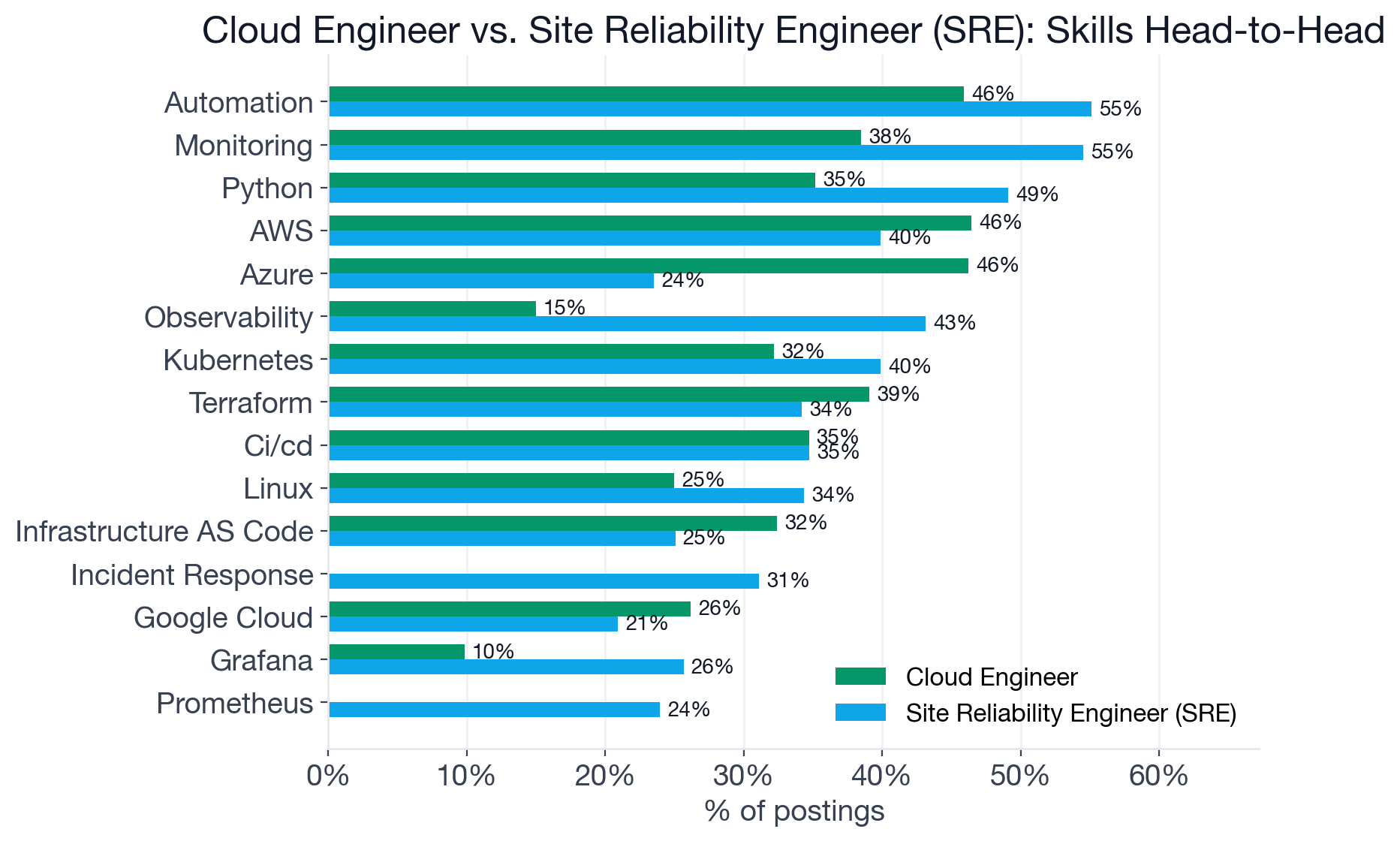 The 15 most common skills across both roles' top-30 lists, one color per role.
| Skill | Cloud Engineer | SRE |
|---|---|---|
| Automation | 45.9% | 55.1% |
| Monitoring | 38.5% | 54.5% |
| AWS | 46.4% | 39.9% |
| Python | 35.1% | 49.1% |
| Terraform | 39.1% | 34.2% |
| Kubernetes | 32.2% | 39.9% |
| Azure | 46.2% | 23.5% |
| CI/CD | 34.7% | 34.7% |
| Linux | 25.0% | 34.4% |
| Observability | 15.0% | 43.1% |
But shared doesn't mean balanced. CI/CD ties almost exactly (34.70% vs. 34.74%, a gap of four-hundredths of a point), the closest true tie on either list. Everything else skews: Azure runs nearly 2x toward Cloud Engineer (46.2% vs. 23.5%), while Observability runs closer to 3x the other way (15.0% vs. 43.1%), a skill both roles technically list but that means something structurally different in each.
Which Skills Are Exclusive to Each Role?
Cloud Engineer's exclusive cluster is provisioning and governance: PowerShell (17.9%), IAM (15.2%), Windows (12.9%), Disaster Recovery (12.4%), Cloud Security (11.8%), and Cloud Architecture (11.7%). These build and keep an environment compliant, not run it once traffic arrives. Agile (15.0%) also clears the exclusivity bar, ahead of four of the six skills above, but it's a process methodology rather than an infrastructure skill, so it's called out on its own rather than folded into this cluster; it shows up again, with its salary figure, in the pay section below.
SRE's exclusive cluster is production firefighting: Incident Response (31.1%), Prometheus (23.9%), Root Cause Analysis (23.7%), Incident Management (19.5%), and Distributed Systems (17.5%). None of these register as a Cloud Engineer skill at meaningful frequency; they describe a job that starts where provisioning ends.
Cloud Engineer or SRE: Which One Pays More?
SRE pays a modest premium: $151,800 vs. $145,600 median US base salary, a $6,200 (4.1%) gap, disclosed across 904 and 786 postings respectively. Both are base salary only; equity, bonus, and sign-on aren't disclosed in postings, so total comp likely runs higher on both sides than these numbers suggest.
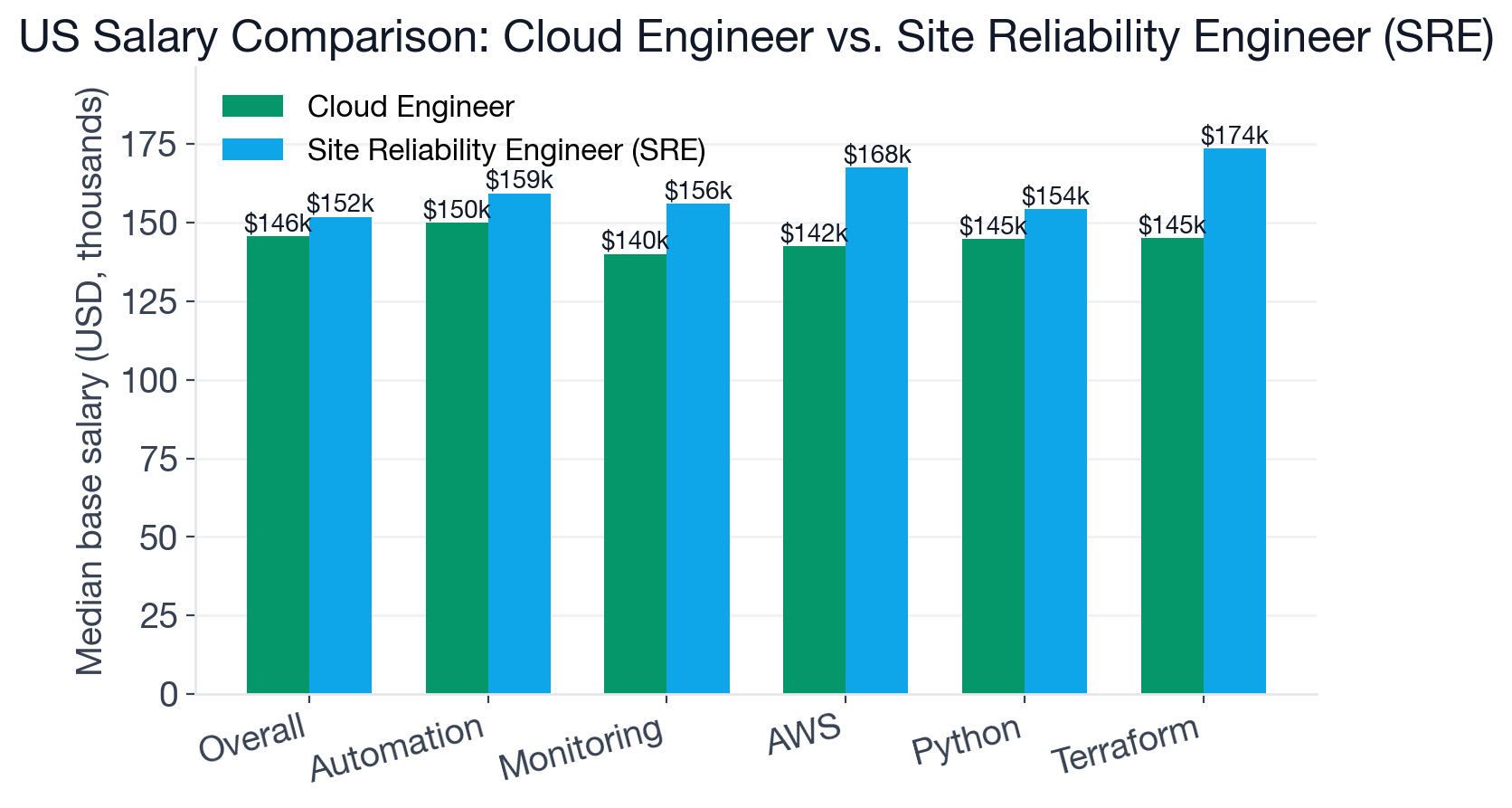 Overall median US base salary plus a handful of shared skills, priced separately for each role.
The gap is small, but the story underneath it isn't. SRE is one of the rarer roles in this series where its own defining skills pay a real premium instead of sitting at table stakes. Naming "Site Reliability Engineering" explicitly inside a posting adds $27,700 over SRE's baseline (n=207); Distributed Systems adds $24,700 (n=156); Incident Response, Incident Management, and Datadog each add $15,700. The rest of SRE's exclusive skills run close to flat: Prometheus (+$3,200), Java (+$1,300), Data Visualization (+$800), Capacity Planning (+$700), and Root Cause Analysis (-$1,800).
Cloud Engineer runs the opposite way, mostly. Eight of its ten defining skills sit at or below its $145,600 baseline: Windows (-$16,000), PowerShell (-$14,200), Disaster Recovery (-$10,600), SQL (-$10,600), Cloud Security (-$6,300), IAM (-$3,200), Agile (-$600), and Containerization (-$100), the table-stakes pattern seen across most roles in this series. Two exceptions carry a real premium anyway: Cloud Architecture (+$4,600, n=146) and Virtualization (+$10,200, n=104). The bigger premiums still sit one layer over, in skills that overlap SRE's territory: Google Cloud (+$10,400, n=234), Distributed Systems (+$18,200, n=52), and Debugging (+$17,800, n=66); naming "Site Reliability Engineering" inside a Cloud Engineer posting itself adds $16,400 (n=30). Production-reliability and architecture-depth skills carry a premium wherever they show up, whether the title says SRE or not, and that now includes two of Cloud Engineer's own name-brand skills.
Explicit AI tags stay rare in both datasets, well below the frequency needed to crack either top-30 list: Generative AI shows up in 4.6% of Cloud Engineer's US salary sample, LLMs in 3.0% of SRE's. That's a posting-language finding, not a usage finding. Stack Overflow's 2025 developer survey found 84% of developers already use or plan to use AI tools, and 51% use them daily, a floor that applies to both roles regardless of what a listing says. SRE has a role-specific signal on top of that floor: AI-assisted incident correlation is already cutting alert noise for teams that use it, and Gartner projects AI-powered SRE tooling adoption will climb from under 5% of enterprises today toward 85% by 2029. Cloud Engineer inherits the general developer-tooling floor instead, but writing Terraform and Python today usually means writing it alongside an AI assistant, posting language or not.
Which Role Has More Openings, and Who Can Get In?
Cloud Engineer carries the larger pool: 3,807 active postings vs. 3,489 for SRE, a 1.09x edge, close enough that either offers a similarly sized market. Neither is an easy first job: entry-level share is 3.4% for Cloud Engineer and 1.8% for SRE, roughly 1 in 29 and 1 in 55. SRE also skews more senior: 48.5% of postings ask for senior or staff candidates, versus 35.8% for Cloud Engineer, consistent with SRE rarely going to someone without prior production experience (though some of that figure likely reflects the industrial "reliability engineer" titles noted above, which carry their own Manager- and Staff-level titling conventions).
Flexibility tilts modestly toward Cloud Engineer: 54.9% of postings are hybrid or remote, versus 49.9% for SRE, though SRE offers slightly more pure-remote work (18.3% vs. 15.3%). Both roles concentrate in the US (33.6% Cloud Engineer, 41.4% SRE), with India the clear second market for each (12.3% and 11.3%).
Decide by the Layer, Not the Label
Choose Cloud Engineer if you:
- Want to build and secure environments (landing zones, IAM policies, network architecture) rather than operate what's already running.
- Are comfortable with more hybrid work (39.5% of postings) and want the marginally larger, marginally easier-to-enter pool (3.4% entry-level vs. 1.8%).
- Already have, or want to build, identity, governance, and infrastructure-as-code skills over incident-response depth.
Choose Site Reliability Engineer if you:
- Want ownership of uptime for systems already carrying production traffic: on-call, incident response, root-cause work, not provisioning.
- Bring prior production experience; nearly half of SRE postings (48.5%) ask for senior or staff-level candidates.
- Want the modest salary edge ($151,800 vs. $145,600) and are prepared to build the observability and distributed-systems depth that comes with it.
Prepare for Either Interview Loop
Whichever side fits, closing the gap between reading the skill list and defending it in an interview takes practice. Practice with AI mock interviews built around what each role actually gets asked: provisioning and IAM design for Cloud Engineer, incident response and postmortems for SRE. The Question Bank breaks both domains down by concept, and our interactive courses build the cloud and systems foundations either path assumes.
For a deeper look at either role on its own, see Cloud Engineer and SRE skills demand, or weigh SRE against Network Engineer for an adjacent infrastructure path.
FAQ
Q. Does Cloud Engineer or Site Reliability Engineer pay more in 2026?
Site Reliability Engineer pays more, but not by much. Among US postings with salary disclosed, the median SRE base salary is $151,800 (n=904) versus $145,600 for Cloud Engineer (n=786), a $6,200 (4.1%) premium. Both figures are base salary only; equity, bonus, and sign-on are not disclosed in postings.
Q. How much do Cloud Engineer and Site Reliability Engineer skill sets overlap?
Fairly heavily on the surface. The two roles share a 50% Jaccard overlap across their top-30 skill lists, driven by Automation, Monitoring, AWS, Python, and Terraform. But several of those officially shared skills split sharply once you look at frequency: Observability appears in 43.1% of SRE postings versus just 15.0% of Cloud Engineer postings, and Azure runs nearly 2x the other way (46.2% vs. 23.5%).
Q. What skills are exclusive to Cloud Engineer but not Site Reliability Engineer?
Cloud Engineer's most distinct skills are PowerShell (17.9%), IAM (identity and access management, 15.2%), Windows (12.9%), Disaster Recovery (12.4%), Cloud Security (11.8%), and Cloud Architecture (11.7%), a cluster centered on provisioning, identity, and governance rather than production operations. Agile (15.0%) is also exclusive to Cloud Engineer, at a higher frequency than four of those six skills, but as a process methodology rather than an infrastructure skill, it's set aside from this cluster rather than silently dropped.
Q. What skills are exclusive to Site Reliability Engineer but not Cloud Engineer?
SRE's most distinct skills are Incident Response (31.1%), Prometheus (23.9%), Root Cause Analysis (23.7%), Incident Management (19.5%), and Distributed Systems (17.5%), a cluster centered on diagnosing and resolving failures in systems that are already live.
Q. Is it easier to get an entry-level job as a Cloud Engineer or an SRE?
Cloud Engineer, though barely. Entry-level postings make up 3.4% of Cloud Engineer listings versus 1.8% for SRE, so both roles are effectively closed to candidates without prior experience. SRE in particular is rarely a first job: 48.5% of its postings ask for senior or staff-level candidates, versus 35.8% for Cloud Engineer.
Q. Do Cloud Engineer and Site Reliability Engineer postings require AI skills?
Rarely as an explicit requirement. Generative AI appears in only 4.6% of Cloud Engineer's US salary-disclosed postings, and LLMs in just 3.0% of SRE's, both long-tail line items well outside either role's top-30 skill list. That reflects posting language, not usage: industry-wide, 84% of developers already use or plan to use AI tools, and AI-assisted incident correlation is a fast-growing category specifically inside SRE tooling.
Q. Can a Cloud Engineer move into a Site Reliability Engineer role, or vice versa?
The 50% skill overlap makes a lateral move realistic for someone who already works with AWS, Terraform, Kubernetes, and Python. The harder part isn't the tools, it's the operating model: Cloud Engineer work centers on building and securing infrastructure before it runs, while SRE work centers on keeping infrastructure alive and diagnosing it under pressure once it's live. Someone moving from Cloud Engineer to SRE should expect to build incident-response and on-call experience; someone moving the other way should expect to pick up identity, governance, and provisioning-architecture depth.
The Numbers Won't Decide This For You
Cloud Engineer and Site Reliability Engineer look like the same job on paper: similar headcount, similar pay, half their skill lists overlapping. They aren't the same job. One builds and secures the environment before anything runs on it; the other keeps that environment alive once it's carrying real traffic, and gets paid a little more for the skills that prove it. If the near-tie in the numbers was going to make this decision for you, it would have by now. Browse live Cloud Engineer openings or SRE openings on InterviewStack.io.
Topics
Ready to practice?
Put what you've learned into practice with AI mock interviews and structured preparation guides.