
Every Advantage Except Volume Belongs to SRE
Most role comparisons force a trade-off: one side pays more, the other has more open jobs or a lower bar to entry. Network Engineer and Site Reliability Engineer (SRE) don't split that way. We looked at every active posting for both roles on the InterviewStack.io job board as of July 2026, 4,133 for Network Engineer and 3,487 for SRE, and SRE comes out ahead on pay, remote access, and seniority. Network Engineer's one clear advantage is more jobs to begin with.
That's not the same as the roles being interchangeable. The skill sets barely overlap (a 25% Jaccard similarity across each role's top-30 skills), and what each role asks for reflects two different jobs wearing adjacent-sounding titles: one keeps the network running, the other keeps everything that runs on top of it running. The gap in pay and flexibility tracks that difference, not a market inefficiency.
| Network Engineer | Site Reliability Engineer (SRE) | |
|---|---|---|
| Median US base salary | $128,200 | $150,000 |
| Active postings analyzed | 4,133 | 3,487 |
| Top skill | Monitoring (44.2%) | Automation (55.5%) |
| Remote share | 9.7% | 18.6% |
| Entry-level share | 2.7% | 1.9% |
| Skill overlap (Jaccard) | 25% shared (pairwise) | 25% shared (pairwise) |
Key Findings
- SRE pays a $21,800 (14.5%) higher US base salary median than Network Engineer: $150,000 vs $128,200.
- SRE offers nearly double the remote share of Network Engineer (18.6% vs 9.7%), and half of all SRE postings (50.0%) are hybrid or remote versus 37.0% for Network Engineer.
- Network Engineer postings outnumber SRE postings 1.19x (4,133 vs 3,487 active listings analyzed).
- The two roles share only a 25% Jaccard overlap across their top-30 skill lists.
- SRE postings skew senior: 48.6% are senior or staff level, versus 31.7% for Network Engineer, which concentrates at mid-level (65.5%).
- Ten skills are effectively exclusive to each side: Network Engineer's cluster is protocol and perimeter work (Firewalls 36.4%, BGP 29.9%, Network Security 29.6%, OSPF 25.9%); SRE's is platform tooling (Observability 43.2%, Kubernetes 39.9%, CI/CD 34.9%, Grafana 26.0%).
- Network Engineer's core protocol specialties pay only a modest premium: BGP, OSPF, and Network Security each add about $6,000 over the role's own $128,200 baseline.
Keeping the Network Up vs Keeping the Whole System Up
A Network Engineer's day centers on the wires, routes, and perimeter that carry everything else: configuring BGP (the protocol that exchanges routing information between networks) and OSPF (a routing protocol for finding the best path within a single network) sessions, hardening firewalls, troubleshooting VPN tunnels, and keeping WAN links up when a data center loses connectivity. The work sits closer to civil engineering than software: build the roads, then defend them.
A Site Reliability Engineer inherits the traffic once it reaches the application. Their day runs through dashboards built on Prometheus (an open-source metrics and alerting toolkit) and Grafana, deploy pipelines, and the on-call rotation that owns incident response when a service degrades. The mandate is uptime for the whole system, not just the network layer underneath it.
What Skills Do Both Roles Actually Share?
Both roles now expect a baseline of software-adjacent skill, visible in live postings on the job board.
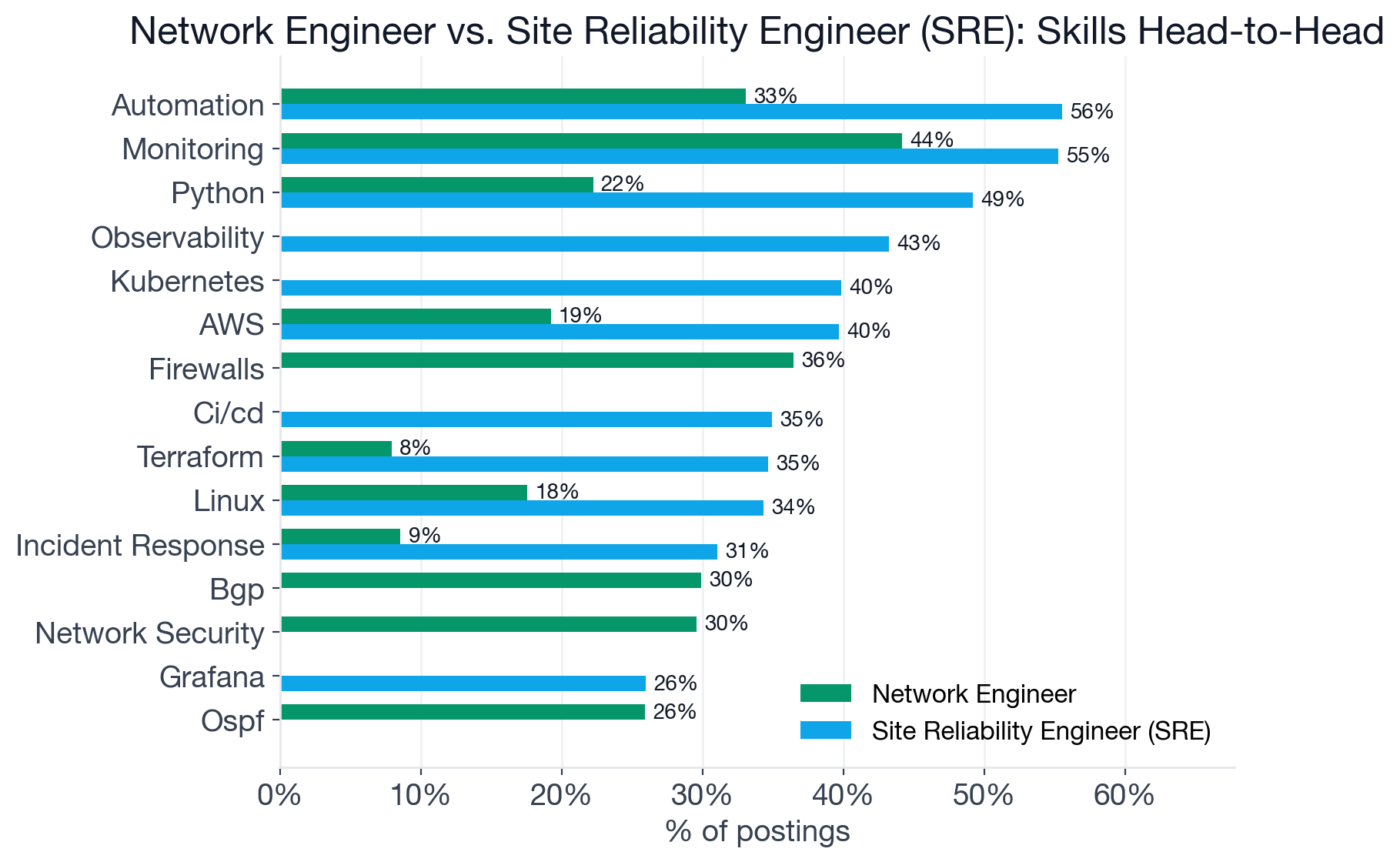 The 15 most common skills across both roles' top-30 lists, Network Engineer in one color, SRE in the other.
| Skill | Network Engineer | SRE |
|---|---|---|
| Monitoring | 44.2% | 55.3% |
| Automation | 33.1% | 55.5% |
| Python | 22.2% | 49.2% |
| AWS | 19.2% | 39.7% |
| Linux | 17.6% | 34.3% |
| Terraform | 7.9% | 34.7% |
None of these are neutral 50/50 splits, every one of the 12 skills that clears the shared-skill threshold is more common on the SRE side, though common enough on the Network Engineer side that a networking background isn't starting from zero for an SRE move. Terraform shows the widest swing, 7.9% versus 34.7%, a roughly 4.4x gap, the clearest sign infrastructure-as-code work is far more central to SRE than to networking today.
Which Skills Are Exclusive to Each Role?
Network Engineer's exclusive cluster is routing-and-perimeter protocol work: Firewalls (36.4%), BGP (29.9%), Network Security (29.6%), OSPF (25.9%), and VPN (21.6%) barely register in SRE postings. These keep packets moving and unauthorized traffic out, deep and narrow expertise most software roles never touch. See Network Engineer roles calling for BGP for where that expertise gets used.
SRE's exclusive cluster is almost entirely platform-observability tooling: Observability itself (43.2%), Kubernetes (39.9%), CI/CD (34.9%), Grafana (26.0%), and Infrastructure as Code (25.1%), the toolkit for running and watching a distributed system in production, not for building the network it runs on.
Which Role Pays More, and Why?
SRE earns a $21,800 (14.5%) premium over Network Engineer at the median: $150,000 vs $128,200 in US base salary, disclosed across 896 and 1,322 postings respectively. These are base salaries only; equity, bonus, and sign-on aren't disclosed in postings, so total comp at senior levels runs higher on both sides than these numbers suggest.
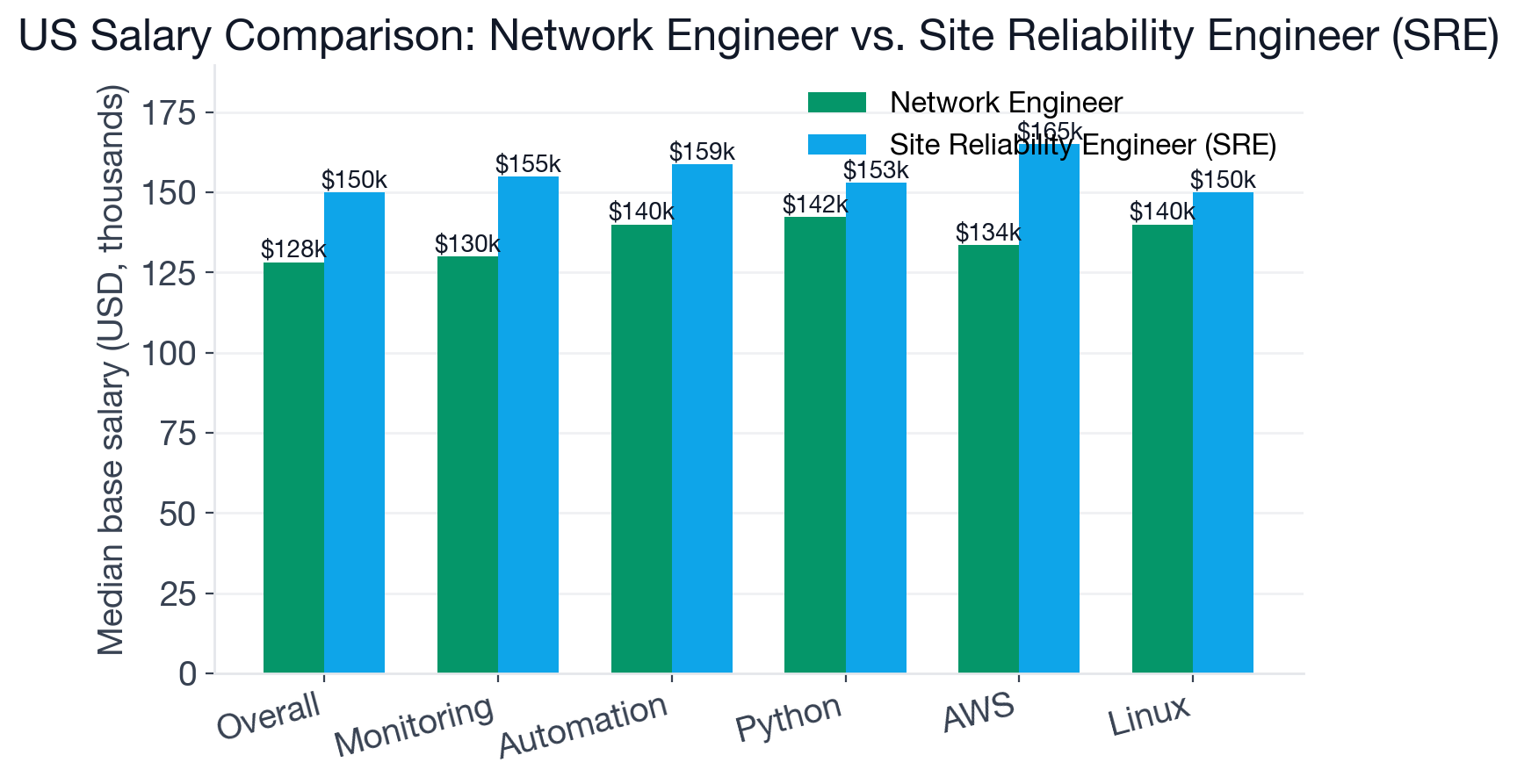 Overall median US base salary plus a handful of shared skills, priced separately for each role.
Part of the gap is seniority mix, not the job itself: 48.6% of SRE postings ask for senior or staff candidates versus 31.7% for Network Engineer. (One caveat on that figure: title-based classification for SRE pulls in some "Reliability Engineer" and "Operations Engineer" postings from industrial, energy, defense, and hardware-testing fields outside software, roles like offshore-reliability or RF-reliability engineers, and those fields have their own Senior/Staff/Principal titling conventions, which may modestly inflate the senior/staff share above. Genuine software SRE hiring skews senior in its own right, so the direction of the finding likely still holds.) But skill-level pay tells a sharper story. Network Engineer's own protocol specialties barely move the needle: BGP, OSPF, and Network Security each pay about $6,000 above baseline. Among the smaller set of postings tagged "Network Administration" (n=93 with salary disclosed), the median sits at $97,500, $30,700 below baseline. Deep protocol expertise buys a little; the generic label buys a discount.
SRE runs the opposite way. Postings that explicitly tag "Site Reliability Engineering" (n=206) pay $179,500, a $29,500 premium over SRE's own baseline, meaning naming the specialty explicitly is rewarded, not just doing SRE-adjacent DevOps work under a different title.
Explicit AI tags are rare in both datasets, below the frequency needed to crack either top-30 list, but where they show up they price like scarce expertise: Machine Learning carries a $163,000 median in Network Engineer postings (+$34,800, n=66) and $190,000 in SRE postings (+$40,000, n=45). That's the build-AI layer, narrow and well-paid. It says nothing about the ambient layer, AI-assisted config review, log triage, and troubleshooting now expected across technical work regardless of posting language. Stack Overflow's 2025 survey found 84% of developers already use or plan to use AI tools. Our prior SRE-specific analysis found 11.4% of postings explicitly require generative-AI skills (a separate dataset, cited for context); Network Engineer's AI story reads more organizational than individual so far, covered in how AI is changing Network Engineer work.
Which Role Has More Openings, and Who Can Get In?
Network Engineer carries the bigger candidate pool: 4,133 active postings versus 3,487 for SRE, a 1.19x edge. Neither is an easy first job: entry-level share is 2.7% for Network Engineer and 1.9% for SRE, close enough to be a rounding error. The roles genuinely differ above entry level. Network Engineer concentrates hard at mid-level (65.5%), senior plus staff at 31.7%. SRE is flatter and older: 49.5% mid-level, but 48.6% senior or staff, roughly one and a half times Network Engineer's share. Read alongside the pay gap, this reads less like "SRE pays more for the same work" and more like "SRE postings ask for a more experienced candidate."
The flexibility gap follows the same pattern. Just over a third of Network Engineer postings (37.0% hybrid plus remote) offer anything besides a desk on-site; SRE clears the halfway mark (50.0%), with remote alone nearly double Network Engineer's share (18.6% vs 9.7%). Both roles concentrate in the US (53.8% Network Engineer, 41.0% SRE), with India the clear second market for each (6.3% and 11.4%).
Pick the Layer You Want to Own
Choose Network Engineer if you:
- Want deep protocol and perimeter expertise (BGP, OSPF, firewalls, VPN) to be your primary craft, not a secondary skill.
- Are comfortable with a role that's still mostly on-site (65.9%) and want the larger, steadier pool of open positions today (4,133 postings, a 1.19x edge over SRE).
- Are earlier in a networking-focused career and want to build protocol depth before branching into cloud or automation work.
Choose Site Reliability Engineer if you:
- Want ownership of the whole production system, deploys, uptime, incident response, not just the network layer underneath it.
- Value remote and hybrid flexibility (50.0% of postings) and are prepared to compete for a role that skews senior (48.6% senior or staff).
- Already have, or want to build, a software-and-cloud toolkit (Kubernetes, Python, CI/CD, observability) rather than protocol-specific depth.
Put This Data to Work in Your Prep
Whichever side you're leaning toward, closing the gap between "I read the skill list" and "I can talk through it in an interview" takes deliberate practice. Practice with AI mock interviews built around scenarios each role actually faces, incident response and escalation for SRE, protocol troubleshooting and change management for Network Engineer. The Question Bank breaks both domains down by concept for targeted drilling, and our interactive courses build the underlying networking and systems foundations either path assumes you already have.
For a deeper look at either role on its own, see Network Engineer and SRE skills demand, or compare Network Engineer against Cloud Engineer and SRE against Systems Engineer for adjacent paths worth weighing.
FAQ
Q. Does Network Engineer or Site Reliability Engineer pay more in 2026?
Site Reliability Engineer pays more. Among US postings with salary disclosed, the median SRE base salary is $150,000 (n=896) versus $128,200 for Network Engineer (n=1,322), a $21,800 (14.5%) premium. Both figures are base salary only; equity, bonus, and sign-on are not disclosed in postings.
Q. How much do Network Engineer and Site Reliability Engineer skill sets overlap?
Not much. The two roles share a 25% Jaccard overlap across their top-30 skill lists. Twelve skills, including Monitoring, Automation, and Python, clear the shared-skill threshold in both roles, but ten skills are exclusive to each side: protocol and perimeter skills (BGP, OSPF, Firewalls, VPN) for Network Engineer, and platform tooling (Kubernetes, Observability, CI/CD, Grafana) for SRE.
Q. Is Network Engineer or Site Reliability Engineer easier to break into?
Neither is an easy first job. Entry-level postings make up just 2.7% of Network Engineer listings and 1.9% of SRE listings. Network Engineer concentrates heavily at mid-level (65.5% of postings), while SRE postings skew more senior overall, with 48.6% at senior or staff level versus 31.7% for Network Engineer.
Q. Which role offers more remote work, Network Engineer or SRE?
SRE. Remote postings make up 18.6% of SRE listings versus 9.7% for Network Engineer, and combined hybrid-plus-remote share clears half of all SRE postings (50.0%) compared to 37.0% for Network Engineer.
Q. Are there more Network Engineer or Site Reliability Engineer jobs?
Network Engineer has more active postings: 4,133 versus 3,487 for SRE, a 1.19x edge, based on active listings analyzed on the InterviewStack.io job board in July 2026.
Q. Do Network Engineer or Site Reliability Engineer postings require AI or machine learning skills?
Rarely, and only as an explicit requirement. Machine Learning doesn't crack the top-30 skill list for either role, though where it is tagged, it pays a premium in both (roughly +$34,800 for Network Engineer, +$40,000 for SRE, over each role's own baseline). That explicit tag is a floor, not the whole picture: ambient AI-assisted tooling for config review, log triage, and troubleshooting is now a baseline expectation across technical roles, tracked by developer surveys rather than job-posting language.
Q. What's the single biggest difference between Network Engineer and Site Reliability Engineer work?
Scope. Network Engineer owns the network layer itself: routing, firewalls, VPNs, and physical or virtual connectivity. SRE owns the reliability of the whole production system running on top of that network: deploys, incident response, and uptime. The skill sets reflect that split more than they reflect a shared 'infrastructure' label.
A Thin but Real Case for Network Engineering
Site Reliability Engineer wins the pay comparison, the flexibility comparison, and the seniority ceiling. Network Engineer's real edge is narrower: more open roles today (4,133 vs 3,487), and a specialty, BGP, OSPF, firewalls, that stays relevant as long as networks need dedicated owners. Cloud-native tooling hasn't replaced that work, it's just priced lower than platform engineering right now. If income and flexibility are the priority, the data points toward SRE, with the caveat that nearly half its postings expect senior-level experience. If access and volume matter more, Network Engineer remains the larger, steadier door in. Browse live Network Engineer openings or SRE openings on InterviewStack.io.
Topics
Ready to practice?
Put what you've learned into practice with AI mock interviews and structured preparation guides.