
The Skill List Barely Changes. The Frequency Doubles.
Systems Engineer and Site Reliability Engineer read like adjacent titles for the same infrastructure work, and the skill data mostly agrees, with one twist. We pulled every active posting for both roles from the InterviewStack.io job board as of July 2026, 5,567 Systems Engineer listings against 3,454 SRE listings, and compared skill frequency, salary by skill, seniority, and work mode across both. The two roles share the same top-line vocabulary: automation, monitoring, Python, Linux, AWS, and Kubernetes all show up on both lists, but not in the same order. Automation and Python hold similar rank on each side; Monitoring jumps from fourth for Systems Engineer to first for SRE, while Linux moves the opposite way, falling from second to well down the list. What changes most is how often each word appears. Monitoring shows up in 27.6% of Systems Engineer postings and 55.6% of SRE postings, almost exactly double. Terraform goes from 9.6% to 35.1%, over 3.5 times as often. Same words, a much louder ask.
That intensity gap sits alongside a real, distinct layer on each side too. SRE postings even cite "Systems Engineering" itself as a named skill often enough to price (n=120, $155,000 median, a small premium over SRE's own baseline), a tell that the two roles share a lineage even where the job titles don't overlap.
| Systems Engineer | Site Reliability Engineer | |
|---|---|---|
| Median US base salary | $142,400 | $150,000 |
| Active postings | 5,567 | 3,454 |
| Top skill | Automation (34.0%) | Monitoring (55.6%) |
| Entry-level share | 2.8% | 1.6% |
| Onsite share | 66.3% | 55.3% |
| Skill overlap (Jaccard) | 33% shared (pairwise) | 33% shared (pairwise) |
Key Findings
- Systems Engineer and SRE share 33% skill overlap (Jaccard on each role's top-30 skill list), a mid-range figure for this comparison series.
- Every shared skill except Agile shows up more often in SRE postings, from a modest 1.1x bump on Linux (30.8% vs. 34.5%) up to a 3.7x jump on Terraform (9.6% vs. 35.1%).
- SRE's median US base salary is $150,000 versus $142,400 for Systems Engineer, a $7,600 (5%) gap; SRE's salary sample is less than half the size (n=844 vs. n=2,020).
- Systems Engineer postings outnumber SRE postings 5,567 to 3,454, a 1.61x volume advantage.
- Entry-level share is thin on both sides: 2.8% for Systems Engineer, 1.6% for SRE.
- SRE postings combine for 50.2% remote and hybrid work versus 37.4% for Systems Engineer.
- Systems Engineer's own defining enterprise-IT skills (Windows, VMware, Active Directory) all pay $5,000 to $20,100 below Systems Engineer's own baseline; SRE's defining skills (Site Reliability Engineering itself, Distributed Systems, Infrastructure as Code) all pay $18,300 to $26,500 above SRE's own baseline.
- Generative AI and LLM-building skills don't crack either role's top-30 most-requested skill list, but Gartner projects AI-driven "AIOps" tooling adoption among enterprises to jump from under 5% in 2025 to 85% by 2029, a category built specifically around the SRE workflow.
The Work Behind Each Title
A Systems Engineer keeps existing infrastructure provisioned and running across a mix of on-prem and hybrid environments: patching servers, managing identity through Active Directory, administering Windows and Linux fleets, running virtualization on VMware, and handling the DNS and network plumbing everything else depends on. A large share of this dataset's postings sit inside defense, aerospace, and large-enterprise IT shops (Northrop Grumman, Leidos, General Dynamics Information Technology, Qualcomm, Peraton, Booz Allen Hamilton, and CACI International all appear among the top employers), so the day-to-day often carries compliance and change-management overhead a pure cloud shop wouldn't have.
A Site Reliability Engineer owns whether a live production service stays up, and how fast it recovers when it doesn't. The week centers on defining and tracking service-level objectives, building and tuning observability with Grafana, Prometheus, and Datadog, taking incident-response on-call shifts, and writing automation and infrastructure-as-code to remove the manual steps that cause outages in the first place. Top employers here (Amazon, Google, Space Exploration Technologies Corp., Anduril Industries, Mastercard, NVIDIA, Apple, Okta) skew toward companies running large-scale, cloud-native production systems.
One data caveat worth flagging: "Systems Engineer" is a broader job-board title than "Site Reliability Engineer," and a sample of the underlying postings shows it. Most carry the job this article describes, but a real minority don't, pre-sales/solutions engineering roles, an IT-instructor posting, data center operations management, even a water-infrastructure advisory role all surfaced under the same title. That noise pulls the Systems Engineer-side numbers (skills, salary, seniority) a bit off center; treat them as directionally right rather than exact. SRE's sample is cleaner, with only an occasional hardware-reliability-engineer title (PCB, photovoltaics) pulled in by the shared word "reliability."
What Skills Do Both Roles Actually Share?
Both roles demand automation, monitoring, and Python in a majority of postings, but "majority" means very different things on each side.
| Skill | Systems Engineer | SRE | SRE multiplier |
|---|---|---|---|
| Automation | 34.0% | 54.9% | 1.6x |
| Monitoring | 27.6% | 55.6% | 2.0x |
| Python | 28.9% | 49.9% | 1.7x |
| Linux | 30.8% | 34.5% | 1.1x |
| AWS | 19.0% | 41.5% | 2.2x |
| Kubernetes | 12.7% | 39.7% | 3.1x |
| CI/CD | 11.0% | 35.0% | 3.2x |
| Terraform | 9.6% | 35.1% | 3.7x |
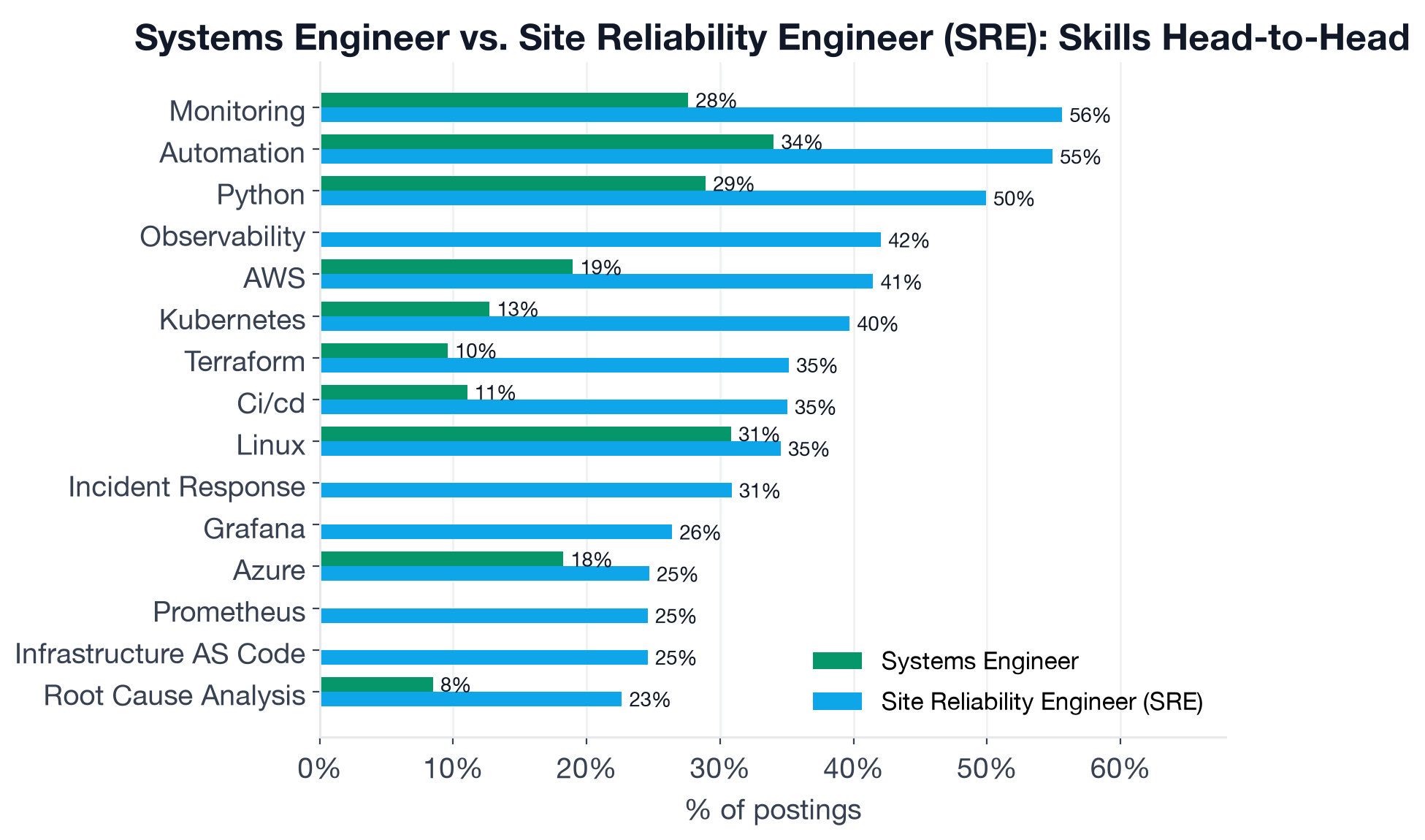 Automation, Monitoring, and Python top both lists; the same skills that anchor Systems Engineer postings show up two to four times more often in SRE postings.
The overlap holds, but the ranking shifts: Systems Engineer's top skill in this table is Automation, while SRE's is Monitoring, which sits fourth for Systems Engineer. What moves most is frequency: five of the eight shared skills here (Monitoring, AWS, Kubernetes, CI/CD, Terraform) show up two to four times more often in SRE postings, and only Linux comes close to a wash at 1.1x. Practically, if you already carry this toolbox from a Systems Engineer background, Systems Engineer roles that already lean into Kubernetes are the closest bridge, since none of the underlying skill is wasted moving toward SRE. You would just be going from occasional use to constant, always-on use of the automation and infrastructure-as-code layer.
Windows Keeps One Role Grounded. The Cloud Owns the Other.
Beyond the shared vocabulary, each role carries its own distinct skill layer, and that layer tells you what the job actually is.
| Systems Engineer exclusive | Freq | SRE exclusive | Freq |
|---|---|---|---|
| Windows | 18.5% | Observability | 42.0% |
| VMware | 14.4% | Incident Response | 30.9% |
| PowerShell | 12.7% | Grafana | 26.4% |
| Virtualization | 12.2% | Infrastructure as Code | 24.6% |
| Active Directory | 10.6% | Prometheus | 24.6% |
Systems Engineer's exclusive cluster is a classic on-prem enterprise-IT stack: Windows, VMware, PowerShell, virtualization, and Active Directory. This is the toolkit for running physical and virtualized fleets and identity in an environment you don't rent by the hour. SRE's exclusive cluster is a cloud-native production-reliability stack: Observability, Incident Response, Grafana, Infrastructure as Code, and Prometheus, layered on top of the automation and Kubernetes intensity already shown above. If you already know Windows Server, Active Directory, and VMware, very little of that transfers directly into an SRE posting; you would be starting the observability and on-call stack from scratch. The reverse holds too: SRE's cloud-native stack doesn't carry back into most on-prem Systems Engineer environments.
Neither role's postings show meaningful explicit AI-building demand. Generative AI and LLM-related skills don't crack either role's top-30 most-requested skill list (the 30th-place skill still clears 7.7% of postings for Systems Engineer and 10.1% for SRE, and generative AI/LLM skills fall short of that). That doesn't mean AI is absent from either job, only that neither posting language requires you to build it. The 2025 Stack Overflow Developer Survey puts regular AI-tool usage among developers at 84% or higher, with 51% using tools like Copilot or ChatGPT daily, a floor that applies to both roles regardless of what the job description says. SRE is the sharper case: Gartner projects AI-driven "AIOps" tooling, AI agents that triage alerts and investigate incidents, to go from under 5% of enterprises in 2025 to 85% by 2029. That makes SRE the more AI-exposed role in practice, even though today's postings barely distinguish the two roles' explicit AI requirements.
Which Pays More: Systems Engineer or SRE?
SRE, but not by much: a $150,000 median US base salary versus $142,400 for Systems Engineer, a $7,600 (5%) gap. These are US base salaries only [Systems Engineer n=2,020; SRE n=844]; equity, bonus, and sign-on are not disclosed in postings and aren't reflected here. Treat the gap as directional: SRE's sample is less than half the size of Systems Engineer's, so a handful of outlier postings can move its median more.
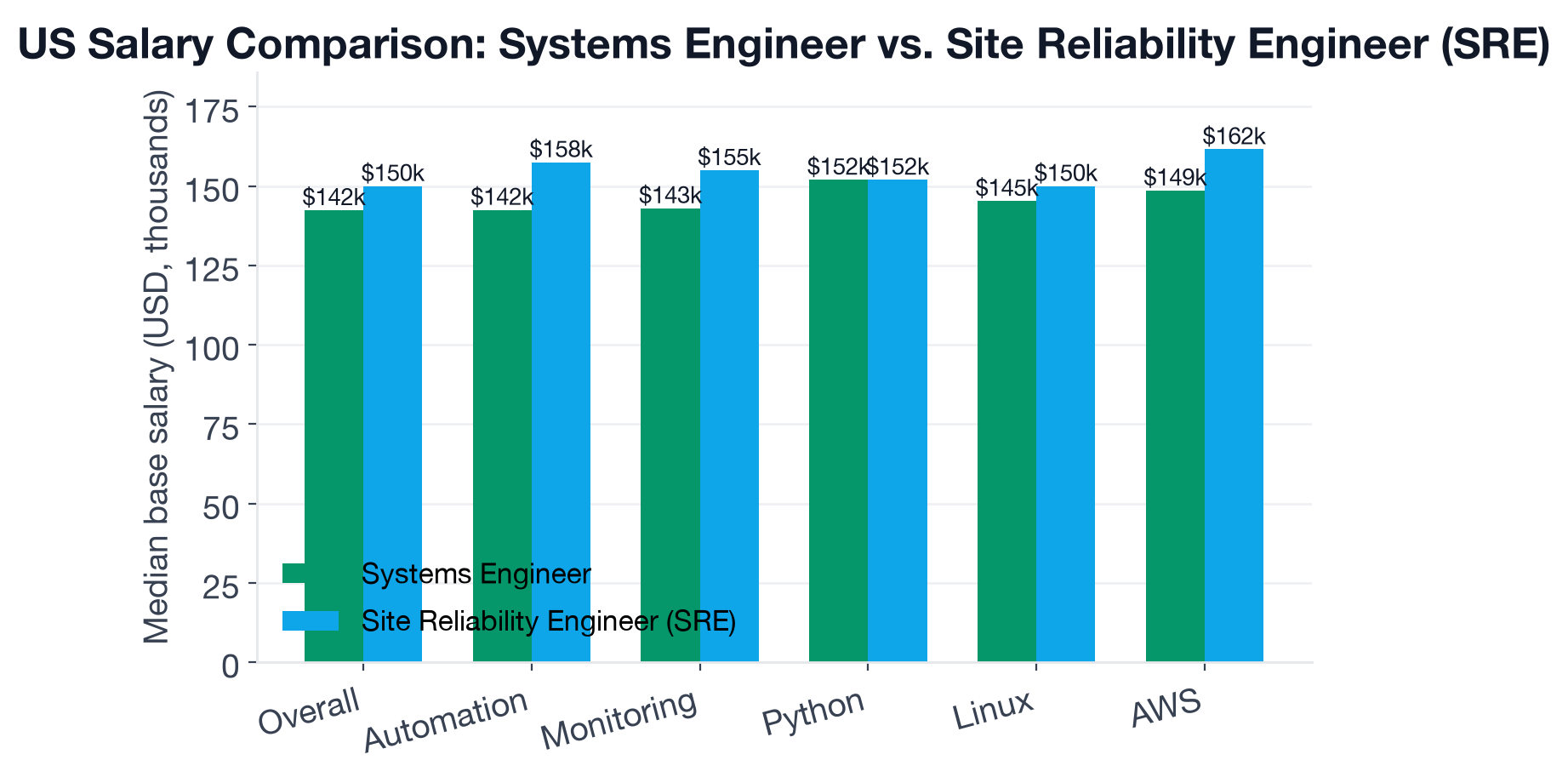 SRE's $150,000 median sits modestly above Systems Engineer's $142,400, but the more telling split is in where each role's premium skills actually sit.
The more interesting split is where the premium lives. Systems Engineer's own defining skills sit below its own baseline: Windows (-$5,000, n=384), PowerShell (-$5,100, n=242), VMware (-$11,600, n=290), and Active Directory (-$20,100, n=182). The real Systems Engineer premiums sit in the exact layer SRE lives in: Distributed Systems (+$35,500, n=110), Observability (+$31,100, n=135), Google Cloud (+$29,100, n=143), and Kubernetes (+$17,600, n=273).
SRE runs the opposite pattern. Its own defining and exclusive skills pay at or above its own baseline, not below it: Site Reliability Engineering itself (+$26,500, n=182), Distributed Systems (+$25,500, n=139), Infrastructure as Code (+$20,600, n=175), and Incident Management (+$18,300, n=128). There's no underpaid legacy layer to route around here; the core SRE stack is itself the premium. That is the clearest financial argument for the intensity gap in the first section: Systems Engineer postings pay extra for occasionally reaching into cloud-native territory, while SRE postings pay for living there full time.
Which Job Is Easier to Land: Systems Engineer or Site Reliability Engineer?
Systems Engineer wins on raw access: 5,567 active postings versus 3,454 for SRE, a 1.61x volume advantage. If you're optimizing for "get hired somewhere soon," that ratio matters more than any skill list.
Entry-level access is thin on both sides, so neither role is a soft landing for a first job. Systems Engineer postings are 2.8% entry-level; SRE postings are 1.6%. SRE also skews more senior overall: 47.3% of SRE postings are senior or staff level versus 36.6% for Systems Engineer, consistent with SRE being the role where the exclusive skill layer (observability, incident response, distributed systems) takes longer to build.
Flexibility and geography diverge more sharply. SRE postings combine for 50.2% remote and hybrid work versus 37.4% for Systems Engineer, whose postings run 66.3% onsite. Geography follows a similar split: Systems Engineer is more US-concentrated (56.0% US) while SRE spreads further, including a notably larger India share (11.9% versus 5.9% for Systems Engineer), consistent with SRE work being easier to run against cloud infrastructure from anywhere.
Match the Role to the Environment You Want
Choose Systems Engineer if you:
- Want to own broad infrastructure, on-prem, virtualization, identity, and networking, not just cloud production
- Already carry a Windows or enterprise-IT background (Active Directory, VMware, PowerShell) rather than cloud-native tooling
- Want more open roles right now (1.61x the postings) and would rather not carry an on-call rotation
Choose SRE if you:
- Want to specialize in keeping a live cloud service up and measurable against defined SLOs
- Are comfortable being on-call and writing automation and infrastructure-as-code to remove manual toil
- Want more remote and hybrid flexibility and a modest pay edge, and are fine with a smaller, more senior-skewed pool
How to Use This in Your Job Search
If you're weighing a move from Systems Engineer toward SRE, the honest starting point is that automation, monitoring, and Python transfer directly, but Windows, VMware, and Active Directory mostly don't. Browse current Site Reliability Engineer openings to see what target postings actually ask for, and use InterviewStack's interactive courses to build the observability and infrastructure-as-code depth (Kubernetes, Terraform, Prometheus) the exclusive skill list shows you'll need. If you're staying on the Systems Engineer side and want to close some of that salary gap, the data points toward the cloud layer: Systems Engineer roles that ask for Terraform price meaningfully above the role's own baseline.
Either direction, drill the specifics with InterviewStack's Question Bank and rehearse the real conversation with AI mock interviews before you apply. Related reading: our deep dives on Systems Engineer skills in 2026 and Site Reliability Engineer skills in 2026 go deeper on each role individually than a head-to-head comparison has room for.
FAQ
Q. Is Site Reliability Engineer just a Systems Engineer job with more automation?
Not quite. The two roles share the same top-line vocabulary (automation, monitoring, Python, Linux, AWS, Kubernetes), but each also carries its own exclusive skill layer: Systems Engineer postings add Windows, VMware, PowerShell, and Active Directory (on-prem enterprise IT), while SRE postings add Observability, Incident Response, Grafana, and Infrastructure as Code (cloud-native production reliability). The overlap, 0.33 Jaccard on each role's top-30 skill list, is real but partial.
Q. How much skill overlap is there between Systems Engineer and Site Reliability Engineer?
The Jaccard overlap on each role's top-30 skill list is 0.33 (33%). Automation, Monitoring, Python, Linux, AWS, Kubernetes, CI/CD, and Terraform are shared, but at very different frequencies: Terraform, for example, shows up in 9.6% of Systems Engineer postings versus 35.1% of SRE postings.
Q. Which role pays more, Systems Engineer or Site Reliability Engineer?
SRE, by $7,600 at the median ($150,000 versus $142,400 US base salary), about a 5% gap. Both figures are base salary only. SRE's salary sample (n=844) is less than half the size of Systems Engineer's (n=2,020), so treat the gap as directional rather than exact.
Q. Which role has more job openings, Systems Engineer or SRE?
Systems Engineer, by a 1.61x margin: 5,567 active postings versus 3,454 for Site Reliability Engineer.
Q. Is it easier to break into Systems Engineering or SRE at the entry level?
Neither is a strong entry path. Systems Engineer postings are 2.8% entry-level; SRE postings are 1.6%. Systems Engineer is somewhat more accessible, but most hiring in both roles targets mid-level and above.
Q. Do I need Kubernetes and Terraform to become a Site Reliability Engineer?
Not universally, but they're close to standard: Kubernetes appears in 39.7% of SRE postings and Terraform in 35.1%, versus 12.7% and 9.6% respectively for Systems Engineer. Neither is a hard requirement in every posting, but both are common enough to treat as expected baseline tooling for the role.
Q. Is remote work more available for SRE or Systems Engineer roles?
SRE. Combined remote and hybrid share is 50.2% for SRE versus 37.4% for Systems Engineer. Systems Engineer postings run 66.3% onsite versus 55.3% for SRE.
One Toolbox, Two Environments
Systems Engineer and SRE pull from nearly the same toolbox: automation, Python, monitoring, Linux, and increasingly Kubernetes and Terraform. What separates them is the environment that toolbox gets pointed at. Systems Engineer deploys it across on-prem and hybrid enterprise infrastructure, often inside defense and large-enterprise IT shops, at a more measured intensity. SRE deploys the same core skills against live cloud production systems, constantly, under SLOs, backed by its own exclusive observability and incident-response layer, and gets paid a modest premium for it. If the environment (on-prem versus cloud production) matters more to you than the specific tool names, that's the real decision this data supports.
Topics
Ready to practice?
Put what you've learned into practice with AI mock interviews and structured preparation guides.