
CySA+ Demand Clusters in the Job That Pays the Least
CompTIA CySA+ (Cybersecurity Analyst+) sits above Security+ in CompTIA's own certification path and is commonly treated as a stepping stone toward more advanced credentials like CISSP. But the postings that actually ask for it don't spread evenly across the security roles it targets. They pile up almost entirely in Information Security Analyst work, the lowest-paying of the five roles in this scope, and all but disappear in Security Architect postings, the highest-paying one.
We looked at every active posting across five security roles on the InterviewStack.io job board over the last 90 days, Information Security Analyst, Cybersecurity Engineer, Penetration Tester, Security Architect, and Digital Forensic Examiner, and screened for CompTIA CySA+ mentions. Every salary figure below is advertised US base pay only (no equity, bonus, or non-US postings), compared against other postings in this same five-role scope, not the whole market.
Key Findings
- CompTIA CySA+ appears in 2.7% of active postings across the five roles in scope (264 of 9,926, last 90 days).
- Information Security Analyst postings mention the cert about five times as often as Security Architect postings do (3.7% vs 0.7% of each role's own postings).
- Security Architect's non-cert baseline pay ($180,100) is about double Information Security Analyst's ($90,000), the two roles at opposite ends of the mention-rate ranking.
- Of the mentions clear enough to classify, 34.9% treat CySA+ as required and 65.1% as preferred (52% of all mentions don't specify either way).
- The aggregate salary comparison looks negative (-11.4%), but at mid-level, where 83% of cert-mentioning postings sit, it flips to +6.0% ($122,275 vs $115,347).
- Cert-mentioning postings skew notably less senior: only 14.8% sit at senior or staff level, versus 32.4% for postings that don't mention the cert.
- CompTIA Security+ co-occurs in 75.4% of CySA+ postings, and CISSP in 43.6%.
- Government and defense contractors account for roughly 85% of the mentions in the top employer roster.
Which Security Roles Actually Ask for CompTIA CySA+?
Averaged across the five roles, CySA+ shows up in 2.7% of postings. That average hides a wide spread, and the spread isn't random: it runs almost perfectly opposite to how each role pays.
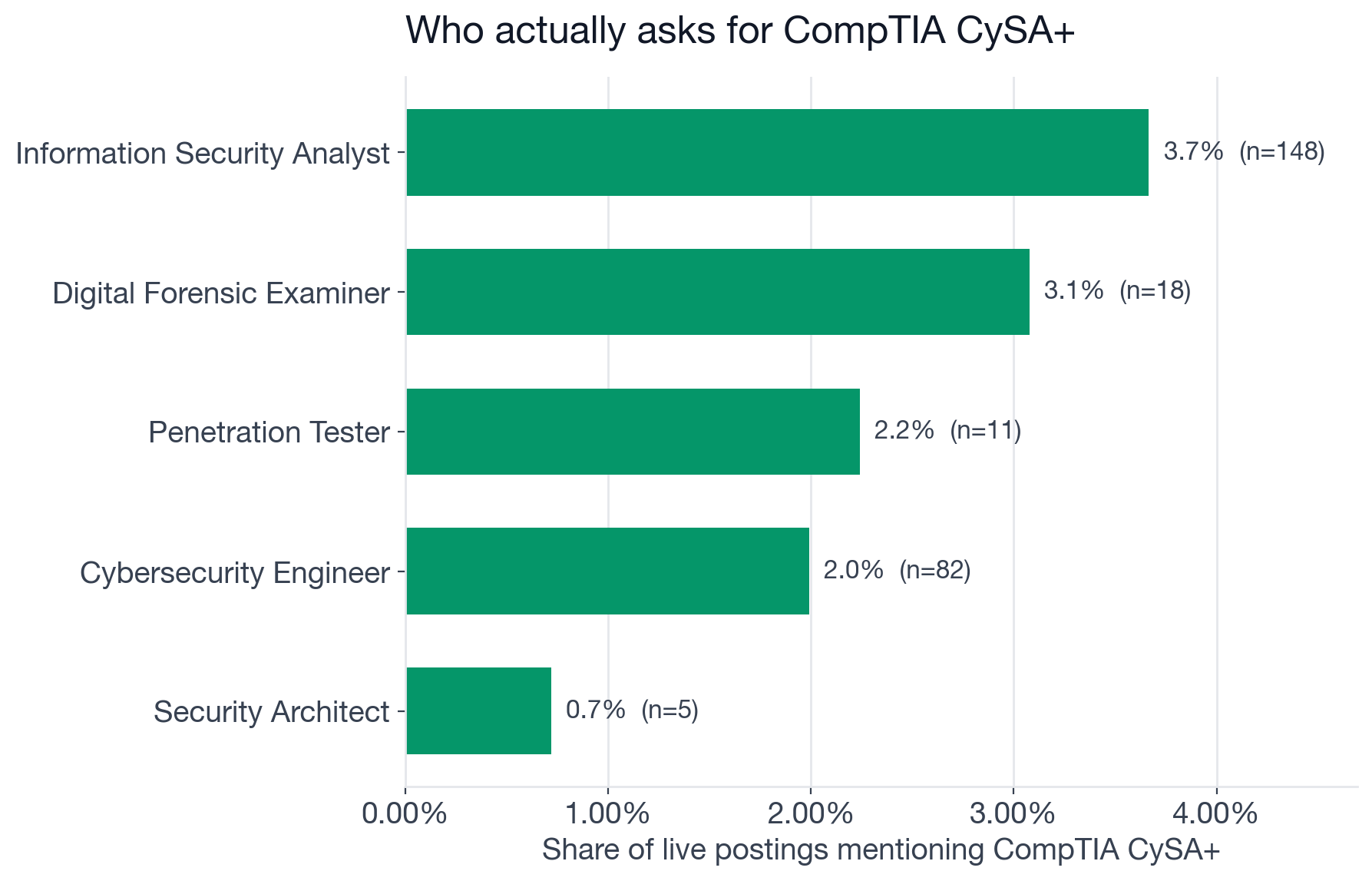 Information Security Analyst and Digital Forensic Examiner postings mention CySA+ well above the five-role average; Security Architect postings almost never do.
| Role | CySA+ mention rate (own postings) | Share of all CySA+ mentions | Baseline pay (postings without the cert) |
|---|---|---|---|
| Information Security Analyst | 3.7% | 56.1% | $90,000 |
| Digital Forensic Examiner | 3.1% | 6.8% | $138,450 |
| Penetration Tester | 2.2% | 4.2% | $143,725 |
| Cybersecurity Engineer | 2.0% | 31.1% | $162,000 |
| Security Architect | 0.7% | 1.9% | $180,100 |
Rank the five roles by baseline pay and the CySA+ mention rate runs in the exact opposite order, every single one. Information Security Analyst is the lowest-paying role in scope and mentions the cert the most; Security Architect is the highest-paying and mentions it the least. Cybersecurity Engineer, the role with the largest posting volume in this scope, sits in between on both counts: above-average pay, below-average mention rate.
That's consistent with what CySA+ actually certifies: continuous security monitoring, log triage, and incident response, the day-to-day work of a SOC or Information Security Analyst seat. It's a working-analyst credential, not an architecture or leadership one, and the postings that ask for it reflect that scope.
Most Postings Treat CySA+ as a Preference, Not a Requirement
Of the 264 postings that mention CySA+, only 126 use wording close enough to the mention to classify it as required or preferred; the other 138 (52%) just name the cert without saying which. Within that classified group, the split leans preferred but isn't lopsided:
- Required: 34.9% of classified mentions (44 of 126)
- Preferred: 65.1% of classified mentions (82 of 126)
Roughly one in three classified mentions is a hard gate, not just a nice-to-have. That's a meaningfully larger required share than "list it and move on" language would suggest, and it lines up with CySA+'s standing as a DoD 8570/8140-recognized baseline certification for Cybersecurity Service Provider roles, where a specific credential can be a compliance checkbox rather than a market preference. Treat the 34.9% figure as a floor: with more than half of all mentions too ambiguous to classify, the real required share across all 264 postings is almost certainly higher than what the classified subset alone shows.
The Pay Comparison Depends Entirely on Seniority Level
Across all seniority levels combined, postings that mention CySA+ advertise a median of $124,038 versus $139,950 for postings in the same role scope that don't, an 11.4% gap in the cert's disfavor. Read on its own, that number says the certification is a pay cut. It isn't the right number to lead with, because it's driven almost entirely by which level the comparison can actually be made at.
| Seniority level | With CySA+ (median) | Without CySA+ (median) | Gap | With-cert sample |
|---|---|---|---|---|
| Entry | Not reportable (n=4) | $94,183 | Not comparable | 4 |
| Mid-level | $122,275 | $115,347 | +6.0% | 113 |
| Senior | Not reportable (n=7) | $165,900 | Not comparable | 7 |
| Staff | Not reportable (n=12) | $175,000 | Not comparable | 12 |
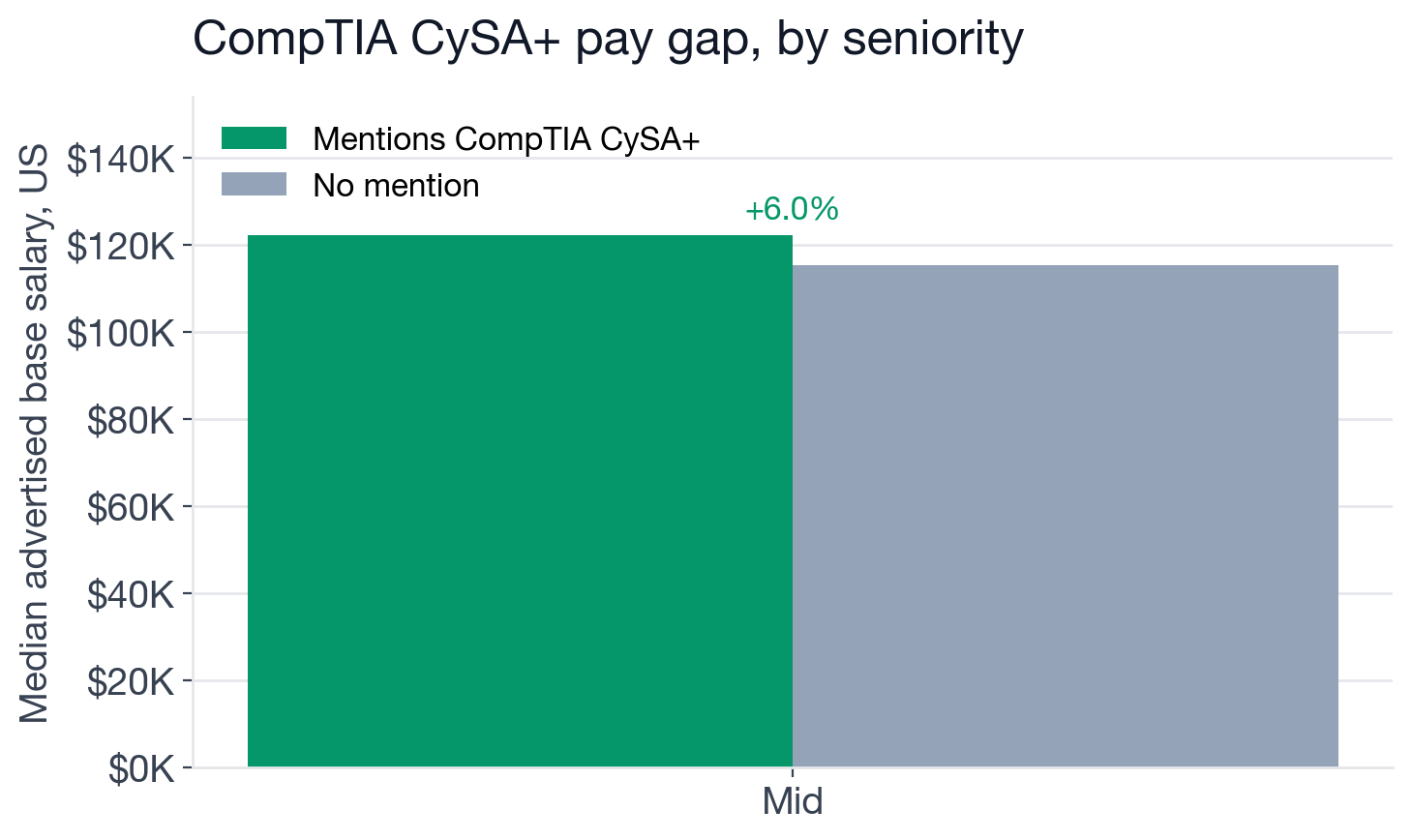 Mid-level is the only band with enough cert-mentioning postings to compare (n=113); every other level's cert-holding sample is too thin to report a median.
Mid-level is where 83% of cert-mentioning postings actually sit, and it's the only band with a large enough with-cert sample (113 postings) to compare fairly. There, CySA+ postings pay 6.0% more than their non-cert counterparts, not less. The negative aggregate number comes from a different effect: cert-mentioning postings are scarce at senior and staff level (19 combined, against a non-cert pool of 662 and 454 respectively), where non-cert pay is already much higher ($165,900 and $175,000). Averaging a thin, mostly-unmeasurable high end against a solid, positive mid-level signal produces a headline that looks worse than the one level we can actually measure.
That thinness is itself a finding: cert-mentioning postings skew notably less senior overall. Only 14.8% of them sit at senior or staff level, versus 32.4% for postings that don't mention the cert. (Seniority here is inferred from title keywords, and a title with no explicit level word defaults to mid-level, which likely inflates the mid-level share somewhat for both groups; the direction of the gap between them is unlikely to be an artifact of that alone, but treat the exact percentages as approximate.) The honest read is that CySA+ tracks with mid-level analyst work, where it correlates with a modest pay edge, and rarely appears in the senior and staff postings where the aggregate baseline is highest. Whatever it "does" to pay, it does it at mid-level or not at all; the aggregate number is a Simpson's paradox artifact, not a market signal on its own.
What Other Certifications and Skills Show Up Alongside CySA+?
CySA+ postings are rarely a single-credential ask. CompTIA Security+ co-occurs in 75.4% of them, effectively a prerequisite in practice even where it isn't stated as one, and a more advanced credential often stacks on top:
| Certification | Share of CySA+ postings |
|---|---|
| CompTIA Security+ | 75.4% |
| CISSP | 43.6% |
| GIAC GCIH | 33.7% |
| CEH | 31.8% |
| SSCP | 26.9% |
| GIAC GSEC | 26.5% |
| CCNA | 25.0% |
On the skills side, the postings read like a SOC job description more than a generalist security one: Monitoring (55.3%), Incident Response (53.8%), and SIEM (47.0%, security information and event management platforms that centralize and correlate log data) lead, followed by Security Operations (37.5%), Risk Management (29.9%), Threat Intelligence (29.5%), and Vulnerability Management (28.8%). That cluster is the day-to-day toolkit of the role CySA+ demand concentrates in: watching alerts, triaging incidents, and closing the loop on vulnerabilities, not designing systems from scratch.
Which Employers Are Actually Asking for This Certification?
The employer roster explains a lot of what's above. Among the top employers by posting count, government and defense contractors dominate the list below: Peraton, Booz Allen Hamilton, AnaVation, Leidos, CACI International, AMERICAN SYSTEMS, General Dynamics Information Technology, Northrop Grumman Corporation, and PGTEK (a Virginia-based federal IT and cybersecurity contractor) together account for roughly 85% of the mentions in this roster.
| Employer | Postings mentioning CySA+ |
|---|---|
| Peraton | 21 |
| Booz Allen Hamilton | 15 |
| AnaVation | 12 |
| Leidos | 11 |
| CACI International | 10 |
| Esri | 10 |
| PricewaterhouseCoopers | 6 |
| AMERICAN SYSTEMS | 6 |
| General Dynamics Information Technology | 6 |
| Northrop Grumman Corporation | 5 |
| PGTEK | 5 |
That concentration tracks with CySA+'s status as a DoD-recognized baseline credential: agencies and their contractors require it for Cybersecurity Service Provider work as a matter of policy, not because the market has bid up a scarce skill. Esri (a GIS and geospatial technology company with substantial federal work) and PricewaterhouseCoopers (consulting) are the closest things to a non-defense presence on this list, and even they sit adjacent to government contracting. If you're studying for CySA+ specifically to break into federal or defense-adjacent security work, this roster is your target list. If you're aiming for commercial security roles instead, treat the certification as a supporting credential rather than the reason you'll get hired.
Putting This Data to Work in Your Job Search
If you're deciding whether to sit for CySA+, the data points to a specific, narrower case for it than "get certified, get hired." It's a strong fit if you're targeting Information Security Analyst or SOC-style work, especially at government contractors, where it's often a stated or unstated requirement and pairs with Security+ almost every time. It's a weaker fit if your target is Security Architect or a similar senior design role, where it shows up in under 1% of postings and the certification alone won't carry the application.
Once you know which postings actually ask for it, practice the monitoring and incident-response scenarios these roles interview on with a mock interview that adapts to your answers. The question bank has focused drills on SIEM triage, incident response, and vulnerability management, the exact skill cluster that shows up alongside CySA+ in these postings, and our interactive courses cover the underlying security fundamentals if you're building toward the exam rather than reviewing for an interview. When you're ready to see what's actually open, browse current postings across all five roles or filter down to Information Security Analyst specifically, where CySA+ demand actually lives.
FAQ
Q. How common is CompTIA CySA+ in cybersecurity job postings?
CompTIA CySA+ appears in 2.7% of active postings across the five security roles it maps to (264 of 9,926 postings analyzed over the last 90 days on the InterviewStack.io job board): Information Security Analyst, Cybersecurity Engineer, Penetration Tester, Security Architect, and Digital Forensic Examiner.
Q. Which role is most likely to ask for CompTIA CySA+?
Information Security Analyst. It mentions the cert in 3.7% of its own postings, about five times as often as Security Architect (0.7%), and it accounts for 56% of every CySA+ mention in this scope despite being 41% of the postings.
Q. Is CompTIA CySA+ usually required or just preferred?
Of the mentions clear enough to classify, 34.9% treat it as required and 65.1% as preferred. More than half of all mentions (52%) don't specify either way, so treat the required share as a floor, not a hard rule.
Q. Does CompTIA CySA+ come with a salary premium?
It depends entirely on level. At mid-level, where 83% of cert-mentioning postings sit, postings that mention CySA+ advertise a median $122,275 versus $115,347 for postings that don't, a 6.0% edge. The aggregate across all levels looks worse (-11.4%), but that number is misleading: cert-mentioning postings are too thin at senior and staff levels, where non-cert pay is much higher, to compare fairly.
Q. Why does the overall CySA+ salary comparison look negative if mid-level pays more?
Because CySA+ postings cluster heavily in mid-level and rarely reach senior or staff level (only 14.8% do, versus 32.4% for non-cert postings), the aggregate median gets pulled down by comparison against a non-cert pool that includes many more high-paying senior and staff postings. It's a seniority-mix effect, not evidence the certification itself reduces pay.
Q. What other certifications show up alongside CompTIA CySA+?
CompTIA Security+ co-occurs in 75.4% of CySA+ postings, CISSP in 43.6%, GIAC GCIH in 33.7%, and CEH in 31.8%. Most CySA+ postings expect a foundational cert plus at least one more advanced credential.
Q. Who is hiring for roles that ask for CompTIA CySA+?
The top employers by posting count are federal and defense contractors: Peraton, Booz Allen Hamilton, AnaVation, Leidos, CACI International, and PGTEK, together with GIS/geospatial technology company Esri and IT consulting firm PricewaterhouseCoopers. Government-adjacent contractors account for roughly 85% of the mentions in the top employer roster.
Deciding Whether CySA+ Belongs on Your Study List
CySA+ isn't a universal credential across security work; it's a targeted one. It clusters in Information Security Analyst and SOC-style postings, correlates with a modest pay edge specifically at mid-level, and shows up on employer rosters dominated by government and defense contractors who often require it by policy. If that's the work and the employer type you're aiming at, the data supports studying for it. If you're aiming higher up the ladder toward architecture or leadership, this certification is a stepping stone at best, and the postings you actually want will barely mention it.
Topics
Ready to practice?
Put what you've learned into practice with AI mock interviews and structured preparation guides.