
One Role Accounts for Nearly Half of CompTIA Network+ Demand
CompTIA Network+, a foundational certification covering routing, switching, subnetting, and network troubleshooting, is not demanded evenly across the infrastructure roles that touch networking. Employers hiring Network Engineers name it 6.6 times as often as employers hiring Cloud Engineers do, and Network Engineer postings alone account for nearly half of every mention across the four roles this analysis covers. We looked at active Network Engineer, Systems Administrator, Systems Engineer, and Cloud Engineer postings on the InterviewStack.io job board over a 90-day window, 11,332 postings in total, with 349 mentioning the certification by name.
That concentration matters more than the overall rate. CompTIA Network+ shows up in just 3.08% of postings across the full scope, but treating that as a flat number hides where the demand actually lives. It also rarely gates a candidate out: of the mentions clear enough to classify, 83.6% call it preferred rather than required. And postings that mention it skew toward mid-level work and pay less, though not for the reason you might assume.
Key Findings
- CompTIA Network+ appears in just 3.08% of active postings across four IT infrastructure roles (349 of 11,332), roughly 1 in 32.
- Network Engineer postings mention it 6.24% of the time, 6.6 times as often as Cloud Engineer postings (0.94%), and account for 45.8% of every mention despite being just 22.6% of postings in scope.
- Of the 195 mentions clear enough to classify, 83.6% call it preferred and only 16.4% require it outright.
- Postings mentioning the cert advertise a median US base salary of $108,000 versus $132,200 for postings that don't, an 18.3% gap.
- The only seniority band with enough with-cert data to check, mid-level (n=112), still shows a 16.5% gap, so seniority mix explains only a small part of the aggregate difference.
- Cert-mentioning postings skew heavily toward mid-level (80.5% vs 63.8%) and are underrepresented at senior (11.7% vs 23.4%) and staff (4.0% vs 10.1%).
- Federal and defense contractors account for close to two-thirds of the top employers, but Amazon is the single largest non-government employer (33 mentions).
- CCNA co-occurs with CompTIA Network+ in 50.7% of its postings, more than any other certification.
Network Engineer Postings Carry This Certification, Not the Rest of the Stack
Demand doesn't track posting volume. Systems Engineer is the largest role in this scope by postings, yet it contributes the second-fewest mentions.
| Role | Active postings | Mention the cert | Share |
|---|---|---|---|
| Network Engineer | 2,563 | 160 | 6.24% |
| Systems Administrator | 2,745 | 101 | 3.68% |
| Systems Engineer | 3,582 | 65 | 1.81% |
| Cloud Engineer | 2,442 | 23 | 0.94% |
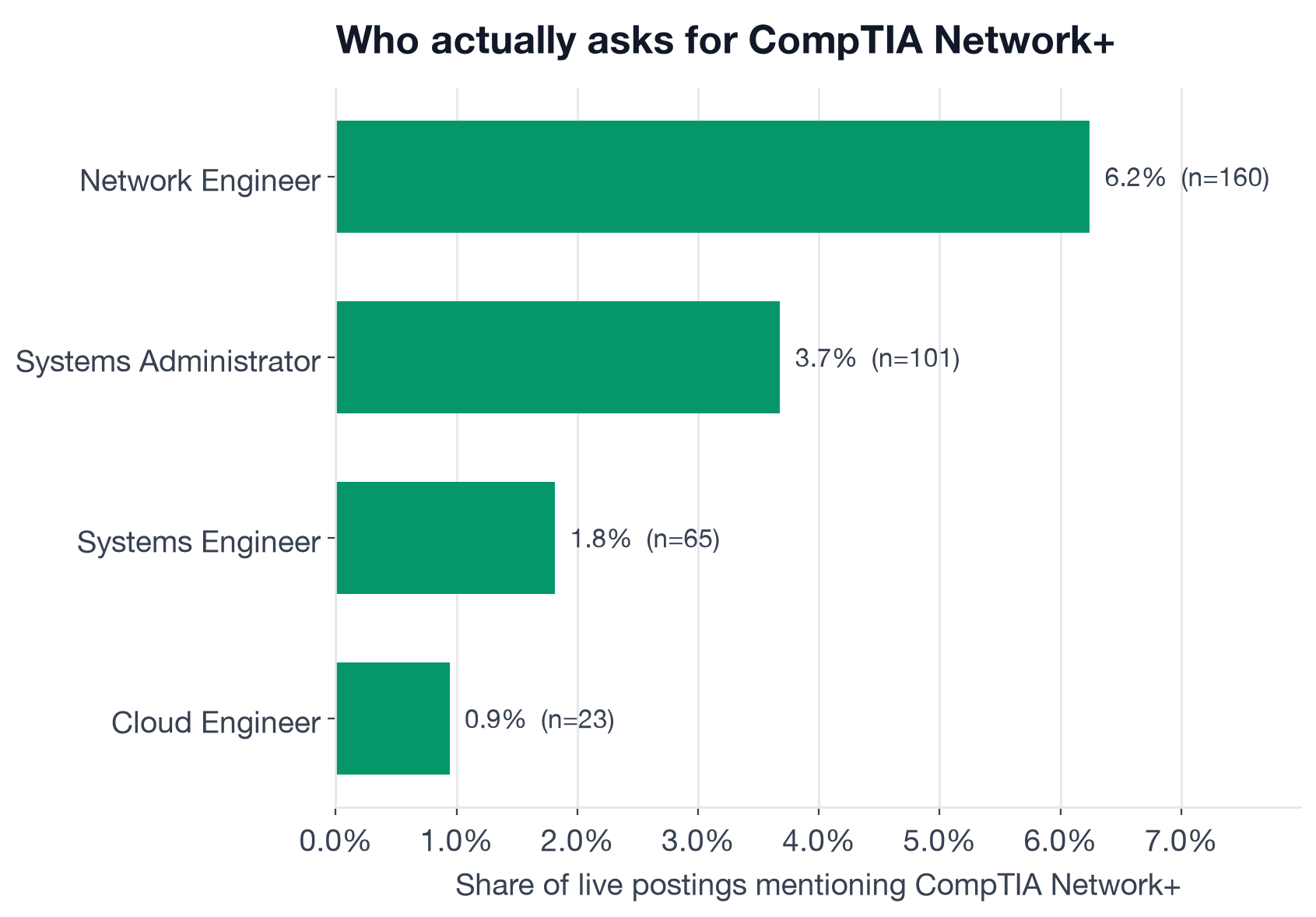 Network Engineer postings name the certification about 70% more often than the next closest role, Systems Administrator, and 6.6 times as often as Cloud Engineer.
Network Engineer makes up 22.6% of postings in this scope but 45.8% of every mention, roughly double its expected share. Systems Administrator runs slightly ahead of its share too (24.2% of postings, 28.9% of mentions). Systems Engineer and Cloud Engineer both run the other way: Systems Engineer is 31.6% of postings but only 18.6% of mentions, and Cloud Engineer, 21.6% of postings, contributes just 6.6% of mentions, less than a third of its expected share.
That split lines up with pay, though not in the direction a "cheap cert for cheap jobs" story would predict on its own. Network Engineer and Systems Administrator, the two roles that over-index on mentions, are also the two lower-paying roles in this scope (non-cert medians of $131,150 and $112,000). Systems Engineer and Cloud Engineer, the two roles that under-index, are the two higher-paying roles ($142,400 and $150,000). The certification clusters where the day-to-day work is closest to physical and logical network operations, which also happens to be where advertised pay in this scope runs lower.
Is CompTIA Network+ Actually Required, or Just Preferred?
Of the 349 total mentions, 195 (55.9%) use language clear enough to classify as required or preferred; the remaining 154 (44.1%) use open-ended phrasing, certification lists, or "or equivalent" clauses that don't resolve either way. Within that classified set, required is rare: 32 postings (16.4%) require the certification outright, and 163 (83.6%) list it as preferred, a ratio of roughly 5 to 1.
Zoomed out to every mention in the dataset, not holding the certification disqualifies a candidate outright in only about 9% of postings that name it at all (32 of 349). For the large majority, it functions as a resume signal an employer is glad to see rather than a line a candidate has to clear, consistent with its position as a foundational credential rather than a specialized gate.
The Salary Gap Barely Shrinks Once You Control for Level
All salary figures here are advertised US base pay only, on the subset of postings that disclose it. Equity, bonus, and other compensation aren't part of job-posting data, so total compensation typically runs higher than what's reported here. The comparison baseline throughout is other postings in the same four-role scope that don't mention the certification, not the broader job market.
Postings that mention CompTIA Network+ show a median US base salary of $108,000 (n=139) against $132,200 for postings that don't (n=3,932), an 18.3% gap. Read on its own, that number would suggest the certification correlates with meaningfully lower pay across the board. Part of that is a seniority story: cert-mentioning postings skew less senior overall (mean level 1.16 versus 1.41 on our internal scale), clustering at 80.5% mid-level versus 63.8% for non-mentioning postings, and thinning out sharply at senior (11.7% versus 23.4%) and staff (4.0% versus 10.1%). One caveat on those mix numbers: seniority here is inferred from title keywords, and a posting with no explicit level word, a bare "Network Engineer" or "Systems Administrator," the most common titles in this dataset, defaults to mid-level. That compresses the measured spread on both sides, so the true entry and senior shares in both groups are likely somewhat larger than shown.
| Level | With the cert (median) | Without the cert (median) | Gap |
|---|---|---|---|
| Entry | Not reportable (n=4) | $84,550 (n=72) | n/a |
| Mid-level | $104,207 (n=112) | $124,800 (n=2,502) | -16.5% |
| Senior | Not reportable (n=15) | $146,825 (n=864) | n/a |
| Staff | Not reportable (n=8) | $162,000 (n=494) | n/a |
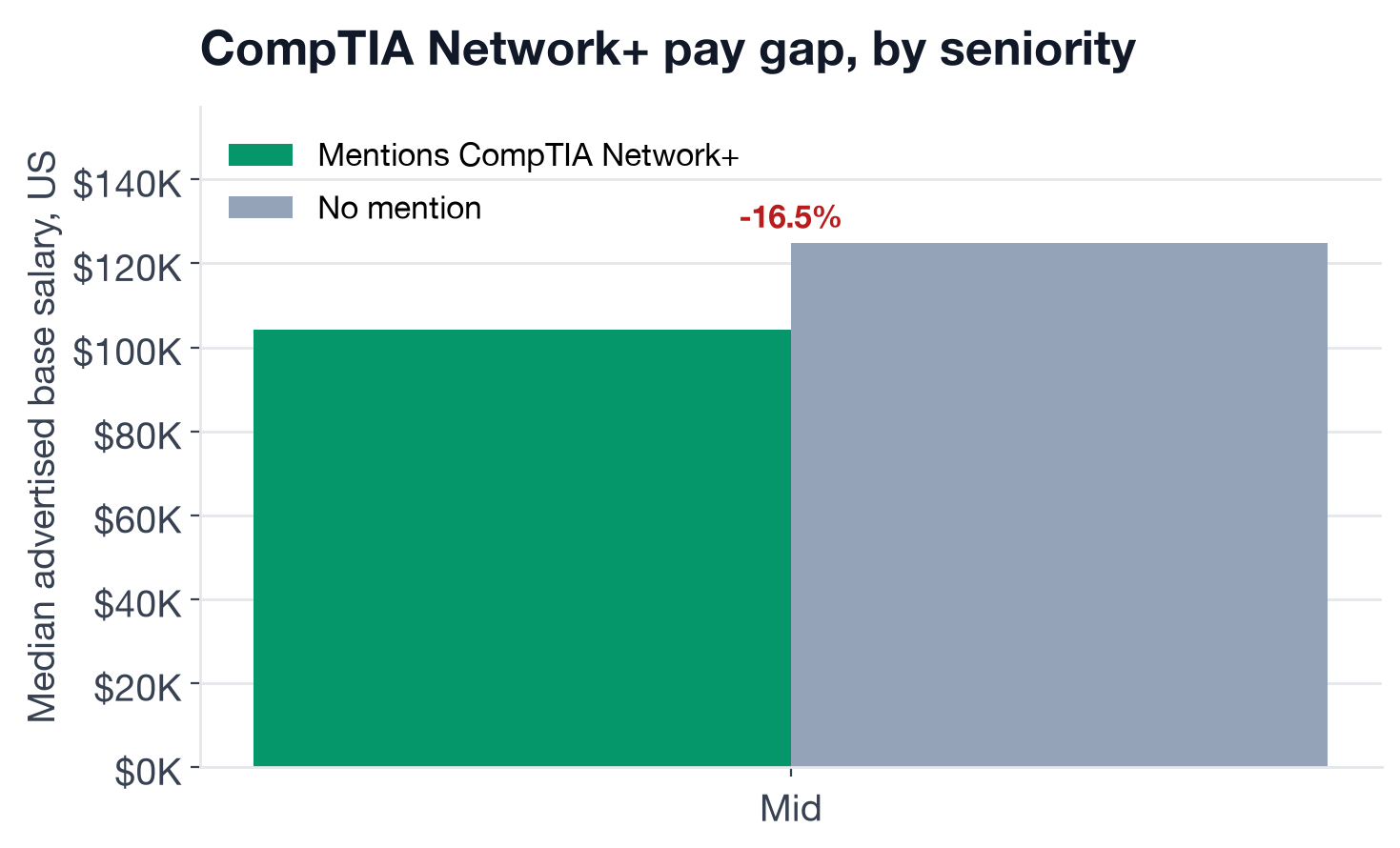 Mid-level is the only band with enough with-cert salary data to report, and the gap there, -16.5%, is nearly as large as the raw aggregate.
Mid-level is the only band with enough with-cert salary data to report on its own; entry, senior, and staff samples (n=4, 15, and 8) are all too thin to break out. At mid-level, the gap narrows only slightly, from -18.3% aggregate to -16.5% within the band. That's the key number here: if seniority mix were doing most of the work, the within-band gap would shrink much further than 1.8 percentage points. Most of the difference holds even after controlling for level, which points back to the role-mix story above, Network Engineer and Systems Administrator, the two lower-paying roles in this scope, are also where the certification concentrates.
The Employer Roster Behind CompTIA Network+ Demand
Among employers with enough mentions to rank, federal and defense contractors make up close to two-thirds of the top roster, but not all of it.
| Employer | Postings mentioning the cert |
|---|---|
| CACI International | 35 |
| Amazon | 33 |
| Peraton | 18 |
| Dynamic Solutions Technology LLC | 12 |
| Thrive | 8 |
| Leidos | 8 |
| Booz Allen Hamilton | 7 |
| Freeport-McMoRan | 7 |
| General Dynamics Information Technology | 6 |
| Apogee Engineering, LLC | 6 |
| Ntt Limited | 4 |
| SOSi | 4 |
Eight of these twelve, CACI International, Peraton, Dynamic Solutions Technology LLC, Leidos, Booz Allen Hamilton, General Dynamics Information Technology, Apogee Engineering, and SOSi, are federal or defense contractors (Dynamic Solutions Technology is a smaller, veteran-owned IT services firm serving the same federal and DoD client base as the larger primes on this list), together accounting for roughly 65% of the mentions among this group. That tracks with the pattern seen across other IT infrastructure and security certifications on this board: government network-operations contracts tend to name specific certifications as part of the statement of work, which also helps explain why the certification shows up more as "preferred" boilerplate than a hard screen.
But this roster isn't purely a government story. Amazon is the single largest non-government employer here, ranking second overall with 33 mentions, more than every contractor except CACI. Freeport-McMoRan (mining) and Ntt Limited (global IT and telecom) operate large-scale network infrastructure of their own and hire for it directly; Thrive, a managed service provider, hires for the same skills to run infrastructure on behalf of its clients. Read together, the roster says CompTIA Network+ demand comes from whoever operates real network infrastructure, government and commercial alike, more than from any single industry.
What Other Skills and Certifications Come Bundled With Network+?
CompTIA Network+ rarely stands alone. CCNA, a Cisco-specific routing and switching certification one tier up from Network+, appears in 50.7% of postings that mention Network+, more than any other certification. CompTIA Security+ (37.5%) and CompTIA A+ (22.6%), Network+'s siblings in CompTIA's core certification track, both show up frequently too, and CCNP (20.6%), a more advanced Cisco credential, appears in roughly 1 in 5.
| Certification | Co-occurs with the cert |
|---|---|
| CCNA | 50.7% |
| CompTIA Security+ | 37.5% |
| CompTIA A+ | 22.6% |
| CCNP | 20.6% |
| Juniper JNCIA | 8.6% |
| CISSP | 4.9% |
On the skills side, these postings lean toward hands-on network and systems operations rather than software development. Monitoring (41.3%), Firewalls (39.5%), DNS (32.1%), and DHCP (26.6%) are the most common accompanying skills, alongside Windows (32.4%) and Active Directory (24.6%), a signature combination of network fundamentals plus Windows systems administration. Cloud skills show up too, AWS (24.1%) and Azure (21.2%), but well behind the core networking and Windows cluster, consistent with a certification whose home is still on-premises infrastructure rather than cloud platforms.
Deciding Where CompTIA Network+ Fits in Your Study Plan
If you're targeting Network Engineer roles specifically, this is the one lane where the certification shows up often enough to be worth having on a resume, even though it's still a "preferred," not a "required," line in the large majority of postings. If you're targeting Systems Engineer or Cloud Engineer roles, the certification itself barely registers; the underlying skills it teaches, subnetting, DNS, DHCP, firewalls, still matter, but employers in those roles aren't asking for Network+ by name.
The co-occurrence data above is also a study-order signal: CCNA shows up alongside Network+ far more than any other credential, which matches how most networking career paths are actually built, Network+ as the foundation, CCNA as the next step once you're targeting Cisco-heavy environments specifically. Drill the underlying topics, subnetting, routing fundamentals, firewall rules, with InterviewStack's Question Bank, or build a broader systems and networking foundation through InterviewStack's interactive courses if you're earlier in the path. Once you have a specific role targeted, run a mock interview against it to see where your real gaps sit against what these postings actually ask for.
To see current openings, browse active postings across all four roles in this scope.
FAQ
Q. How often do employers ask for CompTIA Network+ by name?
It appears in 3.08% of postings across Network Engineer, Systems Administrator, Systems Engineer, and Cloud Engineer roles (349 of 11,332 active postings analyzed over a 90-day window on the InterviewStack.io job board), roughly 1 in 32 postings.
Q. Which role is most likely to ask for CompTIA Network+?
Network Engineer, by a wide margin. It appears in 6.24% of Network Engineer postings (160 of 2,563), compared with 3.68% for Systems Administrator, 1.81% for Systems Engineer, and just 0.94% for Cloud Engineer, a 6.6x gap between the highest and lowest role.
Q. Is CompTIA Network+ usually required or just preferred?
Preferred, overwhelmingly. Of the 195 mentions clear enough to classify, 83.6% (163) list it as preferred and only 16.4% (32) require it outright. A further 154 mentions use language that doesn't specify either way.
Q. Do postings that mention CompTIA Network+ pay more?
No. Postings mentioning it advertise a median US base salary of $108,000 versus $132,200 for postings in the same four roles that don't mention it, an 18.3% gap. At mid-level, the only seniority band with enough with-cert salary data to report (n=112), the gap is still 16.5% ($104,207 versus $124,800).
Q. Does seniority explain the salary gap?
Only partly. Postings mentioning CompTIA Network+ skew notably less senior (mean level 1.16 versus 1.41 on our internal scale) and cluster heavily at mid-level (80.5% versus 63.8% for non-mentioning postings). Seniority is inferred from title keywords, though, and titles with no explicit level word default to mid-level, so the true entry and senior shares in both groups are likely somewhat larger than shown. Still, the within-band gap at mid-level, 16.5%, is close to the overall 18.3% gap, so seniority mix explains only a small slice of the difference.
Q. Who's actually hiring for CompTIA Network+?
Federal and defense contractors make up close to two-thirds of the top employers. CACI International, Peraton, Dynamic Solutions Technology LLC, Leidos, Booz Allen Hamilton, General Dynamics Information Technology, Apogee Engineering, and SOSi together account for roughly 65% of the mentions among the top 12 employers. Amazon is the single largest non-government employer, ranking second overall with 33 mentions.
Q. What else do these postings ask for?
CCNA is the most common co-occurring certification, appearing in 50.7% of CompTIA Network+ postings, followed by CompTIA Security+ (37.5%) and CompTIA A+ (22.6%). On the skills side, Monitoring (41.3%), Firewalls (39.5%), and Windows (32.4%) are the most common accompanying skills.
Where CompTIA Network+ Actually Earns Its Keep
CompTIA Network+ isn't a broad IT infrastructure credential in practice, whatever its marketing suggests. It's a Network Engineer credential first, mostly optional even there, and largely absent once a posting is looking for someone senior. The salary comparison isn't a verdict on the certificate's worth: it mostly reflects which roles and which employers ask for it, government network-operations contractors and hands-on infrastructure teams more than cloud or platform-engineering shops. For candidates on the Network Engineer path, it's still a reasonable early credential to hold, and the data says the natural next step, if you're heading toward Cisco-heavy environments, is CCNA.
Topics
Ready to practice?
Put what you've learned into practice with AI mock interviews and structured preparation guides.