
CompTIA A+ Has Nearly Disappeared From These Job Postings
CompTIA A+ is marketed as the credential that starts an IT career, the first rung before Network+, Security+, or anything more specialized. The postings tell a quieter story once a candidate is past the entry-level help desk work A+ is built to certify. Across four roles that sit just above that tier, Systems Administrator, Systems Engineer, Network Engineer, and Cloud Engineer, only 113 of 11,585 active postings name CompTIA A+ at all, 0.98%. And when employers do name it, they overwhelmingly treat it as a nice-to-have rather than a gate: of the mentions clear enough to classify, 88.2% list it as preferred, not required.
We looked at active postings across those four roles on the InterviewStack.io job board over the last 90 days, 11,585 postings in total, and flagged every one that mentions CompTIA A+ by name. What follows is where it still shows up, why the salary comparison is more about composition than causation, and who's actually hiring for it.
Key Findings
- CompTIA A+ appears in just 0.98% of postings across four IT infrastructure roles (113 of 11,585 analyzed over 90 days).
- Of the 76 mentions clear enough to classify, only 11.8% (9 postings) require A+ outright; 88.2% (67 postings) list it as preferred.
- Systems Administrator has the highest mention rate at 2.16% (61 of 2,818 postings), nearly 4 times Cloud Engineer's 0.56% (14 of 2,500).
- A+ postings skew heavily toward mid-level roles (81.4%) and away from senior and staff work (8.8% combined), versus 33.0% senior-or-staff for non-A+ postings.
- At mid-level, the only band with enough salary data to report, A+ postings show a median US base salary of $77,500 versus $124,500 for non-A+ postings.
- CompTIA Network+ co-occurs in 69.9% of A+ postings, CompTIA Security+ in 34.5%, and CCNA in 20.4%.
- Windows (56.6%), Technical Support (47.8%), and Customer Service (45.1%) are the most common skills alongside A+, a help-desk profile more than a specialist one.
How Often Do Employers Actually Name CompTIA A+?
Systems Administrator is the closest fit in this scope to the desktop-support and hardware-troubleshooting work A+ certifies, and it shows the highest mention rate by a wide margin.
| Role | Active postings | Mention CompTIA A+ | Share |
|---|---|---|---|
| Systems Administrator | 2,818 | 61 | 2.16% |
| Systems Engineer | 3,658 | 23 | 0.63% |
| Network Engineer | 2,609 | 15 | 0.57% |
| Cloud Engineer | 2,500 | 14 | 0.56% |
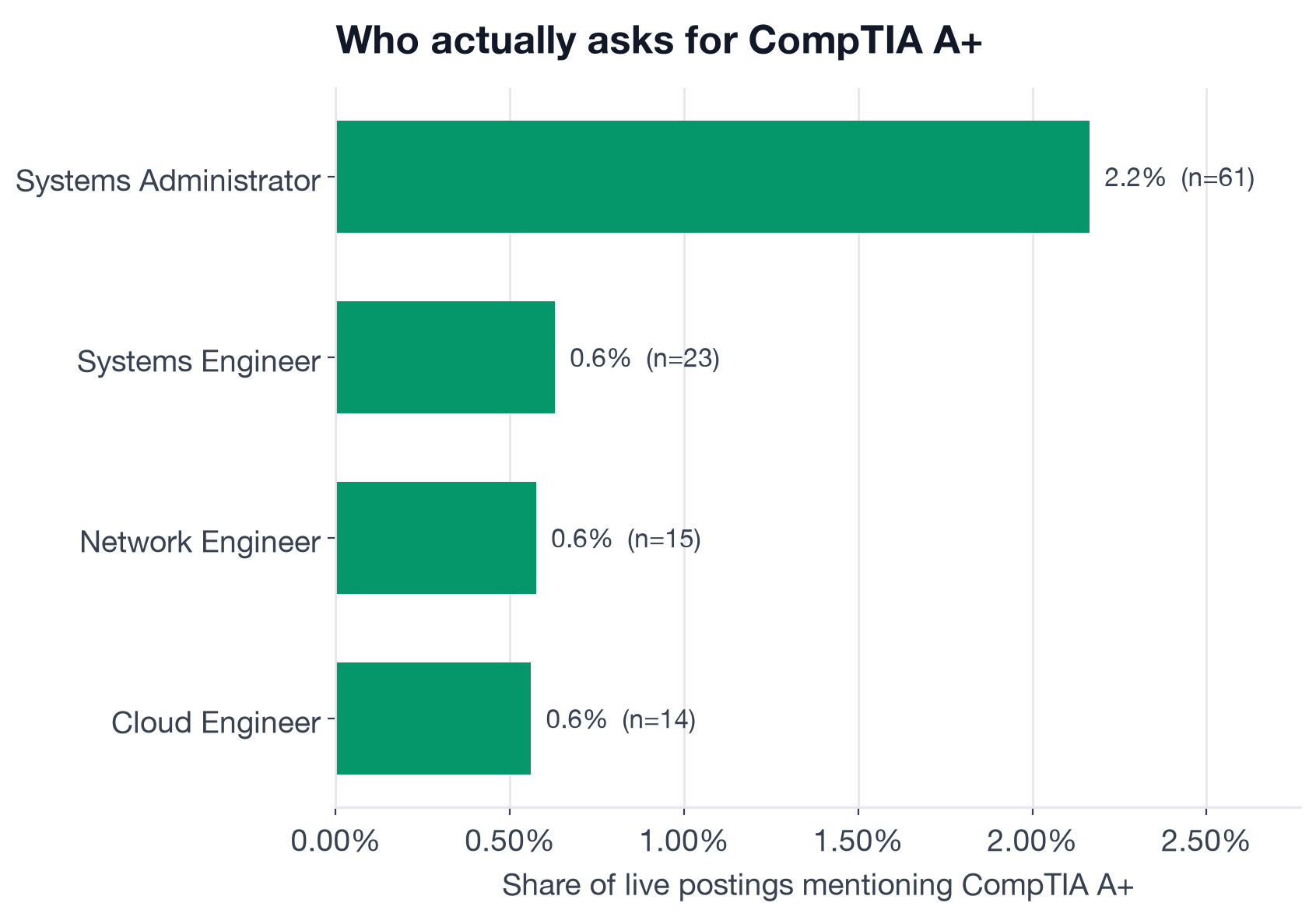 Even Systems Administrator, the role most likely to name CompTIA A+, mentions it in roughly 1 out of every 46 postings.
That 2.16% is nearly 4 times Cloud Engineer's 0.56%, the lowest of the four, and Systems Administrator alone accounts for over half of every A+ mention in this dataset. But it's still a low bar: even in the role most likely to cite it, 46 out of every 47 Systems Administrator postings don't mention CompTIA A+ at all. Systems Engineer, Network Engineer, and Cloud Engineer cluster close together just above half a percent, with no meaningful gap between them.
Required, or Just Nice to Have?
Of the 113 total mentions, 76 are worded clearly enough to classify as required or preferred; the remaining 37 use open-ended phrasing (certification lists, "or equivalent" language) that doesn't resolve either way and isn't counted in the ratio below. Within that classified set, required is rare: 9 postings (11.8%) require CompTIA A+ outright, and 67 (88.2%) list it as preferred.
In practice, not holding A+ disqualifies a candidate outright in only about 1 in 8 of the postings clear enough to classify, and in roughly 1 in 13 of every A+ mention in the entire dataset (9 of 113). A+ functions overwhelmingly as a signal employers are glad to see, not a gate that screens candidates out.
The Salary Gap Is a Seniority Story, and a Role-Mix Story
All salary figures here are advertised US base pay only, on the subset of postings that disclose it. Equity, bonus, and other compensation aren't part of job-posting data, so total compensation for any given role typically runs higher than what's reported here. The comparison baseline throughout is other postings in the same four-role scope that don't mention CompTIA A+, not the broader job market.
Postings that mention CompTIA A+ show a median US base salary of $77,500, against $131,150 for postings that don't mention it in the same four roles, a 40.9% gap. Read on its own, that number looks like a real deficit tied to the certification. It isn't, or at least not entirely: A+ postings and non-A+ postings are pulling from meaningfully different pools before pay ever enters the picture.
The first difference is seniority. A+-mentioning postings skew younger: 81.4% are mid-level and only 8.8% are senior or staff combined, against 64.3% mid-level and 33.0% senior-or-staff for non-A+ postings. Averaged across levels, A+ postings land at a mean seniority score of 1.00, almost exactly mid-level, versus 1.40 for non-A+ postings. One methodology note: seniority here is inferred from title keywords, and a posting with no explicit level cue (several titles in this dataset, like plain "IT Specialist" or "Associate IT Specialist," carry none) defaults to mid-level. That likely overstates the true mid-level share for both groups to some degree, so treat the 81.4%-vs-64.3% split as directionally right rather than exact.
| Level | With A+ (median) | Without A+ (median) | Gap |
|---|---|---|---|
| Entry | Not reportable (n=4) | $86,600 | n/a |
| Mid-level | $77,500 | $124,500 | -37.8% |
| Senior | Not reportable (n=2) | $145,500 | n/a |
| Staff | Not reportable (n=0) | $161,800 | n/a |
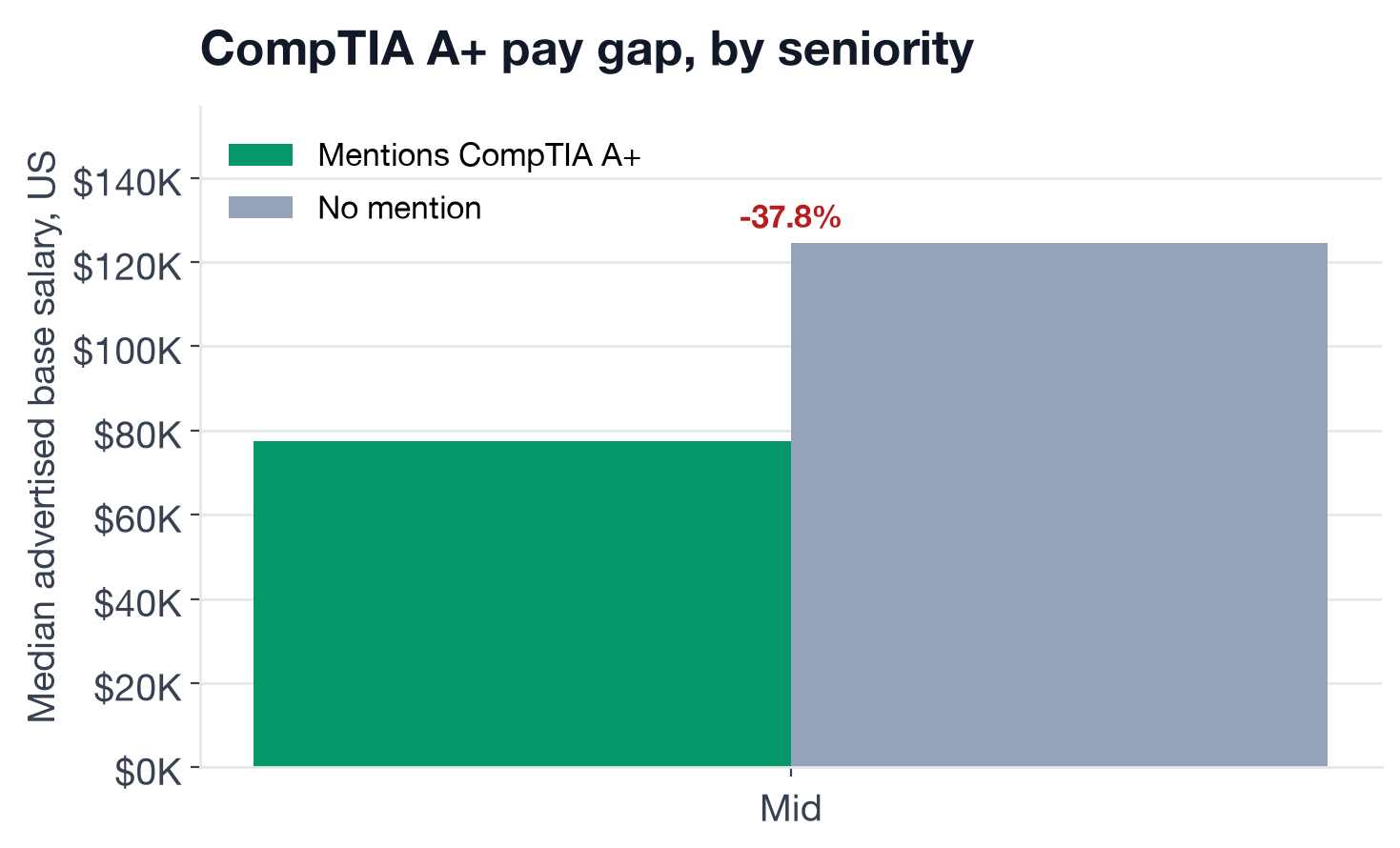 Mid-level is the only band with enough A+ salary data to report, and the gap there, -37.8%, is nearly as wide as the raw aggregate.
Controlling for level barely moves the number: the mid-level-only gap (-37.8%) is almost as large as the uncontrolled aggregate (-40.9%). Entry, senior, and staff A+ postings are all too thin to report on their own, so seniority mix is real, but it isn't the whole explanation.
The second, less obvious factor is which role the mention shows up in. Systems Administrator, the lowest-paying of the four roles by a wide margin ($112,000 median for non-A+ postings, against $130,770 for Network Engineer, $142,400 for Systems Engineer, and $150,000 for Cloud Engineer), accounts for 54.0% of every A+ mention in this dataset but only 24.0% of the non-mentioning pool. Cloud Engineer, the highest-paying of the four, runs the opposite way: 12.4% of A+ mentions against 21.7% of non-mentioning postings. A+ postings aren't just skewed toward junior work, they're skewed toward the specific role in this scope that pays the least regardless of certification.
Both patterns point the same direction: postings that name CompTIA A+ describe less senior, lower-band work than postings that don't, in the same four roles. That's a real difference in what kind of job is being advertised, not evidence that the certificate itself lowers pay.
What Comes Bundled With CompTIA A+?
Employers who name CompTIA A+ almost never stop there. CompTIA Network+ appears in 69.9% of A+-mentioning postings, by far the most common pairing, with CompTIA Security+ (34.5%) and CCNA (20.4%) rounding out the top three. MCSE (4.4%), SSCP (3.5%), and CCNP (3.5%) show up less often but still recur.
| Certification | Co-occurs with CompTIA A+ |
|---|---|
| CompTIA Network+ | 69.9% |
| CompTIA Security+ | 34.5% |
| CCNA | 20.4% |
| MCSE | 4.4% |
| SSCP | 3.5% |
| CCNP | 3.5% |
The skill list underneath these postings reads like a help-desk and desktop-support job description more than a specialist one. Windows (56.6%) and Active Directory (43.4%) anchor the Microsoft-shop fundamentals, while Technical Support (47.8%) and Customer Service (45.1%) show up almost as often as any purely technical skill, evidence that A+ postings are frequently support-facing roles first and infrastructure roles second. DNS (28.3%), Monitoring (27.4%), Ticketing Systems (24.8%), and Firewalls (23.9%) round out the core stack, with Linux (22.1%) and Azure (21.2%) showing that even entry-adjacent postings expect some exposure beyond a pure Windows environment.
Who's Actually Hiring for It?
Unlike CompTIA Security+ and CCNA, where the employer roster is dominated almost entirely by federal and defense contractors, CompTIA A+'s top employers span a wider mix of industries. Government contractors are still present, CACI International, Leidos, General Dynamics Information Technology, and Government Technical Services Corporation collectively account for a meaningful share of mentions, but they sit alongside managed-IT-services firms (Thrive, Intelligent Technical Solutions, DXC Technology) and direct employers running their own internal IT departments in mining (Freeport-McMoRan), aerospace (Cesium Astro), and healthcare (Harmony United Psychiatric Care).
| Employer | Postings mentioning CompTIA A+ |
|---|---|
| Thrive | 7 |
| Freeport-McMoRan | 7 |
| Cesium Astro | 5 |
| CACI International | 5 |
| Dynamic Solutions Technology LLC | 4 |
| Leidos | 4 |
| Harmony United Psychiatric Care | 3 |
| General Dynamics Information Technology | 3 |
| Peraton | 3 |
| Intelligent Technical Solutions | 2 |
| DXC Technology | 2 |
| Government Technical Services Corporation | 2 |
That spread tracks with what A+ actually certifies: baseline hardware, OS, and troubleshooting competence that almost any organization running its own IT department needs, not a specialized or compliance-driven skill that concentrates in one sector. It's a more industry-diverse roster than either of the other CompTIA and networking certifications covered so far.
Turning This Into a Search Strategy
If you're holding CompTIA A+ and targeting one of these four roles, the data points at what to build next rather than at the certificate itself: the Windows, Active Directory, and networking fundamentals (DNS, DHCP, VPN) that make up the bulk of what these postings actually ask for, with Network+ as the natural next credential rather than an optional one, since it co-occurs with A+ more than any other certification in this dataset.
Drill those fundamentals with InterviewStack's Question Bank, organized by topic, or work through networking and systems-administration foundations in InterviewStack's interactive courses if you're still building toward them. Once you have a specific role in mind, run a mock interview against it to see where the real gaps sit before an actual interview does.
To see current openings, browse active postings across all four roles in this scope or filter down to a specific one, including Systems Administrator, the role most likely to name CompTIA A+ directly, and Cloud Engineer, the least.
FAQ
Q. How often do employers ask for CompTIA A+ by name in 2026?
CompTIA A+ appears in just 0.98% of postings across Systems Administrator, Network Engineer, Systems Engineer, and Cloud Engineer roles (113 of 11,585 active postings analyzed over a 90-day window on the InterviewStack.io job board). Systems Administrator carries the highest incidence at 2.16%.
Q. Is CompTIA A+ usually required or just preferred?
Of the 76 CompTIA A+ mentions clear enough to classify, only 9 (11.8%) explicitly require the certification. The remaining 67 (88.2%) list it as preferred rather than mandatory. A further 37 mentions don't specify either way and aren't counted in that ratio.
Q. Do postings that mention CompTIA A+ pay less than similar postings that don't?
Yes, but the comparison is confounded by both seniority and role mix. A+ postings skew heavily toward mid-level Systems Administrator work, while non-A+ postings in the same four roles include far more senior, staff, and higher-paying Cloud Engineer and Systems Engineer listings. At mid-level, the only band with enough reportable data, A+ postings show a median US base salary of $77,500 versus $124,500 for non-A+ postings, a gap that survives controlling for level and is almost as large as the raw aggregate.
Q. Which role is most likely to ask for CompTIA A+?
Systems Administrator, at 2.16% of postings (61 of 2,818), nearly 4 times the rate of Cloud Engineer, the lowest at 0.56% (14 of 2,500).
Q. What other certifications show up alongside CompTIA A+?
CompTIA Network+ appears in 69.9% of A+-mentioning postings, CompTIA Security+ in 34.5%, and CCNA in 20.4%. A+ rarely stands alone; it's typically paired with at least one networking or security credential.
Q. Is CompTIA A+ still worth pursuing for an IT career in 2026?
For the specific roles in this analysis, Systems Administrator, Network Engineer, Systems Engineer, and Cloud Engineer, A+ functions as an entry-point signal rather than a hiring differentiator. It's rarely named explicitly, rarely required when it is, and almost always shows up alongside Network+ or Security+ rather than standing on its own.
CompTIA A+ Is a Starting Point, Not a Job-Search Strategy
CompTIA A+ still does what it was designed to do: certify baseline hardware, OS, and troubleshooting competence for entry-level IT work. What this data shows is where that stops mattering. Once postings are written for Systems Administrator, Systems Engineer, Network Engineer, or Cloud Engineer roles rather than help desk or desktop support, employers rarely bother naming it, and when they do, they treat it as a nice-to-have rather than a gate. The certificate is a reasonable place to start a career. It isn't, on its own, a differentiator once that career is underway.
Topics
Ready to practice?
Put what you've learned into practice with AI mock interviews and structured preparation guides.