
One Posting in 20 Names It, and the Share Has Roughly Doubled Since April
Only 1 in 20 AI Engineer postings says "context engineering" out loud, yet more than half ask for agent work, which is exactly where the context problem lives. That gap is the interview: hiring teams rarely list the skill, but they probe it. Can you keep a model's working memory accurate, cheap, and debuggable?
We looked at every active AI Engineer posting (5,590) and Machine Learning Engineer posting (5,611) on the InterviewStack.io job board, searching the full descriptions for context engineering, agents, RAG, and related terms. The phrase appears in 4.9% of active AI Engineer postings, and among postings first seen each month it has climbed from 2.5% in April to 4.9% in September (by first-seen date, and our source coverage also grew over that window, so part of the climb may be a change in mix).
The timing matters. On September 29, 2026, researchers at the University of Washington and Meta Superintelligence Labs posted Context Language Models, a preprint that proposes letting the model manage its own context. Some interviewers may start asking where you stand on that idea. The questions below cover what they ask today, with model answers you can adapt.
Key Findings
- 4.9% of 5,590 active AI Engineer postings mention context engineering (272 postings); only 0.9% of 5,611 Machine Learning Engineer postings do (50).
- 2.5% to 4.9%: the share of newly seen AI Engineer postings mentioning it, April versus September 2026, measured by first-seen date while source coverage expanded.
- 56.5% of AI Engineer postings ask for agent work (3,156) and 41.5% for RAG (2,320), the two places context decisions get made.
- 25.8% name prompt engineering, roughly five times the rate of context engineering, so the older label still dominates postings.
- More than 10 times the all-roles rate: context engineering shows up in an estimated 0.2% of a 9,000-posting all-roles sample (about 17 matches, so the exact multiple is imprecise), against 4.9% for AI Engineers.
- 12.7% of AI Engineer postings ask for LLM evaluation, versus 4.5% for Machine Learning Engineer postings.
- 261 distinct openings across 149 companies mention context engineering, so the demand is broad, not driven by a few employers.
What is context engineering, and how is it different from prompt engineering?
Prompt engineering is writing the instructions; context engineering is deciding everything else the model sees on each call: tool definitions, retrieved documents, conversation history, memory, intermediate results, and just as importantly what gets left out. Prompt engineering is a subset of it, and the skill that separates the two is treating the context window as a budget to allocate, not a box to fill.
How to say it in an interview: "A prompt is one component. Context engineering is the system that assembles the prompt on every call: what goes in, in what order, how much of the budget each part gets, and what we measure to know it worked." Then give one concrete example from your own work, such as an agent whose tool definitions quietly took a large share of the window until you pruned them per task.
Interviewers use this question to see whether you debug the assembled input (stale chunks, an unpruned tool schema, a constraint buried in turn two) or keep rewriting the instruction.
When should you truncate, summarize, or retrieve conversation history?
Keep the last few turns verbatim, summarize the middle, retrieve from the archive, and pin anything that must never drift (constraints, IDs, user preferences). Truncation is free but forgets silently, summarization is cheap but lossy and compounds errors when it is rolled forward, and retrieval is accurate but only works when you can phrase the lookup.
| Strategy | Best when | How it fails |
|---|---|---|
| Truncate (sliding window) | Turns are independent and old context rarely matters | Forgets silently, including constraints from early turns |
| Summarize | Long sessions where the gist matters more than exact wording | Drops details, and a summary of a summary drifts from the source |
| Retrieve | Large archives where only some past turns are relevant | Misses when the current question does not resemble the stored text |
| Pin | Constraints, IDs, user preferences, task definition | Pinned blocks quietly grow until they crowd out everything else |
How to say it in an interview: "I would not pick one. Recent turns stay verbatim, older turns get a rolling summary that is regenerated from source periodically so errors do not compound, the archive is searchable, and a small pinned block holds the facts that must survive." Then say what you would log to know it is failing, such as how often users repeat themselves.
Is RAG still needed now that context windows hold a million tokens?
Yes, for most production systems. A big window raises the ceiling on what you can stuff in, but you pay for every token on every request, latency grows with prompt size, and models can use evidence in the middle of a very long prompt less reliably than evidence at the edges. Retrieval stays the default; long context wins when the corpus is small, stable, and needs cross-document reasoning.
Three arguments carry this answer. First, cost: a prompt that carries a whole corpus pays for the whole corpus on every request, while retrieval pays for the few thousand tokens that matter. Second, reliability: research on long prompts, known as the lost in the middle result, found that models recall evidence at the start and end of a long input better than evidence buried in the middle, so a bigger window does not mean uniform attention. That study tested 2023 models and newer ones have narrowed the gap on simple lookups, so test for it on your own model and task. Third, everything around the model: retrieval gives you freshness, access control per user, and citations back to a source, none of which come free with a stuffed prompt.
How to say it in an interview: "It is a trade-off, not a replacement. For a small stable corpus or a one-off analysis across many documents I would load it into the window. For a large, changing, permissioned knowledge base I would retrieve, and I would measure both on the same eval set before deciding."
How do you design agent memory that survives across sessions?
Split it into three layers: working memory (what is in the window now), episodic memory (logs of what happened in past sessions), and semantic memory (distilled facts and preferences). Then design the write path (what is worth saving, when, and how it gets deduplicated, updated, or expired) separately from the read path (what gets retrieved into the window under a token budget).
Some designs add an optional fourth layer, procedural memory (learned instructions or skills the agent reuses). A concrete shape to describe: after each session, a background step extracts candidate facts ("prefers Python", "deploys to AWS us-east-1") with the evidence that supports them, checks them against existing memory, and then adds, updates, or deletes. Next session, the agent retrieves a few relevant memories by similarity and recency into a reserved slice of the window.
The follow-ups interviewers like are about failure. Stale memory (the user changed jobs), contradiction (two stored facts disagree), and poisoning (a stored memory contains an instruction an attacker planted in a web page the agent read). Handle them with expiry timestamps, last-write-wins plus an audit trail, and treating memory as untrusted data, and let users see and delete what is stored.
How to say it in an interview: "I design the write path and the read path separately, because most memory bugs are bad writes, not bad retrieval."
How does prompt caching change context design and cost?
Caching rewards a stable prefix. Providers reuse the work for a prompt prefix they have seen recently and bill those cached input tokens at a steep discount, so you order context from most stable (system prompt, tool definitions, reference documents) to most volatile (latest turn), and you avoid editing anything early in the prompt. The catch: rewriting history, for example by summarizing it, invalidates the cache from the first changed token onward.
Suppose an agent runs 30 steps, each re-sending a long identical prefix. The first call pays full price (some providers charge a premium to write the cache) and the other 29 pay the discounted rate while the cache lasts. Insert a fresh summary near the top on step 12 and every later call misses the cache until the new prefix is warmed, so the saving from a shorter prompt can be smaller than the lost discount.
The design rules that follow: keep context append-only where you can, put volatile content (timestamps, the latest message, retrieved chunks) last, keep tool definitions in a fixed order, and compact history in occasional batches. Pricing and cache lifetimes vary by provider, so state the principle and say you would check current rates.
How to say it in an interview: "Caching turns prompt layout into a cost lever. I treat the prefix as an asset and make changes to it deliberately."
How do you evaluate whether a context strategy is working?
Evaluate the context, not just the answer: log the exact assembled prompt for every call, then measure whether the evidence the model needed was in it (context recall), how much of it was noise (context precision), and whether the answer changes when you ablate a block or move it to a different position. Answer-level evals tell you something failed; context evals tell you which tokens to blame.
A general LLM eval scores final answers and cannot say whether a miss was a model failure or an assembly failure. Context evals sit one step earlier:
- Context recall: for a labeled test set, was the gold evidence present in the assembled prompt? If not, retrieval or compaction failed, and no prompt change will fix it.
- Context precision: what fraction of the tokens were relevant? Low precision means you are paying for noise and diluting attention.
- Ablation and position tests: remove one block, or move it from the top to the middle, and see whether the answer changes. A block that changes nothing is a candidate for deletion.
- Long-session regression: score turn 40 against turn 4 on the same task. Quality that decays with session length points to a history policy problem.
- Cost per successful task: tokens, cache hit rate, and latency, tied to task success rather than per call.
How to say it in an interview: "First I log the exact prompt, because I cannot debug what I cannot see. Then I check recall before anything else: if the evidence never reached the model, the model was never given a fair chance." If you want a full worked example of the answer-quality side, we walk one through in our LLM evaluation and observability interview walkthrough.
Should models manage their own context? How to answer in an interview
Context Language Models (CLMs) are a September 2026 research proposal in which the model manages its own context by treating it as a file it can update without restriction, instead of the application deciding what to keep. It is adaptive where hand-built pipelines are rigid, but it trades away some of the predictability that makes context easier to debug, cache, and audit. A strong interview answer: not by default yet; start with predictable rules, and give the model control only where long tasks make fixed rules drop details.
The idea comes from a preprint, "Context Language Models", posted September 29, 2026 by researchers at the University of Washington and Meta Superintelligence Labs. The headline numbers, all the authors' own and all theoretical compute (FLOPs) rather than latency or cost:
- BrowseComp-Plus: 11.4% higher accuracy than Codex-style summarization, the strongest baseline, with 21.5% fewer FLOPs (Qwen3.6-27B, 32K context limit).
- 12-hour EdgeBench (10-task subset): 5% higher scores with 59% fewer FLOPs than the same baseline.
- Online reinforcement learning on Qwen3.5-9B: 28.8% to 42.5% on BrowseComp-Plus, but a summary harness also trained with RL (on task reward only) reached 42.1%, so that comparison is a near-tie, not a win.
For plain-English coverage of the method, every result and the limits, see Context Language Models Explained.
For interview prep the fundamentals do not change: a model that rewrites its own context still needs a budget, evidence that the right information survived, and someone to find out why it forgot something. What shifts is who holds the decisions, from writing the assembly rules to constraining and auditing an agent that writes them. Name the trade-offs: it adapts where a fixed rule such as "summarize after 20 turns" is wrong for the task, but it is harder to debug and replay, it breaks the stable prefix that prompt caching rewards, and unrestricted edits can delete a constraint you cared about (pinned, read-only regions are a natural guardrail).
How to say it in an interview: "I would pilot it where tasks are long and varied, keep a protected block for constraints, log every edit, and compare against a hand-built baseline on the same eval before trusting it." Saying you have read the abstract and not run it is fine; overclaiming is the failure.
Do AI Engineer job postings actually ask for context engineering?
Explicitly, in about 1 in 20: 4.9% of 5,590 active AI Engineer postings on the InterviewStack.io job board use the phrase (272 postings), versus 0.9% of 5,611 Machine Learning Engineer postings and roughly 0.2% of an all-roles sample (about 17 of 9,000). The phrase has roughly doubled among newly seen postings since April (by first-seen date, while our source coverage grew), and the work it names is far more common than the label: 56.5% of AI Engineer postings ask for agent work and 41.5% for RAG.
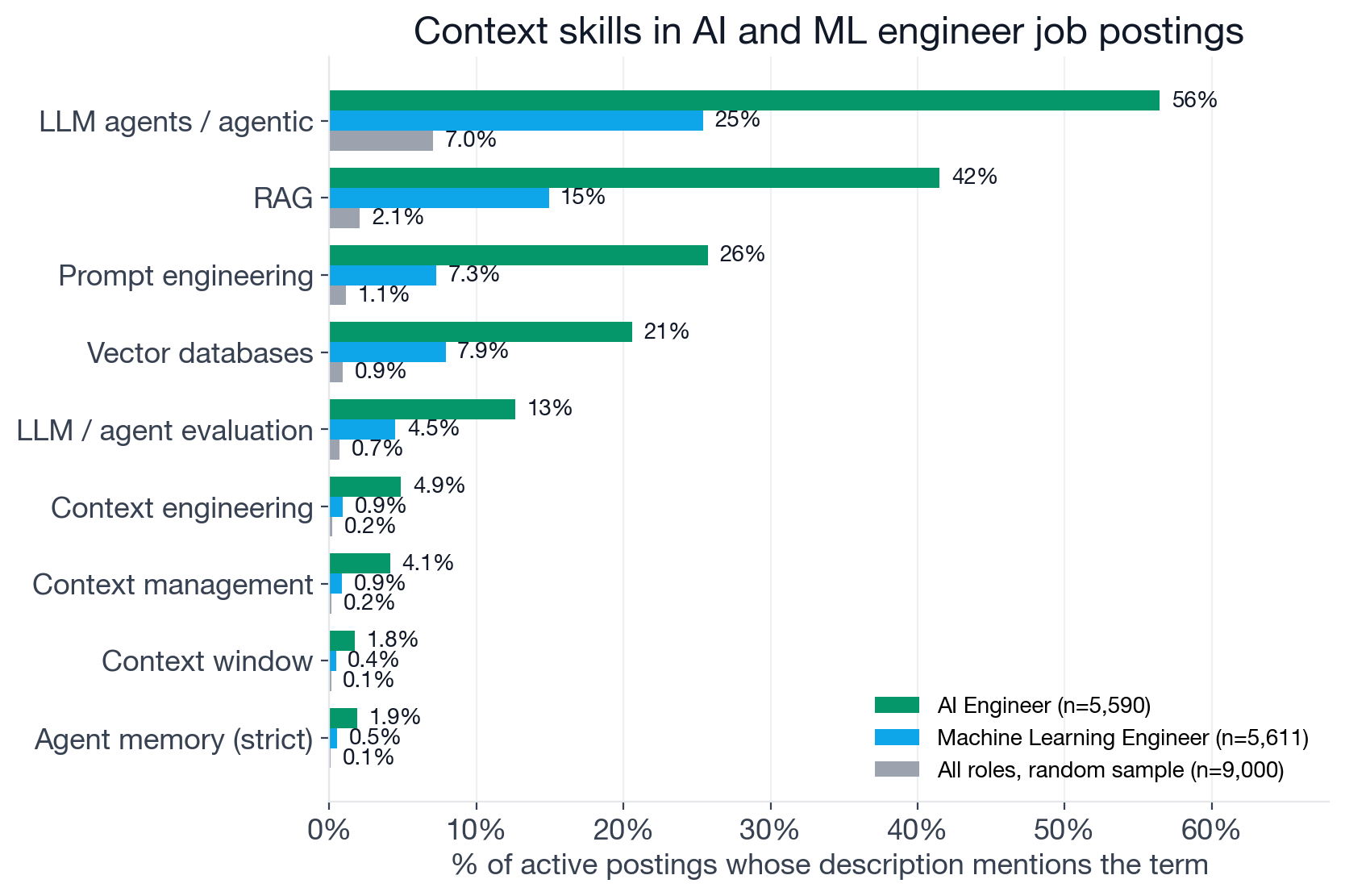
The takeaway: context vocabulary is concentrated in AI Engineer postings, and even there it sits well below the headline skills. The same numbers with denominators:
| Term in the description | AI Engineer (n=5,590) | Machine Learning Engineer (n=5,611) | All roles (sample, n=9,000) |
|---|---|---|---|
| LLM agents / agentic | 56.5% | 25.4% | 7.0% |
| RAG | 41.5% | 14.9% | 2.1% |
| Prompt engineering | 25.8% | 7.3% | 1.1% |
| Vector databases | 20.6% | 7.9% | 0.9% |
| LLM evaluation | 12.7% | 4.5% | 0.7% |
| Context engineering | 4.9% | 0.9% | 0.2% |
| Context management | 4.1% | 0.9% | 0.2% |
The all-roles column is an estimate from a random sample of 9,000 active postings, so treat it as a guide to scale; the two role columns are full counts.
Read the 4.9% as a floor on explicit demand, not a measure of how many teams care. A job that says "build agents with tool calling and retrieval" is asking for context engineering without using the phrase. Explicit agent-memory phrasing appears in about 1.9% of AI Engineer postings (105); descriptions express the idea in many other ways, so treat that as a loose lower bound.
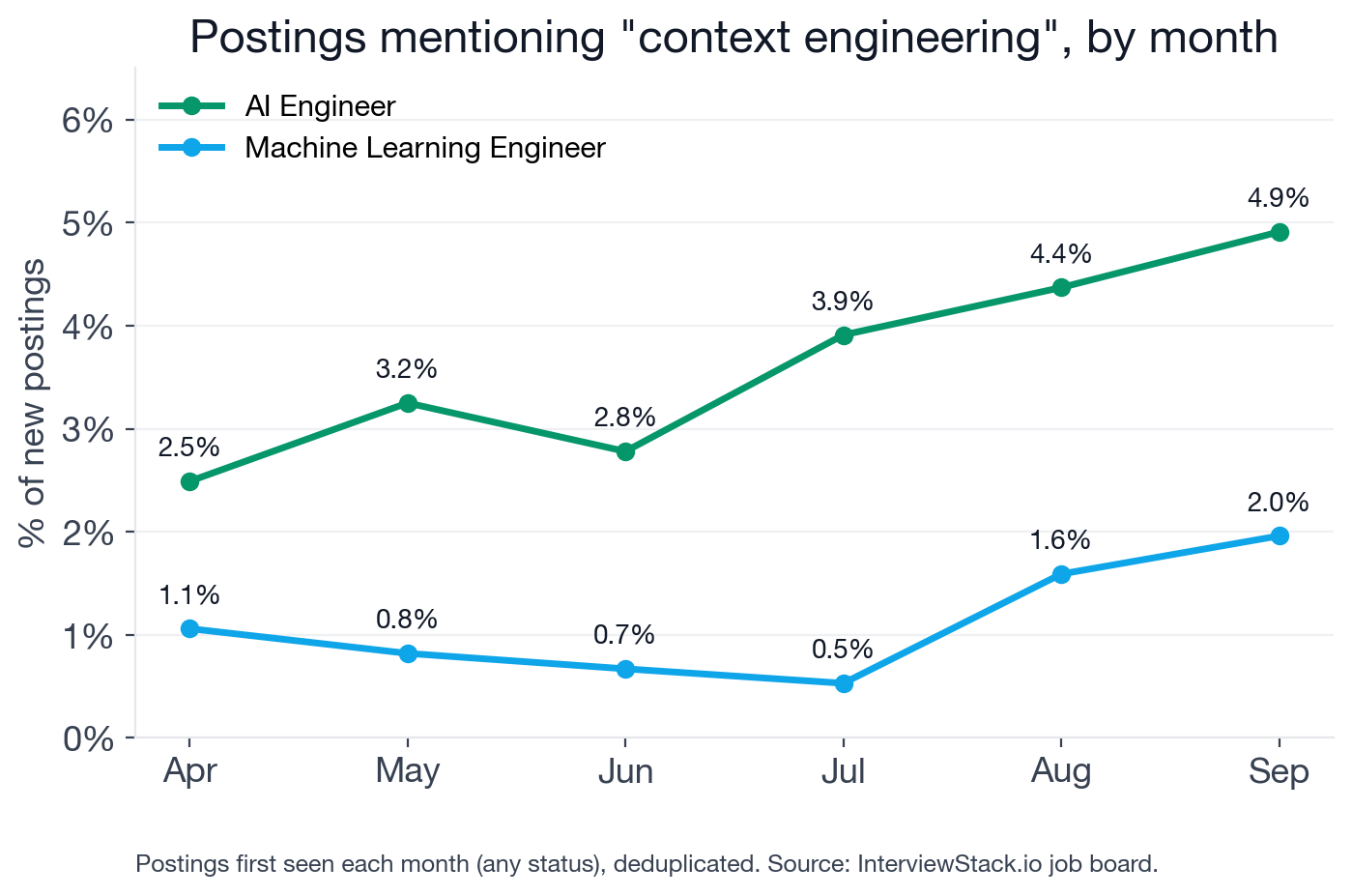
The trend line shows a mostly rising share for AI Engineers (2.5% of newly seen postings in April, 3.9% in July, 4.9% in September, with a dip in June) and a late lift for Machine Learning Engineers (0.5% in July to 2.0% in September, from 1.1% in April). As noted above, the trend uses first-seen dates and our source coverage grew, so part of any movement can be a change in mix.
Who mentions it is spread out. The 261 distinct openings come from 149 companies. Anthropic, Royal Bank of Canada, Accenture, Citi, Cloudera, and NewRocket each have 7 or more distinct openings that use the phrase, so it shows up in AI labs, banks, and consultancies alike. Three employers (Celonis SE, Janus Henderson, Exadel) republish one description per location, which is about 24 of the 261 hashes but only around five real openings, so we left them out of the named employers here. All 10 randomly sampled matches for the phrase were genuine uses. And because only 2 AI Engineer postings carry a structured skill tag for it, the job board's skill filters will not find it; search by AI Engineer and read the descriptions, or start from the better-tagged RAG filter.
How to Use This in Your Job Search
Drill the concepts first. The generative AI and LLM question bank covers retrieval, context windows, and sampling, and our question bank lets you practice by topic. Then run the answers out loud: practice with AI mock interviews, where a follow-up like "and what happens at turn 50?" is the real test. If the fundamentals feel shaky, the interactive courses cover the foundations underneath.
For the full interview format, our AI Engineer LLM interview walkthrough takes a candidate through a realistic session, and AI Engineer skills companies want in 2026 maps the wider skill stack. When you are ready, browse current AI Engineer openings and look for descriptions that mention agents and RAG.
Where to Start
If you have a week, spend it on one habit: for any LLM system you have built, be able to draw the assembled prompt, say what each block costs in tokens, and say how you would know it failed. That one skill underlies the answers on history, RAG versus long context, memory, caching, and evaluation, and it will still apply if models start managing their own context.
Topics
Ready to practice?
Put what you've learned into practice with AI mock interviews and structured preparation guides.