
The Smaller, More Specialized Job Doesn't Win on Pay
In most of the role pairs we've compared on InterviewStack.io, the smaller, more specialized job is the one that pays a premium. Not here. Digital Forensic Examiner is the narrower, more investigative role of this pair, and it still loses on salary.
We looked at every active Cybersecurity Engineer and Digital Forensic Examiner posting on the InterviewStack.io job board as of August 2026: 5,866 and 710 listings. Cybersecurity Engineer posts 8.26 times as often as Digital Forensic Examiner and still carries the higher median US base salary. (Base salaries only; postings don't disclose equity or bonus, so total compensation at top employers runs higher than the figures below.)
| Cybersecurity Engineer | Digital Forensic Examiner | |
|---|---|---|
| Active postings | 5,866 | 710 |
| Median US base salary | $162,000 | $135,000 |
| Top skill | Automation (45.5%) | Incident Response (91.7%) |
| Remote share | 21.2% | 15.2% |
| Entry-level share | 1.5% | 3.7% |
| Skill overlap (Jaccard) | 46% shared (pairwise) | 46% shared (pairwise) |
Key Findings
- Cybersecurity Engineer posts 8.26x as often as Digital Forensic Examiner (5,866 vs. 710 active postings) yet still pays a $27,000 (20%) higher US median base salary ($162,000 vs. $135,000).
- Incident Response appears in 91.7% of Digital Forensic Examiner postings but only 33.4% of Cybersecurity Engineer postings, the sharpest single-skill divide between the two roles.
- The two skill sets share 46% overlap (Jaccard similarity) on their top-30 skill lists, a real but moderate fork, not a rename of the same job.
- Cybersecurity Engineer's largest per-skill salary premium is Threat Modeling, +$18,900 over its own $162,000 baseline (n=395); its own DevSecOps label prices $2,900 below baseline despite being an exclusive differentiator.
- Digital Forensic Examiner's largest per-skill premium is Threat Intelligence, +$28,800 over its own $135,000 baseline (n=26); the role's namesake skill, Digital Forensics itself, adds just $2,000.
- Entry-level postings are thin on both sides: 1.5% for Cybersecurity Engineer, 3.7% for Digital Forensic Examiner.
- Cybersecurity Engineer's exclusive skill set leans cloud and build security (Application Security 25.7%, CI/CD 24.6%, IAM 19.8%, Kubernetes 15.2%), while Digital Forensic Examiner's leans investigative (Threat Intelligence 17.7%, Incident Management 15.9%, Digital Forensics 14.6%, Malware Analysis 10.7%).
A note on this dataset: none of the 30 job titles InterviewStack sampled from the Digital Forensic Examiner side of this comparison contain the word "forensic" or "forensics." The role's own namesake skill, Digital Forensics, shows up in just 14.6% of its postings, far behind Incident Response at 91.7%. In practice, this bucket is dominated by Incident Responder, SOC, and general Information Security titles, with a handful of physical-security titles mixed in (a CCTV-room security coordinator, a manufacturing-plant security shift lead). Read every Digital Forensic Examiner figure in this post as describing that broader digital-forensics-and-incident-response population as InterviewStack's job board classifies it, not a narrow sample of examiners doing hands-on evidence work full time.
What Does Each Role Actually Look Like on the Job?
A Cybersecurity Engineer spends most of the week making sure a compromise doesn't happen, or gets caught fast if it does. That means writing Terraform for security controls, tuning IAM (Identity and Access Management) policies, running threat models on new architecture before it ships, and wiring detection and automation into a CI/CD pipeline so security checks run alongside every deploy. It's a builder's job embedded inside the software delivery process.
A Digital Forensic Examiner, in the classic sense of the title, gets called in after something has already happened: an intrusion, a departing employee taking data, a fraud claim, a subpoena. The work is preserving and imaging evidence with a defensible chain of custody, reconstructing a timeline from logs and system artifacts, and writing findings that can hold up in a courtroom or a board review. It's reconstruction, not construction; the deliverable is a defensible account of what occurred, not a system that prevents it from occurring again. As the data note above flags, though, many of the postings behind this comparison's Digital Forensic Examiner numbers are Incident Responder and SOC titles where that reconstruction work is one part of a broader response job, not dedicated forensic examination.
Which Skills Do Both Roles Actually Share?
Both roles lean on the same cloud and monitoring foundation: AWS, Azure, and Google Cloud all clear meaningful frequency on each side, alongside Monitoring and SIEM (Security Information and Event Management). If you already know cloud platforms and monitoring tooling, that part transfers directly between these jobs.
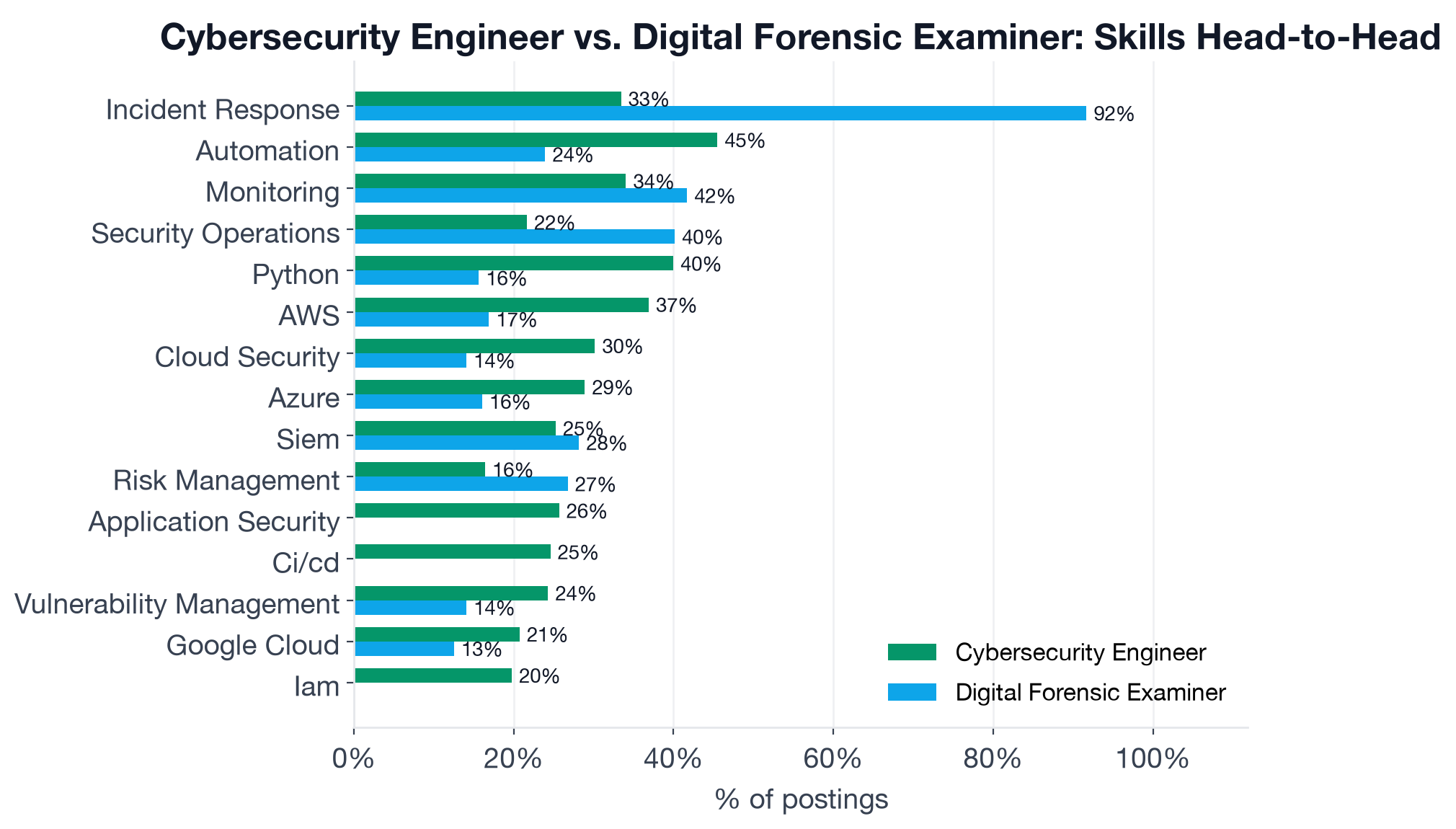 Cybersecurity Engineer and Digital Forensic Examiner overlap most in cloud platforms and monitoring; Incident Response is the outlier, nearly universal for Digital Forensic Examiner and a secondary skill for Cybersecurity Engineer.
But "shared" doesn't mean balanced. Automation is officially a shared skill, yet it shows up in 45.5% of Cybersecurity Engineer postings against 23.9% of Digital Forensic Examiner postings, nearly double, because for Cybersecurity Engineer "automation" usually means pipeline and infrastructure automation, not evidence-processing automation. Incident Response runs the opposite direction and far more sharply: at 91.7% of Digital Forensic Examiner postings it's close to a universal requirement, but at 33.4% of Cybersecurity Engineer postings it's one skill among many, not the center of the job.
Where the Two Skill Sets Split
Cybersecurity Engineer's exclusive skills read like a build-and-harden checklist: Application Security (25.7%), CI/CD (24.6%), IAM (19.8%), Security Architecture (19.1%), Threat Modeling (18.9%), Kubernetes (15.2%), DevSecOps (14.8%), Penetration Testing (14.8%), Terraform (13.3%). These are the tools of someone embedded in the software delivery pipeline, making sure security gets baked in before code ships.
Digital Forensic Examiner's exclusive skills point the opposite direction, toward what happens after: Threat Intelligence (17.7%), Incident Management (15.9%), Digital Forensics itself (14.6%), Threat Hunting (13.7%), Root Cause Analysis (11.0%), Malware Analysis (10.7%). One role designs the system to resist compromise. The other gets called in once compromise, or a legal question, has already happened.
Neither role's postings explicitly demand AI or machine learning skills at meaningful volume: Generative AI and LLM tags surface only as thin salary cuts in Cybersecurity Engineer's data (n=71 and n=76, well below top-30 frequency) and don't appear in Digital Forensic Examiner's postings at all. Treat that as a floor, not a ceiling. SANS Institute's 2026 survey found active generative-AI use among cybersecurity practitioners jumping from roughly 50% to 78% in a year, and Magnet Forensics' 2026 DFIR report found AI use in investigations climbing from 20% to 68% in two years, likely because AI-assisted triage solves an acute pain point examiners already have: too much evidence per case. A posting staying quiet on "AI" doesn't mean the tool isn't already on the desk.
Which Pays More: Cybersecurity Engineer or Digital Forensic Examiner?
Cybersecurity Engineer's $162,000 median US base salary sits $27,000 (20%) above Digital Forensic Examiner's $135,000. Digital Forensic Examiner's US salary sample (n=209) is also considerably thinner than Cybersecurity Engineer's (n=1,718), so treat its per-skill figures as directional rather than precise.
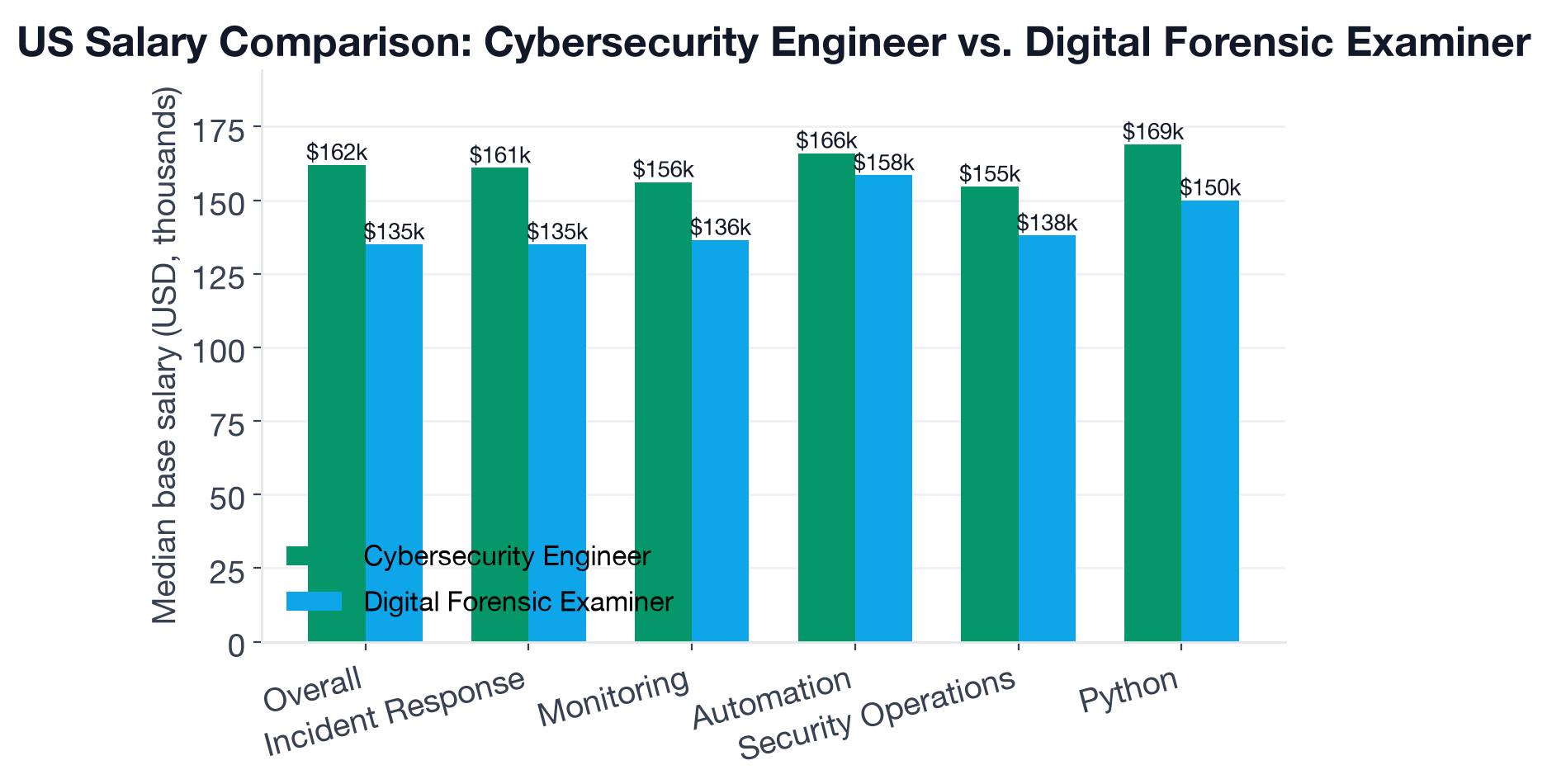 Cybersecurity Engineer's $162,000 US base salary median sits $27,000 above Digital Forensic Examiner's $135,000. Within each role, the top-paying skill isn't the namesake one: Threat Modeling adds $18,900 over Cybersecurity Engineer's own baseline, while Digital Forensics itself adds just $2,000 over Digital Forensic Examiner's own baseline.
On both sides, the skill that defines the role isn't the skill that pays the most. On Cybersecurity Engineer's own salary data, Threat Modeling carries the largest premium among its exclusive skills:
| Skill exclusive to Cybersecurity Engineer | Share of postings | Premium over $162,000 baseline |
|---|---|---|
| Threat Modeling | 18.9% | +$18,900 (n=395) |
| Kubernetes | 15.2% | +$15,000 (n=279) |
| Terraform | 13.3% | +$13,000 (n=244) |
| CI/CD | 24.6% | +$10,300 (n=394) |
| Application Security | 25.7% | +$8,100 (n=391) |
| DevSecOps | 14.8% | -$2,900 (n=219) |
On Digital Forensic Examiner's own salary data, Threat Intelligence carries the largest premium, and it's a bigger dollar figure than anything on the Cybersecurity Engineer side of its own baseline:
| Skill exclusive to Digital Forensic Examiner | Share of postings | Premium over $135,000 baseline |
|---|---|---|
| Threat Intelligence | 17.7% | +$28,800 (n=26) |
| Digital Forensics | 14.6% | +$2,000 (n=26) |
| Incident Management | 15.9% | -$10,000 (n=27) |
Notice what doesn't pay: DevSecOps is a genuine Cybersecurity Engineer differentiator at nearly 15% of postings, yet it prices below the role's own baseline. Digital Forensics, the role's namesake skill, barely moves Digital Forensic Examiner pay at all. Incident Management, exclusive to Digital Forensic Examiner at 15.9%, actually prices $10,000 under baseline. The pattern holds across both roles: the skill in the job title is table stakes, priced at or near the floor. The premium sits one layer over, in the rarer, more targeted specialty, Threat Modeling for Cybersecurity Engineer, Threat Intelligence for Digital Forensic Examiner.
Which Has More Job Openings, and Who Can Break In?
Cybersecurity Engineer posts 8.26 times as often as Digital Forensic Examiner (5,866 vs. 710 active postings), the deeper market by volume. Neither role is an easy first job: entry-level postings sit at just 1.5% for Cybersecurity Engineer and 3.7% for Digital Forensic Examiner, both well under a 1-in-10 shot.
Seniority skews slightly differently once you're past entry level. Cybersecurity Engineer runs more senior overall, 40.4% of its postings carry a senior or staff signal versus 32.8% for Digital Forensic Examiner, yet Digital Forensic Examiner's staff share alone (15.4%) edges past Cybersecurity Engineer's (13.8%). The specialist track has fewer rungs but a slightly denser one at the top.
Geographically the two roles look almost identical: the US accounts for 46.4% of Cybersecurity Engineer postings and 45.1% of Digital Forensic Examiner postings, with India, the UK, and Canada rounding out both top-five country lists. Remote work is where they separate: Cybersecurity Engineer offers remote options in 21.2% of postings against 15.2% for Digital Forensic Examiner, plausibly because evidence handling and chain-of-custody work put a premium on physical access to devices and secure facilities.
Match the Role to the Work
Choose Cybersecurity Engineer if you:
- Want to build and harden systems before something goes wrong, not investigate after it does; the role's exclusive skills (CI/CD, Terraform, Kubernetes, IAM) put you inside the software delivery pipeline.
- Want the larger, steadier job market: 8.26x the active postings means more geographic and employer choice.
- Are optimizing for base pay: the $162,000 median sits $27,000 above Digital Forensic Examiner's, and cloud-native skills like Threat Modeling and Kubernetes carry real premiums on top.
Choose Digital Forensic Examiner if you:
- Want investigative, evidence-driven work: Incident Response, Threat Intelligence, and Malware Analysis define the job far more than any cloud or delivery-pipeline skill.
- Don't mind a narrower, more concentrated market in exchange for specialized, courtroom-adjacent work a generalist security title doesn't offer.
- Can build toward Threat Intelligence specifically: it's the single largest per-skill premium measured on either side of this comparison, +$28,800 over the role's own baseline.
How to Use This in Your Job Search
If you're weighing which path fits, test yourself against real interview conditions for each: InterviewStack.io's AI mock interviews run role-specific sessions so you can feel the difference between a threat-modeling design discussion and an incident-timeline walkthrough before committing. The question bank covers structured drilling on both cloud security architecture and incident response and forensics. Once you know which market you're targeting, browse live Cybersecurity Engineer openings or Digital Forensic Examiner openings on the job board.
FAQ
Q. Does Cybersecurity Engineer pay more than Digital Forensic Examiner?
Yes. The median US base salary for Cybersecurity Engineer postings is $162,000, versus $135,000 for Digital Forensic Examiner, a $27,000 (20%) gap. Cybersecurity Engineer also posts far more often (5,866 vs. 710 active postings), so the higher-paid role is also the more available one in this comparison. One caveat: InterviewStack's Digital Forensic Examiner postings skew toward Incident Responder and SOC titles rather than dedicated evidence-examiner roles, so this figure describes that broader population, not a narrow sample of forensic examiners.
Q. How much skill overlap is there between Cybersecurity Engineer and Digital Forensic Examiner?
The two roles share 46% Jaccard overlap on their top-30 skill lists. That is a moderate fork: real shared ground in cloud platforms and monitoring, but distinct cores: build-and-harden work for Cybersecurity Engineer, investigate-and-reconstruct work for Digital Forensic Examiner.
Q. Is Incident Response required for both roles?
It appears in both, but at very different rates. Incident Response shows up in 91.7% of Digital Forensic Examiner postings, essentially universal, but only 33.4% of Cybersecurity Engineer postings, where it is one skill among many rather than the center of the job. That 91.7% figure is partly a symptom of how this dataset's Digital Forensic Examiner bucket is composed: it captures many Incident Responder and SOC titles alongside dedicated forensic examiners, which pulls Incident Response frequency up.
Q. Which role is easier to break into?
Neither is an easy first job. Entry-level postings make up just 1.5% of Cybersecurity Engineer listings and 3.7% of Digital Forensic Examiner listings, so both roles expect prior security experience even at the entry tier.
Q. What skills pay the most within each role?
For Cybersecurity Engineer, Threat Modeling carries the largest premium on the role's own salary data, $18,900 above its $162,000 baseline (n=395). For Digital Forensic Examiner, Threat Intelligence carries the largest premium on that role's own salary data, $28,800 above its $135,000 baseline, though on a thinner sample (n=26).
Q. Does Digital Forensic Examiner experience transfer to Cybersecurity Engineer?
Partially. Monitoring, SIEM, and cloud-security fundamentals transfer directly, but Cybersecurity Engineer postings lean heavily on skills that rarely clear meaningful frequency in Digital Forensic Examiner postings, including CI/CD, Terraform, Identity and Access Management, and Kubernetes. The move usually means adding build and cloud-engineering skills, not just relabeling investigative ones.
Q. Do either of these roles require AI or machine learning skills?
Not explicitly, in this dataset. Neither role's top-30 skill list includes an AI or ML tag at meaningful frequency. That does not mean AI is absent from the job: industry surveys show cybersecurity practitioners' active generative AI use rising from roughly 50% to 78% in a year, and DFIR-specific AI use in investigations climbing from 20% to 68% in two years, both faster-moving than what job postings alone explicitly require.
The Bigger Market Also Pays More
Both roles are healthy, but they're not the same bet. Cybersecurity Engineer is the larger market and the better median payer at once, an unusual combination in this comparison series, where the smaller, more specialized role usually wins on pay even as it loses on volume. Digital Forensic Examiner's specialization shows up in its skill set, not in its paycheck: the role's own namesake skill barely moves salary, while a narrower investigative specialty like Threat Intelligence does. Keep in mind, as noted above, that this dataset's Digital Forensic Examiner postings lean Incident Responder and SOC rather than narrowly forensic examiners, so treat the comparison as InterviewStack.io versus that broader digital-forensics-and-incident-response population rather than a head-to-head against a purely evidence-examination role. For a look at how Digital Forensic Examiner stacks up against a closer sibling role, see our comparison of Information Security Analyst vs Digital Forensic Examiner; for the fuller skill breakdown behind each role here, see Cybersecurity Engineer skills companies want in 2026 and Digital Forensic Examiner skills companies want in 2026.
Topics
Ready to practice?
Put what you've learned into practice with AI mock interviews and structured preparation guides.