
The Engineer Keeps the Platforms. The Tester Keeps the Code.
Cybersecurity Engineer's own defining skills, the ones its postings ask for that Penetration Tester's don't, are every one of them a platform or a process: SIEM, IAM, firewalls, Terraform. Penetration Tester's run the opposite direction: TypeScript, C++, Java, general-purpose languages, not a fixed security toolset. We looked at every active posting for both roles on the InterviewStack.io job board as of August 2026, 5,891 for Cybersecurity Engineer and 593 for Penetration Tester, and the split holds across each side's entire exclusive-skill list. The role with "Engineer" in the title owns the tools. The role built around testing owns the code.
A scope note on the Penetration Tester side: this dataset's Penetration Tester bucket catches the wider offensive-security and vulnerability-research family, not only postings titled exactly "Penetration Tester." Vulnerability management, threat/vulnerability analyst, security researcher, and AI red-teaming postings show up in the same pool, and Mercor, a marketplace that mostly staffs AI-training and AI red-teaming contract work, is this role's single largest employer at 4.9% of postings. That mix likely nudges the skill and pay numbers below toward general-purpose programming and away from a narrower, hands-on-pentest-only sample, so read the exclusive-skill split as directional rather than a precise job description for a role titled exactly "Penetration Tester." Cybersecurity Engineer's side of this dataset does not show the same blending.
| Cybersecurity Engineer | Penetration Tester | |
|---|---|---|
| Median US base salary | $162,000 | $143,700 |
| Active postings | 5,891 | 593 |
| Top skill | Automation (45.3%) | Penetration Testing (41.5%) |
| Remote share | 21.1% | 20.4% |
| Entry-level share | 1.6% | 4.9% |
| Skill overlap (Jaccard) | 58% shared (pairwise) | 58% shared (pairwise) |
Key Findings
- Cybersecurity Engineer posts 9.93 times more active openings than Penetration Tester: 5,891 versus 593.
- Cybersecurity Engineer pays an $18,300 (12.7%) higher median US base salary: $162,000 versus $143,700 (n=1,742 vs. n=160).
- The two roles share 58% skill overlap (Jaccard), with Python appearing in almost identical shares of both, 39.6% and 40.0%.
- All eight of Cybersecurity Engineer's exclusive skills are security platforms or processes: SIEM (25.1%), IAM (19.6%), Security Architecture (19.1%), Threat Modeling (18.9%), DevSecOps (14.8%), Firewalls (13.6%), Terraform (13.2%), and EDR (12.5%).
- Penetration Tester's exclusive skills lean toward general-purpose programming: TypeScript (11.0%), C++ (11.0%), and Java (10.8%), alongside Threat Intelligence (17.2%), Bash (12.5%), APIs (11.5%), Active Directory (9.8%), and Vulnerability Assessment (8.8%).
- Cybersecurity Engineer's biggest salary premiums aren't security skills at all: Go adds $40,500 (n=55) and Distributed Systems adds $38,000 (n=83) over the role's own baseline.
- Entry-level openings make up 4.9% of Penetration Tester postings versus 1.6% of Cybersecurity Engineer postings, though Cybersecurity Engineer still posts more entry-level roles in raw count, 93 versus 29.
Two Different Jobs Under One Industry Label
A Cybersecurity Engineer builds and runs the defensive stack: SIEM pipelines, IAM policies, Terraform-provisioned cloud infrastructure, and the EDR alerts that follow. Most of the job is keeping systems that block threats running, and proving to auditors that they work. A Penetration Tester does the opposite: given a target environment, break in, scripting exploits in Python, C++, or Java and moving laterally through an Active Directory domain the way a real attacker would. The output isn't a dashboard, it's a report the client has to act on. One role is measured by uptime and clean audits; the other by what it can compromise before the engagement ends.
Which Skills Do Both Roles Actually Share?
Both roles lean on the same starting toolkit, but only barely past that point. Python appears in essentially identical shares of each role's postings, 39.6% for Cybersecurity Engineer and 40.0% for Penetration Tester, the one skill that transfers cleanly in either direction. Automation is the next-closest bridge, though it splits unevenly: 45.3% of Cybersecurity Engineer postings versus 24.3% of Penetration Tester postings. AWS, Incident Response, Monitoring, Vulnerability Management, and Cloud Security round out the rest of the overlap.
| Skill | Cybersecurity Engineer | Penetration Tester |
|---|---|---|
| Python | 39.6% | 40.0% |
| Automation | 45.3% | 24.3% |
| AWS | 37.0% | 19.7% |
| Penetration Testing | 15.0% | 41.5% |
| Incident Response | 33.2% | 17.9% |
| Monitoring | 34.0% | 15.7% |
| Vulnerability Management | 24.4% | 20.1% |
| Cloud Security | 30.2% | 13.8% |
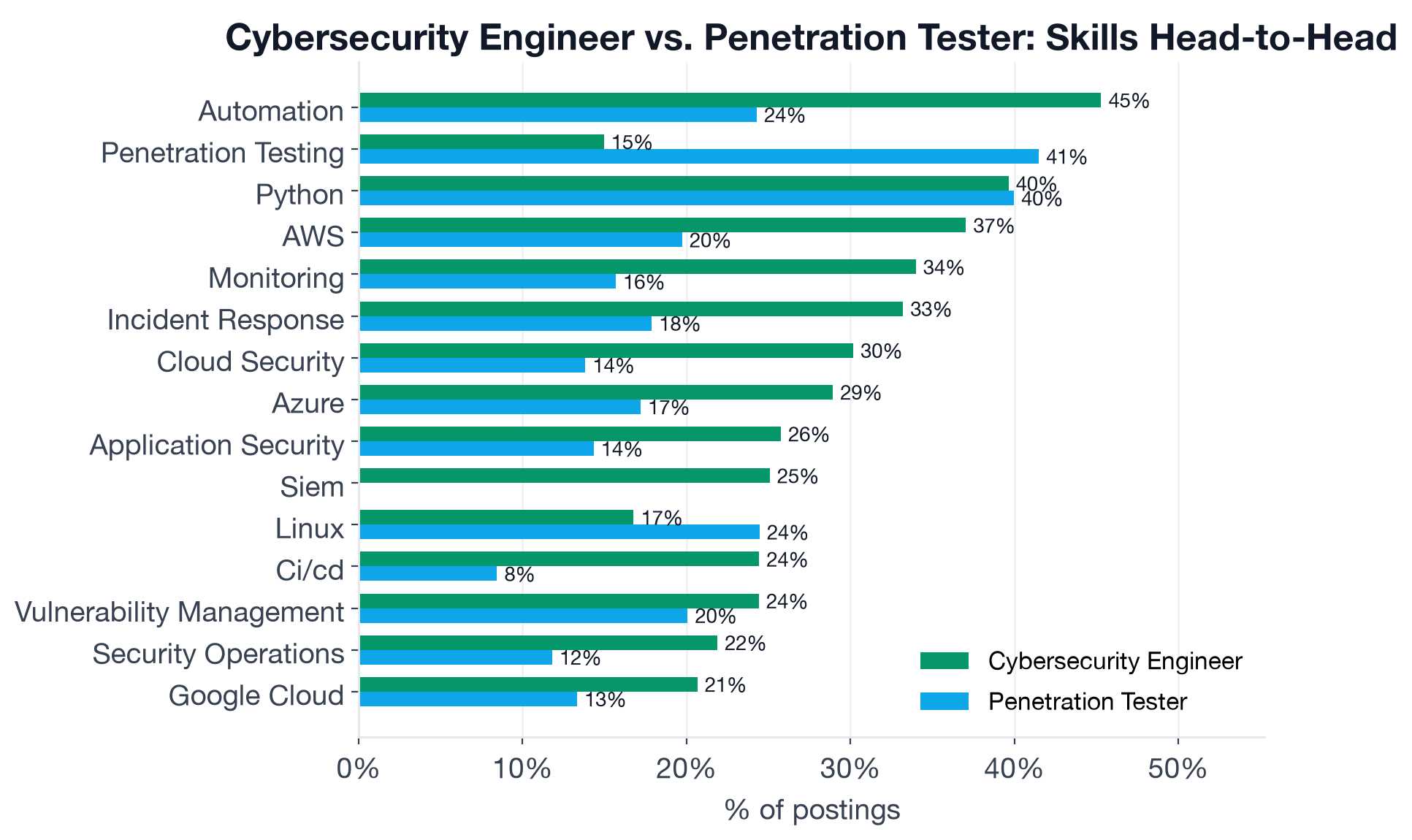
Penetration Testing itself counts as "shared" by this dataset's threshold, since it shows up in 15.0% of Cybersecurity Engineer postings too, but it skews nearly 3-to-1 toward the role named after it. Only Python is a genuinely even bridge between the two.
Where Do the Exclusive Skills Split?
Cybersecurity Engineer's eight exclusive skills, the ones that clear the bar in its postings but not in Penetration Tester's, are every one of them a security platform or a security process: SIEM (security information and event management software, 25.1%), IAM (identity and access management, 19.6%), Security Architecture (19.1%), Threat Modeling (18.9%), DevSecOps (14.8%), Firewalls (13.6%), Terraform (infrastructure-as-code software for provisioning cloud resources, 13.2%), and EDR (endpoint detection and response, 12.5%). Every single one is a tool or a process a security team operates, not a line of code a person writes.
Penetration Tester's exclusive list runs the other way. Threat Intelligence (17.2%) leads it, but the clearest signal sits in three general-purpose languages: TypeScript (11.0%), C++ (11.0%), and Java (10.8%), alongside Bash (12.5%), APIs (11.5%), Active Directory (9.8%), and Vulnerability Assessment (8.8%). The role that sounds narrower on paper, testing one thing, actually needs the broader engineering toolkit; the role with "Engineer" in the title owns the fixed set of platforms instead.
| Cybersecurity Engineer exclusive | % of postings | Penetration Tester exclusive | % of postings |
|---|---|---|---|
| SIEM | 25.1% | Threat Intelligence | 17.2% |
| IAM | 19.6% | Bash | 12.5% |
| Security Architecture | 19.1% | APIs | 11.5% |
| Threat Modeling | 18.9% | TypeScript | 11.0% |
| DevSecOps | 14.8% | C++ | 11.0% |
| Firewalls | 13.6% | Java | 10.8% |
| Terraform | 13.2% | Active Directory | 9.8% |
| EDR | 12.5% | Vulnerability Assessment | 8.8% |
The reason isn't mysterious: a Cybersecurity Engineer operates the tools that make up a company's defenses, so its differentiators are the tools themselves. A Penetration Tester has to attack whatever a client happens to run, so its differentiators are the raw programming skills that let someone build anything, not a fixed toolset. Worth repeating here: some of that programming signal, particularly TypeScript and APIs, is plausibly inflated by the vulnerability-management and AI-red-teaming postings mixed into this role's dataset (see the scope note above), so treat the size of the gap as directional rather than exact.
Neither exclusive list carries an explicit AI skill. Among Cybersecurity Engineer's 1,742 US salary-disclosed postings, Generative AI appears in 4.2% and RAG (retrieval-augmented generation) in 1.7%; LLM-related tags run higher, between 4.5% and 7.6% depending on how the raw skill keyword is counted in the underlying data. Penetration Tester's top-30 skill list has none at all. That's a floor, not a ceiling: a 2026 SANS Institute survey found AI use in cybersecurity jumped to 78% of organizations, up from 50% a year earlier, though only 37% have a governance policy, and only about 10% of SOC teams call the value "excellent". On offense, Bishop Fox found AI tooling cuts time-to-report on mid-scope engagements by roughly 35%, mostly from reconnaissance and report drafting, but a separate 2026 survey found 87.8% of AI-generated findings still need manual validation. Cybersecurity Engineers are more likely deploying and governing that tooling; Penetration Testers are more likely deciding whether to trust its output. Both are ambient realities of the job whether or not a posting names them. See our deep dives on Cybersecurity Engineer and Penetration Tester AI adoption for more.
Cybersecurity Engineer vs Penetration Tester: Which Pays More?
Cybersecurity Engineer pays more: a $162,000 median US base salary versus $143,700 for Penetration Tester, an $18,300 (12.7%) gap. Both figures are base salary only; equity, bonus, and sign-on aren't disclosed in job postings, and Penetration Tester's figure comes from a notably smaller sample (n=160 versus n=1,742), so treat it as directionally right rather than precise to the dollar.
On the Cybersecurity Engineer side, the platform-versus-code split repeats in the pricing. Operational tools sit at or below the $162,000 baseline: SIEM prices $3,400 below it (n=420), Firewalls $17,000 below (n=197), EDR $7,000 below (n=189). Two of the more architecture-leaning exclusives do better, Threat Modeling adds $18,900 (n=400) and Terraform adds $13,000 (n=242), but the biggest premiums sit outside security entirely: Go adds $40,500 (n=55), Distributed Systems adds $38,000 (n=83), and Rust adds $37,800 (n=70), rare software-engineering skills that outpay the platforms defining the role's daily work.
Penetration Tester's own exclusive skill set is a mixed bag once priced. Only three of its eight exclusive skills have enough US salary data to price: Threat Intelligence adds $23,800 (n=29) and TypeScript adds $7,700 (n=48), but Bash actually prices $10,500 below the $143,700 baseline (n=34), not every general-purpose skill pays. The more consistent premium sits in the skills Penetration Tester shares with Cybersecurity Engineer instead: Linux and Windows each add $18,300 (n=51 and n=37), and AWS adds $11,300 (n=33).
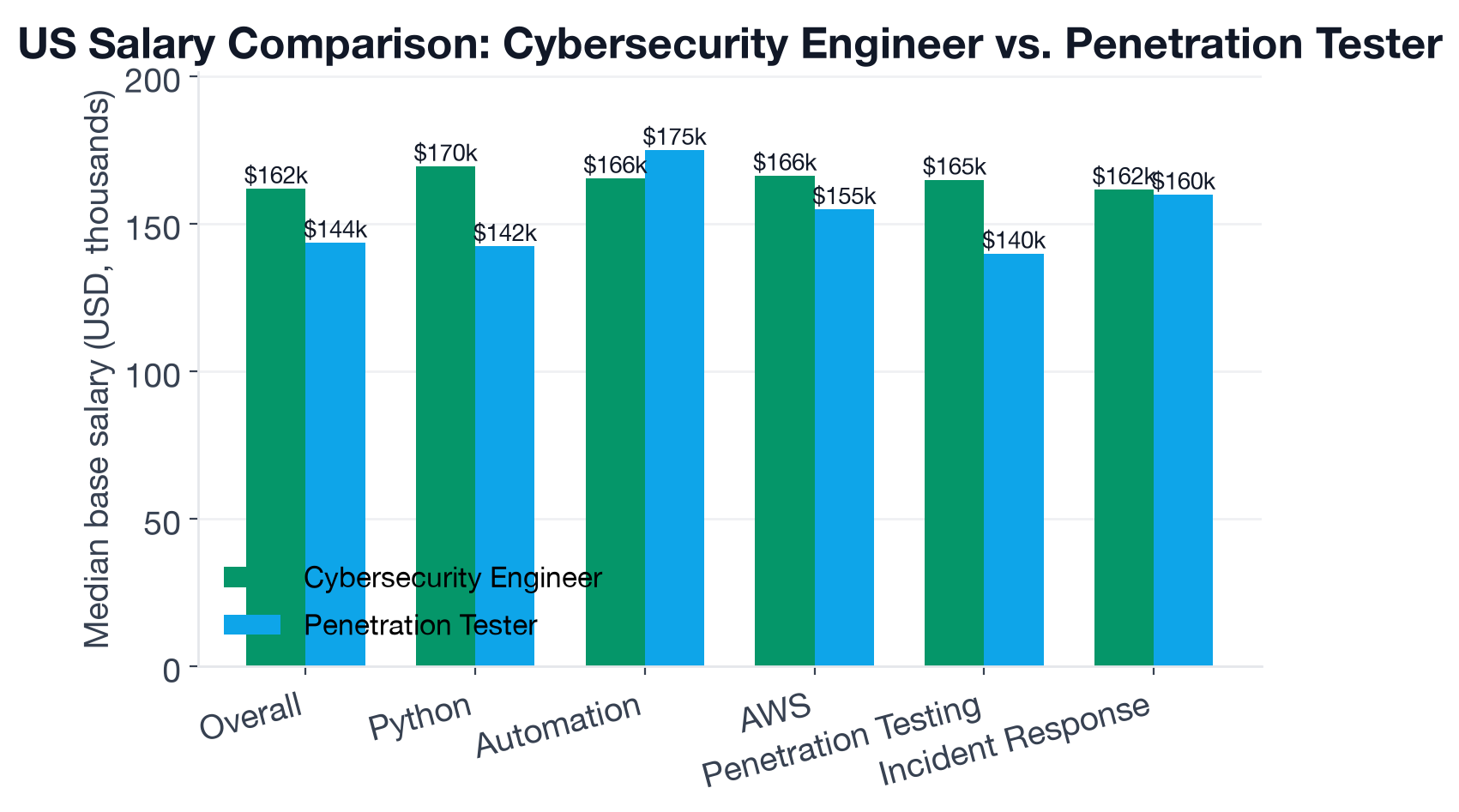
Automation and Incident Response both carry a real premium over the Penetration Tester baseline (+$31,400 and +$16,300) while barely moving the needle for Cybersecurity Engineer (+$3,500 and -$300), even though Cybersecurity Engineer's overall baseline is higher.
Which Role Has More Openings?
Cybersecurity Engineer has 9.93 times more active postings than Penetration Tester, 5,891 versus 593. That gap alone tells most of the "which is the safer bet" story: Penetration Tester is a genuine specialty niche within the broader security field, not a parallel-sized career track.
Entry-level share runs the other way, though not enough to flip the calculus. Penetration Tester posts entry-level roles 4.9% of the time versus Cybersecurity Engineer's 1.6%, but in raw counts Cybersecurity Engineer still posts more entry-level openings outright, 93 versus 29, simply because its total pool is so much larger.
Geography and flexibility track closely. Both roles concentrate in the US (46.8% Cybersecurity Engineer, 44.5% Penetration Tester) and stay mostly onsite (54.4% and 58.5%). Cybersecurity Engineer offers somewhat more hybrid work (33.0% versus 27.8%), the edge you would expect from a role built around maintaining always-on platforms rather than engagement-based testing on a client's network.
Which Role Should You Target?
Target Cybersecurity Engineer if you:
- Want to work with the platforms companies run every day, SIEM, IAM, firewalls, cloud security architecture, rather than attacking someone else's.
- Are comfortable building and operating: provisioning secured infrastructure, tuning detection systems, being on call when they fire.
- Want the larger, steadier market and higher baseline pay: 9.93 times more postings, $162,000 versus $143,700.
Target Penetration Tester if you:
- Already write real code, not just scripts, in C++, Java, or TypeScript, and want to apply it to breaking into systems rather than building them.
- Prefer project-based, engagement-driven work over maintaining one stack long-term.
- Are willing to trade market size for specialization: 593 postings versus 5,891, where programming skill, not a fixed toolset, is the differentiator.
Whichever direction fits, practice the technical rounds with AI mock interviews, drill specific skill gaps with the Question Bank, or build foundational depth with interactive courses before you apply. For a deeper look at either role, see what Cybersecurity Engineer postings ask for and the same breakdown for Penetration Tester.
FAQ
Q. Which pays more, Cybersecurity Engineer or Penetration Tester?
Cybersecurity Engineer pays more. The median US base salary is $162,000 across 1,742 postings with US salary disclosed, versus $143,700 across 160 postings for Penetration Tester, an $18,300 (12.7%) gap. Both figures are base salary only; equity, bonus, and sign-on are not disclosed in job postings, and Penetration Tester's smaller sample means the figure is directionally right rather than precise to the dollar.
Q. How many Cybersecurity Engineer and Penetration Tester jobs are open right now?
Cybersecurity Engineer is the far larger market: 5,891 active postings versus 593 for Penetration Tester, a ratio of about 9.93 to 1. Penetration Tester is a specialized niche within the broader security field, not a parallel-sized career track.
Q. Do Cybersecurity Engineer and Penetration Tester require the same skills?
Partly. The two roles share 58% skill overlap (Jaccard similarity), with Python appearing in roughly 40% of postings for both roles and Automation appearing in 45.3% of Cybersecurity Engineer postings versus 24.3% of Penetration Tester postings. Beyond that shared core, the two roles diverge sharply on what makes each one distinct.
Q. What skills are exclusive to each role?
Cybersecurity Engineer's eight exclusive skills are all security platforms or processes: SIEM, IAM, Security Architecture, Threat Modeling, DevSecOps, Firewalls, Terraform, and EDR. Penetration Tester's eight exclusive skills include three general-purpose programming languages, TypeScript, C++, and Java, alongside Threat Intelligence, Bash, APIs, Active Directory, and Vulnerability Assessment. Note that the Penetration Tester dataset also includes adjacent vulnerability-management, security-research, and AI red-teaming postings, which likely pushes this list toward general-purpose languages more than a strict penetration-tester-only sample would.
Q. Is Cybersecurity Engineer or Penetration Tester easier to break into?
Penetration Tester has the higher entry-level share (4.9% of postings versus 1.6% for Cybersecurity Engineer), but Cybersecurity Engineer's much larger volume means it still posts more entry-level roles in absolute terms, 93 versus 29. A first-time applicant will generally find more open doors in Cybersecurity Engineer, even though the percentage favors Penetration Tester.
Q. Do these roles require AI skills?
Not explicitly in most postings today. Among Cybersecurity Engineer's 1,742 US salary-disclosed postings, Generative AI appears in 4.2% and RAG (retrieval-augmented generation) in 1.7%; LLM-related tags run higher, between 4.5% and 7.6% depending on how the raw skill keyword is counted in the underlying data. Penetration Tester's top skill list has no AI or machine-learning tag at all. That's a floor, not a ceiling: a 2026 SANS Institute survey found AI use in cybersecurity jumped to 78% of organizations, up from 50% a year earlier. On the offensive side, Bishop Fox reported AI tooling cutting time-to-report by roughly 35% on typical engagements, though a separate 2026 survey found 87.8% of AI-generated findings still need manual validation.
Pick the Toolkit, Not the Title
Both of these jobs live inside the same security org chart, and a resume built for one won't automatically read as a fit for the other. Cybersecurity Engineer rewards people who want to own the platforms that keep a company's defenses running, an exclusive skill list that's entirely tools and process, in a job market nearly ten times the size of Penetration Tester's. Penetration Tester rewards people who would rather write the code that finds the gap in someone else's platform, an exclusive list built from general-purpose languages instead of security products. Browse open Cybersecurity Engineer roles or Penetration Tester roles on InterviewStack.io to see which toolkit is actually being asked for.
Topics
Ready to practice?
Put what you've learned into practice with AI mock interviews and structured preparation guides.