
One Role Is Five Times Scarcer. It Also Pays $72,300 More.
Applied Scientist is a small door: for every posting for the role, there are roughly five Data Analyst postings sitting on the same job board. That scarcity would be a footnote if the pay tracked the smaller pool downward, the way a niche or declining role often does. It does not. The median US base salary for Applied Scientist postings runs $72,300 above Data Analyst, and the two skill stacks barely resemble each other underneath the shared "data" label.
We pulled every active posting for both roles from the InterviewStack.io job board as of July 2026, 7,937 for Data Analyst and 1,575 for Applied Scientist, with skills normalized through a synonym map so "genAI" and "generative ai" count once. The picture that comes out is less "two flavors of the same job" and more "two different labor markets that happen to compete for some of the same graduates."
Both labels carry some scope noise worth flagging up front. A manual check of sampled titles found the Data Analyst set includes a meaningful share of Business Analyst postings (roughly one in six to one in four sampled titles) that share "data" language without being the same job, and the Applied Scientist set pulls in a smaller share of adjacent research and domain-science titles (computational biology, geology, imagery science, academic research-associate posts) that use "Scientist" language without being the AI/ML-focused role this comparison targets. Skill and salary figures held up as internally consistent regardless, so treat the headline percentages below as directional, not exact.
| Data Analyst | Applied Scientist | |
|---|---|---|
| Active postings analyzed | 7,937 | 1,575 |
| Median US base salary | $115,000 | $187,300 |
| Skill overlap (Jaccard) | 0.20 (pairwise) | 0.20 (pairwise) |
| Entry-level share | 7.4% | 6.4% |
| Staff-level share | 7.4% | 17.4% |
| Remote share | 15.6% | 15.9% |
| Onsite share | 56.7% | 66.7% |
| US share of postings | 37.7% | 59.2% |
Key Findings
- Applied Scientist postings are a fifth as common as Data Analyst postings in this analysis: 1,575 versus 7,937, a 5.04x volume ratio.
- Applied Scientist's median US base salary is $187,300 versus $115,000 for Data Analyst, a $72,300 (38.6%) gap, the second-largest dollar gap InterviewStack.io has measured in its role-comparison series.
- The two skill stacks overlap by only 20% (Jaccard 0.20); Python is the one skill that shows up at meaningful frequency on both sides (43.6% Data Analyst, 60.3% Applied Scientist).
- SQL anchors Data Analyst at 59.0% of postings but appears in just 7.6% of Applied Scientist postings.
- Machine Learning is an explicit requirement in 59.3% of Applied Scientist postings versus 12.3% of Data Analyst postings.
- Applied Scientist's staff-level share (17.4%) is more than double Data Analyst's (7.4%), while entry-level access is nearly identical (6.4% vs 7.4%).
- Applied Scientist postings are 59.2% US-based versus 37.7% for Data Analyst; one employer, Amazon, accounts for 14.8% of the Applied Scientist postings analyzed here.
- Remote share is nearly tied (15.9% Applied Scientist vs 15.6% Data Analyst); Applied Scientist actually runs more onsite overall (66.7% vs 56.7%).
What Skills Do Data Analyst and Applied Scientist Postings Actually Share?
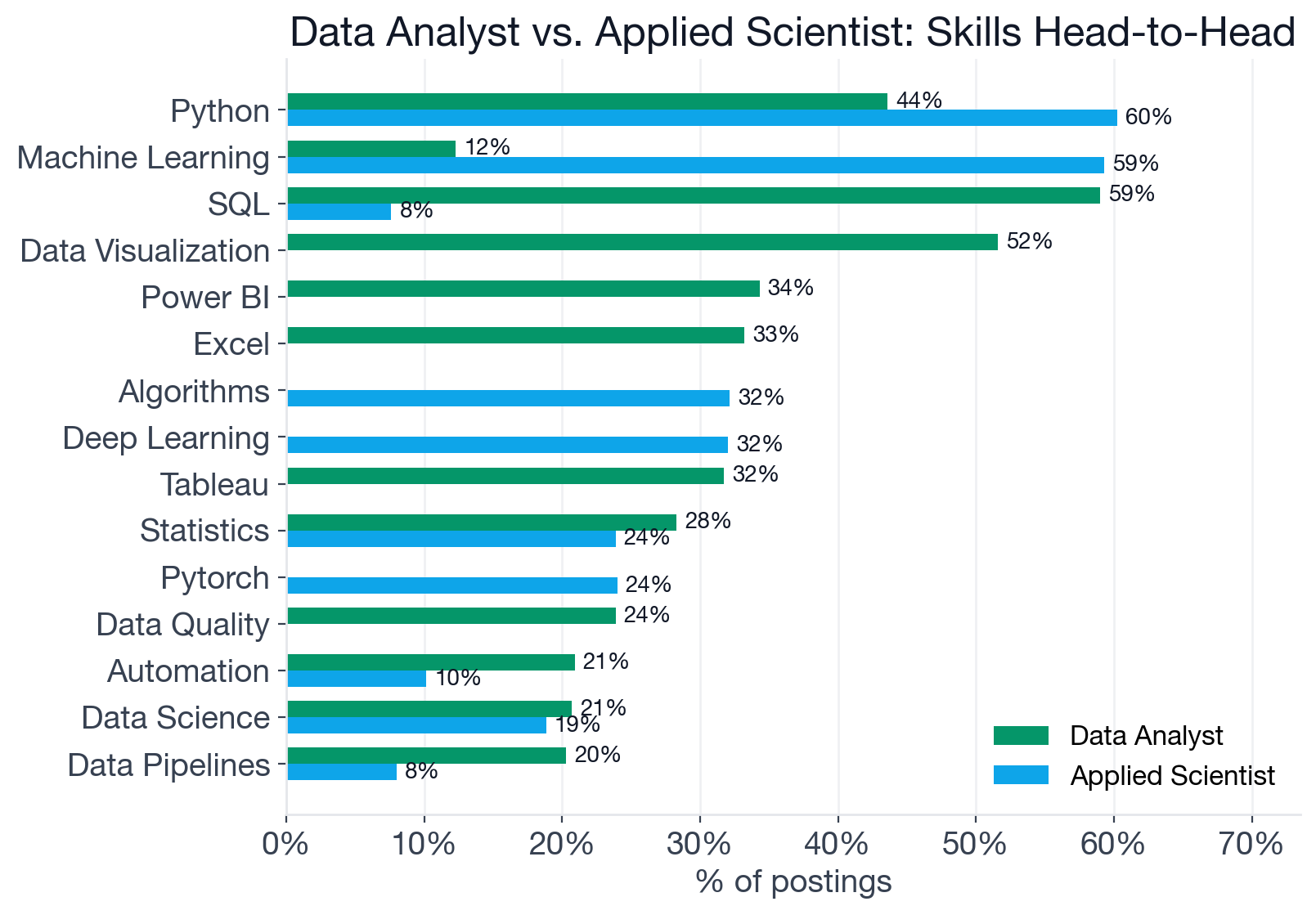 Skill frequency by role: Data Analyst in one color, Applied Scientist in the other, across the union of both roles' top-30 skill lists.
Ten skills clear the 5% threshold in both roles' top-30 lists, but "shared" is doing a lot of work in that sentence. Only three of the ten sit at genuinely comparable frequencies (Statistics, Data Science, Monitoring); the rest swing hard toward one side or the other.
| Shared skill | Data Analyst | Applied Scientist |
|---|---|---|
| Python | 43.6% | 60.3% |
| Machine Learning | 12.3% | 59.3% |
| SQL | 59.0% | 7.6% |
| Statistics | 28.3% | 23.9% |
| Data Science | 20.7% | 18.9% |
| Automation | 20.9% | 10.2% |
| Data Pipelines | 20.3% | 8.0% |
| Monitoring | 13.5% | 12.6% |
| A/B Testing | 7.2% | 16.2% |
| AWS | 8.0% | 12.7% |
Python is the only real bridge skill: present at meaningful, comparable rates on both sides, which is exactly why it is the safest single skill to have if you are not sure which of these two careers you will end up in. SQL and Machine Learning are the two sharpest dividers, and they run in opposite directions. SQL is Data Analyst's foundation (59.0%) and barely registers for Applied Scientist (7.6%). Machine Learning flips that: a supporting skill for Data Analyst (12.3%) and close to table stakes for Applied Scientist (59.3%).
Below the shared list, the two roles diverge into genuinely separate toolkits. Data Analyst's exclusive cluster is presentation and governance: Data Visualization (51.6%), Power BI (34.3%), Excel (33.2%), Tableau (31.8%), Data Quality (23.9%). Applied Scientist's exclusive cluster is model-building and systems programming: Algorithms (32.1%), Deep Learning (32.0%), PyTorch (24.0%), C++ (20.1%), Generative AI (20.0%), LLMs (19.9%).
| Data Analyst exclusive | Freq | Applied Scientist exclusive | Freq |
|---|---|---|---|
| Data Visualization | 51.6% | Algorithms | 32.1% |
| Power BI | 34.3% | Deep Learning | 32.0% |
| Excel | 33.2% | PyTorch | 24.0% |
| Tableau | 31.8% | C++ | 20.1% |
| Data Quality | 23.9% | Generative AI | 20.0% |
| Data Governance | 13.4% | LLMs | 19.9% |
| Agile | 11.8% | Java | 15.2% |
| Looker | 10.0% | TensorFlow | 14.0% |
The Generative AI and LLM skills sitting in Applied Scientist's exclusive column are worth a caveat, because it is easy to read the 12.3% Machine Learning figure for Data Analyst and conclude the role is largely AI-free. It is not. That 12.3% measures who is explicitly asked to build or tune models, a real and structural difference: Applied Scientist is a role built around shipping ML and AI systems, Data Analyst is not. It says nothing about who is expected to use AI tools day to day. The tools Data Analysts already touch, Excel, Power BI, Tableau, have shipped native AI copilots (formula generation, anomaly detection, natural-language dashboard queries), and ambient AI tool use is now a near-universal baseline expectation across analyst and developer roles generally, independent of whether a given posting spells it out. A Data Analyst posting that never mentions "AI" is still very likely to expect Copilot-in-Excel fluency; the skill-frequency gap above is about who architects AI, not who is allowed to use it.
If dbt and Snowflake come up in a Data Analyst posting you are eyeing, or Machine Learning shows up on an Applied Scientist req, those postings are worth browsing directly.
Which Role Pays More, and Where Does the Premium Come From?
Every figure in this section is a US-only base salary median; postings from other countries were excluded for comparability, and equity, bonus, and sign-on pay are not disclosed in job postings, so total compensation at top employers runs higher than the numbers below.
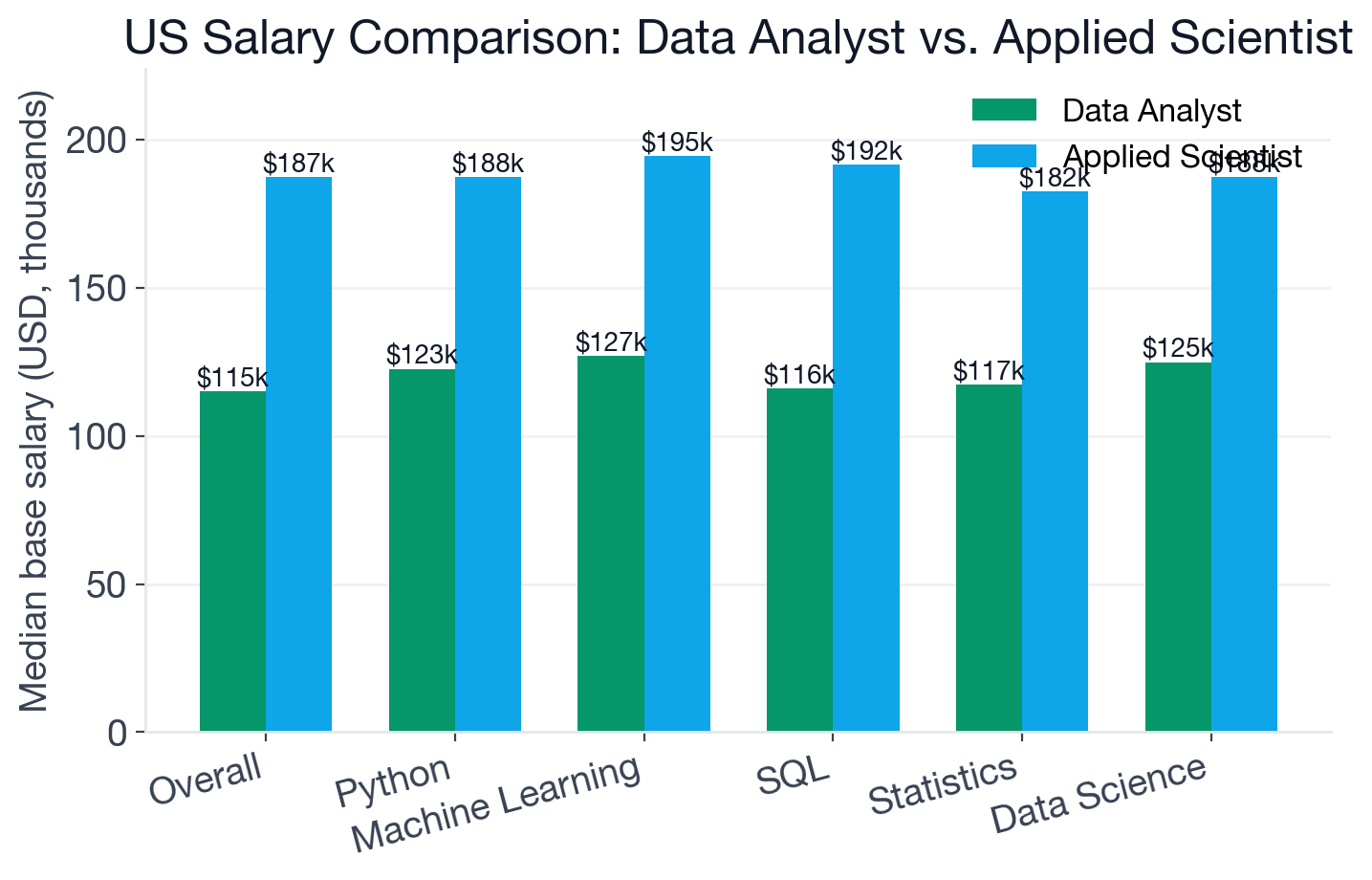 Median US base salary by role, plus shared skills with enough salary data to compare directly.
Applied Scientist's $187,300 median (n=645) sits $72,300 above Data Analyst's $115,000 (n=1,655), a 38.6% gap. That is the second-largest dollar gap InterviewStack.io has measured across its full role-comparison series, trailing only the $81,900 gap between Data Analyst and Machine Learning Engineer. Given how thin the skill overlap is, that is not really surprising: you are largely pricing two different labor markets, not two levels of the same job.
The more useful finding is what actually earns the premium inside each role, and it is not each role's own headline tools. Data Analyst's defining skills sit at or below its own $115,000 baseline: SQL (+$1,000), Data Visualization (+$1,500), Tableau ($0, exactly at baseline), Power BI (-$5,000), Excel (-$15,000). The real premium lives one layer down, in the modern-data-stack and AI-adjacent skills:
| Data Analyst skill | Premium over $115,000 | Sample size |
|---|---|---|
| A/B Testing | +$27,500 | 139 |
| dbt | +$25,000 | 115 |
| Generative AI | +$23,500 | 72 |
| LLMs | +$21,300 | 30 |
| Snowflake | +$19,500 | 194 |
| Machine Learning | +$12,000 | 239 |
| Python | +$7,600 | 744 |
Applied Scientist shows the identical pattern one rung up the ladder. Its own defining exclusives sit at or slightly below its own $187,300 baseline: Algorithms (-$300), Statistics (-$4,800), and Python, the shared bridge skill, is paid at almost exact parity (+$200). Once you are already inside the Applied Scientist tier, everyone has Python, so it stops being a differentiator. The real premium sits in specialized model-training and infrastructure skills:
| Applied Scientist skill | Premium over $187,300 | Sample size |
|---|---|---|
| Jax | +$28,300 | 48 |
| Distributed Training | +$21,300 | 41 |
| Model Training | +$19,500 | 57 |
| NLP | +$16,700 | 69 |
| LLM | +$12,200 | 81 |
| TensorFlow | +$11,200 | 102 |
The pattern repeats across both roles: the skill in the job title pays at parity, the skill one specialization deeper pays the premium. For Data Analyst, that means dbt and Snowflake outearn Power BI and Excel. For Applied Scientist, it means Jax and Distributed Training outearn plain Python and Algorithms. If you are trying to close either gap, the differentiator list is where the edge is, not the table-stakes list. One employer, Amazon, accounts for 14.8% of the Applied Scientist postings analyzed here, worth keeping in mind since it means Applied Scientist's baseline is not evenly spread across the whole employer landscape the way Data Analyst's is.
Where Does Applied Scientist's Extra Seniority Show Up?
The seniority gap between these two roles is not where you would expect it. Entry-level access is nearly identical: 7.4% of Data Analyst postings versus 6.4% of Applied Scientist postings. Mid-level is close too (61.8% vs 54.3%), and senior is close as well (23.4% vs 21.8%). The entire extra seniority Applied Scientist carries shows up at exactly one level: staff, where it is 17.4% of postings versus Data Analyst's 7.4%, more than double.
That concentration matters for how you read the $72,300 gap. It is not that Applied Scientist postings skew senior across the board and Data Analyst postings skew junior; the two ladders look similar until the very top rung, where Applied Scientist opens up a wider, better-paid tier that Data Analyst mostly does not have. If you are early in your career, the entry-level door into Applied Scientist is roughly as open as the one into Data Analyst. The harder part is what happens after year five or six, when Applied Scientist keeps offering a staff track and Data Analyst, in this dataset, mostly does not.
Where Are These Jobs, and How Onsite Are They?
Applied Scientist is a far more US-concentrated role: 59.2% of postings are US-based versus 37.7% for Data Analyst, which draws a much more global mix (11.5% India, 4.5% UK, 4.1% Canada, among others). Part of that concentration traces to one employer: Amazon accounts for 14.8% of the Applied Scientist postings in this analysis, more than the next several companies on the list combined, so treat the US-heavy geography as partly an artifact of one large hirer's footprint rather than a pure reflection of where the specialty sits globally.
Work mode does not follow the salary story the way you might expect. Remote share is essentially tied: 15.9% for Applied Scientist versus 15.6% for Data Analyst. If anything, Applied Scientist runs slightly more onsite overall (66.7% vs 56.7%), with a smaller hybrid slice (23.6% vs 28.9%). The $72,300 premium buys pay, not flexibility. If remote work matters more to you than the ceiling on comp, that is a real trade-off here, not a false one.
How to Use This in Your Job Search
If Python and SQL are already solid but Machine Learning is thin on your resume, that gap is exactly what separates the two roles' exclusive skill clusters above; drilling deep-learning fundamentals and a framework like PyTorch or TensorFlow is the more direct path toward Applied Scientist than adding more BI tools. InterviewStack's interactive courses cover the statistics, machine learning, and systems foundations that show up in both exclusive lists, and the question bank lets you drill the specific topics, from A/B testing design to model training, that this data shows carry real salary weight.
Before an interview for either role, AI mock interviews let you rehearse the kind of technical and behavioral questions each posting type tends to ask, tuned to the role you are targeting. And if you want to see what is actually open right now rather than a snapshot from this analysis, browse current Data Analyst openings or current Applied Scientist openings directly. For a broader read on either role's own skill demand, see our deep dives on Data Analyst skills and Applied Scientist skills, or our comparison of Data Analyst vs Machine Learning Engineer if you are weighing a different AI-adjacent pivot.
FAQ
Q. What is the salary difference between Data Analyst and Applied Scientist in 2026?
The median US base salary for Applied Scientist postings is $187,300 (n=645), compared with $115,000 for Data Analyst postings (n=1,655), a $72,300 gap (38.6%). That is the second-largest dollar gap InterviewStack.io has measured across its role-comparison series, trailing only the $81,900 gap between Data Analyst and Machine Learning Engineer.
Q. Do Data Analyst and Applied Scientist roles share any skills?
Yes, but the overlap is thin: about 20% of the two roles' combined top-30 skill sets (Jaccard overlap 0.20). Python is the strongest bridge, appearing in 43.6% of Data Analyst postings and 60.3% of Applied Scientist postings. Statistics, Data Science, Automation, and Monitoring also appear on both sides, usually at very different rates.
Q. Which role has more job postings, Data Analyst or Applied Scientist?
Data Analyst, by a wide margin. This analysis found 7,937 active Data Analyst postings versus 1,575 Applied Scientist postings, roughly 5 Data Analyst openings for every 1 Applied Scientist opening.
Q. Is SQL important for Applied Scientist roles?
Not especially. SQL appears in just 7.6% of Applied Scientist postings versus 59.0% of Data Analyst postings, making it one of the sharpest single-skill dividers between the two roles. Applied Scientist postings lean on Python, Machine Learning, and deep learning frameworks like PyTorch and TensorFlow instead.
Q. Do Data Analysts need machine learning skills in 2026?
Only a minority of postings ask for it explicitly: Machine Learning appears in 12.3% of Data Analyst postings versus 59.3% of Applied Scientist postings. That gap measures who is asked to build models, not who uses AI day to day. Ambient AI assistants inside Excel, Power BI, and Tableau are now a near-universal expectation regardless of what the posting states.
Q. Which role is easier to break into at the entry level?
They are close. Data Analyst postings are entry-level 7.4% of the time, Applied Scientist 6.4%. The real seniority gap shows up higher on the ladder: staff-level titles make up 17.4% of Applied Scientist postings versus 7.4% of Data Analyst postings, more than double.
Q. Are Applied Scientist jobs remote-friendly?
About as much as Data Analyst jobs, and not more. Applied Scientist postings are 15.9% remote versus 15.6% for Data Analyst, and Applied Scientist actually skews more onsite overall (66.7% vs 56.7%). The salary premium does not buy extra location flexibility.
Decide on the Work, Not Just the Number
$72,300 is a real gap, and it is easy to let it decide the question by itself. It should not. The two roles pull from almost entirely different skill stacks, so the choice is less "which pays more" and more "which kind of work do you actually want to do": presenting data and keeping a warehouse trustworthy, or designing and shipping the models other teams rely on. Pick the stack you would rather spend the next five years building, then use the numbers above to know what that choice is worth.
Topics
Ready to practice?
Put what you've learned into practice with AI mock interviews and structured preparation guides.