
The Generalist Job Is Six Times More Common. It Also Pays $77,000 Less.
Data Analyst and Research Scientist both get filed under "data careers," and that is roughly where the resemblance ends. We pulled every active posting for both roles on the InterviewStack.io job board as of July 2026, 8,284 Data Analyst listings against 1,375 Research Scientist listings, and compared skill frequency, salary by skill, seniority, and work mode across both. Data Analyst is the far bigger market, roughly 6x the openings. Research Scientist is the far bigger paycheck: a $192,000 US median base salary against $115,000 for Data Analyst, a $77,000 (40%) gap. That is not a modest premium for a slightly harder version of the same job. It is closer to the price of a genuinely different one.
The skill data backs that up. Measured as Jaccard similarity across each role's top-30 skill set, overlap between Data Analyst and Research Scientist sits at 0.18, meaning the two skill stacks share less than a fifth of their combined vocabulary. One quirk worth noting before the numbers: on this job board, "Research Scientist" postings skew heavily toward AI and machine-learning research specifically, not scientific research broadly. Employers here include Google, Meta, NVIDIA, Anthropic, and Huawei, and the sample titles run through DeepMind research-engineer roles and foundation-model postings. If you work in life-sciences or physical-sciences research, treat the skill and pay figures below as describing AI-lab research work, not your field.
Two smaller dataset quirks worth flagging. First, a slice of the Research Scientist sample is quantitative-finance research (Quantitative Researcher postings at firms like Point72, Jane Street, and Jump Trading), swept in because "Researcher" matches the role even though the job itself is closer to quant trading than AI/ML research; the AI-lab postings still dominate by volume, but treat the figures as a market-wide average across the label rather than a pure AI-research read. Second, the Data Analyst sample includes some adjacent titles beyond core BI/reporting work, such as risk analysts, data architects, and consulting-advisory associates, plus a handful of director-level strategy roles, which sit above what a typical individual-contributor Data Analyst earns and can nudge the salary figures upward.
| Data Analyst | Research Scientist | |
|---|---|---|
| Median US base salary | $115,000 | $192,000 |
| Active postings | 8,284 | 1,375 |
| Top skill | SQL (58.8%) | Machine Learning (58.8%) |
| Entry-level share | 7.4% | 6.9% |
| Onsite share | 55.9% | 68.6% |
| Skill overlap (Jaccard) | 18% shared (pairwise) | 18% shared (pairwise) |
Key Findings
- Research Scientist's median US base salary is $192,000 versus $115,000 for Data Analyst, a $77,000 (40%) gap.
- Data Analyst postings outnumber Research Scientist postings roughly 6 to 1 (8,284 vs. 1,375).
- Skill overlap between the two roles (Jaccard on top-30 skill sets) is just 0.18. Python is the only skill that clears meaningful frequency on both sides (43.5% Data Analyst, 56.4% Research Scientist).
- Machine Learning nominally clears the shared-skill threshold for both roles but appears in 12.5% of Data Analyst postings versus 58.8% of Research Scientist postings, a nearly 5x gap.
- Entry-level share is almost identical: 7.4% for Data Analyst, 6.9% for Research Scientist, despite the huge pay and specialization difference.
- Research Scientist postings run more onsite (68.6%) than Data Analyst postings (55.9%); the higher-paying role is also the less flexible one.
- Neither role's own defining skills carry a meaningful salary premium over that role's own baseline. SQL (+$1,700) and Tableau (+$1,700) sit within a couple thousand dollars of Data Analyst's median, while Excel (-$15,000) sits well below it; PyTorch (+$0), Algorithms (+$0), and Deep Learning (-$2,500) sit at or below Research Scientist's median.
- Explicit AI-building skills (LLMs, Generative AI) show up in 14 to 18% of Research Scientist postings; Generative AI is absent from Data Analyst's top-30 skill list entirely, well under that list's roughly 5.5% floor.
One Job Explains the Data. The Other Tries to Build What Comes Next.
A Data Analyst's week runs on querying, cleaning, and visualizing data to answer a specific business question, then presenting that finding to a stakeholder who needs to make a decision. The exclusive skill list confirms it: SQL, Data Visualization, Power BI, Excel, Tableau, Data Quality, and Data Governance all show up at meaningful frequency in Data Analyst postings and barely register in Research Scientist ones. This is presentation-and-decision-support work, closer to the business than to the model.
A Research Scientist's week, at least as this dataset captures it, runs on training and evaluating models: PyTorch, Deep Learning, Reinforcement Learning, Computer Vision, and C++ are exclusive to this role, alongside a growing LLM-specific cluster (18.2% of postings mention LLMs directly, 13.6% mention Generative AI by name). The output is usually a model, a paper, or an internal capability, not a slide deck. The two jobs sit on opposite ends of the same industry: one turns existing data into a decision, the other builds systems that generate new capability.
Which Skills Do Both Roles Actually Share?
Genuinely, not many, and even the ones that clear the threshold do not mean the same thing on both sides.
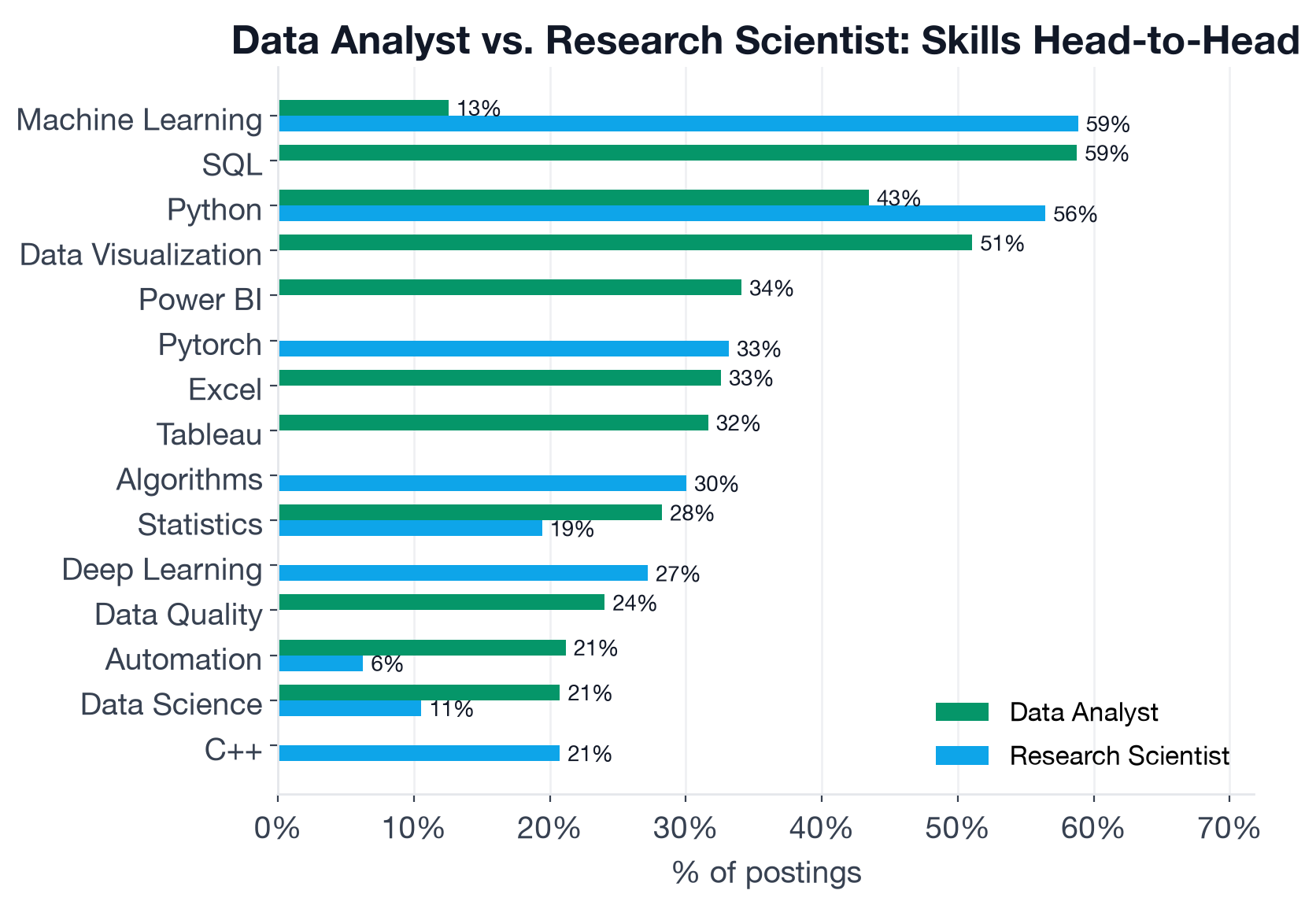 Python is the only skill at meaningfully high frequency in both roles; nearly everything else that clears the shared-skill bar skews sharply toward one side.
Python is the real bridge: 43.5% of Data Analyst postings and 56.4% of Research Scientist postings ask for it. Statistics is the next-closest, but it actually skews toward Data Analyst (28.2% vs. 19.4%), the opposite of what the "scientist" title might suggest. Everything past that thins out fast: Data Science, Automation, Data Pipelines, and Monitoring all clear the 5% floor in both roles, but each is 2 to 3x more common on the Data Analyst side, they are operational skills that show up more in analyst postings than in research ones.
Machine Learning is the one worth slowing down on. It clears the shared-skill bar for both roles, but 12.5% of Data Analyst postings mention it against 58.8% of Research Scientist postings, a near-5x gap in how central it is to each job. It prices that difference too: Machine Learning adds a $12,000 premium over Data Analyst's own $115,000 baseline (n=253), because it is a differentiator there. For Research Scientist, it lands at exactly the role's own $192,000 median (n=356), no premium, because at that point it is simply assumed. A/B Testing tells a similar but smaller story: a $31,900 premium over baseline for Data Analyst, an $8,000 premium for Research Scientist. Same skill, same direction, very different weight.
What Separates the Two Stacks?
Data Analyst's exclusive cluster reads like a BI department's toolbox: SQL (58.8%), Data Visualization (51.1%), Power BI (34.1%), Excel (32.6%), Tableau (31.6%), Data Quality (24.0%), and Data Governance (13.6%). These are reporting, presentation, and stewardship tools. They signal a role that sits close to business stakeholders and existing data, not one that builds new systems.
Research Scientist's exclusive cluster is a model-building toolbox: PyTorch (33.2%), Algorithms (30.0%), Deep Learning (27.2%), C++ (20.7%), LLMs (18.2%), Reinforcement Learning (17.0%), Computer Vision (16.8%), and TensorFlow (12.4%). This is production-of-new-capability work, not consumption of existing data.
If you already know SQL, Excel, Power BI, and Tableau, none of that transfers directly to a Research Scientist posting; you would be starting the technical stack over. The reverse is also true. This is the concrete meaning behind the 0.18 overlap score: two careers that share an industry and, loosely, a job-title word ("data" or "research" on either side), but almost no tooling.
Which Role Actually Pays More, Data Analyst or Research Scientist?
Research Scientist, clearly, by $77,000 (40%) at the median. These are US base salaries only [Data Analyst n=1,739, Research Scientist n=550]; equity, bonus, and sign-on are not disclosed in postings and are not reflected here, so total compensation at top employers on either side runs higher than these figures. The Data Analyst figure likely sits a bit above what a pure reporting/BI-focused Data Analyst earns, since the underlying sample also includes some adjacent risk-analyst, data-architect, and consulting-advisory titles (see the dataset note above); treat $115,000 as a market-wide average for the classifier, not a floor for an entry-level BI role.
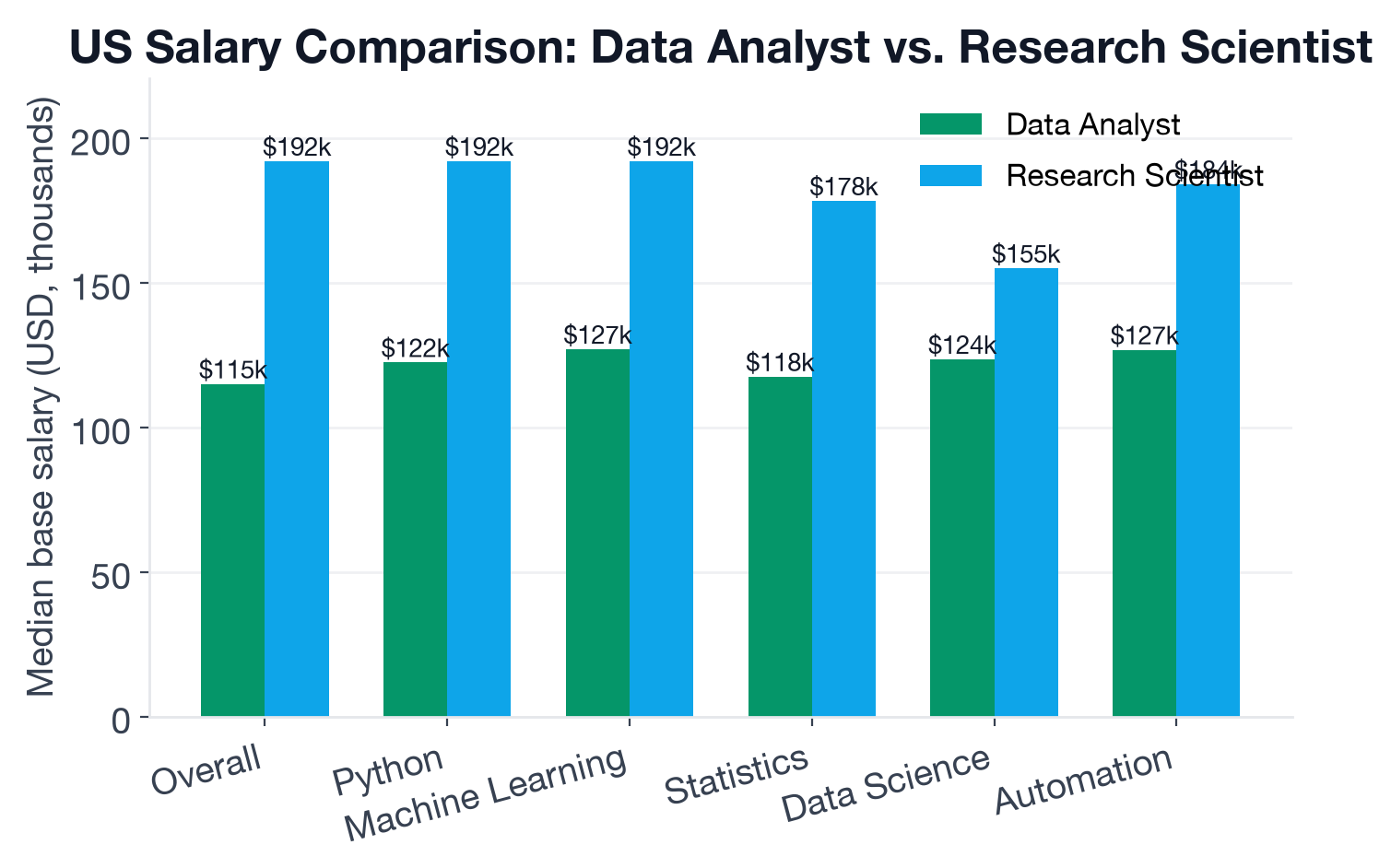 Research Scientist's $192,000 median sits well above Data Analyst's $115,000, and the premium skills on each side point toward different specializations, not a shared ladder.
The interesting part is where the premium actually lives. On the Data Analyst side, the role's own defining skills barely move the needle: SQL (+$1,700), Data Visualization (+$1,600), and Tableau (+$1,700) all sit within a rounding error of the $115,000 baseline, and Excel (-$15,000) and Power BI (-$5,400) sit below it. The real Data Analyst premiums come from the modern data-stack layer: dbt (a SQL-based data-transformation tool that runs inside the warehouse; +$25,000, n=116), Apache Spark (+$20,000, n=63), Snowflake (+$20,000, n=199), Generative AI (+$23,500, n=73), and A/B Testing (+$31,900, n=143).
The same pattern holds on the Research Scientist side, just at a higher baseline. PyTorch (+$0), Algorithms (+$0), and Deep Learning (-$2,500) sit at or below the $192,000 median; they are the price of entry, not a premium. The real Research Scientist premiums sit one layer down, and lean toward production ML infrastructure rather than pure research technique: Data Pipelines (+$46,000, n=45), Distributed Systems (+$43,000, n=35), Kubernetes (+$37,000, n=29), LLMs (+$21,800 to +$28,000 depending on tag variant, n=67-111), and Distributed Training (+$22,300, n=38). (A small number of Data Analyst salary entries, Clinical Research at $215,000 and Population Health at $171,600, come from small, specialized slices of the sample (n=29 and n=36) rather than typical analyst work, so we left them out of the table above.)
The takeaway on both sides is the same shape: the skill in the job title is table stakes, not the pay driver. The pay driver is whatever sits one specialization deeper.
Which Job Is Easier to Land, and Where?
Data Analyst wins on raw access: 8,284 open postings against 1,375 for Research Scientist, a 6.02x volume advantage. If you're optimizing for "get hired somewhere soon," that ratio matters more than any skill list.
Entry-level access is the surprise, though. Data Analyst's entry-level share is 7.4%; Research Scientist's is 6.9%, statistically almost the same rate, despite the $77,000 pay gap and the near-total skill mismatch. The bar differs in kind rather than degree: entry-level Research Scientist postings tend to expect a completed graduate degree with a research or publication record, while entry-level Data Analyst postings more often accept a bachelor's degree or an analytics bootcamp background. Neither role is meaningfully more closed to newcomers than the other in raw posting-language terms, but the credential each expects at that entry point is different.
Where the roles diverge more sharply is flexibility and geography. Research Scientist postings run 68.6% onsite versus 55.9% for Data Analyst, so the higher-paying role is also the less remote-friendly one, roughly consistent with frontier AI labs preferring in-person collaboration. Research Scientist is also far more concentrated in the US (63.0% of postings) than Data Analyst (37.4% US, with a meaningful India share at 11.5%), which tracks with how much AI-research hiring is still clustered around a handful of US labs.
On AI skills specifically: Research Scientist postings on this board already require them explicitly (LLMs 18.2%, Generative AI 13.6%), because a large share of these postings are hiring people to build AI systems, not just use them. Data Analyst postings almost never state an AI requirement (Generative AI misses the top-30 skill list entirely, well under that list's roughly 5.5% floor), but that reflects hiring language, not actual usage. The 2025 Stack Overflow Developer Survey, the largest AI-adoption dataset available, puts regular AI-tool use among developers above 84%; no comparably large survey isolates data analysts or non-software research scientists specifically, but vendor and practitioner sources describe Copilot in Excel, Power BI Copilot, and ChatGPT-based analysis as now-standard parts of a 2026 analyst's toolkit, alongside AI research-assistant tools like Elicit and Claude for the research side. Employers simply do not write "must already use AI tools" into a posting the way they don't write "must know how to use email."
How to Use This in Your Job Search
If you're weighing a move from Data Analyst toward Research Scientist, the honest starting point is that Python and statistics transfer, but SQL, Power BI, Excel, and Tableau mostly do not. Browse current Research Scientist openings to see what the target postings actually ask for before committing to a study plan, and use InterviewStack's interactive courses to build the deep-learning and ML foundations (PyTorch, algorithms, statistics) that the exclusive skill list shows you'll need. If you're staying on the Data Analyst side and want to close some of that salary gap, the data points toward the modern data-stack layer, Data Analyst roles that ask for dbt or Snowflake pay meaningfully above the role's own baseline.
Either direction, drill the specifics with InterviewStack's Question Bank and rehearse the real conversation with AI mock interviews before you apply. If a specific AI lab is on your list, our company prep guides cover interview processes at employers like Google and Meta that show up repeatedly in this Research Scientist dataset. Related reading: our deep dives on Data Analyst skills in 2026 and Research Scientist skills in 2026, and, if the AI-research angle is what draws you, our comparison of Data Engineer vs Research Scientist for a second data-adjacent path into the same labs.
FAQ
Q. How much does a Research Scientist earn compared to a Data Analyst in 2026?
Research Scientist postings show a median US base salary of $192,000, versus $115,000 for Data Analyst, a $77,000 (40%) gap. Both figures are base salary only, from US postings with disclosed pay; equity and bonus are not included.
Q. How much skill overlap is there between Data Analyst and Research Scientist?
Not much. The Jaccard overlap on each role's top-30 skill list is 0.18 (18%), meaning the two roles' skill stacks look almost nothing alike. Python is the only skill that shows up at meaningfully high frequency in both (43.5% of Data Analyst postings, 56.4% of Research Scientist postings).
Q. Is Machine Learning a shared skill between the two roles?
It clears the shared-skill frequency threshold, but the two roles use it at very different rates: 12.5% of Data Analyst postings mention it versus 58.8% of Research Scientist postings, a nearly 5x gap. It also prices differently: Machine Learning adds a $12,000 premium over Data Analyst's own baseline, but sits right at Research Scientist's own median with no premium at all, because it is assumed there rather than differentiating.
Q. Which role has more job openings, Data Analyst or Research Scientist?
Data Analyst, by a wide margin: 8,284 active postings versus 1,375 for Research Scientist, a roughly 6-to-1 volume ratio in this dataset.
Q. Is it harder to get an entry-level Research Scientist job than an entry-level Data Analyst job?
Surprisingly, the entry-level shares are almost identical: 7.4% of Data Analyst postings versus 6.9% of Research Scientist postings. The bar differs in kind, not degree: entry-level Research Scientist listings typically expect a completed graduate degree, while entry-level Data Analyst listings more often accept a bachelor's degree. But neither role locks out newcomers more than the other at the posting-language level.
Q. Do Data Analysts need to know AI or machine learning skills in 2026?
Explicit AI-building skills are nearly absent from Data Analyst postings: Generative AI does not crack the top-30 skill list at all, putting it well under that list's roughly 5.5% floor (an estimate drawn from the smaller salary subsample puts the actual mention rate near 1%). That does not mean Data Analysts skip AI tools day to day. The 2025 Stack Overflow Developer Survey, the largest AI-adoption dataset available, puts regular AI-tool usage among developers at 84% or higher; no comparably large survey isolates data analysts specifically, but Copilot in Excel, Power BI Copilot, and ChatGPT-based analysis are described in practitioner writeups as standard parts of the 2026 analyst toolkit, just not something employers state as a hiring requirement.
Q. What's the single biggest skill difference between Data Analyst and Research Scientist postings?
SQL defines Data Analyst (58.8% of postings) and barely registers for Research Scientist. PyTorch defines Research Scientist (33.2%) and is nearly invisible in Data Analyst postings. Neither skill earns a premium over its own role's baseline; both are simply the price of entry into each role.
The Price of Staying General
Data Analyst is the more available job by a wide margin and asks for a stack most business-adjacent professionals can build without a graduate degree. Research Scientist is scarcer, more onsite, more US-concentrated, and pays $77,000 more at the median, and that premium sits almost entirely in specialized, model-building skills that have nothing to do with the BI toolkit. Neither path is the "safer" or "smarter" one in the abstract. One trades volume and flexibility for approachability; the other trades both away for a narrower, better-paid lane. The skill lists above tell you which one you'd actually be signing up to learn.
Topics
Ready to practice?
Put what you've learned into practice with AI mock interviews and structured preparation guides.