
The Bigger, More Flexible Job Doesn't Pay More
DevOps Engineer offers more than twice the job postings of Embedded Developer, and it pays with far more flexibility: 54.9% of DevOps postings allow remote or hybrid work, versus 28.4% for Embedded Developer, which is 73.4% onsite. By the usual market logic, that abundance and flexibility should show up as a pay discount. It doesn't. We pulled every active DevOps Engineer posting (6,970) and Embedded Developer posting (3,135) on the InterviewStack.io job board as of July 2026, extracted skills, salary, seniority, and location from each, and compared them head to head. The result: Embedded Developer's median US base salary, $155,000, edges out DevOps Engineer's $151,900 by $3,100, close enough to be a rounding error at this scale.
That near-parity would be unremarkable between two similar jobs. It's more interesting here because these two roles barely resemble each other. Their skill lists overlap just 15% (Jaccard on the top-30 skills each role's postings ask for), a genuinely low figure for two engineering roles. DevOps Engineer runs on cloud infrastructure and automation; Embedded Developer runs on firmware and the hardware it talks to. Two different jobs, two different labor markets, and pay that lands in almost the same place.
A methodology note: both postings sets are classified by job title and content, and a modest share of each sits at the edges of the category, mostly infrastructure/IAM-consulting titles on the DevOps Engineer side and pure hardware-design titles with no firmware or software component on the Embedded Developer side. That doesn't change the shape of the comparison below, but treat the percentages as directional rather than laboratory-precise.
| DevOps Engineer | Embedded Developer | |
|---|---|---|
| Median US base salary | $151,900 | $155,000 |
| Active postings analyzed | 6,970 | 3,135 |
| Top skill | CI/CD (66.9%) | C++ (49.9%) |
| Remote + hybrid share | 54.9% | 28.4% |
| Entry-level share | 2.1% | 3.0% |
| Skill overlap (Jaccard) | 15% shared (pairwise) | 15% shared (pairwise) |
Key Findings
- DevOps Engineer and Embedded Developer share just a 15% skill overlap (Jaccard on top-30 skills).
- DevOps Engineer postings outnumber Embedded Developer postings 2.22x (6,970 vs. 3,135 active listings analyzed).
- Despite that volume gap, the median US base salary is nearly identical: $151,900 for DevOps Engineer vs. $155,000 for Embedded Developer, a difference of just $3,100 (2%).
- DevOps Engineer is far more remote-friendly: 54.9% of postings allow remote or hybrid work, versus 28.4% for Embedded Developer (73.4% onsite).
- Kubernetes appears in 55.7% of DevOps Engineer postings; C++ appears in 49.9% of Embedded Developer postings. Neither shows up at meaningful frequency in the other role.
- Only 8 skills clear the 5% shared-frequency threshold for both roles, and most of them (CI/CD, Automation, Monitoring) lean heavily toward DevOps Engineer.
- Entry-level share is thin for both roles (2.1% DevOps, 3.0% Embedded), and Embedded Developer skews more senior overall (17.2% staff-level postings vs. 11.5% for DevOps Engineer).
Two Engineering Jobs, Almost No Shared Vocabulary
A DevOps Engineer keeps other teams' code running: building the CI/CD pipelines that ship it, the Kubernetes clusters and Terraform-defined infrastructure that host it, and the monitoring and observability tooling that catches it when it breaks. The work happens almost entirely in the cloud, on infrastructure that can in principle be managed from anywhere, which is a large part of why the role is so hybrid- and remote-friendly.
An Embedded Developer writes the software that runs directly on physical hardware: firmware for a microcontroller, drivers for the sensors and radios wired to it, and low-level code that has to behave correctly inside a real-time operating system's timing constraints. Debugging often means an oscilloscope and a physical board on a desk, not a log aggregator, which is a large part of why the role stays so overwhelmingly onsite.
Browse current DevOps Engineer openings or Embedded Developer openings and the difference shows up in the first few requirements listed.
Which Skills Do DevOps Engineer and Embedded Developer Actually Share?
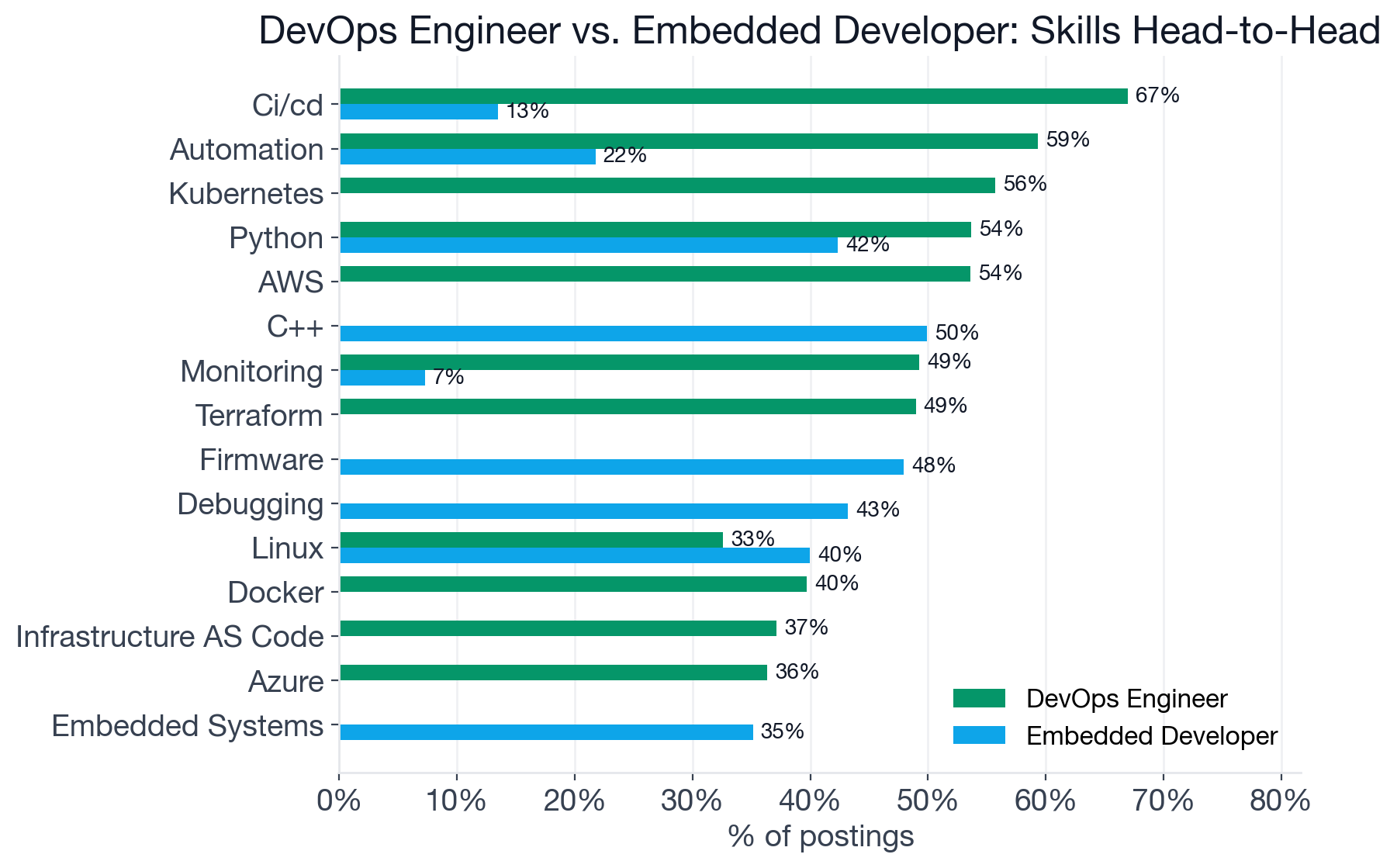 DevOps Engineer's top skills cluster around cloud infrastructure and automation. Embedded Developer's cluster around firmware and hardware protocols. The two bars barely touch.
Eight skills clear the 5% shared-frequency threshold in both roles' postings, but "shared" doesn't mean evenly shared. Python is the closest thing to a genuine bridge, appearing in 53.7% of DevOps Engineer postings and 42.3% of Embedded Developer postings, a skill that transfers cleanly in either direction. Linux (32.6% vs. 40.0%) and Git (18.2% vs. 20.2%) are similarly close. The rest of the shared list, CI/CD (66.9% vs. 13.5%), Automation (59.3% vs. 21.8%), Monitoring (49.3% vs. 7.3%), and Bash (28.9% vs. 7.1%), technically clears both roles' thresholds but is really a DevOps Engineer habit that happens to show up often enough in Embedded Developer postings to count, not evidence the two jobs converge.
Cloud Automation on One Side, the Metal Underneath on the Other
With only a 15% Jaccard overlap, DevOps Engineer and Embedded Developer read less like two rungs on the same ladder and more like two different ladders that happen to share a training program. DevOps Engineer's exclusive cluster, Kubernetes (55.7%), AWS (53.6%), Terraform (49.0%), Docker (39.7%), Infrastructure as Code (37.1%), Azure (36.4%), Observability (31.9%), Jenkins (27.1%), Ansible (25.4%), and Google Cloud (23.6%), is entirely about orchestrating software that already exists across machines someone else owns.
Embedded Developer's exclusive cluster runs in the opposite direction: C++ (49.9%), Firmware (47.9%), Debugging (43.2%), Embedded Systems (35.1%), RTOS (22.6%, short for real-time operating system, the software layer that guarantees code responds within a fixed time window), SPI and I2C (22.6% and 20.5%, two common protocols chips use to talk to each other over a handful of wires), Firmware Development (18.1%), UART (16.7%, a simpler serial protocol), and Algorithms (15.8%). None of it assumes the code is running in someone else's data center; all of it assumes the code is running a few inches from a soldering iron.
A DevOps background doesn't transfer to Embedded Developer hiring, and the reverse is equally true. The 15% overlap isn't a rounding artifact of how the data was collected, it's an honest measure of how little these two jobs actually share.
Do Either of These Jobs Actually Require AI Skills?
No, at least not in the language employers use to write postings. Neither role's top-30 skill list includes an AI, ML, or LLM skill at meaningful frequency. Generative AI shows up for DevOps Engineer only in the long tail of salary-correlated skills (60 of the 1,365 US salary data points), and Machine Learning shows up similarly thin for Embedded Developer (58 of 1,065). Read that as: almost nobody is hiring a DevOps Engineer or an Embedded Developer specifically to build AI systems.
That's an explicit-requirement floor, not a picture of actual usage. Developer surveys put AI tool adoption at 84% overall and daily use at 51% across the profession (Stack Overflow 2025 Developer Survey), and industry-specific data puts daily AI tool use among DevOps and platform professionals at 72% (Arcade.dev, 2026). For DevOps Engineer, that adoption is layering onto existing CI/CD and automation workflows rather than replacing them: engineers spend less time hand-writing scripts and more time on the system-design and orchestration decisions AI tools can't make for them. For Embedded Developer, it's reasonable to expect adoption to look narrower and more supervised, with AI tools drafting boilerplate driver code and suggesting interrupt-handling patterns while engineers keep ownership of real-time correctness and hardware verification, because a bug in a device driver fails on physical hardware, not just in a log.
Does the Bigger Job Market Pay Less?
Not here. Embedded Developer's median US base salary is $155,000 versus $151,900 for DevOps Engineer, a $3,100 (2%) edge for the smaller, far more onsite role. These are base salaries only; equity, bonus, and sign-on pay aren't disclosed in job postings and aren't reflected in either figure.
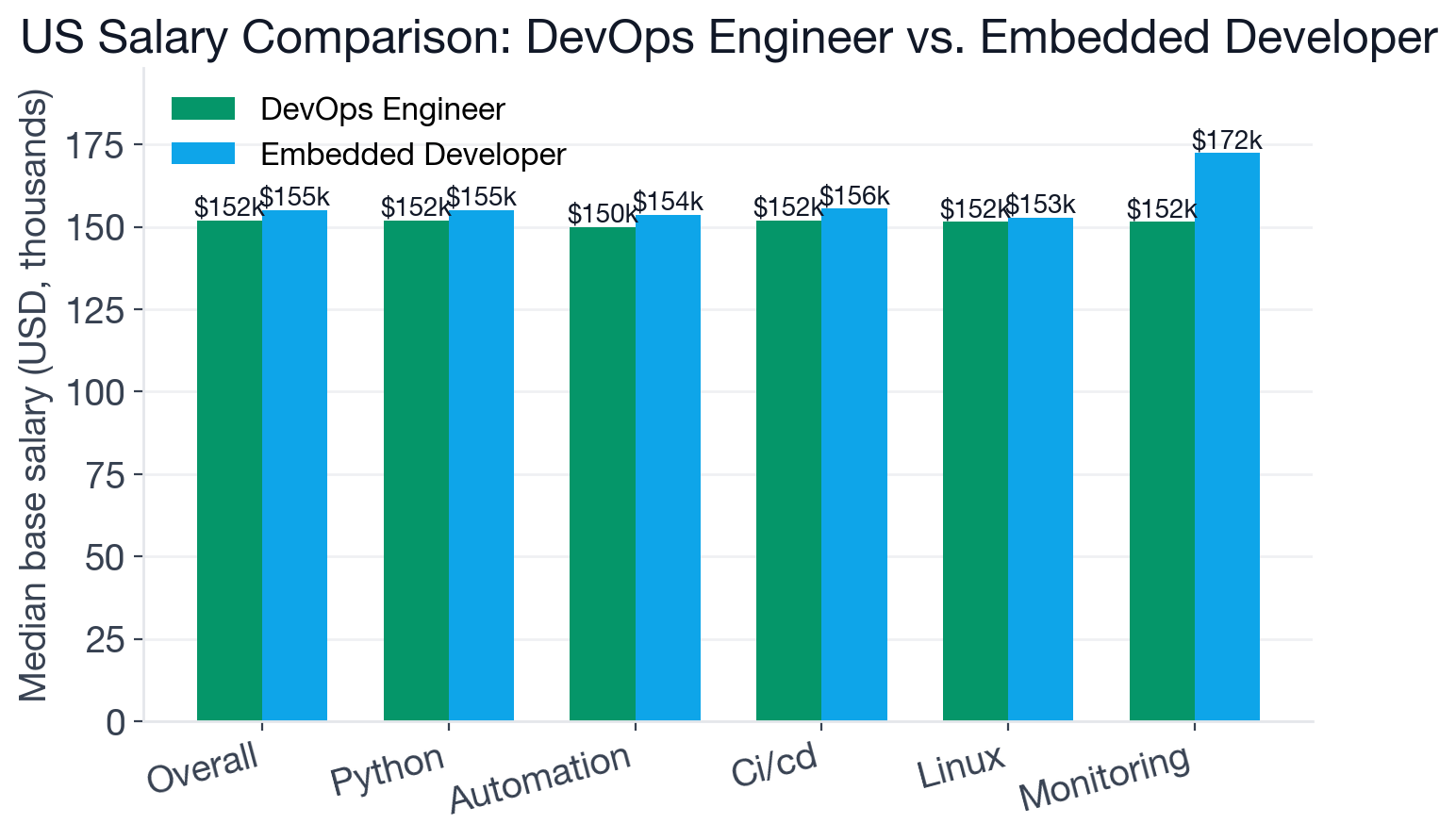 The headline medians sit within 2% of each other. The real pay differences for both roles live one layer down, in specific skills rather than the baseline title.
For DevOps Engineer, the skills that define the role barely move the needle above its own $151,900 baseline:
| Skill | % of postings | US median | vs. baseline |
|---|---|---|---|
| Observability | 31.9% | $165,000 | +$13,100 |
| Kubernetes | 55.7% | $155,000 | +$3,100 |
| AWS | 53.6% | $153,500 | +$1,600 |
| Terraform | 49.0% | $151,800 | -$100 |
| Docker | 39.7% | $151,500 | -$400 |
| Azure | 36.4% | $140,400 | -$11,500 |
The real premium sits one layer down, in data and AI-infrastructure skills that show up in a narrower slice of DevOps postings: Kafka adds $25,600 ($177,500, n=107), MLOps adds $24,700 ($176,600, n=46), and Apache Spark adds $32,700 ($184,600, n=48).
Embedded Developer's own defining skills fare a bit better against its $155,000 baseline:
| Skill | % of postings | US median | vs. baseline |
|---|---|---|---|
| Firmware Development | 18.1% | $172,000 | +$17,000 |
| Algorithms | 15.8% | $170,000 | +$15,000 |
| SPI | 22.6% | $162,500 | +$7,500 |
| I2C | 20.5% | $162,500 | +$7,500 |
| C++ | 49.9% | $159,600 | +$4,600 |
| Debugging | 43.2% | $155,000 | $0 |
But the largest Embedded Developer premiums also sit in a narrower, more specialized slice: the edge-AI perception cluster of Computer Vision (+$38,000, $193,000, n=83) and Natural Language Processing (+$58,500, $213,500, n=27), reflecting the smaller set of postings where embedded work means running AI inference on the device itself, not in the cloud.
The pattern holds on both sides: the skill in the job title is close to table stakes. The real money sits in a specialization most postings don't ask for.
Which Job Is Actually Easier to Land?
DevOps Engineer isn't just the bigger market on paper, it's the more accessible one on volume, even though entry-level share edges slightly in Embedded Developer's favor. There are 2.22x more active DevOps Engineer postings than Embedded Developer postings (6,970 vs. 3,135), but neither role is easy to enter cold: entry-level postings sit at 2.1% for DevOps Engineer and 3.0% for Embedded Developer, both effectively rounding errors in a mid-level-and-up hiring market.
Where the two roles genuinely part ways is at the senior end and on geography. Embedded Developer skews more senior overall, 17.2% of postings are staff-level versus 11.5% for DevOps Engineer, which tracks with a role where hardware mistakes are expensive and experience is harder to substitute for. Embedded Developer is also far more US-concentrated (50.0% of postings vs. 32.9% for DevOps Engineer, which spreads more broadly into India and the UK), likely because embedded and hardware-adjacent work tends to sit closer to where the physical product is designed and manufactured, while cloud infrastructure work can be run from nearly anywhere.
The Trade-off Isn't Salary, It's Everything Else
Pay isn't the variable that should drive this decision. A $3,100 gap is too small to matter next to everything else that differs.
Choose DevOps Engineer if you:
- Want the larger, more open job market (2.22x more active postings) and the option to work remotely or hybrid (54.9% of postings allow it)
- Are comfortable owning software that runs on infrastructure you don't physically touch, debugging through logs and dashboards rather than a bench setup
- Already know Python, Linux, or scripting and want to build on cloud and automation tooling rather than hardware protocols
Choose Embedded Developer if you:
- Want work that's tied to a physical product, where debugging means an oscilloscope and a board on your desk, not just a terminal
- Don't mind a mostly-onsite role (73.4%) concentrated in the US, and are aiming for the more senior end of the market (17.2% staff-level postings)
- Already know C++ or have a hardware and electronics background, and want to specialize in firmware, RTOS, or chip-to-chip protocols like SPI and I2C
How to Use This in Your Job Search
For the complete per-role skill and salary breakdown, see our deep dives on DevOps Engineer skills and Embedded Developer skills. Whichever direction you're leaning, test it against real interview conditions before committing months of study. If you already have DevOps fundamentals, practice mock interviews built around Kubernetes, Terraform, and CI/CD scenarios to see where the gaps actually are. If Embedded Developer's firmware and protocol depth is unfamiliar, the question bank is a faster way to drill RTOS, SPI, and I2C fundamentals than working through a full course first. For either path, interactive courses covering algorithms, systems, and cloud infrastructure can fill foundational gaps before you start interviewing. When you're ready, browse current DevOps Engineer openings or Embedded Developer openings to see what companies are actually asking for right now.
FAQ
Q. Does DevOps Engineer or Embedded Developer pay more in 2026?
They're within statistical rounding of each other. Embedded Developer's median US base salary is $155,000 versus $151,900 for DevOps Engineer, a $3,100 (2%) gap based on 1,065 and 1,365 US salary data points respectively. Equity, bonus, and sign-on pay are not captured in either figure.
Q. How much skill overlap is there between DevOps Engineer and Embedded Developer?
Not much. The two roles share a 15% Jaccard overlap on their top-30 skill lists. Eight skills clear the 5% shared-frequency threshold in both roles' postings (Python, Automation, CI/CD, Linux, Monitoring, Agile, Git, Bash), but most of them, including CI/CD (66.9% DevOps vs 13.5% Embedded) and Monitoring (49.3% vs 7.3%), lean heavily toward DevOps Engineer rather than reflecting genuinely shared ground.
Q. Which role has more job postings, DevOps Engineer or Embedded Developer?
DevOps Engineer, by a wide margin. The dataset analyzed 6,970 active DevOps Engineer postings versus 3,135 for Embedded Developer, a 2.22x volume advantage for DevOps Engineer.
Q. Is DevOps Engineer more remote-friendly than Embedded Developer?
Yes, considerably. 54.9% of DevOps Engineer postings offer remote or hybrid work (20.0% remote, 34.9% hybrid) versus 28.4% for Embedded Developer (7.1% remote, 21.3% hybrid). Embedded Developer work is 73.4% onsite, reflecting the hands-on hardware access the role typically requires.
Q. What skills does Embedded Developer require that DevOps Engineer doesn't?
C++ (49.9% of postings), Firmware (47.9%), Debugging (43.2%), Embedded Systems (35.1%), RTOS (22.6%, short for real-time operating system), and the low-level communication protocols SPI and I2C (22.6% and 20.5%) define the Embedded Developer stack and rarely appear in DevOps Engineer postings.
Q. Do DevOps Engineer or Embedded Developer roles require AI skills?
Not explicitly, at least not in the job-posting language. Neither role's top-30 skill list includes an AI, ML, or LLM skill at meaningful frequency; Generative AI and Machine Learning each show up only in the long tail of salary-correlated skills (60 and 58 data points respectively, out of thousands of postings). That's a floor, not a ceiling: developer surveys put AI tool adoption at 84% overall and daily use at 51% across the profession, and as high as 72% daily among DevOps and platform professionals specifically.
Q. Is it easier to break into DevOps Engineer or Embedded Developer as an entry-level candidate?
Neither is easy, but Embedded Developer has a slightly larger entry-level share: 3.0% of postings versus 2.1% for DevOps Engineer. Both roles are overwhelmingly mid-level-and-up hiring markets, and Embedded Developer additionally skews more senior at the top (17.2% staff-level postings versus 11.5% for DevOps Engineer).
The Money Isn't the Tiebreaker
Two roles this different in skills, work environment, and job-market size shouldn't converge on pay, but DevOps Engineer and Embedded Developer do, within $3,100 at the median. That's the actual finding here: whichever way you're leaning, don't let salary be the deciding factor, it barely differs between the two. What differs is everything else. DevOps Engineer offers a bigger, more open, more remote-friendly market built on cloud and automation skills. Embedded Developer offers a smaller, more onsite, more senior-skewed market built on firmware and hardware protocols. Pick the one whose daily work you'd actually want; the paycheck will land in roughly the same place either way.
Topics
Ready to practice?
Put what you've learned into practice with AI mock interviews and structured preparation guides.