
The Management Title Doesn't Ask for Management Skills
Engineering Manager is supposed to be the job where you stop writing code and start managing people. The postings don't back that up. We pulled every active listing on the InterviewStack.io job board as of July 2026, 8,365 Engineering Manager postings against 3,057 for Embedded Developer, and the skill everyone assumes defines the EM title, People Management, doesn't even crack the role's own top 10. Automation, Agile, AWS, CI/CD, and Python all outrank it.
Embedded Developer, the comparison role here, isn't a management job at all. It's the low-level counterpart: C++, firmware, and debugging on real hardware. Putting the two side by side does two things at once. It shows how thin the actual skill overlap is between "manages engineers" and "is one," and it uses Engineering Manager's own top-30 list to make a sharper point: the postings for the job with "manager" in the title read more like a senior technical role than a people-leadership one.
A data-quality note on both samples: InterviewStack.io's role classifiers aren't perfect. Roughly a fifth of the sampled Engineering Manager titles are non-software engineering managers, defense- and hardware-adjacent titles like "Production Engineering Manager" and "Power (DC-DC) Engineering Manager" at employers such as Northrop Grumman, Boeing, and GE Vernova, plus a couple of intern and student listings that don't belong in a manager population at all. The Embedded Developer sample carries a similar-sized slice of pure hardware and electronics titles ("RF Hardware Engineer," "Digital Design Engineer," "Senior Electronics Engineer") alongside genuine embedded-software roles. Neither contamination changes the shape of the comparison, technical and cloud skills still beat people-management skills in the EM data by a wide margin, and firmware/C++ still dominate the embedded data, but it means the skill percentages below, especially Engineering Manager's top skill, Automation, which likely blends software delivery automation with some industrial-process automation, should be read as directional rather than exact.
| Engineering Manager | Embedded Developer | |
|---|---|---|
| Median US base salary | $200,000 | $157,500 |
| Active postings | 8,365 | 3,057 |
| Top skill | Automation (24.0%) | C++ (51.4%) |
| Onsite share | 56.7% | 73.2% |
| Entry-level share | 1.6% | 3.0% |
| Skill overlap (Jaccard) | 0.13 (tied lowest in series) | (pairwise) |
Key Findings
- Engineering Manager's own top skill, Automation, sits at just 24.0% of postings, and People Management, the skill in the job title, ranks 15th at 12.0%.
- Engineering Manager pays a $42,500 (27%) median premium over Embedded Developer: $200,000 vs $157,500 US base salary.
- Skill overlap between the two roles is 0.13 Jaccard, tying the lowest overlap measured across this comparison series so far.
- Embedded Developer is 73.2% onsite versus 56.7% for Engineering Manager, a 16.5-point gap in work-mode flexibility.
- Engineering Manager posts 2.74 times more openings than Embedded Developer (8,365 vs 3,057 active listings).
- Distributed Systems and People Management carry the two largest pay premiums among Engineering Manager's own exclusive skills: $39,200 and $30,000 above the role's baseline, respectively.
- Neither role is a true entry-level track: 1.6% of Engineering Manager postings and 3.0% of Embedded Developer postings are entry-level.
Two Titles, Two Very Different Days at Work
An Engineering Manager runs 1:1s and performance reviews, translates a director's priorities into a roadmap the team can execute, and unblocks technical decisions without necessarily writing production code day to day. In 2026, that increasingly includes using agentic AI tools to stay hands-on in the codebase, a "player-coach" pattern industry commentary attributes directly to AI tool maturity, so the EM can review a pull request or debug an incident without doing full-time implementation work.
An Embedded Developer writes and debugs the software that runs directly on hardware: device drivers, real-time operating systems, and communication protocols like SPI and I2C that move data between a microcontroller and its sensors. The work is scoped to a bill of materials and a hardware bring-up schedule, not a product roadmap, and it hands off a working firmware image to a QA or manufacturing team rather than to an end user directly.
Which Skills Do Both Jobs Actually Share?
Python is the strongest bridge between the two roles, but its frequency runs backward from what the titles suggest. It shows up in 42.3% of Embedded Developer postings, roughly double its 20.8% rate in Engineering Manager postings, because embedded teams use it to script test rigs, automate hardware bring-up, and drive calibration tools. The other shared skills tilt the other way: Automation, Agile, and CI/CD are more common in Engineering Manager postings, delivery-process skills a manager needs to run a team's cadence more than an individual firmware engineer needs to hit a chip's timing budget.
| Skill | Engineering Manager | Embedded Developer |
|---|---|---|
| Python | 20.8% | 42.3% |
| Automation | 24.0% | 21.3% |
| Agile | 23.9% | 18.4% |
| CI/CD | 21.8% | 13.0% |
| Code Review | 13.8% | 14.5% |
| Monitoring | 16.6% | 7.7% |
| System Design | 9.0% | 7.0% |
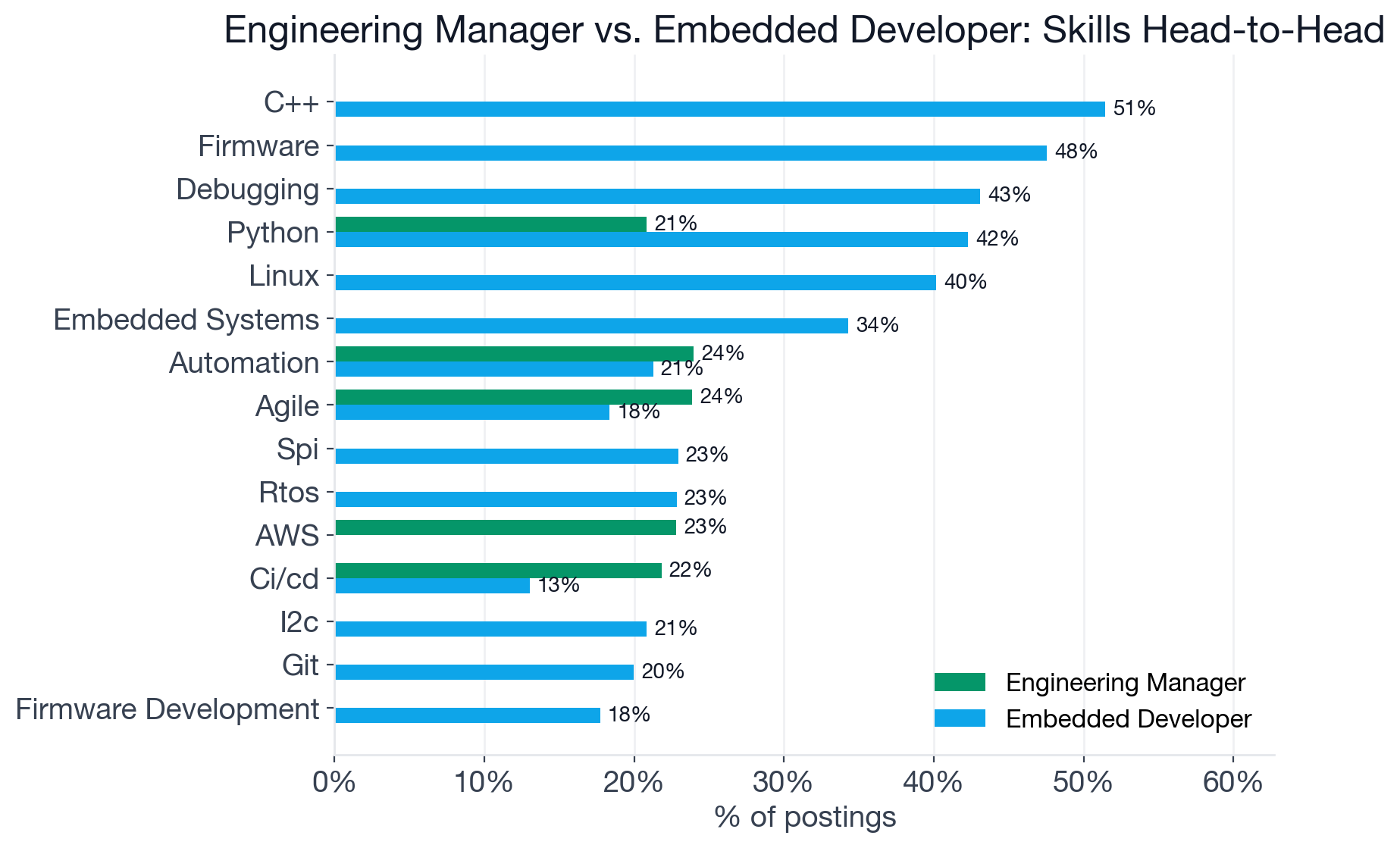 Automation, Agile, and CI/CD cluster on the Engineering Manager side; C++, Firmware, and Debugging dominate Embedded Developer's side, with almost nothing bridging the two beyond Python.
Where the Two Roles Pull Apart
The divergence explains the low overlap better than any single number does. On the Engineering Manager side, the top exclusive skills are all cloud and platform infrastructure, AWS (22.8%), Scalability (15.5%), Java (15.3%), Observability (15.2%), Azure (13.2%), Kubernetes (12.5%), Google Cloud (12.3%), and Distributed Systems (12.3%), before People Management (12.0%) or SQL (11.8%) even appear. Project Management (10.9%), Performance Management (8.5%), Team Leadership (8.5%), and Stakeholder Management (8.0%) round out the role's people-adjacent skills further down the list. Every one of them trails Engineering Manager's own leading technical skills.
Embedded Developer's exclusive list is a different kind of job entirely: C++ (51.4%), Firmware (47.6%), Debugging (43.1%), Linux (40.1%), Embedded Systems (34.3%), SPI (22.9%), RTOS (22.8%, a real-time scheduler built for hardware timing constraints), I2C (20.8%), Git (20.0%), and Firmware Development (17.7%). None of these appear on Engineering Manager's list at meaningful frequency, which is why the Jaccard overlap between the two roles lands at 0.13, tying the lowest overlap measured across InterviewStack.io's role-comparison series so far (Full-Stack Developer vs Embedded Developer, published earlier this month, is the other 0.13 pairing).
| Exclusive to Engineering Manager | Freq | Exclusive to Embedded Developer | Freq |
|---|---|---|---|
| AWS | 22.8% | C++ | 51.4% |
| Scalability | 15.5% | Firmware | 47.6% |
| Java | 15.3% | Debugging | 43.1% |
| Observability | 15.2% | Linux | 40.1% |
| Azure | 13.2% | Embedded Systems | 34.3% |
| Kubernetes | 12.5% | SPI | 22.9% |
| Google Cloud | 12.3% | RTOS | 22.8% |
| Distributed Systems | 12.3% | I2C | 20.8% |
| People Management | 12.0% | Git | 20.0% |
| SQL | 11.8% | Firmware Development | 17.7% |
Which Role Pays More?
Engineering Manager, and by a wide margin: $200,000 median US base salary (n=2,369) versus $157,500 for Embedded Developer (n=1,033), a $42,500 gap, 27% higher. These are base salaries only; equity, bonus, and sign-on aren't disclosed in postings, so total compensation at top employers runs higher than either figure on its own.
Inside that gap, the two most valuable Engineering Manager skills aren't the most common ones. Distributed Systems and People Management carry the largest premiums over the role's own $200,000 baseline, at $39,200 and $30,000 respectively, while more common skills like AWS (+$5,300) and Azure (-$4,600 below baseline) barely move the needle or actively pull it down. SQL, despite clearing the exclusivity threshold, pays $14,800 below the EM median. The pattern: the skills every EM posting lists (cloud, automation) are table stakes; the skills only some postings list (distributed-systems depth, genuine people leadership) are what the pay premium is actually built on.
Embedded Developer's own premiums follow a similar shape. Its defining skills, C++ (+$2,500), Firmware (+$4,500), Debugging (-$1,500 below baseline), Linux (-$2,500), and Embedded Systems (exactly at baseline), pay close to the role's $157,500 median either way. The real premiums sit one layer down, in protocol-specific work: SPI (+$7,900), I2C (+$7,500), and Firmware Development (+$12,000, the production-scoped counterpart to generic "Firmware"). A small elite tail exists too: Natural Language Processing and Computer Vision postings pay $193,000 to $213,500 (n=29-89), edge-AI and perception niches within embedded work, not the mainstream hiring signal.
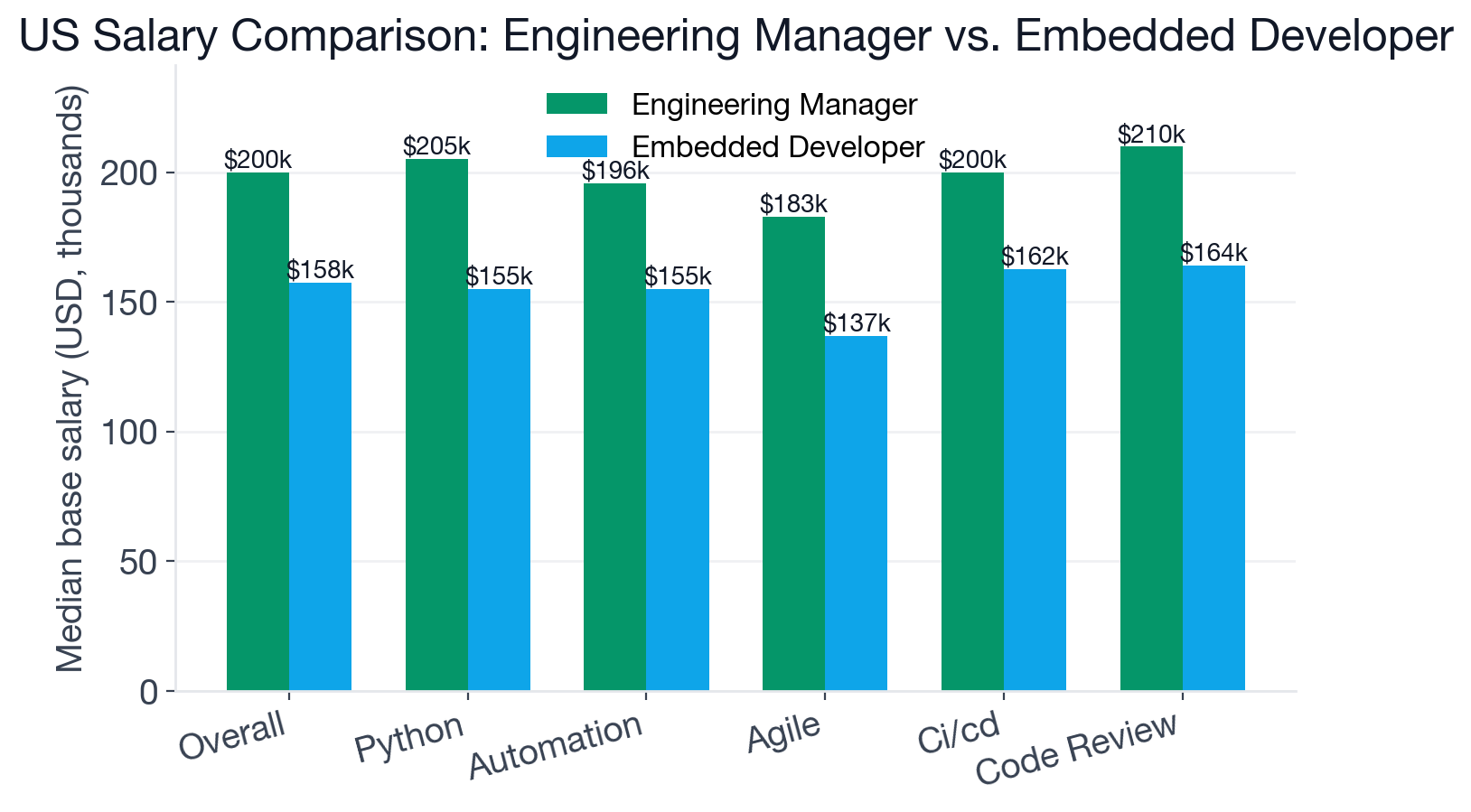 US base salary only; Engineering Manager's premium widens further once Distributed Systems or People Management is an explicit requirement.
Neither role's top-30 skill list carries a mainstream AI or machine learning tag: Machine Learning reaches 8.4% of Engineering Manager postings and doesn't appear at all in Embedded Developer's top 30. That understates real usage. Developer surveys put AI-coding-tool adoption at 84% among developers generally in 2025 (Stack Overflow), and a 2026 embedded-specific survey put it at 89% among embedded software teams (Black Duck), even as embedded's AI story is newer and more cautious than general software's: AI coding assistance for hardware-coupled, real-time code only became reliably useful in 2026, and adoption there comes with more code-quality scrutiny given the higher cost of a mistake in timing- or safety-critical firmware. For Engineering Managers, the shift is different in kind: agentic tools are enabling more EMs to review AI-assisted code themselves, a use case that jumped from 20% to 49% adoption in a single year (Jellyfish, 2026).
Which Has More Job Openings, and Who Can Get One?
Engineering Manager, by 2.74 times: 8,365 active postings versus 3,057 for Embedded Developer. Neither role is a realistic entry point, though. Engineering Manager postings are 1.6% entry-level and 65.4% mid-level, essentially requiring prior engineering experience before management experience. Embedded Developer is a little more open at 3.0% entry-level, still thin, but roughly double EM's share, with 52.1% mid-level and a notably higher senior-plus tail (27.7% senior, 17.1% staff, versus EM's 15.3% senior and 17.7% staff).
Work mode is where the two roles diverge hardest outside of skills. Engineering Manager is 56.7% onsite, 31.0% hybrid, and 17.9% remote. Embedded Developer is 73.2% onsite, 21.2% hybrid, and just 7.4% remote, a gap that tracks the nature of the work: firmware and hardware bring-up require lab access and physical proximity to the device under test in a way that running engineering standups does not. Geographically, both roles concentrate in the US (43.9% EM, 50.0% Embedded) and India (13.0% EM, 8.5% Embedded), but Embedded Developer's list includes Taiwan (4.0%), reflecting the semiconductor and hardware-manufacturing hubs that don't show up in Engineering Manager's geographic footprint at all.
Weighing the Trade-offs
Choose Engineering Manager if you:
- Already have People Management experience or want to build it deliberately. It's rare enough (12.0% of postings) and paid well enough (+$30,000 over the EM baseline when explicitly required) to function as a genuine differentiator, not a checkbox.
- Want the larger job pool and the higher pay ceiling. EM posts 2.74x more openings and pays a $42,500 median premium.
- Are comfortable with a cloud-and-platform technical baseline. AWS, Kubernetes, and distributed-systems fluency show up far more often than pure people-leadership skills, so staying technical still matters.
Choose Embedded Developer if you:
- Want to work directly on hardware-coupled software: firmware, device drivers, RTOS scheduling, and protocols like SPI and I2C.
- Are fine trading remote flexibility for the work itself. 73.2% of postings are onsite, tied to lab and manufacturing access.
- Want a narrower, more defined skill stack to specialize in rather than a broad, title-dependent one. C++ alone clears 51.4% of postings, more concentration than Engineering Manager's entire top skill.
How to Use This in Your Job Search
If you're weighing a move into engineering management, the gap between what the title implies and what postings actually ask for is worth closing before you apply. Practice with AI mock interviews that simulate both technical and people-management scenarios, since real EM postings test both. If Distributed Systems is the skill you're missing, the Question Bank has focused drilling on system design and scaling scenarios that show up in EM interview loops.
For Embedded Developer, the stack is narrower but deeper: interactive courses covering algorithms, systems fundamentals, and low-level programming can build the foundation before you specialize into RTOS or protocol work. Either way, browse current Engineering Manager or Embedded Developer openings on the InterviewStack.io job board to see what a specific posting actually requires, rather than assuming from the title.
FAQ
Q. Which pays more, Engineering Manager or Embedded Developer?
Engineering Manager pays more. The median US base salary is $200,000 for Engineering Manager (n=2,369) versus $157,500 for Embedded Developer (n=1,033), a $42,500 (27%) gap. Equity, bonus, and sign-on are not reflected in job-posting salary fields.
Q. How much skill overlap is there between Engineering Manager and Embedded Developer?
Very little. The Jaccard overlap across each role's top-30 skills is 0.13, tying the lowest overlap measured across InterviewStack.io's role-comparison series to date (Full-Stack Developer vs Embedded Developer is the other 0.13 pairing). Python, Automation, Agile, CI/CD, Code Review, Monitoring, and System Design are the only skills that clear the shared-skill threshold in both roles.
Q. Do Engineering Manager job postings actually ask for people management skills?
Rarely, relative to technical skills. People Management appears in just 12.0% of Engineering Manager postings, ranking 15th among the role's own top 30 skills, behind Automation (24.0%), Agile (23.9%), AWS (22.8%), CI/CD (21.8%), Python (20.8%), Monitoring (16.6%), Scalability (15.5%), Java (15.3%), Observability (15.2%), Code Review (13.8%), Azure (13.2%), Kubernetes (12.5%), and Google Cloud and Distributed Systems (12.3% each).
Q. What skills define Embedded Developer that Engineering Manager doesn't need?
C++ (51.4% of postings), Firmware (47.6%), Debugging (43.1%), Linux (40.1%), Embedded Systems (34.3%), SPI (22.9%), and RTOS (22.8%, a scheduler built for time-critical embedded code) are the skills that separate Embedded Developer from Engineering Manager most sharply.
Q. Is Engineering Manager or Embedded Developer easier to break into?
Neither is a genuine entry-level track, but Embedded Developer has roughly double the entry share: 3.0% of Embedded Developer postings are entry-level versus 1.6% for Engineering Manager. Engineering Manager still posts 2.74 times more openings overall (8,365 vs 3,057).
Q. Which role offers more remote or hybrid work?
Engineering Manager, by a wide margin. 48.9% of Engineering Manager postings offer hybrid or remote work versus 28.6% for Embedded Developer, which is 73.2% onsite. Hardware bring-up, lab access, and manufacturing coordination keep embedded work tied to a physical location far more than software delivery does.
Q. How much of each role explicitly requires AI or machine learning skills?
Barely any, on paper. Machine Learning appears in just 8.4% of Engineering Manager postings and doesn't clear Embedded Developer's top-30 skill list at all. But explicit mentions understate real usage: developer surveys put AI-coding-tool adoption at 84% among developers generally (Stack Overflow, 2025) and around 89% among embedded software teams specifically (Black Duck, 2026), so most engineers in both roles already use AI tools day to day even though job postings rarely say so.
Look at the Skills List, Not the Job Title
"Engineering Manager" promises people leadership; the postings mostly ask for cloud infrastructure and delivery process, with people management as a minority requirement that happens to pay well when it's genuinely there. "Embedded Developer" promises hardware-level code, and the postings deliver exactly that, tightly, at 51.4% C++ concentration. If you're choosing between these two paths, or deciding whether a management track is really what a given EM posting wants from you, read the skill list in the posting itself before you read the title.
Topics
Ready to practice?
Put what you've learned into practice with AI mock interviews and structured preparation guides.