
GCFA Shows Up Constantly in Forensics Postings, But It Rarely Gates the Job
Job postings for Digital Forensic Examiner, Cybersecurity Engineer, and Information Security Analyst roles name the GIAC Certified Forensic Analyst (GCFA) credential often enough to look like a standard expectation for forensic work, then almost never insist on it. Of the 172 GCFA mentions we found across 9,080 active postings in these three roles on the InterviewStack.io job board (a trailing 90-day window), only 4 use language that reads as a hard requirement. The rest either explicitly call it preferred or drop the name into a list of nice-to-haves with no qualifier at all.
That gap between "named constantly" and "actually mandatory" is the story. GCFA is real, targeted, forensic-specific demand, not a generic keyword: it shows up roughly nine times more often in Digital Forensic Examiner postings than in the two adjacent security roles that share its scope. But naming a credential and gating a hire on it are different acts, and this dataset draws that line unusually clearly.
Key Findings
- GCFA appears in just 1.9% of postings across its three-role scope (172 of 9,080), concentrated heavily in one role.
- Digital Forensic Examiner asks for GCFA in 11.3% of its postings (66 of 582), roughly 9 times the rate of Cybersecurity Engineer (1.2%) or Information Security Analyst (1.3%).
- Only 4.8% of classified GCFA mentions (4 of 83) read as a hard requirement; 95.2% (79 of 83) read as preferred.
- Over half of all GCFA mentions (89 of 172, 52%) do not specify required or preferred at all.
- GCFA-mentioning postings advertise a median US base salary of $151,475 versus $139,950 for non-mentioning postings in the same three roles, an 8.2% gap that narrows to 5.7% at mid-level, the one seniority band with enough disclosed salaries to measure directly.
- GIAC GCIH appears alongside GCFA in 82% of GCFA-mentioning postings; CISSP appears in 52%.
- No single employer dominates: Booz Allen Hamilton and Leidos each account for just 4.7% of mentions (8 of 172), and the top 12 employers combined cover only 33% of all mentions.
How Rarely Do GCFA Postings Actually Spell Out "Required"?
Of the 172 postings that mention GCFA, only 83 (48%) use wording near the mention that clearly signals required or preferred; the other 89 (52%) name the credential without saying which it is. Within that classified group of 83, the split is lopsided: 4 mentions (4.8%) read as a hard requirement, and 79 (95.2%) read as preferred. The comparison group here is other GCFA-mentioning postings in the same three roles, not the whole job market.
That is a striking ratio for a credential this specific to the work. GCFA is not a generic keyword getting swept into boilerplate; it signals real forensic depth (memory analysis, timeline reconstruction, advanced incident investigation), which is exactly why the near-absence of hard-requirement language stands out. The likely read is that hiring managers want to see the credential on a resume and treat it as a strong positive signal, but they are not willing to shrink an already thin applicant pool by making it a hard gate. A recruiter screening for the underlying skills, not the certificate, gets more candidates that way.
Digital Forensic Examiner Asks for GCFA About Nine Times as Often as the Other Two Roles
Digital Forensic Examiner is the smallest of the three scoped roles by posting volume (582 of the 9,080 postings, 6.4%) but supplies 38% of every GCFA mention (66 of 172). Its mention rate, 11.3%, is roughly nine times Information Security Analyst's rate (1.3%, 53 of 4,150) and Cybersecurity Engineer's rate (1.2%, 53 of 4,348), which land within a rounding error of each other despite Cybersecurity Engineer having the larger posting base.
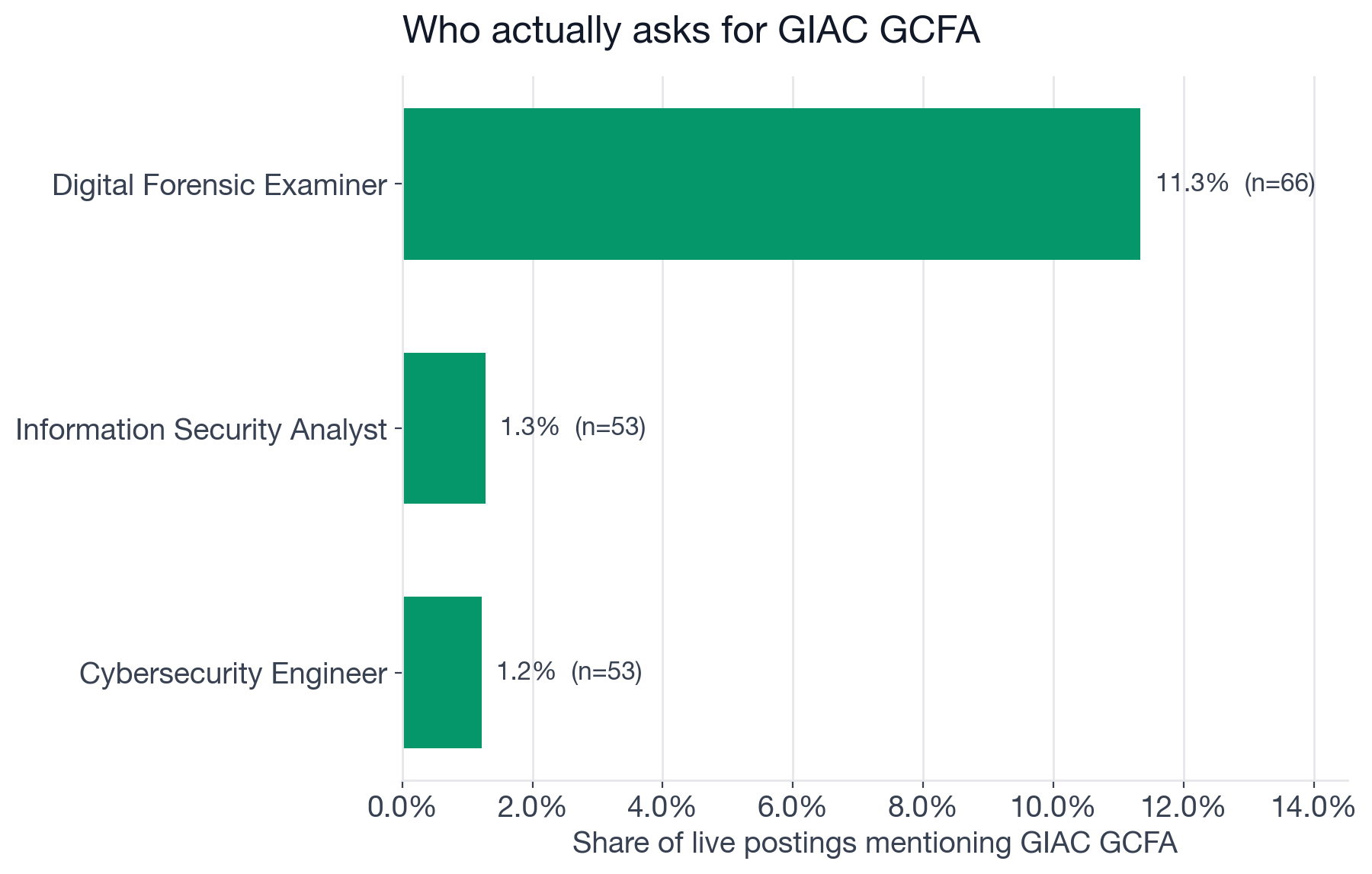 Digital Forensic Examiner postings mention GCFA at roughly nine times the rate of Cybersecurity Engineer or Information Security Analyst postings in the same 90-day window.
That concentration is not a pay-tier artifact. Digital Forensic Examiner's own baseline pay ($140,100 median among postings that do not mention GCFA) sits between Information Security Analyst's ($104,300, the lowest of the three) and Cybersecurity Engineer's ($163,000, the highest), not at either extreme, yet it has by far the strongest pull on this credential. The more plausible explanation is functional fit: GCFA's focus on memory forensics and timeline reconstruction maps directly onto what a Digital Forensic Examiner actually does day to day, closer to that role's core work than to general security-analyst or engineering duties. That is a reasonable read of the pattern, not a claim the data proves outright.
One methodology note: role classification on this job board is drawn from title and description matching, and the Digital Forensic Examiner bucket in particular tends to sweep in incident-response and SOC-analyst postings alongside literal forensic-examiner roles. Read the 582-posting DFE pool and its 11.3% GCFA rate as describing the broader DFIR-adjacent population the certification targets, not a narrow count of postings titled exactly "Digital Forensic Examiner."
GCFA's Pay Gap Narrows When You Control for Seniority, But Doesn't Vanish
Salary figures here are advertised US base pay only, on the subset of postings in these three roles that disclose a number: no equity, bonus, or non-US postings, and the comparison is against other postings within the same role scope, not the whole market.
GCFA-mentioning postings advertise a median of $151,475 across 65 postings with disclosed salary, versus $139,950 across 3,194 postings that do not mention it, a gap of $11,525, or 8.2%. Before reading that as what the certificate is worth, look at who is in each group: GCFA-mentioning postings skew meaningfully more senior. More than half (50.6%) sit at senior level or above, versus 31.3% of the comparison group, and the average seniority (on a 0-to-3, entry-to-staff scale) is 1.62 for GCFA postings versus 1.39 for the rest. (Seniority here is inferred from title keywords, and a title with no explicit level word defaults to mid-level, which can compress this measured spread; treat the 50.6%-versus-31.3% comparison as directional rather than exact.)
That composition difference explains a real share of the gap. The only seniority band with enough salary-disclosing postings on both sides to report a median directly is mid-level, and there the gap is $6,775, or 5.7% ($126,350 versus $119,575), noticeably smaller than the 8.2% headline number.
| Level | With GCFA | Without GCFA | Delta |
|---|---|---|---|
| Entry | Not reportable (n=1) | $80,500 (n=87) | N/A |
| Mid-level | $126,350 (n=42) | $119,575 (n=2,038) | +5.7% |
| Senior | Not reportable (n=9) | $165,750 (n=652) | N/A |
| Staff | Not reportable (n=13) | $176,100 (n=417) | N/A |
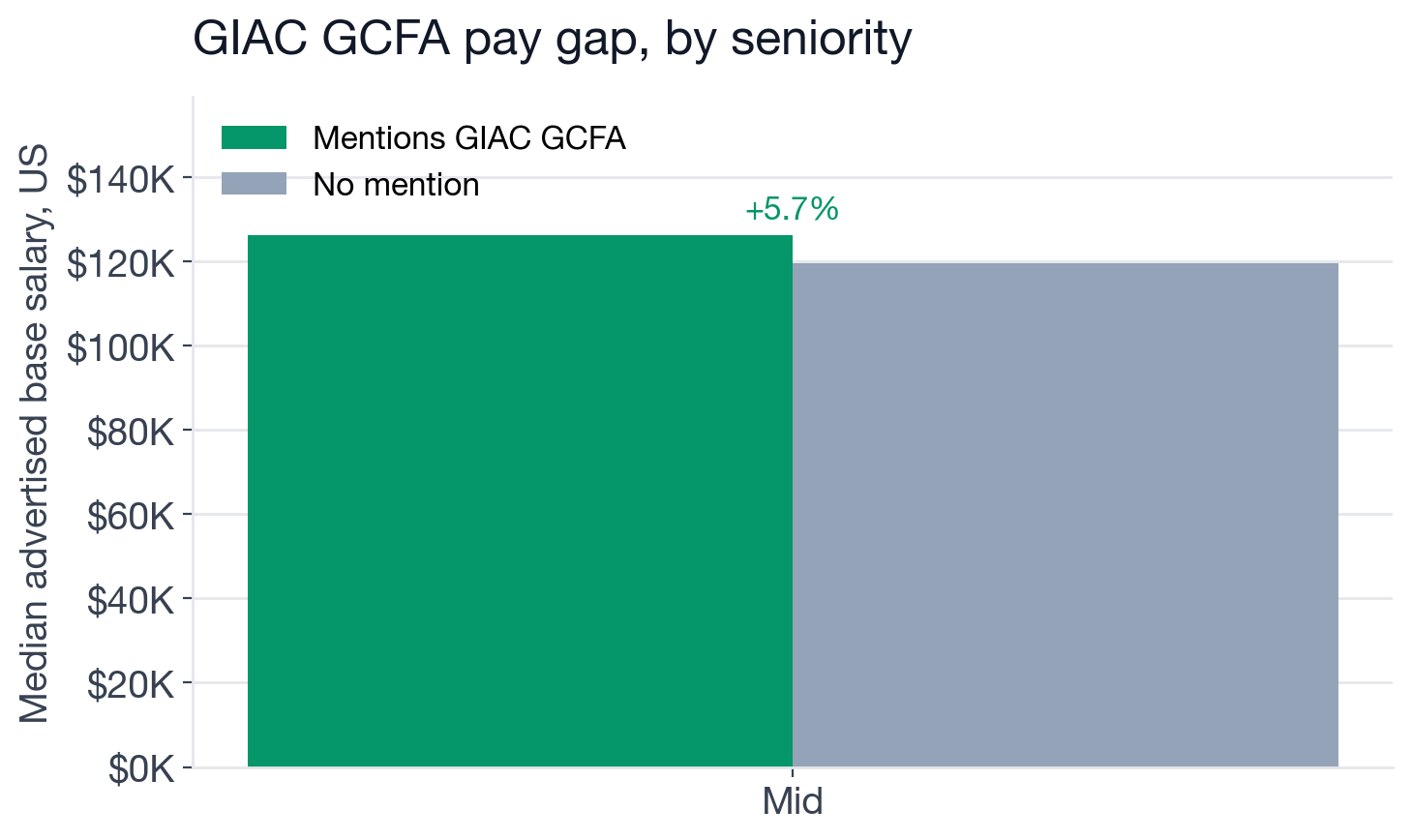 Entry, senior, and staff bands fall below the 25-posting floor needed to report a median with confidence; mid-level is the only band measurable on both sides.
Entry, senior, and staff bands all fall below the 25-posting floor needed for a reliable median (GCFA sample sizes of 1, 9, and 13). The honest read: a real, positive premium survives at mid-level, and the more senior bands, where the comparison group already earns $165,750 to $176,100 without the credential, are pulling the aggregate higher without a directly measurable GCFA-specific number to confirm by how much.
Does GCFA Ever Appear on Its Own?
Rarely. GIAC GCIH shows up alongside GCFA in 82% of GCFA-mentioning postings, and CISSP in 52%. GCFA functions less like a standalone line item and more like one credential in a blue-team stack that postings tend to list together.
| Certification | Co-occurs with GCFA | Share of GCFA mentions |
|---|---|---|
| GIAC GCIH | 141 | 82.0% |
| CISSP | 90 | 52.3% |
| GIAC GCIA | 74 | 43.0% |
| OSCP | 33 | 19.2% |
| CEH | 28 | 16.3% |
| CompTIA CySA+ | 25 | 14.5% |
The skills named alongside GCFA tell the same story. Incident Response leads at 92.4% of GCFA-mentioning postings, followed by SIEM (Security Information and Event Management platforms) and Security Operations, both at 58.7%, and Threat Intelligence at 55.8%.
| Skill | Share of GCFA postings |
|---|---|
| Incident Response | 92.4% |
| SIEM | 58.7% |
| Security Operations | 58.7% |
| Threat Intelligence | 55.8% |
| Python | 47.7% |
| Digital Forensics | 30.8% |
That mix reads as active investigation and response work, not general security administration. A candidate weighing GCFA is better served drilling incident-response and SIEM fluency than treating the certificate itself as the differentiator; the credential and those skills travel together in nearly every posting that mentions it.
GCFA Hiring Spans Banks, Chipmakers, and Cybersecurity Vendors, Not Just Contractors
No single company or industry drives GCFA demand. The top 12 employers combined account for only 33% of all 172 mentions, and the top two, Booz Allen Hamilton and Leidos, are tied at 8 mentions apiece.
| Company | Mentions | Sector |
|---|---|---|
| Booz Allen Hamilton | 8 | Defense/government contractor |
| Leidos | 8 | Defense/government contractor |
| BNY | 7 | Banking |
| 6 | Technology | |
| Peraton | 4 | Defense/government contractor |
| PricewaterhouseCoopers | 4 | Consulting |
| CrowdStrike | 4 | Cybersecurity vendor |
| KPN | 4 | Telecommunications |
| Altruist | 3 | Fintech |
| Salesforce | 3 | Enterprise software |
| NXP Semiconductors | 3 | Semiconductors |
| Flywire | 3 | Fintech |
Even counting every defense and government contractor in that list (Booz Allen Hamilton, Leidos, and Peraton), they add up to just 35% of the top 12's mentions and 12% of all 172 mentions overall, well short of a majority. The rest of the roster is genuinely mixed: a bank running its own security operations (BNY), a Big Four consultancy (PricewaterhouseCoopers), a dedicated cybersecurity vendor (CrowdStrike), a European telecom running its own incident-response team (KPN, whose titleSample includes a "Cyber Security Specialist - KPN-CERT" posting), and hardware and fintech companies (NXP Semiconductors, Flywire) that need forensic capability to protect their own infrastructure. GCFA demand reads as broad-based interest in in-house forensic and incident-response capacity, not a compliance requirement specific to one sector.
How to Act on GCFA's Numbers in Your Own Search
If you are deciding whether to add GCFA to your resume, treat these numbers as a targeting signal, not a gate. The skills that travel with GCFA mentions, incident response, SIEM operations, and threat hunting, are worth drilling directly through the Question Bank, which has focused practice sets for incident-response and digital-forensics topics, so you can find where your own answers are thin before an interviewer does.
Since GCFA rarely functions as a hard requirement, the interview conversation around it (how you would walk through a memory-forensics case, reconstruct an incident timeline, or justify an investigative decision) matters more than the credential line on a resume. AI mock interviews let you rehearse that conversation against realistic follow-up questions before it counts.
If you are earlier in the path and GCFA feels like a stretch, interactive courses covering security operations, incident response, and cloud security can build the foundation the certification assumes you already have.
For the search itself, Digital Forensic Examiner openings are where GCFA mentions concentrate most heavily. Cybersecurity Engineer and Information Security Analyst postings are worth screening too, since GCFA still shows up there, just at a much lower rate. Two closely related GIAC credentials are also worth reading about if you are weighing which to pursue first: GIAC GCIH, the certification that appears alongside GCFA most often, and CISSP, the broad security-management credential that shows up in over half of GCFA-mentioning postings.
FAQ
Q. What percentage of security postings mention the GCFA certification?
GCFA appears in 172 of 9,080 active postings (1.9%) across Digital Forensic Examiner, Cybersecurity Engineer, and Information Security Analyst roles on the InterviewStack.io job board, in a trailing 90-day window. Demand concentrates heavily in Digital Forensic Examiner postings specifically.
Q. Is GCFA usually a required certification, or is it just preferred?
Among the 83 GCFA mentions that clearly state required or preferred, only 4 (4.8%) are phrased as a hard requirement; the remaining 79 (95.2%) read as preferred. Over half of all 172 mentions (89, or 52%) do not specify either way.
Q. Which role most often asks for GCFA?
Digital Forensic Examiner. GCFA appears in 11.3% of Digital Forensic Examiner postings (66 of 582), roughly 9 times the rate seen in Cybersecurity Engineer (1.2%) or Information Security Analyst (1.3%) postings in the same dataset. Note that this job board's Digital Forensic Examiner classification also captures incident-response and SOC-analyst postings, not just literally-titled examiner roles, so this figure describes DFIR-adjacent demand broadly.
Q. Do postings that mention GCFA advertise higher salaries?
Postings mentioning GCFA advertise a median US base salary of $151,475 versus $139,950 for postings in the same three roles that do not mention it, an 8.2% gap. Most of that gap traces to seniority mix: GCFA postings skew more senior, and the one seniority band with enough salary data to measure cleanly (mid-level) shows a smaller, 5.7% gap.
Q. What other certifications typically appear alongside GCFA in job postings?
GIAC GCIH appears alongside GCFA in 82% of GCFA-mentioning postings, and CISSP in 52%. GCFA rarely stands as the only forensics or security credential listed in a posting.
Q. What does GCFA stand for?
GCFA stands for GIAC Certified Forensic Analyst, a digital forensics and incident-response credential issued by GIAC, the certification body affiliated with the SANS Institute.
Q. Which companies post the most GCFA-related openings?
No single employer or industry dominates. Booz Allen Hamilton and Leidos each account for 8 of the 172 mentions, but the roster also includes a bank (BNY), a Big Four consultancy (PricewaterhouseCoopers), cybersecurity vendors (CrowdStrike), and hardware and fintech companies (NXP Semiconductors, Flywire), spanning well beyond government contracting.
Where GCFA Actually Fits in a Forensics Career Plan
GCFA's numbers describe a credential that forensic teams recognize and value without treating it as a gate. It shows up in roughly 1 in 9 Digital Forensic Examiner postings, about nine times the rate of the two adjacent security roles, and it rarely travels alone: postings that name GCFA usually name GIAC GCIH and CISSP right alongside it. But when a posting bothers to say whether the credential is required or merely preferred, it says preferred nineteen times out of twenty. Read that as employers signaling a real preference for candidates who have done the deep forensic and incident-response work GCFA represents, without narrowing the applicant pool by drawing a hard line. If you already have the underlying skills, adding GCFA is a reasonable resume move. It just will not be the line that gets an application opened on its own; the incident-response and forensics substance behind it will.
Topics
Ready to practice?
Put what you've learned into practice with AI mock interviews and structured preparation guides.