
GCIH's Demand Is a Digital Forensics Story, Not a Security-Wide One
Look at GCIH (GIAC Certified Incident Handler), issued through the SANS Institute's GIAC certification body, across five security roles and the aggregate rate looks modest: 3.58% of postings mention it. That number buries the actual story. Narrow the same search to Digital Forensic Examiner postings alone and the rate climbs to 14.83%, nearly 17 times the 0.89% rate at Security Architect, the role least likely to name it. GCIH doesn't read as a general security credential that shows up everywhere a little. It reads as a forensics-and-incident-response credential that shows up a lot in exactly one role and modestly elsewhere.
We looked at active postings across Information Security Analyst, Cybersecurity Engineer, Penetration Tester, Security Architect, and Digital Forensic Examiner roles on the InterviewStack.io job board over a 90-day window, screening each description for a GCIH mention and the language immediately around it. GCIH turned up in 347 of 9,691 postings in scope.
The rest of this breakdown covers exactly how lopsided that role split is, whether a GCIH mention is usually a real requirement, what the pay comparison actually shows once you control for seniority, and who is posting these jobs.
Key Findings
- GCIH appears in 3.58% of active postings across five security roles (347 of 9,691 analyzed over 90 days).
- Digital Forensic Examiner postings mention GCIH at 14.83%, nearly 17 times Security Architect's 0.89% rate and about 4.1 times the five-role aggregate.
- Only 11.64% of classified mentions call GCIH required; 88.36% call it preferred, and 45.5% of all mentions don't specify either way.
- The aggregate US salary comparison is nearly flat (+1.17%), but both reportable seniority bands show a real premium: +5.02% at mid-level, +4.09% at senior.
- By role, the salary story is mixed: Cybersecurity Engineer, tied for the most GCIH mentions of any role, shows a small negative comparison (-2.0%), while Information Security Analyst (+21.4%) and Digital Forensic Examiner (+6.3%) both show clear premiums.
- GCIH-mentioning postings skew more senior than the rest of the market (36.0% senior-plus-staff versus 31.0%).
- Incident Response appears in 76.08% of GCIH-mentioning postings, the single most common associated skill.
- CISSP co-occurs with 55.9% of GCIH mentions; two other GIAC credentials, GCIA (39.8%) and GCFA (39.2%), rank next.
- Four federal contractors, CACI International, Peraton, Leidos, and Booz Allen Hamilton, account for roughly 58% of the top-12 employer mentions.
Digital Forensic Examiner Names GCIH Far More Than Any Other Role
| Role | Postings | GCIH mentions | Mention rate |
|---|---|---|---|
| Digital Forensic Examiner | 553 | 82 | 14.8% |
| Information Security Analyst | 3,926 | 124 | 3.2% |
| Cybersecurity Engineer | 3,996 | 124 | 3.1% |
| Penetration Tester | 541 | 11 | 2.0% |
| Security Architect | 675 | 6 | 0.9% |
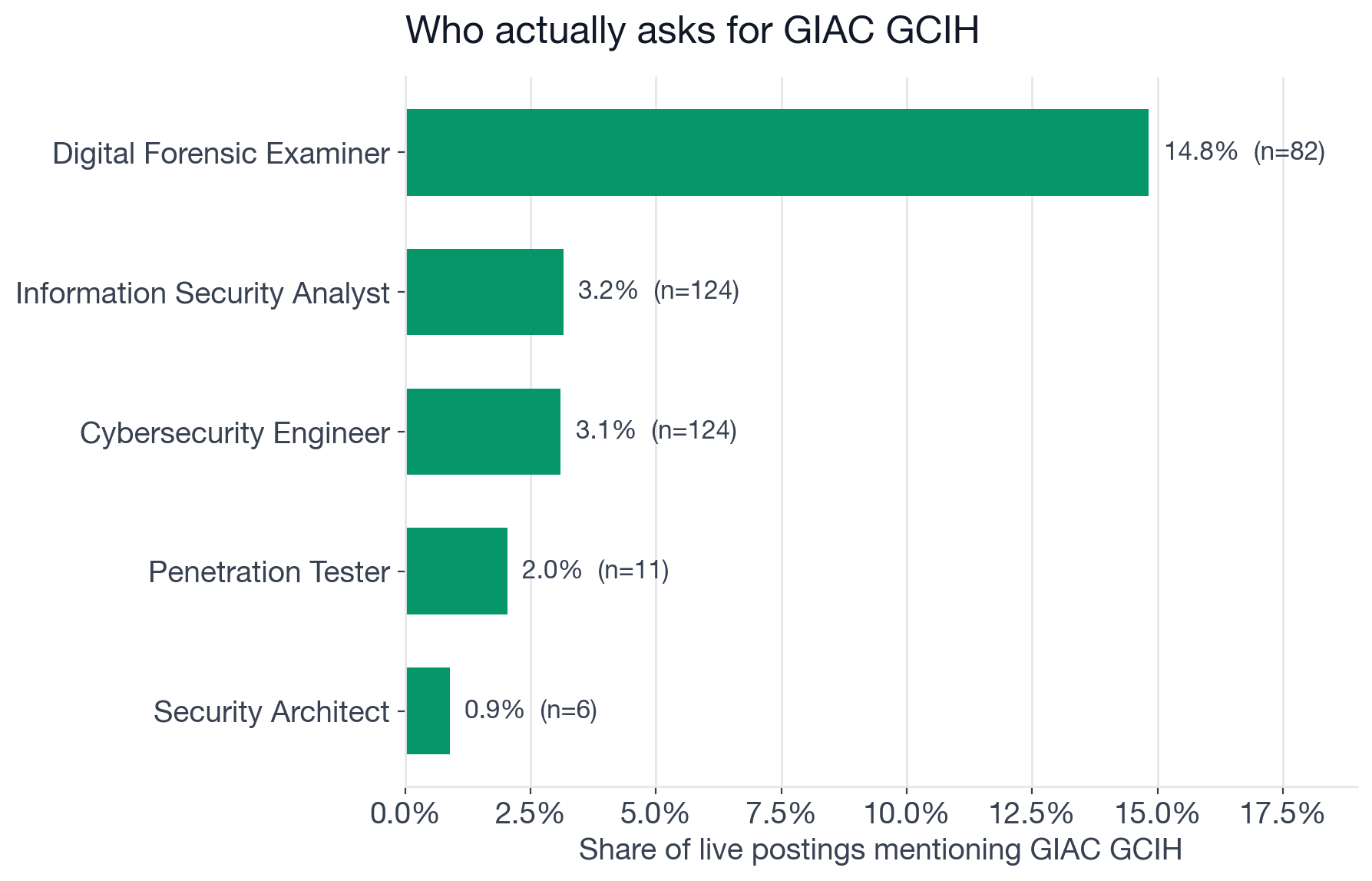 Digital Forensic Examiner sits far above the other four roles, which all fall at or below the five-role aggregate rate of 3.58%.
Digital Forensic Examiner postings mention GCIH at 14.83%, an over-index of roughly 4.1 times the aggregate rate. That single role supplies 23.6% of every GCIH mention despite being only 5.7% of the postings scanned. The other four roles all under-index: Information Security Analyst (3.16%) and Cybersecurity Engineer (3.10%) sit close to each other and modestly below the aggregate, Penetration Tester (2.03%) trails further, and Security Architect (0.89%) is the least likely of the five to name it at all, about a quarter of what its share of postings would predict.
This tracks the exam's actual content, not pay tier. GCIH is GIAC's incident-handling curriculum, built around detecting, containing, and investigating an active compromise, work that overlaps directly with what a Digital Forensic Examiner does day to day. Security Architect's own non-GCIH baseline pay ($180,050) is the highest of the five roles, and Digital Forensic Examiner's ($139,650) sits closer to the middle, so the concentration in Digital Forensic Examiner postings isn't a "cheaper roles ask for it more" pattern. It's a role-identity match: incident handling is close to the job title itself.
One methodology note worth flagging given how much of this post's headline rests on the Digital Forensic Examiner numbers: role classification for job postings is imperfect, and in past audits of this specific role category on the InterviewStack.io job board, "Digital Forensic Examiner" has sometimes swept in generalist incident-response and SOC-lead titles alongside postings for literal forensic-examination work. Read the Digital Forensic Examiner figures here as describing the broader forensics-and-incident-response-adjacent job family this category captures, not a guarantee that every one of the 553 postings behind that 14.83% is a courtroom-facing forensic examiner role.
Is a GCIH Mention Usually a Real Requirement?
| Framing | Mentions | Share of classified |
|---|---|---|
| Required | 22 | 11.64% |
| Preferred | 167 | 88.36% |
| Unspecified | 158 | not classified (45.5% of all 347 mentions) |
Of the 347 GCIH mentions in this scope, 189 used language specific enough to classify as required or preferred. Of those, only 11.64% (22 mentions) call GCIH a hard requirement; the other 88.36% (167 mentions) list it as preferred, roughly 1 in 9 classified mentions treating it as mandatory. The remaining 158 mentions, 45.5% of every GCIH mention in the dataset, don't specify either way and are excluded from that ratio rather than folded into either side. Nearly half of every GCIH mention falls into that unclassified bucket, worth reading as "we can only say what employers say clearly," not as a claim about the true required rate.
The comparison baseline throughout this post is other postings in the same five-role scope that don't mention GCIH, not the broader job market.
The Flat GCIH Salary Number Hides Two Real, Same-Direction Premiums
All salary figures here are advertised US base pay only, drawn from postings that disclose a number; equity, bonus, and total compensation are not captured.
| Level | GCIH-mentioning median | Other postings median | Difference | Sample (with / without) |
|---|---|---|---|---|
| Entry | Not reportable (n=6) | $80,500 | n/a | 6 / 77 |
| Mid-level | $122,500 | $116,650 | +5.0% | 87 / 2,033 |
| Senior | $171,750 | $165,000 | +4.1% | 28 / 616 |
| Staff | Not reportable (n=23) | $177,738 | n/a | 23 / 416 |
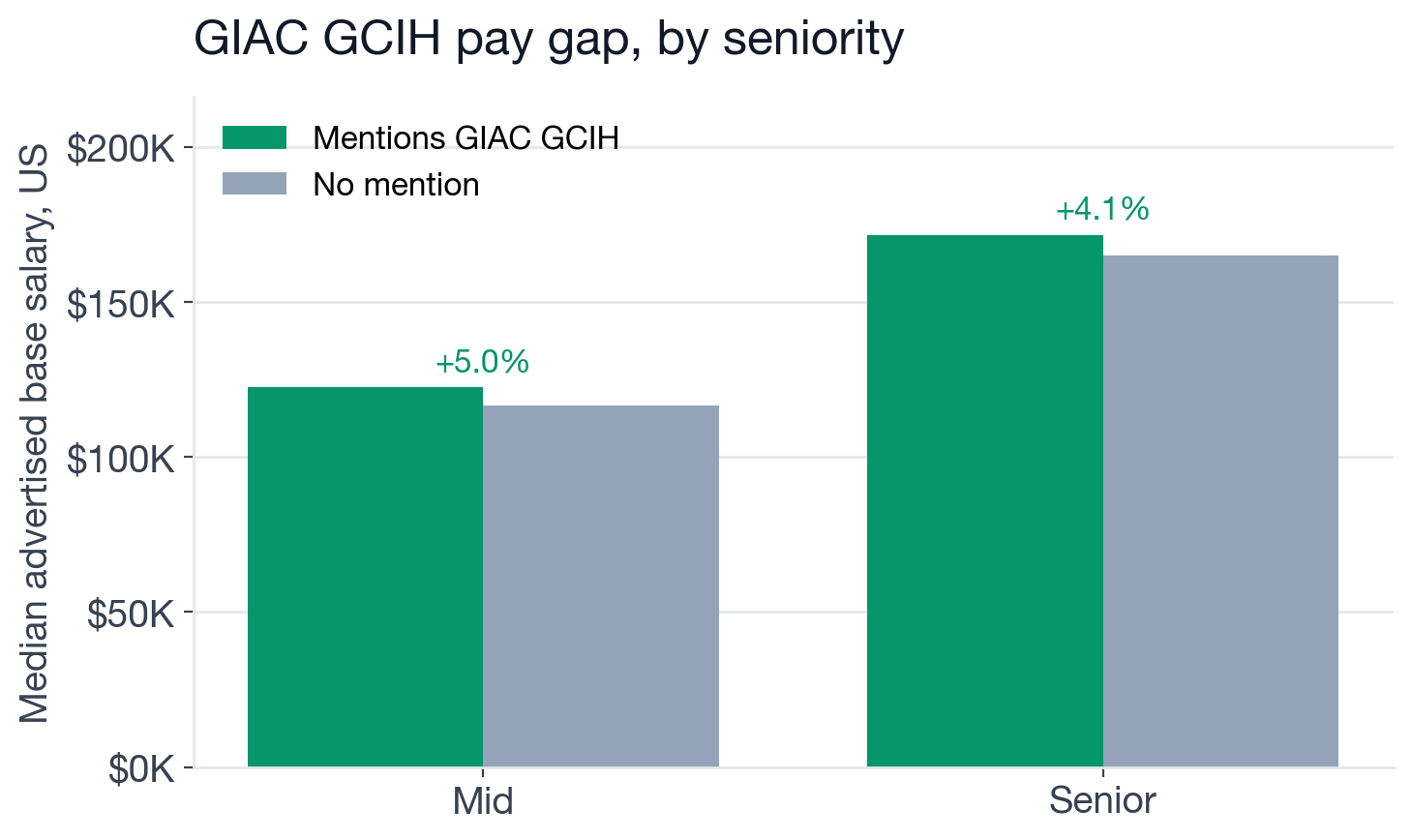 Mid-level and senior are the only two bands with enough GCIH-tagged postings to compare directly, and both move the same direction: GCIH-mentioning postings out-earn the rest at both levels.
The overall comparison looks almost flat: $140,625 versus $139,000, a 1.17% gap that reads as noise. But the two levels with enough sample to report separately both show a real premium in the same direction, not a reversal. At mid-level, GCIH-mentioning postings earn $5,850 more (+5.02%, 87 postings versus 2,033). At senior level, the gap is similar in size: $6,750 more (+4.09%, 28 postings versus 616). Neither reportable level flips negative: GCIH doesn't lose its edge at the top of the two bands this dataset can actually measure.
What's worth flagging honestly: the pooled aggregate (+1.17%) is noticeably smaller than either individual level's premium (+5.02%, +4.09%). dataQualityFlags for this dataset is empty, no automated reversal or confound fired, and the seniority mix, if anything, points the wrong way to explain a smaller aggregate: GCIH-mentioning postings skew more senior overall (36.0% senior-plus-staff versus 31.0%, mean level 1.45 versus 1.39), and senior pays more than mid, so a more-senior mix should pull the aggregate up, not compress it. (Seniority here is inferred from title keywords, and postings with no explicit level word default to mid-level per the dataset's own methodology; roughly half of this dataset's sampled titles carry no explicit seniority marker, which plausibly compresses the measured senior share on both sides. If anything, correcting for that would push the true senior-plus-staff share higher still, which would strengthen this point rather than undercut it.) The likely explanation is mechanical rather than a hidden pay story: entry (n=6) and staff (n=23) are both too thin to report on their own, and a median computed across a small, unevenly distributed pool of disclosed salaries doesn't decompose cleanly into a weighted average of the two reportable levels. Read the level-specific numbers, not the aggregate, as the honest comparison here.
There's a second wrinkle the seniority breakdown alone doesn't surface: broken out by role instead of level, the salary story is mixed, not uniformly positive. Cybersecurity Engineer, tied with Information Security Analyst for the most GCIH mentions of any role (124 each, together 71.5% of all 347 mentions), shows a small negative comparison at the role level: GCIH-mentioning Cybersecurity Engineer postings have a lower median ($158,821, n=59) than non-mentioning ones ($162,000, n=1,308), about -2.0%. Information Security Analyst runs the opposite way and by a wide margin (+21.4%, $119,500 versus $98,444, n=47 versus 1,370), and Digital Forensic Examiner shows a smaller positive gap (+6.3%, $148,500 versus $139,650, n=28 versus 151). Penetration Tester and Security Architect don't have enough GCIH-mentioning postings with disclosed salary to compare at the role level (n=7 and n=3). So one of the two largest contributing roles actually pays a little less, not more, when GCIH is mentioned; the positive level-based premiums above are real, but they aren't the whole picture once you look at which roles are driving the pooled numbers.
What Else Shows Up Alongside a GCIH Mention?
| Certification | Share of GCIH mentions |
|---|---|
| CISSP | 55.9% |
| GIAC GCIA | 39.8% |
| GIAC GCFA | 39.2% |
| CompTIA Security+ | 32.9% |
| CEH | 32.3% |
| CompTIA CySA+ | 24.8% |
CISSP is the dominant pairing, appearing alongside 55.9% of every GCIH mention. The next two are GIAC's own sibling credentials, GCIA (GIAC Certified Intrusion Analyst, 39.8%) and GCFA (GIAC Certified Forensic Analyst, 39.2%), both close enough in scope to GCIH that a posting naming one often names two or three of the family together. CEH (32.3%) and CompTIA CySA+ (24.8%) round out the top six, both broader SOC-and-analyst-oriented credentials rather than GCIH's specific incident-handling focus.
| Skill | Share of GCIH-mentioning postings |
|---|---|
| Incident Response | 76.1% |
| SIEM (security information and event management) | 57.3% |
| Monitoring | 54.2% |
| Automation | 49.3% |
| Security Operations | 49.3% |
| Threat Intelligence | 42.4% |
| Python | 38.6% |
| EDR (endpoint detection and response) | 38.3% |
Incident Response leads by a wide margin at 76.1%, unsurprising given GCIH's name, but the rest of the list confirms this is genuinely SOC-and-response work rather than a generic security posting: SIEM, Monitoring, Security Operations, and Threat Intelligence all outrank general infrastructure skills. Python and EDR sitting near 38% suggest that GCIH-tagged incident-response work increasingly expects scripting and endpoint-tooling fluency, not just process knowledge.
Do Federal Contractors Dominate GCIH Hiring?
| Company | GCIH-mentioning postings |
|---|---|
| CACI International Inc | 20 |
| Peraton | 18 |
| Leidos | 15 |
| Booz Allen Hamilton | 14 |
| PricewaterhouseCoopers | 11 |
| Trend Micro | 7 |
| Salesforce | 6 |
| NVIDIA | 6 |
| 5 | |
| Amazon | 5 |
| Dun & Bradstreet | 4 |
| DXC Technology | 4 |
Mostly, but not entirely. CACI International, Peraton, Leidos, and Booz Allen Hamilton, the top four employers on this list, together account for 58.3% of the mentions in this table, consistent with GCIH's recognition as one of the certifications accepted under the Department of Defense's 8570/8140 workforce framework for certain incident-response roles.
The rest of the roster looks different. PricewaterhouseCoopers is a consulting firm running its own incident-response practice, and Trend Micro, a dedicated cybersecurity vendor, and NVIDIA both show up because they staff internal detection-and-response teams too. Salesforce, Google, and Amazon, three large technology employers, and Dun & Bradstreet and DXC Technology round out the list. Federal contracting is the largest single cluster here, but it isn't the only story: GCIH also reads as a credential that any organization running a real SOC or incident-response function will ask for.
Putting the GCIH Numbers to Work Before You Register
If a posting names GCIH and calls it required, take that seriously, though that's true for only about 1 in 9 classified mentions in this dataset; most of the time it's a preferred line, not a hard bar. The clearest place to build a GCIH-relevant profile is Digital Forensic Examiner work, where the certification's demand actually concentrates; practice with AI mock interviews built around incident-response and SIEM-triage scenarios, since those, not general infrastructure questions, are what most GCIH-tagged postings actually test for. To drill the SIEM, threat-intelligence, and EDR fundamentals behind that skill profile, the question bank has focused practice by topic, and the interactive courses catalog covers security fundamentals for readers building toward incident-response work from scratch. From there, browse current Digital Forensic Examiner openings, where GCIH shows up most, or the full five-role search to see where it appears today.
FAQ
Q. What percentage of security job postings ask for GCIH?
GCIH appears in 3.58% of postings across five security roles analyzed over a 90-day window (347 of 9,691), but that overall rate hides a lot: within Digital Forensic Examiner postings specifically, the rate jumps to 14.83%.
Q. Is GCIH usually required, or just preferred?
Among the 54.5% of mentions with language specific enough to classify, 88.36% call GCIH preferred and 11.64% treat it as required, roughly 1 in 9 classified mentions. The other 45.5% of all mentions don't specify either way.
Q. Which security role is most likely to ask for GCIH?
Digital Forensic Examiner, by a wide margin. GCIH appears in 14.83% of Digital Forensic Examiner postings, compared with 3.16% for Information Security Analyst, 3.10% for Cybersecurity Engineer, 2.03% for Penetration Tester, and just 0.89% for Security Architect, nearly 17 times Security Architect's rate. Worth noting: Digital Forensic Examiner as a job-posting category has, in past audits, sometimes captured generalist incident-response titles alongside literal forensic-examiner roles, so read this as the broader forensics-and-IR-adjacent job family rather than a strict count of courtroom-facing examiner postings.
Q. Do postings that mention GCIH pay more?
The overall gap is nearly flat (median $140,625 with GCIH versus $139,000 without, +1.17%), but broken out by seniority, mid-level postings that mention GCIH show a $5,850 premium (+5.02%, n=87 versus 2,033) and senior postings show a $6,750 premium (+4.09%, n=28 versus 616). Entry and staff levels don't have enough GCIH-mentioning postings with disclosed salary to report separately. Broken out by role instead, the picture is mixed: Cybersecurity Engineer, tied for the most GCIH mentions of any role, actually shows a small negative comparison (-2.0%), while Information Security Analyst (+21.4%) and Digital Forensic Examiner (+6.3%) show clear premiums.
Q. What other certifications commonly appear alongside GCIH?
CISSP appears in 55.9% of GCIH-mentioning postings, followed by two other GIAC credentials, GCIA (39.8%) and GCFA (39.2%), then CompTIA Security+ (32.9%) and CEH (32.3%).
Q. Which employers post the most GCIH-related jobs?
Four federal contractors, CACI International, Peraton, Leidos, and Booz Allen Hamilton, together account for roughly 58% of the mentions in the top-12 employer table, though the rest of the roster includes cybersecurity vendors, cloud companies, and financial services firms, not just government contracting.
Q. What skill most often shows up alongside a GCIH mention?
Incident Response, appearing in 76.08% of GCIH-mentioning postings, by far the most common. SIEM (57.3%) and Monitoring (54.2%) round out the top three.
GCIH Sends a Narrow but Strong Signal
GCIH isn't a certification that shows up a little everywhere in security hiring. It shows up a lot in one place, Digital Forensic Examiner postings, and comparatively rarely everywhere else, including Security Architect, where it barely registers. Where it does appear, the pay comparison is a genuine, consistent premium at both measurable seniority levels, not a reversal, even though the blended headline number understates that story; broken out by role instead, the picture is more mixed, with one of the two largest contributing roles, Cybersecurity Engineer, actually showing a small negative comparison. For someone building toward incident-response or forensics work, this dataset makes a clear case for it. For someone in a role like Security Architect where it almost never comes up, the study time is better spent elsewhere.
Topics
Ready to practice?
Put what you've learned into practice with AI mock interviews and structured preparation guides.