
CISSP Is a Senior Credential With a Mid-Level Salary Signal
CISSP is ISC2's flagship credential, positioned as the standard for security leadership and gated behind five years of paid, cumulative experience across multiple domains before the credential itself is fully awarded. Candidates without that experience can still sit and pass the exam; they earn Associate of ISC2 status instead and have up to six years to accrue the required experience before the full CISSP designation is granted. So the salary data is not what CISSP's senior-leadership positioning would predict: postings that mention it do advertise more than postings that don't, but almost the entire gap sits at mid-level. At senior and staff level, exactly where a "senior leadership" credential should matter most, postings mentioning CISSP actually advertise less than postings that don't.
We looked at active postings across the five roles closest to CISSP's scope, Information Security Analyst, Cybersecurity Engineer, Penetration Tester, Security Architect, and Digital Forensic Examiner, on the InterviewStack.io job board, 10,121 postings from the last 90 days, and flagged every one that mentions CISSP by name: 1,766 of them do. What follows is where that mid-level premium comes from, why it disappears higher up the ladder, and who's actually hiring for it.
Key Findings
- CISSP appears in 17.4% of postings across the five-role scope, 1,766 of 10,121 analyzed over 90 days, roughly 1 in 6.
- Security Architect leads all five roles at a 30.3% mention rate (215 of 709 postings), more than double Information Security Analyst's 13.5%.
- Of the 1,044 postings clear enough to classify, CISSP is preferred in 88.5% and required outright in only 11.5%.
- Postings mentioning CISSP advertise a median US base salary of $145,500, 9.4% above the $133,050 median for otherwise-comparable postings, but that aggregate hides a reversal.
- The premium is a mid-level phenomenon: +30.2% at mid-level ($140,000 vs $107,500), reversing to -8.4% at senior and -10.1% at staff.
- CISM is the dominant co-occurring credential, appearing in 47.6% of CISSP-mentioning postings.
- The employer roster mixes government contractors (Booz Allen Hamilton, CACI International, Peraton) with finance and technology firms (Morgan Stanley, Amazon, Google), a more industry-diverse pattern than most security certifications show.
The Level Where CISSP's Pay Edge Shows Up, and Where It Vanishes
All salary figures here are advertised US base pay only, on the subset of postings that disclose it; equity, bonus, and any other compensation aren't part of job-posting data. The comparison baseline throughout is other postings in the same five-role scope that don't mention CISSP, not the broader job market.
Postings mentioning CISSP advertise a median $145,500 against $133,050 for non-CISSP postings in the same roles, a 9.4% gap that reads like a straightforward premium until it's split by level. Almost none of that gap belongs to senior or staff postings. Nearly all of it comes from mid-level.
| Level | With CISSP (median) | Without CISSP (median) | Gap |
|---|---|---|---|
| Entry | Not reportable (n=5) | $94,183 | n/a |
| Mid-level | $140,000 | $107,500 | +30.2% |
| Senior | $154,800 | $169,000 | -8.4% |
| Staff | $161,850 | $180,000 | -10.1% |
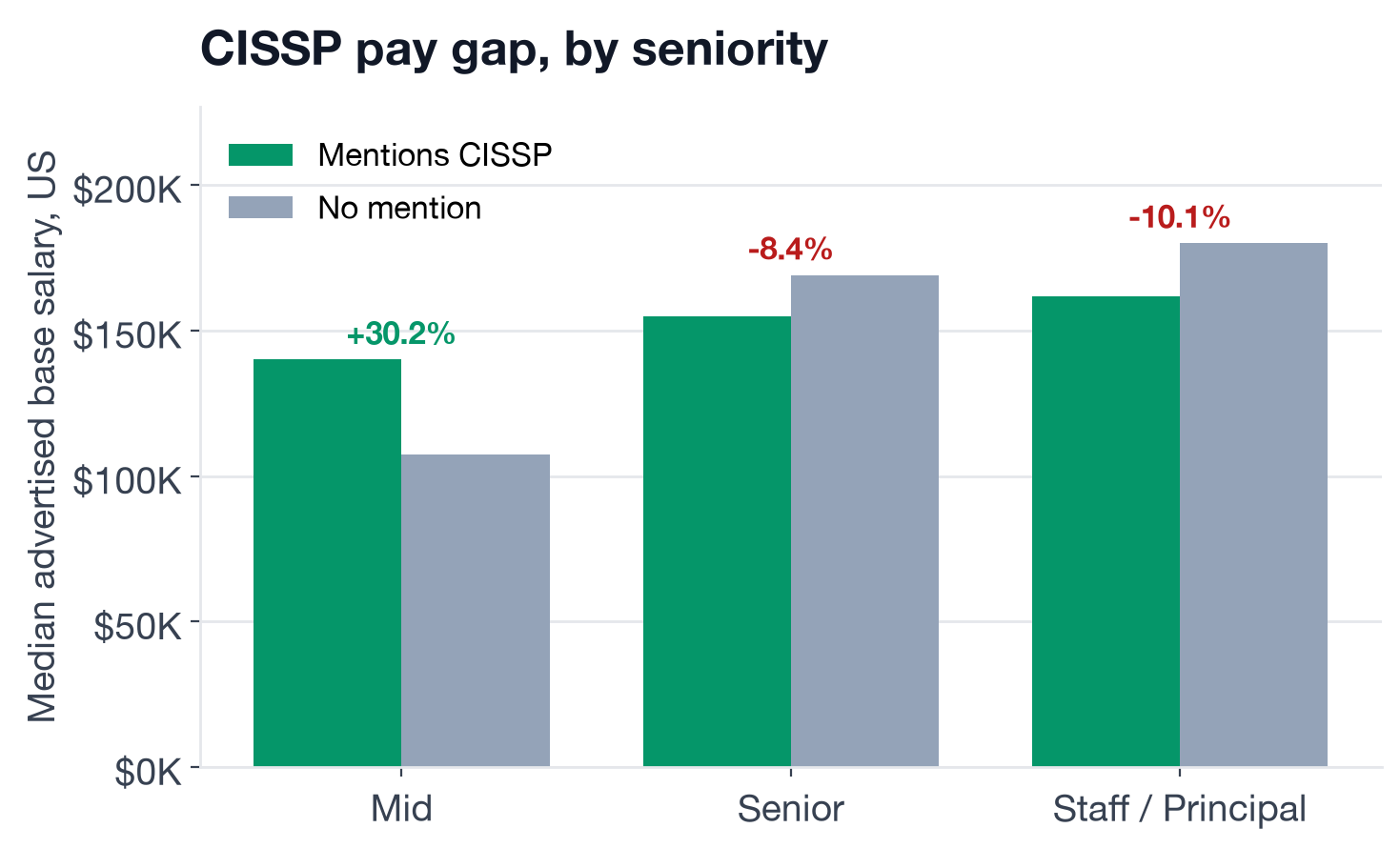 The premium is real only at mid-level; senior and staff CISSP postings advertise less than their non-CISSP counterparts in the same roles.
This isn't a case of CISSP postings skewing younger and dragging the seniority-adjusted comparison down. If anything, it's the opposite: senior and staff postings together make up 38.5% of CISSP-mentioning postings, versus 30.5% of non-CISSP postings in the same roles. CISSP postings skew slightly more senior on average, which should push the comparison toward CISSP postings advertising more at the top, not less. The reversal survives that adjustment; it isn't explained away by it.
Part of what's happening shows up in how employers actually phrase the requirement, covered next. CISSP functions overwhelmingly as a preferred signal rather than a hard gate, which means it does more differentiating work where fewer candidates already clear the experience bar it implies. At mid-level, that's a real signal. At senior and staff level, the roster of who's asking for it looks different, and that roster is where the rest of this reversal likely lives.
CISSP's Employer Roster Isn't Just Government Contractors
For the CompTIA Security+ and CCNA certifications we've profiled so far, the top-employer list has been dominated almost entirely by federal and defense contractors. CISSP's roster includes those same names at the top, but it doesn't stop there.
| Employer | Postings mentioning CISSP |
|---|---|
| Booz Allen Hamilton | 54 |
| CACI International | 49 |
| Peraton | 34 |
| Leidos | 26 |
| Thales Group | 20 |
| Morgan Stanley | 17 |
| Royal Bank of Canada | 17 |
| General Dynamics Information Technology | 16 |
| Amazon | 15 |
| Ntt Limited | 15 |
| 14 | |
| Danaher Corporation | 12 |
Booz Allen Hamilton and CACI International lead, consistent with CISSP's long-standing status as one of the credentials accepted under DoD 8570/8140 baseline requirements for senior information-assurance roles, which explains its presence at Peraton, Leidos, and General Dynamics IT as well. What's different from other security certifications is what shows up below them: Morgan Stanley, Royal Bank of Canada, Amazon, and Google, employers where CISSP isn't tied to a federal compliance directive. It's recognized on its own terms as a senior generalist security credential.
That mix is a plausible, not proven, piece of the salary reversal above. The government-contracting side of this roster tends to run on standardized, banded pay scales at every level. The finance and technology firms in the mix are exactly the kind of employer that can pay senior and staff security specialists well above those bands, often without needing to cite a specific certification in the posting to do it. The data shows the roster and the reversal side by side; it doesn't show which company paid what for which posting, so treat this as context, not proof.
Which Security Roles Actually Ask for CISSP?
Security Architect asks for CISSP far more than any other role in scope, appearing in 30.3% of its postings, just under 1 in 3.
| Role | Active postings | Mention CISSP | Share |
|---|---|---|---|
| Security Architect | 709 | 215 | 30.3% |
| Digital Forensic Examiner | 586 | 129 | 22.0% |
| Cybersecurity Engineer | 4,226 | 814 | 19.3% |
| Information Security Analyst | 4,127 | 558 | 13.5% |
| Penetration Tester | 473 | 50 | 10.6% |
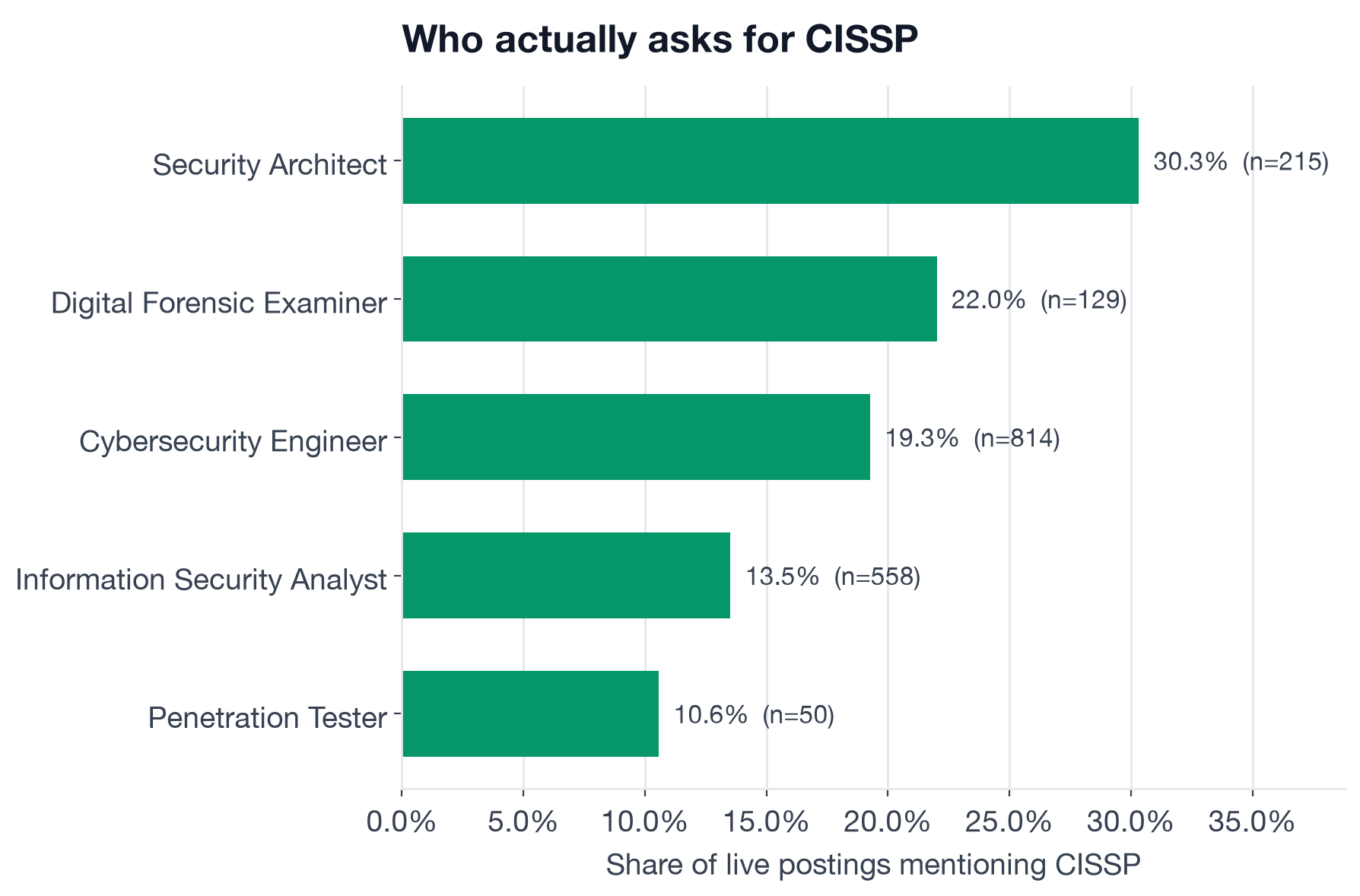 Security Architect postings mention CISSP nearly three times as often as Penetration Tester postings, the widest spread of any role in this scope.
Security Architect topping the list tracks with what the credential actually covers: security architecture and engineering is one of CISSP's eight domains by name, so the fit with a role built around that discipline is direct. Cybersecurity Engineer contributes the largest raw number of CISSP-mentioning postings, 814, even though its 19.3% mention rate trails Security Architect's and Digital Forensic Examiner's, simply because it's the largest role in this scope by posting volume (4,226 postings). If you're weighing where to point a CISSP toward next, current Security Architect openings are the highest-concentration place to look.
Is CISSP a Requirement, or Just a Preference?
CISSP rarely gates a candidate out on its own. Of the 1,044 postings clear enough to classify as required or preferred, 88.5% (924 postings) list it as preferred and 11.5% (120 postings) require it outright. Another 722 mentions, about 41% of all CISSP references, use phrasing too ambiguous to classify either way (open-ended cert lists, "or equivalent" language) and aren't counted in that ratio.
The practical read: holding CISSP clears the preferred bar in the large majority of postings that state a clear position. Not holding it disqualifies you outright in roughly 1 in 9 of the postings clear enough to classify, and in just under 1 in 15 of all CISSP mentions overall.
What Else Do CISSP Postings Ask For?
CISSP rarely stands alone as a credential. CISM, ISACA's senior information-security-management certification, appears in 47.6% of CISSP-mentioning postings, by far the most common pairing. CompTIA Security+ (24.2%), CCSP (21.0%, ISC2's cloud-focused counterpart to CISSP), and CISA (20.2%, ISACA's auditor credential) round out the top four.
| Certification | Co-occurs with CISSP |
|---|---|
| CISM | 47.6% |
| CompTIA Security+ | 24.2% |
| CCSP | 21.0% |
| CISA | 20.2% |
| CEH | 18.5% |
| OSCP | 11.8% |
| CRISC | 10.6% |
| GIAC GCIH | 10.2% |
The skill list underneath CISSP postings skews toward governance and cloud operations rather than hands-on offensive security. Incident Response (40.2%) and Monitoring (36.7%) are the two most-cited skills, with Risk Management (35.7%) close behind, and Cloud Security (33.6%) alongside AWS (33.4%) and Azure (31.4%) show that CISSP-holding candidates are expected to operate across both major clouds, not just understand cloud security in the abstract. Automation shows up in 32.7% of postings, evidence that even governance-flavored senior security roles now expect some scripting or infrastructure-as-code fluency layered on top of the credential itself. Postings that pair Security Architect work with Cloud Security specifically are a reasonable place to see what that combination looks like in practice.
What to Do With This Before You Sit the Exam
If you're deciding whether CISSP is worth the study time, the data points at level and role more than raw value: it shows the clearest wage signal at mid-level, is most concentrated in Security Architect postings specifically, and its pay edge over non-CISSP postings disappears at senior and staff level, where CISM and cloud-security depth increasingly carry more of the signal. Our breakdown of Security Architect skills companies want in 2026 covers that fuller skill stack if you're targeting that role specifically.
Drill the governance and risk-management fundamentals CISSP covers with InterviewStack's Question Bank, organized by topic. If you're earlier in the path and want to build the underlying security-architecture and cloud concepts before the exam or the interview, InterviewStack's interactive courses cover those foundations. Once you have a target role in mind, run a mock interview against it to see where the real gaps are.
To see current openings, browse active postings across all five roles in this scope or filter down to a specific one, including Digital Forensic Examiner and Penetration Tester roles.
FAQ
Q. What percentage of security postings mention CISSP in 2026?
1,766 of 10,121 active postings analyzed across five roles, Information Security Analyst, Cybersecurity Engineer, Penetration Tester, Security Architect, and Digital Forensic Examiner, on the InterviewStack.io job board mention CISSP, about 17.4% of the scope, over a 90-day window.
Q. Which role most often asks for CISSP?
Security Architect, by a wide margin. CISSP appears in 30.3% of Security Architect postings (215 of 709), more than double the rate of Information Security Analyst at 13.5% and nearly three times Penetration Tester at 10.6%.
Q. Is CISSP usually required or just preferred?
Preferred, in the large majority of postings that specify one. Of the 1,044 postings clear enough to classify, 88.5% list CISSP as preferred and 11.5% require it outright. Another 722 mentions, about 41% of all references, use phrasing too ambiguous to classify.
Q. Do postings that ask for CISSP pay more than postings that don't?
It depends entirely on seniority level. Postings mentioning CISSP advertise a median $145,500 against $133,050 for non-CISSP postings in the same roles, a 9.4% aggregate gap, but that aggregate is carried almost entirely by mid-level postings (+30.2%). At senior level the comparison flips to -8.4%, and at staff level to -10.1%.
Q. Why would senior CISSP postings pay less than senior postings that don't mention it?
The data can show the pattern but not prove the cause. One consistent clue: CISSP-mentioning postings skew slightly more senior on average than non-CISSP postings in the same roles, so the reversal isn't a seniority-mix artifact. The employer roster offers a partial explanation instead. It includes government contractors with standardized pay bands, Booz Allen Hamilton, CACI International, and Peraton among them, alongside finance and technology employers, Morgan Stanley, Amazon, and Google, that can pay senior specialists above those bands without necessarily naming a specific certification in the posting.
Q. What other certifications pair with CISSP?
CISM, ISACA's senior information-security-management credential, by far. It appears in 47.6% of CISSP-mentioning postings. CompTIA Security+ (24.2%), CCSP (21.0%), and CISA (20.2%, ISACA's auditor credential) also show up frequently.
Q. Is CISSP worth pursuing for a security career?
It depends on where you are in your career and which role you're targeting. CISSP shows the clearest wage signal at mid-level and is most in-demand for Security Architect roles specifically, but the premium doesn't extend to senior and staff postings in this data. Most CISSP holders pair it with CISM rather than treat it as a standalone credential.
The Level-by-Level Truth About CISSP Pay
CISSP is what its five-year experience requirement suggests: a credential built for people already well into a security career, not an entry-level differentiator. What the data adds is a level-by-level correction to the marketing pitch. The premium is real and sizable at mid-level, where it functions as a genuine signal ahead of the experience curve. Higher up, where CISSP is supposed to matter most, the postings that cite it by name pay less than the ones that don't, a pattern the employer roster explains better than the credential itself does. Read the number by level, not the headline.
Topics
Ready to practice?
Put what you've learned into practice with AI mock interviews and structured preparation guides.