
CEH's Overall Pay Number Hides Two Opposite Effects
Compare every posting that mentions CEH (Certified Ethical Hacker) against every posting in the same five security roles that doesn't, and the headline gap looks like almost nothing: a 3.3% lower advertised median. That number is the wrong takeaway. Split the same comparison by seniority level and two real, opposite effects show up: CEH-mentioning postings pay a genuine 6.2% more at mid-level, which is where most of the certification's demand actually sits, and a genuine 15.4% less at senior level. A flat-looking aggregate is not evidence that this certification does nothing to a posting's advertised pay. It's two real effects nearly canceling each other out.
We looked at active postings across Information Security Analyst, Cybersecurity Engineer, Penetration Tester, Security Architect, and Digital Forensic Examiner roles on the InterviewStack.io job board over a 90-day window, screening each description for a CEH mention and the language immediately around it. CEH, issued by EC-Council, turned up in 477 of 9,983 postings in scope, about 4.8%, roughly 1 in every 21 listings.
The rest of this breakdown covers where that pay split actually lives, which role names the certification most, how often a mention is a real requirement rather than a wish-list line, and who is actually hiring for it.
Key Findings
- CEH appears in 4.8% of active postings across five security roles (477 of 9,983 analyzed), roughly 1 in 21 listings.
- The overall pay comparison looks nearly flat (-3.3%), but that hides a real +6.2% premium at mid-level and a real -15.4% shortfall at senior level.
- Mid-level makes up 70.9% of CEH-mentioning postings, so the level with the premium is also the level carrying most of the demand.
- Penetration Tester postings mention CEH at 9.2%, the highest rate of the five roles and nearly twice the five-role aggregate.
- Cybersecurity Engineer and Information Security Analyst together supply 76.3% of every CEH mention by volume, despite neither role over-indexing on rate.
- Among the 295 mentions specific enough to classify, only 12.5% state CEH as required; 87.5% list it as preferred.
- CACI International alone accounts for 8.0% of every CEH mention in this scope, and federal contractors make up roughly two-thirds of the top employer roster.
- CISSP appears alongside 63.3% of CEH mentions, the dominant co-occurring certification, well ahead of the sibling offensive-security exam OSCP (24.7%).
The Mid-Level Premium Doesn't Survive Into Senior Roles
All salary figures here are advertised US base pay only, drawn from postings that disclose a number; equity, bonus, and total compensation are not captured. The comparison group throughout is other postings within the same five-role scope that do not mention CEH, not the wider job market.
| Level | CEH-mentioning median | Other postings median | Difference | Sample (with / without) |
|---|---|---|---|---|
| Entry | Not reportable (n=7) | $80,857 | n/a | 7 / 78 |
| Mid-level | $122,275 | $115,174 | +6.2% | 107 / 2,116 |
| Senior | $139,650 | $165,000 | -15.4% | 27 / 631 |
| Staff | Not reportable (n=23) | $176,500 | n/a | 23 / 423 |
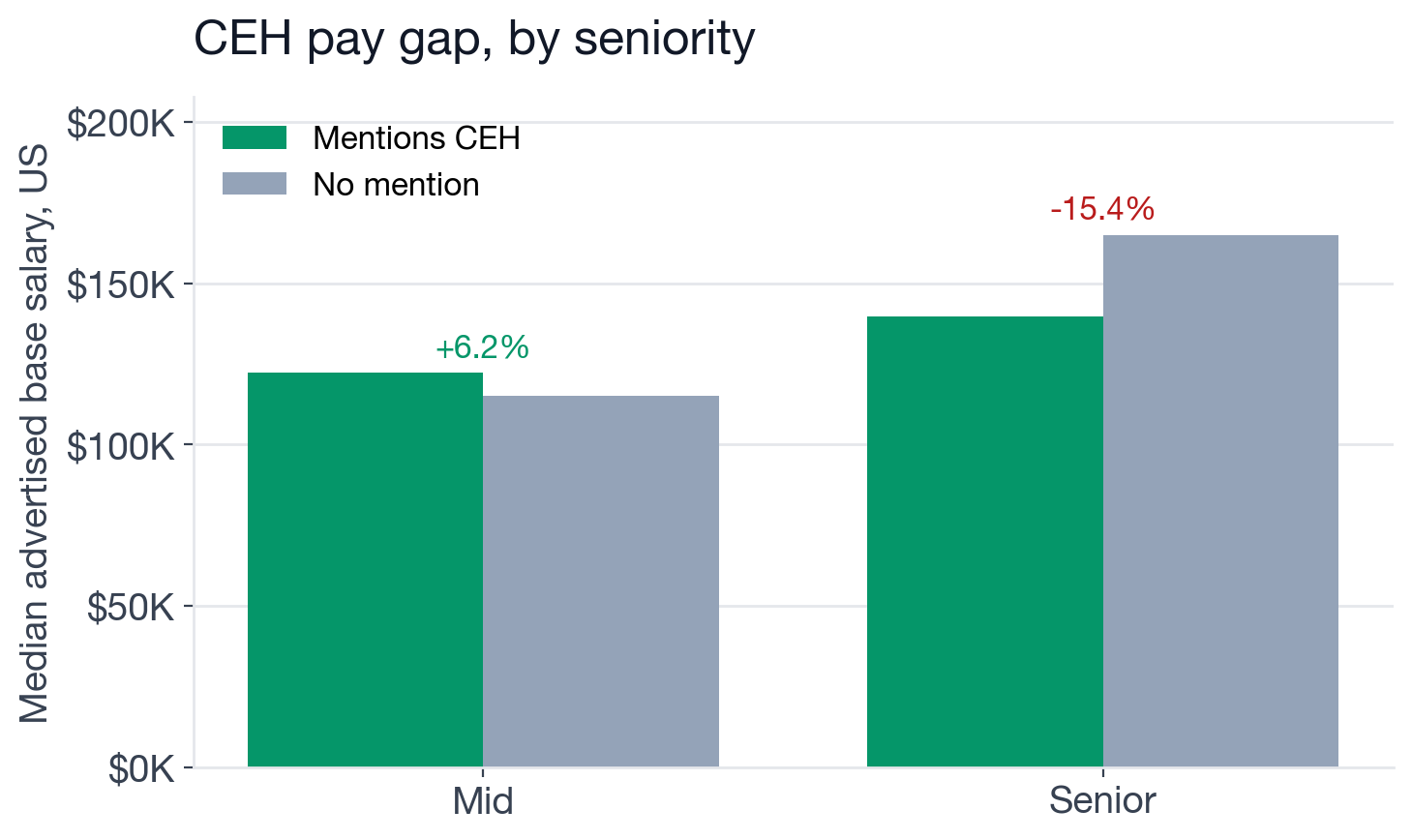 Mid-level and senior are the only two bands with enough CEH-tagged postings to compare directly, and they move in opposite directions: CEH-mentioning postings out-earn the rest at mid-level and trail at senior.
Entry (n=7) and staff (n=23) both fall below the 25-posting floor needed to report a reliable median, so the real comparison lives in mid-level and senior. At mid-level, where 70.9% of CEH-mentioning postings sit, the certification-mentioning group earns nearly $7,100 more ($122,275 versus $115,174, +6.2%). At senior level, the opposite holds: CEH-mentioning postings earn $25,350 less ($139,650 versus $165,000, -15.4%). The blended aggregate, -3.3%, is what you get by averaging those two real, opposite effects together with the two unreportable bands, and it undersells both the mid-level story and the senior-level one.
Part of why the aggregate leans negative rather than landing at zero: CEH-mentioning postings skew slightly less senior than the rest of the scope. Senior and staff levels combined make up 25.6% of CEH-mentioning postings, versus 31.8% of postings that don't mention it, a 6.2-point gap. Since senior is exactly the band where CEH-mentioning postings pay noticeably less, that mix shift compounds the effect rather than explaining it away: a certification-mentioning pool that already skews away from the highest-paying levels, combined with a real pay shortfall at the one senior band that's measurable, both pull the blended number down. One caveat on both reads above: seniority here is inferred from job-title keywords, and postings with no clear signal default to mid-level, which compresses the measured spread at every band for both groups, not just mid-level. That means the senior-plus-staff mix-shift (25.6% versus 31.8%) is measured through the same compression as the mid-level premium, so its exact size is less certain than the headline figures suggest, even though the direction of both findings likely still holds.
Penetration Testers Ask for CEH Most, but Bigger Roles Carry the Volume
| Role | Postings | CEH mentions | Mention rate |
|---|---|---|---|
| Penetration Tester | 546 | 50 | 9.2% |
| Digital Forensic Examiner | 564 | 34 | 6.0% |
| Cybersecurity Engineer | 4,119 | 202 | 4.9% |
| Information Security Analyst | 4,025 | 162 | 4.0% |
| Security Architect | 729 | 29 | 4.0% |
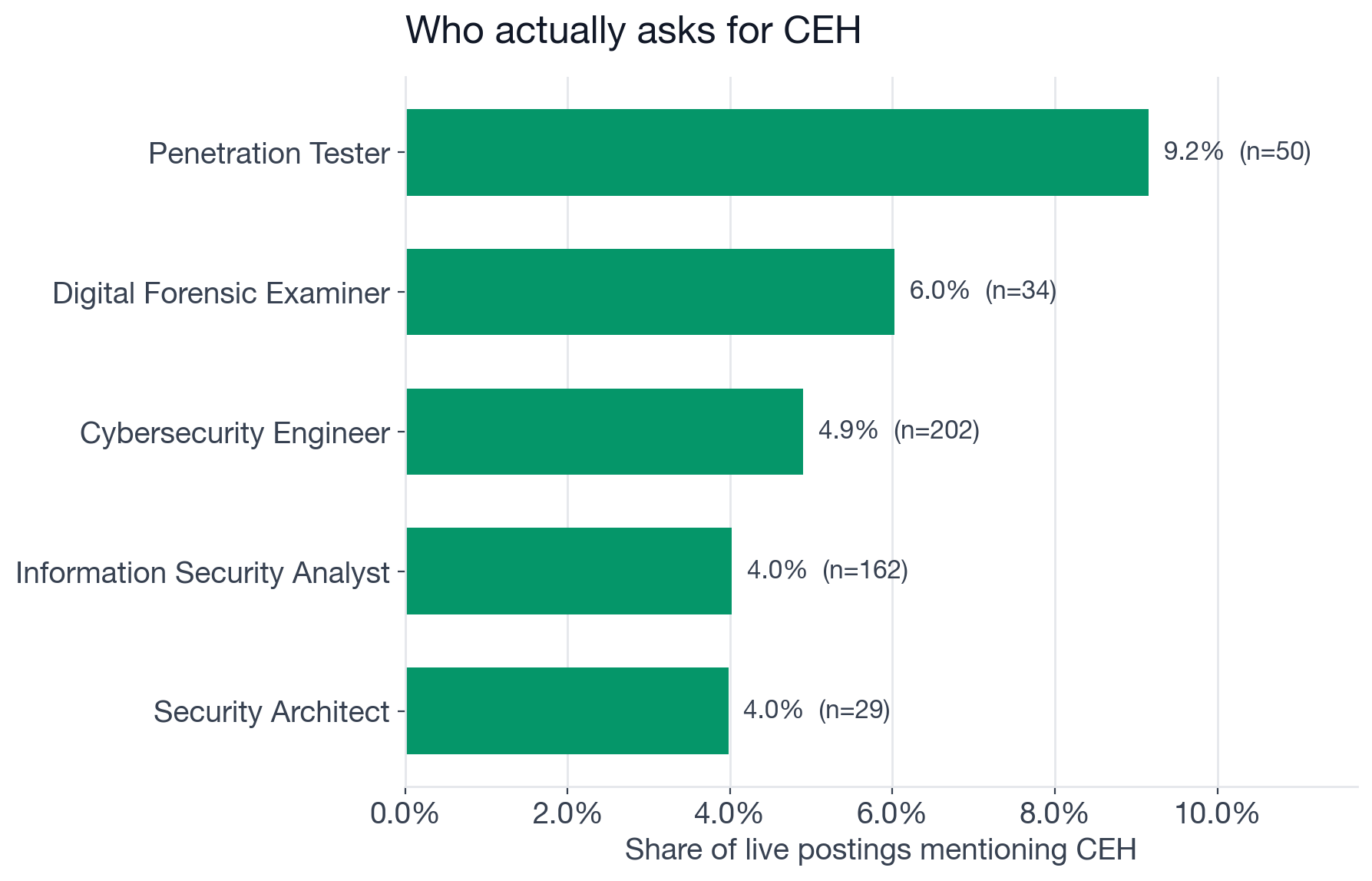 Penetration Tester postings mention CEH at nearly twice the five-role aggregate rate; Security Architect and Information Security Analyst sit at the bottom, both close to 4%.
Penetration Tester postings mention CEH at 9.2%, an over-index of 1.92 times the aggregate rate and about 1.5 times Digital Forensic Examiner's 6.0%, the next highest. That ordering tracks the exam's actual content: CEH is EC-Council's ethical-hacking curriculum, built around the reconnaissance, scanning, and exploitation techniques a Pen Tester uses directly, and Digital Forensic Examiner work regularly overlaps with the same offensive tooling from the investigation side. One caveat on that framing: the "Digital Forensic Examiner" label in this dataset comes from a role classifier that other audits have found runs broad, often sweeping in general incident-response and SOC-management postings alongside literal forensic-examination roles, so its 6.0% CEH mention rate is best read as characterizing security-investigation work broadly rather than forensic examiners specifically.
But rate isn't the same as volume. Penetration Tester is a small role in this scope, just 546 of 9,983 postings, so its high mention rate only produces 50 of the 477 total CEH mentions, 10.5% of the total. Cybersecurity Engineer and Information Security Analyst mention CEH at rates close to the five-role aggregate (4.9% and 4.0%, versus 4.8% overall), but because those two roles alone make up 81.6% of every posting scanned, they still supply 76.3% of every CEH mention between them. If a company is drafting a posting that happens to reference CEH, the odds favor a Cybersecurity Engineer or Information Security Analyst title, not a Penetration Tester one, even though a Penetration Tester posting is individually far more likely to name it.
Is CEH Usually a Requirement, or Just a Nice-to-Have?
| Framing | Mentions | Share of classified |
|---|---|---|
| Required | 37 | 12.5% |
| Preferred | 258 | 87.5% |
| Unspecified | 182 | not classified (38.2% of all 477 mentions) |
Of the 477 CEH mentions in this scope, 295 used language specific enough to classify as required or preferred. Of those, only 12.5% (37 mentions) call CEH a hard requirement; the other 87.5% (258 mentions) list it as preferred, about 1 in 8 classified mentions treating it as mandatory. The remaining 182 mentions, 38.2% of every CEH mention in the dataset, don't specify either way and are excluded from that ratio rather than folded into either side.
That's a comparatively low required rate for a security certification. Postings asking for offensive-security skills tend to name CEH as one acceptable credential among several rather than the specific bar a candidate must clear. Required language shows up more often on the sibling exam OSCP, which functions as a harder, hands-on filter for the same kind of work; more on how the two compare below. The comparison baseline throughout this post is other postings in the same five-role scope that don't mention CEH, not the broader job market.
One Federal Contractor Accounts for 8% of Every CEH Mention
| Company | CEH-mentioning postings |
|---|---|
| CACI International | 38 |
| Leidos | 17 |
| Booz Allen Hamilton | 14 |
| Peraton | 13 |
| Ntt Limited | 8 |
| Accenture | 6 |
| Uvation | 6 |
| DXC Technology | 6 |
| Phoenix Cyber | 5 |
| General Dynamics Information Technology | 5 |
| SAS | 5 |
| LBG | 4 |
CACI International alone accounts for 38 of the 477 CEH mentions in this scope, 8.0% of every mention nationally, more than double the next employer on the list. Five of the twelve companies above, CACI International, Leidos, Booz Allen Hamilton, Peraton, and General Dynamics Information Technology, are large federal contractors, and together they account for 68.5% of the mentions in this table. That concentration lines up with CEH's real-world status: it's one of the certifications recognized under the Department of Defense's 8570/8140 workforce framework as a baseline credential for certain cybersecurity job categories, the kind of compliance-driven line that shows up on a government contract rather than a competitive differentiator in the open market.
The rest of the roster is more varied. Ntt Limited, Accenture, and DXC Technology are large IT-services and consulting firms rather than direct federal contractors, and Uvation, Phoenix Cyber, SAS, and LBG round out the list without a single dominant industry behind them.
CISSP Appears Alongside Nearly Two-Thirds of CEH Mentions
| Certification | Share of CEH mentions |
|---|---|
| CISSP | 63.3% |
| CompTIA Security+ | 44.4% |
| CISM | 27.7% |
| OSCP | 24.7% |
| GIAC GCIH | 23.3% |
| CompTIA CySA+ | 18.0% |
CISSP shows up alongside 63.3% of every CEH mention, by far the dominant pairing, followed by CompTIA Security+ (44.4%) and CISM (27.7%). That ordering is a useful tell: CEH's most common partner isn't a specialist offensive-security exam, it's the broad, governance-oriented CISSP, which suggests many CEH mentions sit inside a longer, generalist list of accepted certifications rather than a posting built specifically around hands-on offensive testing. OSCP, the offensive-security certification this dataset tracks as CEH's closest sibling, co-occurs in just 24.7% of CEH mentions, well behind CISSP and Security+, and only modestly behind CISM's 27.7%.
The skill profile behind these postings leans toward operations and cloud more than pure exploitation work:
| Skill | Share of CEH-mentioning postings |
|---|---|
| Monitoring | 43.2% |
| Incident Response | 42.3% |
| SIEM (security information and event management) | 40.5% |
| AWS | 34.4% |
| Cloud Security | 33.5% |
| Python | 32.5% |
| Azure | 31.2% |
| Automation | 30.8% |
Monitoring and Incident Response lead, both ahead of Penetration Testing itself (28.3%), and AWS, Cloud Security, and Azure all outrank it too. That mix fits the co-occurring-certification pattern above: a CEH mention in this dataset is more often riding alongside a SOC-and-cloud-security posting than a dedicated offensive-testing one.
How to Use This Before You Sit for CEH
If a posting names CEH and calls it required, treat it as a real filter, though that's true for only about 1 in 8 classified mentions in this dataset; most of the time it's one accepted credential among several, not a hard bar. Before an interview at a federal contractor or another compliance-driven employer, practice with AI mock interviews built around the monitoring, incident-response, and cloud-security scenarios that actually dominate CEH-adjacent postings, since those, not raw exploitation techniques, are what most of these listings test for. To drill the SIEM, vulnerability-management, and network-security fundamentals behind that skill profile, the question bank has focused practice by topic, and the interactive courses catalog covers security fundamentals for readers building toward a CEH-adjacent role from scratch. From there, browse current Penetration Tester openings, where CEH shows up most often by rate, Digital Forensic Examiner roles, the next highest, or the full five-role search to see where CEH appears today.
FAQ
Q. How many active postings mention CEH?
Across the five security roles tracked (Information Security Analyst, Cybersecurity Engineer, Penetration Tester, Security Architect, and Digital Forensic Examiner), CEH appears in 477 of 9,983 active postings, about 4.8%, or roughly 1 in 21 listings.
Q. Do postings that mention CEH pay more?
It depends entirely on seniority level. The overall comparison looks nearly flat (-3.3%, $133,000 versus $137,500), but that hides two real effects: mid-level postings that mention CEH earn 6.2% more ($122,275 versus $115,174, n=107 versus 2,116), and senior-level postings that mention it earn 15.4% less ($139,650 versus $165,000, n=27 versus 631). Entry and staff levels don't have enough CEH-tagged postings to compare reliably.
Q. Is CEH usually required, or just preferred?
Among the 295 CEH mentions specific enough to classify, 12.5% state it as required and 87.5% list it as preferred, about 1 in 8 classified mentions. Another 182 mentions, 38.2% of all 477, don't specify either way.
Q. Which security role is most likely to ask for CEH?
Penetration Tester postings mention CEH at 9.2%, the highest rate of the five roles and nearly twice the aggregate rate of 4.8%. Cybersecurity Engineer and Information Security Analyst mention it less often by rate (4.9% and 4.0%), but because those two roles make up most of the postings in scope, they still supply 76.3% of every CEH mention by volume.
Q. Who is actually hiring for CEH?
Federal contractors dominate the roster. CACI International alone accounts for 8.0% of every CEH mention in this scope, and CACI International, Leidos, Booz Allen Hamilton, Peraton, and General Dynamics Information Technology together account for 68.5% of the mentions in the top-12 employer table, consistent with CEH's status as a Department of Defense-recognized baseline certification for certain cybersecurity roles.
Q. What other certifications commonly appear alongside CEH?
CISSP is the dominant pairing, appearing alongside 63.3% of CEH mentions, followed by CompTIA Security+ (44.4%) and CISM (27.7%). OSCP, the certification closest to CEH in scope, appears in 24.7% of CEH mentions, notably behind CISSP and Security+, and only modestly behind CISM.
Q. Does CEH help if the goal is a Penetration Tester role?
It's the strongest single-role match in this dataset: Penetration Tester has the highest CEH mention rate of the five roles tracked (9.2%, nearly twice the aggregate). But CEH mentions still co-occur most often with CISSP and Security+ rather than with OSCP, the more specialized offensive-security exam, so a posting naming CEH is more often testing for broad security competence than for hands-on exploitation skill specifically.
What CEH's Flat Number Actually Hides
CEH reads as a broadly accepted credential more than a specialist bar. It shows up in under 5% of postings across five security roles, and when it does, the postings asking for it usually pair it with CISSP or Security+, not its harder offensive-security sibling, OSCP. The pay comparison that looks almost flat overall is really two real, opposite stories: a mid-level premium where most CEH demand actually sits, and a senior-level shortfall where it doesn't. For someone building toward Penetration Tester or Digital Forensic Examiner work, especially at a federal contractor, CEH is a reasonable line to add. For a senior candidate weighing whether it's worth the study time, this dataset doesn't show a pay case for it.
Topics
Ready to practice?
Put what you've learned into practice with AI mock interviews and structured preparation guides.