
Security Architects Drive Most of CISM's Demand
CISM does not spread evenly across security work. Among five security roles we tracked on the InterviewStack.io job board over the trailing 90 days (9,990 active postings in total), it shows up in nearly 15% of Security Architect listings, the highest rate of the five, and in just 2.9% of Penetration Tester listings, the lowest, a gap of more than five times. That split lines up with what the certification actually tests: CISM (Certified Information Security Manager) is ISACA's governance-and-risk-management credential, built for people who own security strategy and program decisions, not for the hands-on offensive work a Penetration Tester does day to day.
Digital Forensic Examiner runs a close second at 12.8%, which matters because it breaks a simpler story you might expect. Digital Forensic Examiner is one of the lower-paying roles in this scope, so CISM's concentration there isn't just "the cert clusters where the money is." Information Security Analyst (8.4%) and Cybersecurity Engineer (7.5%) sit closer to the 8.5% aggregate rate across all five roles (853 of 9,990 postings). Pay tells its own complicated story too, and it isn't a clean "certified professionals earn more" one: postings that mention CISM pay noticeably more at mid-level, but less at senior level, once you look level by level instead of at one blended average. More on that below.
Key Findings
- CISM appears in 8.5% of active postings across five security roles (853 of 9,990 analyzed).
- Security Architect postings mention CISM at 15.0% (109 of 728), the highest of any role, versus 2.9% (14 of 475) for Penetration Tester, a gap of more than 5x.
- Only 8.6% of classified mentions (42 of 491) treat CISM as a hard requirement; 91.4% call it preferred, and another 362 mentions don't specify either way.
- Median US base salary is $146,922 for CISM-mentioning postings vs $136,500 without (+7.6%), but that aggregate reverses at senior level (-11.2%) and is driven almost entirely by a +24.2% premium at mid-level.
- CISSP appears alongside CISM in 96.5% of CISM-mentioning postings (823 of 853), making the two credentials nearly inseparable in practice.
- Risk Management is the top associated skill, appearing in 44.7% of CISM-mentioning postings, ahead of Monitoring (37.9%) and Incident Response (36.8%).
- The top employer roster splits between defense contractors (Booz Allen Hamilton, Peraton, Leidos) and regulated finance/insurance firms (Mitsubishi UFJ Financial Group, Sun Life Financial, Allianz).
How Unevenly Does CISM Demand Split Across Security Roles?
| Role | Postings | Mentioning CISM | Mention rate |
|---|---|---|---|
| Security Architect | 728 | 109 | 15.0% |
| Digital Forensic Examiner | 592 | 76 | 12.8% |
| Information Security Analyst | 4,084 | 344 | 8.4% |
| Cybersecurity Engineer | 4,111 | 310 | 7.5% |
| Penetration Tester | 475 | 14 | 2.9% |
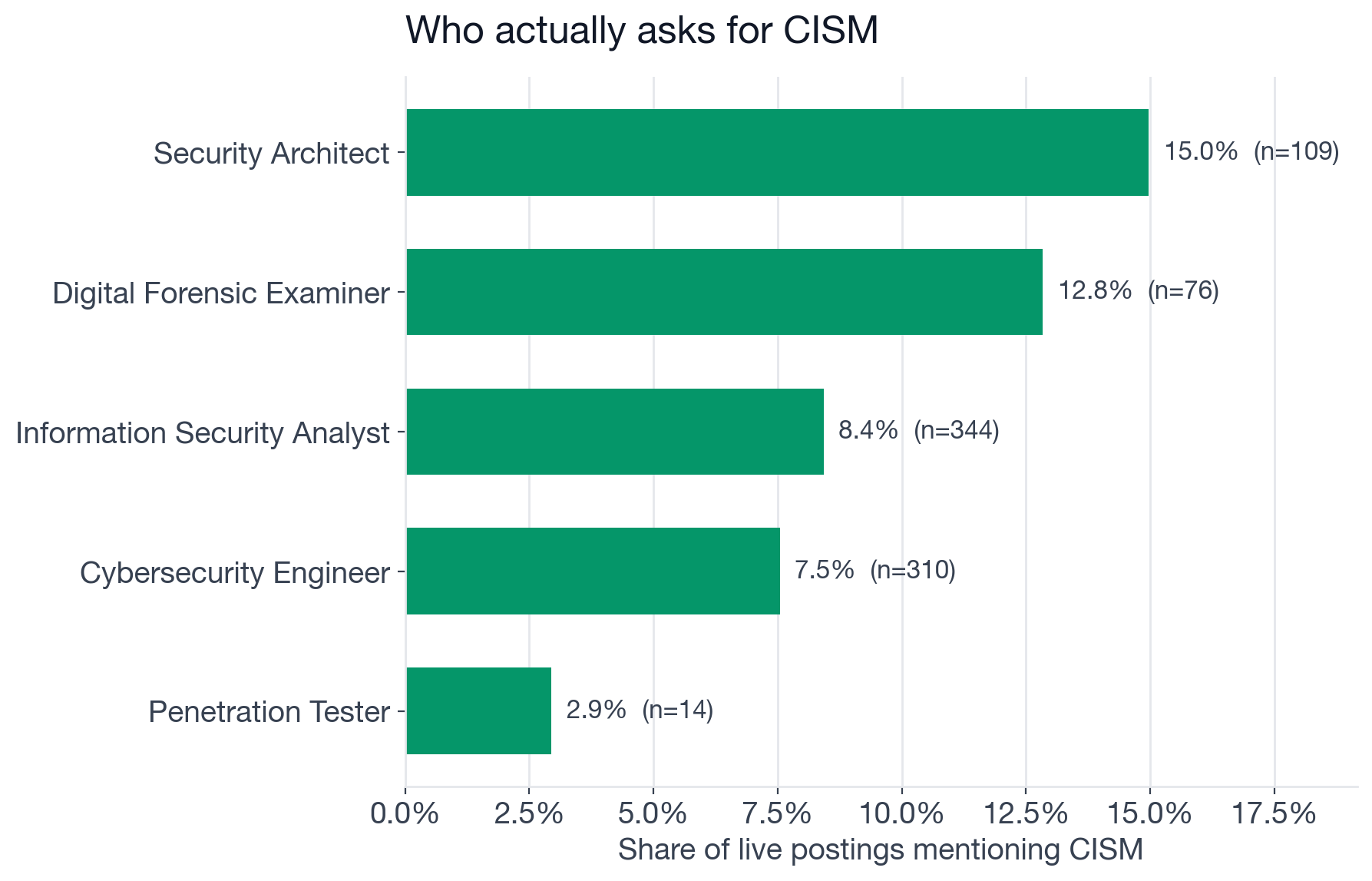 CISM's mention rate by role runs from 15.0% at the top (Security Architect) to 2.9% at the bottom (Penetration Tester), with the other three roles clustered in between.
Browse the full scope on the InterviewStack.io job board and the pattern gets clearer once you weigh each role by how much of the total CISM-mention pool it represents, not just its own mention rate. Security Architect is 7.3% of postings in this scope but 12.8% of every CISM mention, an over-index of about 1.75x. Digital Forensic Examiner shows the same shape at smaller scale: 5.9% of postings, 8.9% of mentions, about 1.5x. Information Security Analyst sits almost exactly at parity (40.9% of postings, 40.3% of mentions). Cybersecurity Engineer under-indexes modestly (41.2% of postings, 36.3% of mentions), and Penetration Tester under-indexes sharply: 4.8% of postings, just 1.6% of mentions, about a third of what its posting share would predict.
That pattern tracks role function more than role pay. Digital Forensic Examiner over-indexing despite being one of the lower-paying roles in this scope rules out a simple "the cert follows the money" story. What Security Architect and Digital Forensic Examiner have in common is that both routinely require formal, defensible judgment calls (an architecture decision that has to survive an audit, a forensic finding that has to survive a courtroom), which is the exact terrain CISM's governance-and-risk curriculum covers. Worth noting: "Digital Forensic Examiner" here is a job-board role classification that, in practice, captures a broader mix of incident-response and security-management postings alongside dedicated forensic examiners, so read the courtroom-forensics framing as illustrative of the role family's judgment-heavy character rather than literal for every posting counted in it. (For the fuller skill picture behind Security Architect, see our Security Architect skills breakdown.) Penetration Tester is the opposite: a hands-on, adversarial-simulation role where CISM's management focus has little to sell, and our Penetration Tester skills breakdown reflects a very different toolkit. We're describing a pattern here, not proving a mechanism the data can't test directly.
Is CISM a Requirement, or Just a Preference?
Among the 491 CISM mentions clear enough to classify as required or preferred, only 8.6% (42) are phrased as a hard requirement. The other 91.4% (449) call it preferred, meaning it strengthens a candidacy without gatekeeping it. Another 362 mentions, 42.4% of all 853, don't specify clearly enough to classify either way; treat the 8.6% figure as a floor on how often CISM is truly mandatory, not the whole picture.
That split is consistent with a credential that signals seniority and judgment rather than one that gatekeeps entry to a role. If you already have relevant experience, not holding CISM is unlikely to disqualify you outright for the roles in this scope. The certification is doing more work as a tiebreaker and a résumé signal than as a hard filter.
CISM's Aggregate Pay Bump Is a Mid-Level Story, Not a Senior One
One scoping note before the numbers: salary figures here are US-only advertised base pay on the subset of postings that disclose it (equity, bonus, and other compensation aren't included), and the comparison baseline is other postings in the same five-role scope that don't mention CISM, not the whole market.
Look at CISM pay level by level, not as one blended number, and a different picture appears than the aggregate suggests:
| Level | With CISM | Without CISM | Difference |
|---|---|---|---|
| Entry | Not reportable (n=1) | $86,000 (n=74) | n/a |
| Mid-level | $141,250 (n=171) | $113,700 (n=2,085) | +24.2% |
| Senior | $149,006 (n=66) | $167,819 (n=608) | -11.2% |
| Staff | $172,500 (n=39) | $174,960 (n=433) | -1.4% |
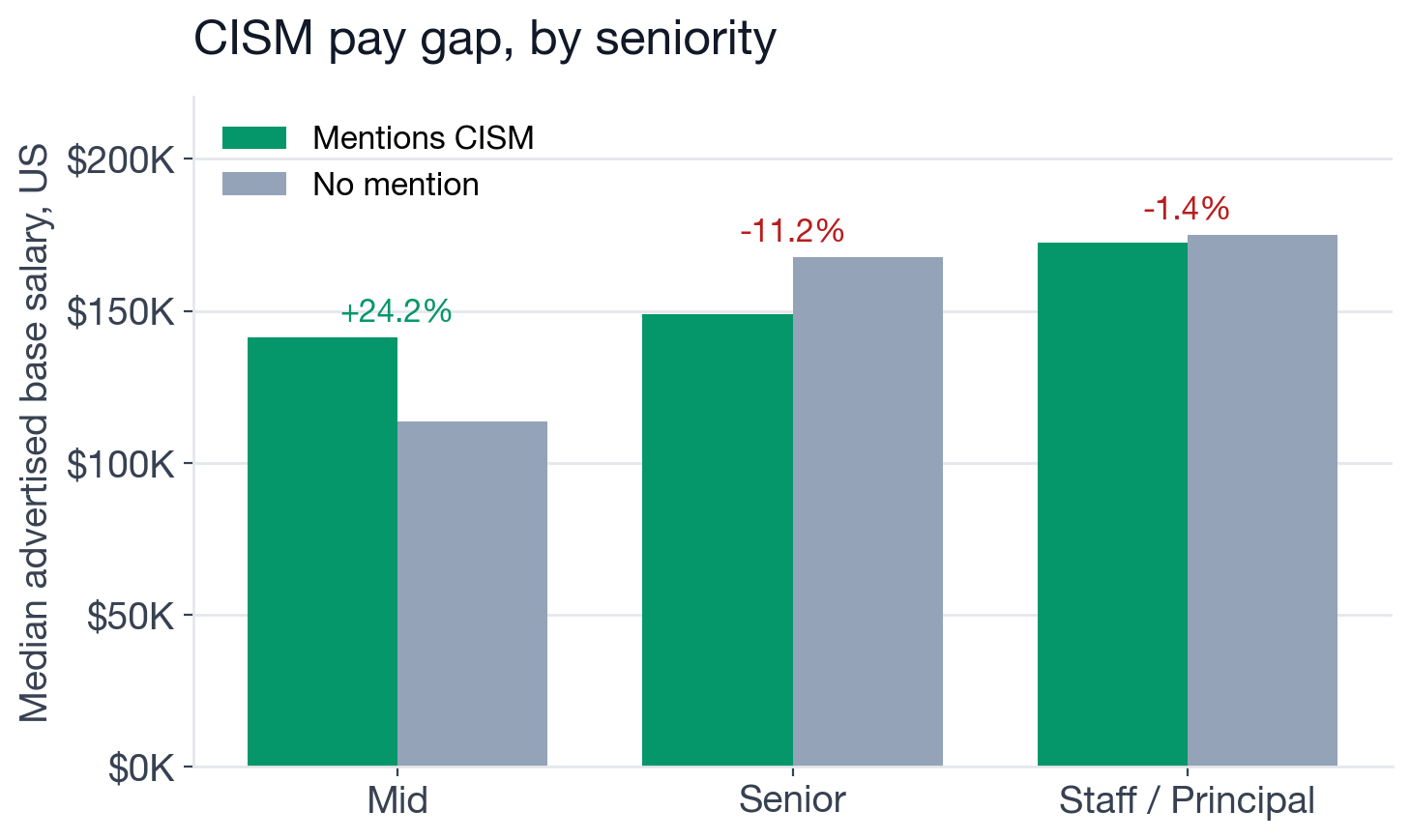 CISM's pay advantage lives entirely at mid-level; senior-level postings that mention CISM actually pay less than senior-level postings that don't.
Blend all four levels together and you get a tidy +7.6% overall premium ($146,922 vs $136,500, across 277 CISM-mentioning and 3,200 non-CISM US postings). That number is real, but it isn't the finding. It exists because 66% of CISM-mentioning postings sit at mid-level, exactly where the premium is largest, so the mid-level swing dominates the blend and buries the senior-level reversal underneath it.
It also isn't a seniority-mix artifact working in CISM's favor. CISM-mentioning postings actually run slightly more senior overall (33.3% are senior or staff, versus 31.3% for non-CISM postings in the same five roles), which should pull the blended number down, not up, given that senior-level CISM postings pay less. (Seniority here is inferred from job-title keywords, and a title with no explicit level word, like a bare "Information Security Manager" or "Security Architect," defaults to mid-level, which likely compresses the measured senior/staff share for both groups. If anything, that makes the "unfavorable mix" argument conservative rather than overstated.) The mid-level premium is real and large enough to overcome a mildly unfavorable mix, and the senior-level reversal is real too, not explained away by who happens to hold the cert at what level. If you're evaluating CISM as a mid-career move, this data backs a genuine pay signal. If you're already senior and considering it as a raise strategy, this data doesn't support that.
What Do CISM Postings Ask for Beyond the Certification Itself?
| Also mentioned | Share of CISM-mentioning postings |
|---|---|
| CISSP | 96.5% |
| CISA | 29.1% |
| CompTIA Security+ | 22.7% |
| CCSP | 17.7% |
| CRISC | 17.6% |
| CEH | 16.5% |
CISSP travels with CISM almost every time: 96.5% of CISM-mentioning postings (823 of 853) also name CISSP, which makes the two closer to a paired requirement than substitutes for each other in practice. CISSP carries its own mid-level-heavy salary pattern, worth a look if you're weighing both. Two more ISACA credentials, both audit-and-risk-adjacent, also outrank the hands-on offensive certifications: CISA (29.1%) clears CEH (16.5%) and OSCP (7.6%, not shown above) by a wide margin, while CRISC (17.6%) only narrowly edges out CEH. That ordering reinforces the same governance read as the role-concentration data above.
On skills, the top associated skill isn't a specific tool, it's Risk Management (44.7% of CISM-mentioning postings), followed by Monitoring (37.9%) and Incident Response (36.8%). Cloud literacy still matters even in a governance-heavy credential: AWS (29.8%), Cloud Security (29.0%), and Azure (27.1%) each appear in more than a quarter of CISM-mentioning postings, a reminder that security governance work today still assumes hands-on familiarity with where the infrastructure actually lives. If you're building toward this combination, Security Architect openings that also ask for Risk Management are a reasonable place to start.
CISM Hiring Splits Between Defense Contractors and Regulated Finance
| Company | Postings mentioning CISM |
|---|---|
| Booz Allen Hamilton | 29 |
| Peraton | 15 |
| Ntt Limited | 12 |
| Danaher Corporation | 10 |
| Leidos | 9 |
| Amazon | 9 |
| Mitsubishi UFJ Financial Group | 9 |
| Leonardo S.p.A. | 8 |
| Sun Life Financial | 8 |
| Thales | 8 |
| Allianz | 8 |
| PricewaterhouseCoopers | 7 |
Five of these twelve are defense contractors or defense-adjacent aerospace firms (Booz Allen Hamilton, Peraton, Leidos, Leonardo S.p.A., Thales), a bit over half of the mentions in this table (52.3%). CISM sits on the DoD 8570/8140 baseline list for information assurance management roles, so its presence at contractors like these likely reflects a compliance requirement as much as a market signal for the role itself, the same dynamic this series has documented for other IA-baseline certifications.
The rest of the roster isn't more of the same, though. Mitsubishi UFJ Financial Group, Sun Life Financial, and Allianz are large, heavily-regulated banks and insurers that run their own internal security governance programs, a different context where a management-and-risk credential like CISM maps directly onto the job, independent of any federal compliance mandate. Ntt Limited, Danaher Corporation, Amazon, and PricewaterhouseCoopers round out the roster as global technology, industrial, and consulting employers with their own security governance needs. CISM's hiring base looks less like one sector and more like whoever has to formally answer for security decisions, whether that's a government auditor or a bank regulator.
What to Do With This Before You Sit for CISM
If you're prepping for a Security Architect or Digital Forensic Examiner role where CISM keeps showing up, practice with AI mock interviews that simulate the governance and risk-framing questions those roles actually ask, not just technical trivia. The question bank has focused drilling on risk management, incident response, and security architecture, the three topics that show up most often alongside CISM in real postings. If your background is stronger on individual tools than on program-level thinking, our interactive courses can help build the governance and risk fundamentals CISM tests before you spend a study cycle on flashcards. And since demand for CISM is concentrated rather than universal, check current Security Architect openings and Digital Forensic Examiner openings directly rather than assuming the certification helps equally everywhere; if you're aiming at Penetration Tester roles instead, this data says CISM probably isn't the credential to prioritize.
FAQ
Q. Does CISM appear often in security job postings?
CISM appears in 8.5% of active postings across five security roles (853 of 9,990 analyzed on the InterviewStack.io job board over the trailing 90 days), but that rate hides a wide spread by role.
Q. Which security roles ask for CISM most often?
Security Architect postings mention CISM at the highest rate (15.0%, 109 of 728 postings), more than five times the rate seen in Penetration Tester postings (2.9%, 14 of 475). Digital Forensic Examiner (12.8%), Information Security Analyst (8.4%), and Cybersecurity Engineer (7.5%) fall in between.
Q. Is CISM usually required or just preferred?
Among the 491 mentions clear enough to classify, only 8.6% (42) state CISM as a hard requirement; 91.4% (449) call it preferred. Another 362 mentions, 42.4% of all 853, don't specify either way.
Q. Do CISM postings pay more?
It depends entirely on seniority level. Postings that mention CISM advertise a median US base salary of $146,922 versus $136,500 for postings in the same roles that don't, a 7.6% aggregate difference. But that aggregate hides a reversal: the premium is concentrated at mid-level (+24.2%, $141,250 vs $113,700), while senior-level CISM postings actually pay 11.2% less ($149,006 vs $167,819), and staff-level pay is essentially flat (-1.4%).
Q. What certification most often appears alongside CISM?
CISSP, by a wide margin. It shows up in 96.5% of CISM-mentioning postings (823 of 853), making the two credentials closer to a paired requirement than substitutes for each other.
Q. Who is actually hiring for CISM?
The employer roster splits between defense contractors (Booz Allen Hamilton, Peraton, Leidos, Leonardo S.p.A., Thales) and regulated financial and insurance firms (Mitsubishi UFJ Financial Group, Sun Life Financial, Allianz), reflecting CISM's governance and risk-management focus rather than one dominant industry.
Q. Does CISM help if you're aiming for a Penetration Tester role?
The data says probably not for that reason. CISM barely registers in Penetration Tester postings (2.9%, the lowest of the five roles in this scope), consistent with CISM being a governance and management credential rather than a hands-on offensive-security one.
CISM Rewards a Specific Kind of Security Career, Not Every One
CISM's job-market footprint is narrow but real: heaviest in Security Architect and Digital Forensic Examiner postings, thin everywhere near hands-on offensive work, and almost always paired with CISSP rather than standing alone. The salary story rewards that same narrowness: a genuine premium at mid-level, a reversal at senior level once the blended number is set aside. If your target role sits in governance, architecture, or forensics, and especially if you're eyeing defense-adjacent or heavily-regulated finance and insurance employers, CISM is worth the study time. If you're building toward offensive security work, the data says look elsewhere first.
Topics
Ready to practice?
Put what you've learned into practice with AI mock interviews and structured preparation guides.