
Penetration Testers Are the Real Audience for OSCP
OSCP gets talked about as a general security credential, the kind of thing that helps almost any cybersecurity career along. The postings data says otherwise. Across the five security roles in this analysis, Penetration Tester postings mention OSCP at 20.4%, roughly five times the aggregate rate and dramatically ahead of every other role in scope. Cybersecurity Engineer, the next closest, sits at just 5.2%. OSCP isn't a broad security signal. It's a Penetration Tester signal that occasionally shows up elsewhere.
This is drawn from 417 OSCP mentions across 10,043 active postings for Information Security Analyst, Cybersecurity Engineer, Penetration Tester, Security Architect, and Digital Forensic Examiner roles on the InterviewStack.io job board over the trailing 90 days. OSCP (Offensive Security Certified Professional, the hands-on offensive-security certification from OffSec built around a proctored, real-system exploitation exam) is a niche credential in absolute terms: just 4.15% of postings in this scope mention it at all. Where it does show up, though, it shows up hard, and the salary pattern behind it is more interesting than the headline number suggests.
Key Findings
- OSCP appears in 4.15% of active postings across five security roles (417 of 10,043 scanned).
- Penetration Tester postings mention OSCP at 20.4%, roughly five times the aggregate rate and far ahead of any other role in scope.
- Only 8.5% of postings clear enough to classify treat OSCP as required; 91.5% call it preferred.
- OSCP-mentioning postings report a median US base salary of $145,000 versus $137,250 for postings that don't mention it (+5.6%).
- That gap widens to +22.5% at mid-level ($140,200 vs $114,465) and narrows to +2.4% at senior level ($169,000 vs $165,000).
- 49.2% of OSCP-mentioning postings also ask for CISSP, and 33.6% also ask for CEH.
- Penetration Testing (53.0%) and Python (51.1%) are the most common accompanying skills.
How Lopsided Is OSCP Demand Across Security Roles?
OSCP shows up in one out of every five active Penetration Tester postings (20.4%, 100 of 491 scanned), a rate that dwarfs every other role in this analysis. Cybersecurity Engineer is a distant second at 5.2% (217 of 4,157 postings). Digital Forensic Examiner (2.9%), Information Security Analyst (1.8%), and Security Architect (1.6%) barely register the credential at all. Security Architect's low rate is the more surprising one: it's the highest-paying role in this scope by a wide margin ($180,100 median base salary among postings that don't mention OSCP), yet architecture-level roles apparently lean on other credentials rather than a hands-on exploitation cert. Information Security Analyst's low rate tracks its pay: at $92,000 median (without-cert), it's the lowest-paying role in the scope, consistent with a more generalist title that skews away from offensive-security work.
The gaps compound fast. Penetration Tester postings mention OSCP nearly five times as often as the aggregate rate across all five roles, and nearly four times Cybersecurity Engineer's rate. Against Information Security Analyst the gap is more than 11-fold; against Security Architect it's nearly 13-fold. Pen Tester postings also account for nearly a quarter of every OSCP mention in this dataset (24.0%, 100 of 417) despite being under 5% of the postings scanned (491 of 10,043). For a deeper look at the rest of that role's skill stack, see our breakdown of Penetration Tester skills.
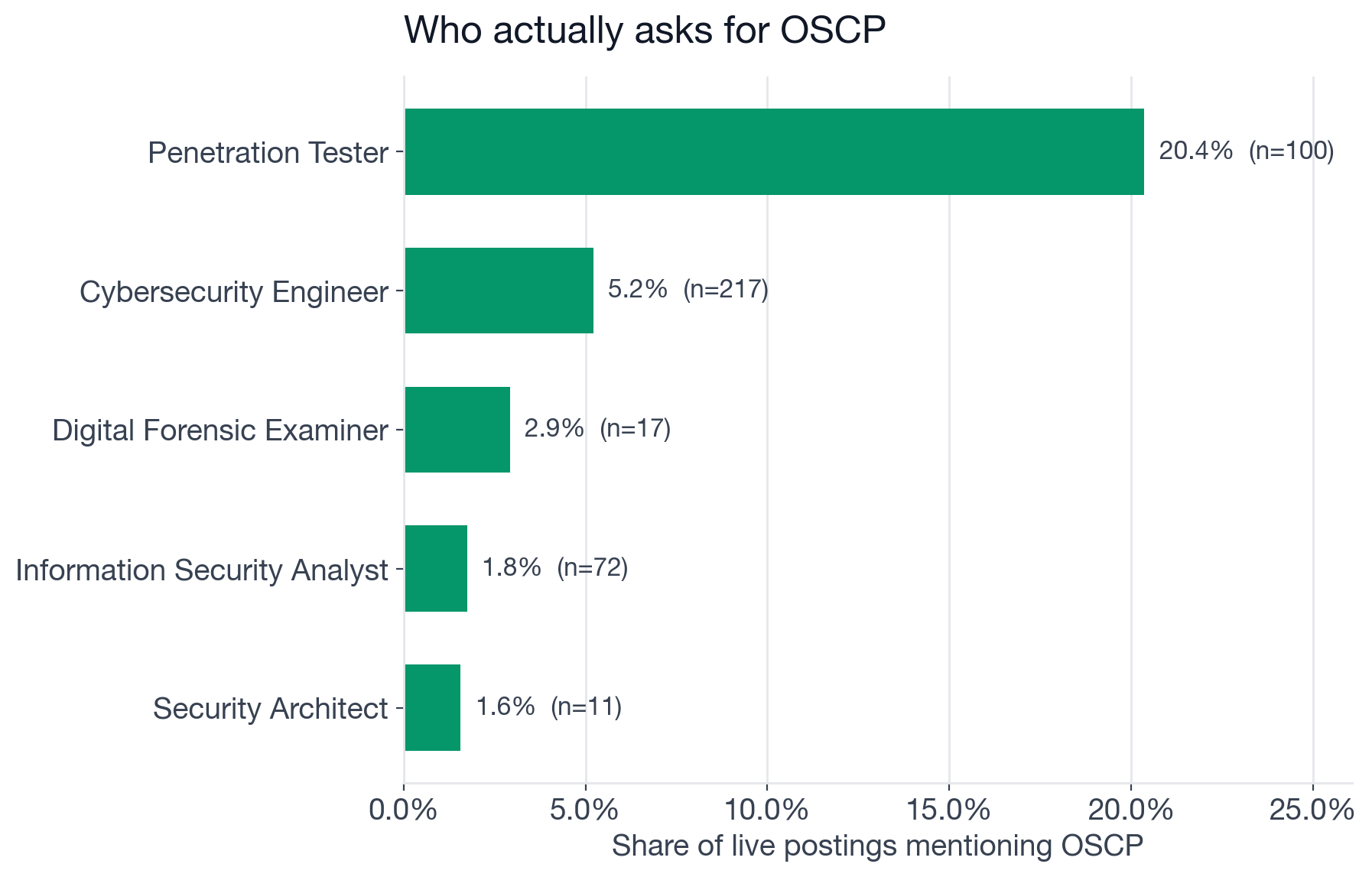 Penetration Tester is the clear outlier; every other role sits under 6%.
That concentration tracks the credential itself. OSCP is a hands-on, exam-based offensive-security certification built around exploiting real systems under time pressure, not a management framework or a compliance checkbox, so it makes sense that the role built entirely around offensive testing is the one that actually asks for it.
OSCP Is Preferred Almost Everywhere, Required Almost Nowhere
Of the 260 OSCP mentions specific enough to classify as required or preferred, only 22 (8.5%) treat it as a hard requirement. The other 238 (91.5%) list it as preferred: a credential that strengthens a candidate's file without gating the application outright. Another 157 mentions (37.6% of all 417) don't specify either way and are excluded from that split.
Put differently: roughly 1 in 12 postings clear enough to classify makes OSCP mandatory. The rest treat it as a strong signal of hands-on offensive skill, not a hard gate. That matters for anyone weighing the exam cost and time against a specific job search: not holding OSCP disqualifies you from very few of the postings that mention it at all, but it's still the single most common credential Penetration Tester listings call out by name.
The Headline OSCP Pay Gap Hides a Much Bigger Mid-Level Story
One note before the numbers: these are advertised US base salaries only, on the subset of postings that disclose pay. Equity, bonus, and non-US postings are excluded, and the comparison baseline is other postings in the same five-role scope, not the broader job market. A second note: seniority itself is inferred from title keywords, and postings with no explicit seniority signal default to mid-level. That likely inflates the mid-level bucket on both sides of the comparison below and compresses how much the premium actually varies by level, so read the by-level split as directionally real rather than exact.
Postings that mention OSCP report a median US base salary of $145,000, compared with $137,250 for postings in the same scope that don't mention it, a 5.6% gap (about $7,750). Taken at face value, that's a modest edge. It also happens to be the least interesting number in this dataset.
| Level | With OSCP | Without OSCP | Gap | Sample (with / without) |
|---|---|---|---|---|
| Entry | Not reportable (n=1) | $88,609 | n/a | 1 / 66 |
| Mid-level | $140,200 | $114,465 | +22.5% | 74 / 2,180 |
| Senior | $169,000 | $165,000 | +2.4% | 39 / 630 |
| Staff | Not reportable (n=15) | $172,500 | n/a | 15 / 459 |
Split by seniority level, the picture changes. At mid-level, OSCP-mentioning postings report a median of $140,200 versus $114,465 for postings that don't mention it, a 22.5% gap, nearly four times the headline number. At senior level, that gap narrows to 2.4%. Entry and staff-level with-OSCP samples are too small to report reliably (n=1 and n=15, below the 25-posting floor used throughout this analysis).
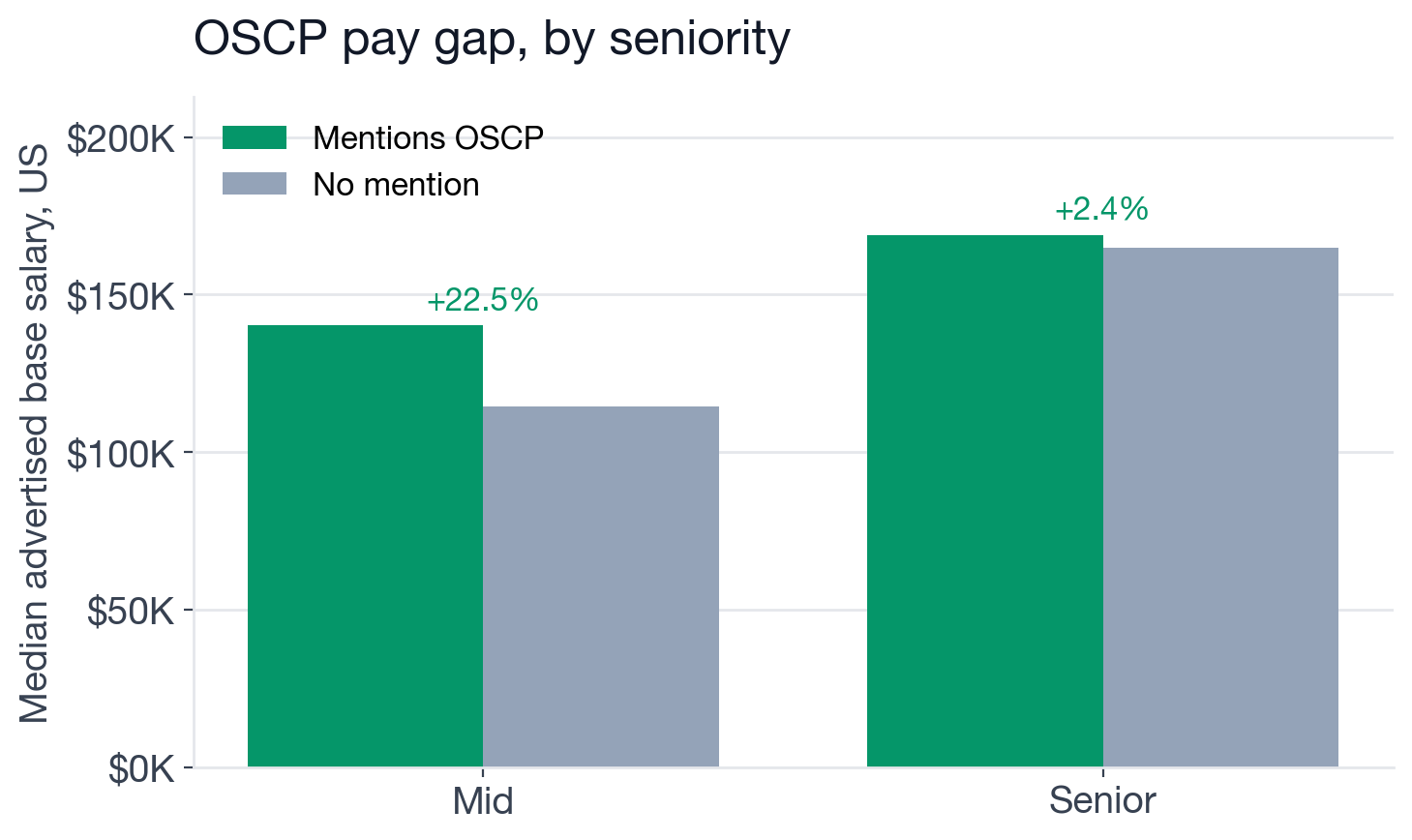 The gap is largest at mid-level (+22.5%) and nearly closes at senior level (+2.4%); entry and staff levels don't have enough OSCP postings to report reliably.
The aggregate undersells the mid-level story because OSCP-mentioning postings skew more senior than the rest of the market: 39.1% of them sit at senior or staff level, versus 31.3% of postings that don't mention the cert. Mid-level, where the premium is largest, makes up 58.8% of OSCP postings but 66.0% of the rest. That shift toward senior roles, where the premium mostly evaporates, drags the blended number well below what a mid-level candidate holding OSCP is actually seeing in the market. This is a correlation between which postings mention the credential and what those postings pay, not proof that sitting the exam adds $25,735 to a paycheck.
What Else Travels With an OSCP Listing?
Nearly half of OSCP-mentioning postings (49.2%, 205 of 417) also ask for CISSP (Certified Information Systems Security Professional, the broad, management-oriented security credential). See our own breakdown of CISSP's demand and pay pattern for how that credential behaves on its own. A third of OSCP postings (33.6%, 140 of 417) also ask for CEH (Certified Ethical Hacker), OSCP's closest sibling in the offensive-security space, and CISM (17.7%) and CompTIA Security+ (17.0%) round out the top four.
The CISSP pairing is notable because the two credentials test almost opposite things. CISSP is broad and largely conceptual; OSCP is narrow and entirely hands-on. Seeing them requested together points to senior offensive-security roles that want both strategic security judgment and proof a candidate can actually break into a system.
The accompanying skill list confirms the offensive-security lean. Penetration Testing itself appears in 53.0% of OSCP-mentioning postings, followed closely by Python at 51.1% (scripting exploits and automation tooling), Incident Response at 39.1%, and Automation at 34.1%. Cloud platforms show up too: AWS (33.6%) and Azure (28.8%) reflect how much offensive-security work now targets cloud infrastructure rather than on-premises networks alone.
OSCP Hiring Splits Three Ways, With No Single Sector Dominating
The top employers split three ways. Federal contractors that run defense and intelligence-community security programs (Booz Allen Hamilton, CACI International, Peraton, and the French aerospace-and-defense group Thales) account for just under half of the mentions in the table below. Large enterprises building their own offensive-security or red-team function (Google, Roche, the German fashion retailer ABOUT YOU) make up a second cluster. Security-focused vendors and consultancies (Qualys, PricewaterhouseCoopers, DirectViz Solutions, 10a Labs) fill out the rest.
| Company | OSCP-mentioning postings |
|---|---|
| Booz Allen Hamilton | 13 |
| 10 | |
| CACI International | 10 |
| Peraton | 7 |
| Roche | 6 |
| Thales | 6 |
| Qualys | 6 |
| PricewaterhouseCoopers | 5 |
| DirectViz Solutions | 5 |
| 10a Labs | 4 |
| ABOUT YOU SE & Co. KG | 4 |
Unlike some of the other certifications in this series, OSCP's roster isn't dominated by any single sector. Government-adjacent employers are the largest cluster, but Google, Roche, and a German e-commerce retailer all show up hiring for the same credential, a reminder that offensive-security testing is now a function most large organizations staff directly rather than something only defense contractors need.
Using This Before You Book the OSCP Exam
If you're deciding whether OSCP is worth the exam fee and the proctored practical, treat it first as a Penetration Tester credential and only distantly as a general security one. Start by browsing current Penetration Tester openings to see how often it's actually named in postings you'd apply to today, and compare against Cybersecurity Engineer roles if you're weighing a broader defensive-security path where OSCP shows up far less often.
Once you know which roles you're targeting, practice with AI mock interviews built around real offensive-security scenarios, drill methodology and incident-response questions in the question bank, and use our interactive courses to shore up the cloud-security and scripting fundamentals that show up alongside OSCP in the data above. When you're ready to apply, the full five-role search covering all five roles in this analysis is the fastest way to see what's live right now.
FAQ
Q. Does OSCP get you hired as a Penetration Tester in 2026?
OSCP shows up in about 1 in 5 active Penetration Tester postings (20.4%, 100 of 491 postings scanned on the InterviewStack.io job board), by far its highest concentration across the five security roles in this analysis. Looking at all OSCP mentions across the full five-role dataset, not just Penetration Tester postings, it is rarely a strict requirement: of postings clear enough to classify, only 8.5% require it and 91.5% call it preferred.
Q. How many security job postings actually mention OSCP?
OSCP appears in 4.15% of the 10,043 active postings scanned across Information Security Analyst, Cybersecurity Engineer, Penetration Tester, Security Architect, and Digital Forensic Examiner roles on the InterviewStack.io job board, a niche but consistent signal concentrated almost entirely in offensive-security work.
Q. Is OSCP required or just preferred?
Preferred, overwhelmingly. Of the 260 OSCP mentions specific enough to classify, only 22 (8.5%) treat it as required and 238 (91.5%) call it preferred. Another 157 mentions (37.6% of all 417) don't specify either way and aren't part of that split.
Q. Does OSCP come with a salary premium?
Postings that mention OSCP report a median US base salary of $145,000, versus $137,250 for postings in the same role scope that don't mention it, a 5.6% gap. That aggregate understates the real story: the gap is 22.5% at mid-level ($140,200 vs $114,465, n=74) and narrows to 2.4% at senior level ($169,000 vs $165,000, n=39). This is a correlation between which postings ask for OSCP and what they pay, not proof that the credential itself adds dollars. Seniority is inferred from title keywords and defaults to mid-level when a posting has no explicit signal, which likely inflates that bucket on both sides of the comparison.
Q. What other certifications commonly appear alongside OSCP?
CISSP is the most common co-occurring credential, appearing in 49.2% of OSCP-mentioning postings, followed by CEH at 33.6% and CISM at 17.7%. The pairing suggests many senior offensive-security roles want both hands-on exploitation skill and a broader security-management credential.
Q. Which companies are hiring for OSCP most often?
Federal contractors including Booz Allen Hamilton, CACI International, and Peraton appear most often, alongside enterprises such as Google and Roche building in-house offensive-security capability, and security-focused vendors and consultancies like Qualys and PricewaterhouseCoopers.
Q. What skills typically appear alongside OSCP in job postings?
Penetration Testing itself (53.0% of OSCP-mentioning postings), Python (51.1%), Incident Response (39.1%), and cloud platforms like AWS (33.6%) and Azure (28.8%) round out the typical stack, reflecting how much offensive-security work now touches cloud infrastructure.
What the OSCP Data Actually Tells You
OSCP isn't a general-purpose security credential the way CISSP or Security+ function across the board. It's a specialist signal that lives almost entirely inside Penetration Tester postings, gets asked for as a preference rather than a gate, and carries its real salary story at mid-level rather than in the aggregate number most people would quote. If offensive testing is the work, OSCP is worth knowing well. If it isn't, the data suggests the exam buys far less than its reputation implies.
Topics
Ready to practice?
Put what you've learned into practice with AI mock interviews and structured preparation guides.