
Google Cloud Is a Second-Cloud Ask: 1 in 10 Postings, Rarely Alone
Google Cloud (GCP) is named in 15,547 of the 155,348 postings on the InterviewStack.io job board in the 90 days to 22 November 2026, which is 10.0%, and it appears in 37 of the 39 roles we track. The share is flat across the window (9.7%, 9.9%, 10.0% by 30-day slice; older slices only hold postings still active, so this is not a long-run trend), and within the same role and title level, ads that name it list about 4% more US base pay than ads that do not, with 9 of 57 role-and-level groups going the other way.
Those two sentences are the whole headline; the rest of the post is who is asking, how firmly, and what sits next to it. The most useful pattern is the last one. About 3 in 4 Google Cloud ads also name AWS (74.0%), and 65% name Azure, so Google Cloud usually appears next to other clouds in the same ad, rarely on its own. A posting is an advertisement, not a hire, and a share here is how often employers write the term, not what a job requires.
Key Findings
- Google Cloud is named in 15,547 of 155,348 postings (10.0%) across 37 roles, 90 days to 22 November 2026.
- The share is flat: 9.7% (postings first seen 61 to 90 days ago), 9.9% (31 to 60) and 10.0% (last 30 days).
- It is most standard in Data Engineer (21.2% of the role's postings), DevOps Engineer (20.3%) and Cloud Engineer (20.0%); Software Engineer supplies the most ads (3,764, 24.2% of the total) at only 9.9% of its own.
- Where wording could be read (4,832 postings), 90.7% frame it as preferred and 9.3% as required.
- Within the same role and level, US posted base pay in Google Cloud ads is about 4% higher (weighted over 57 groups); 40 groups go up and 9 go down, with DevOps Engineer at mid-level 8.2% lower.
- 74.0% of Google Cloud ads also name AWS and 64.9% name Azure; Terraform pairs most strongly among tools beyond the clouds (3.1 times its overall rate).
- Google itself lists 586 distinct openings that name Google Cloud, 3.8% of all of them; IT services firms (Accenture, PwC, Cognizant, Booz Allen, Kyndryl) and data vendors (Databricks, MongoDB) make up about half of the rest of the top 15.
Who Hires for Google Cloud? Cloud, Data and DevOps Roles Lead
Google Cloud is closest to standard in the infrastructure and data roles, and thin in product and design work.
| Role | Postings naming Google Cloud | Share of the role's postings |
|---|---|---|
| Software Engineer | 3,764 | 9.9% |
| Data Engineer | 1,546 | 21.2% |
| DevOps Engineer | 1,045 | 20.3% |
| Cybersecurity Engineer | 880 | 17.2% |
| AI Engineer | 780 | 17.5% |
| Full-Stack Developer | 765 | 14.5% |
| Engineering Manager | 753 | 10.7% |
| Data Scientist | 683 | 11.6% |
| Cloud Engineer | 653 | 20.0% |
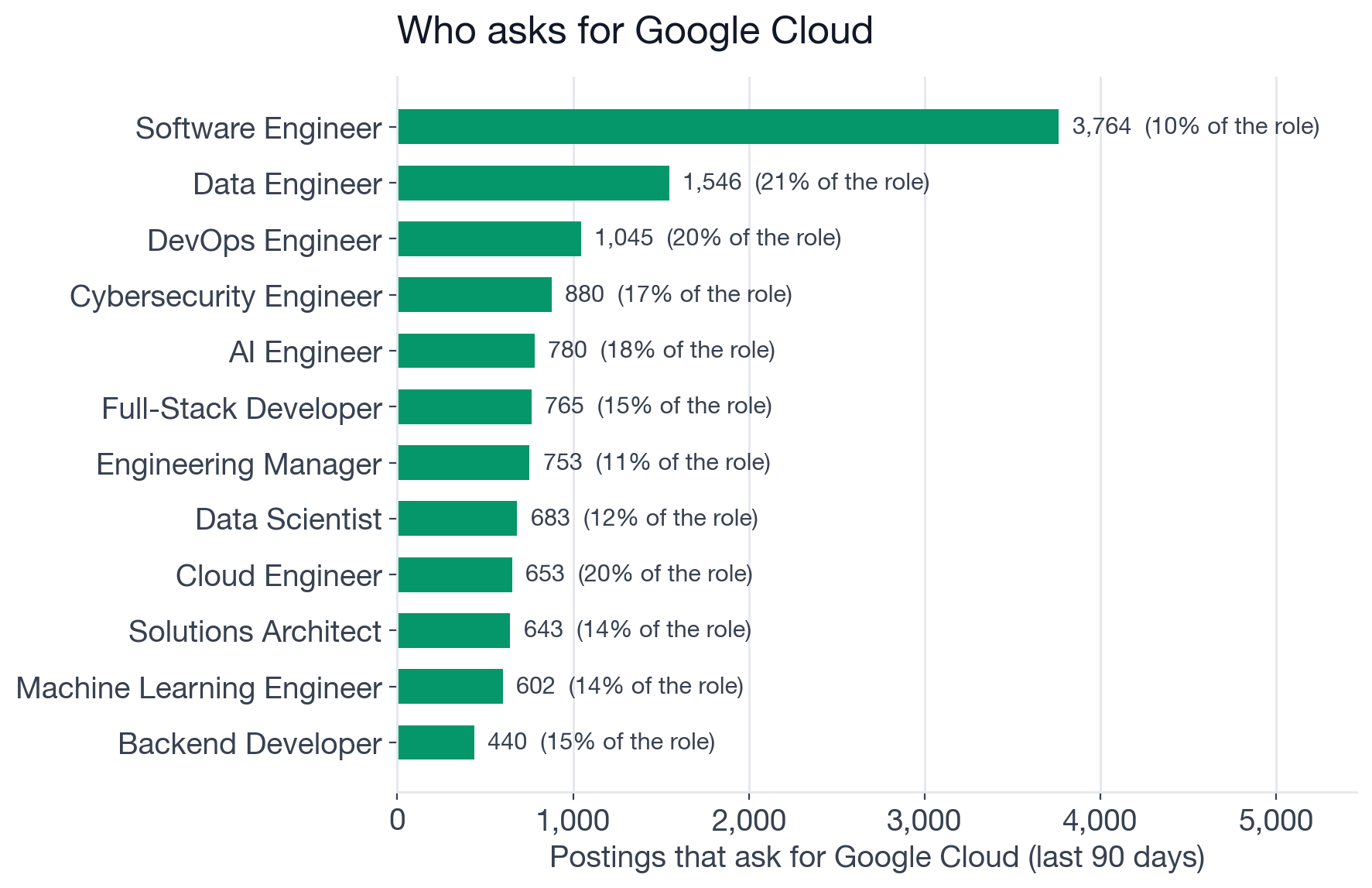
Postings naming Google Cloud by role, from active postings on the InterviewStack.io job board, 90 days to 22 November 2026.
Two readings sit side by side. By volume, Software Engineer is the largest source, because it is the largest role on the board. By how standard the skill is inside the role, it is Data Engineer, DevOps Engineer, Cloud Engineer and Cloud Architect (18.8%), where roughly 1 in 5 ads name it. If you are choosing which cloud to learn for a data or platform path, those are the roles where it is named most often, though even there about 4 in 5 ads do not name it. In Data Analyst (4.6%) and Product Manager (1.7%) postings it is rare. For the role-level picture, see our skills guides for Data Engineer, DevOps Engineer, Cloud Engineer and Software Engineer.
Is Google Cloud Required or a Nice-to-Have?
Mostly a plus: where we could read the wording, about 9 in 10 ads put it under preferred rather than required.
We could locate the surrounding wording for 4,832 of the 15,547 postings (31%). In that subset 450 (9.3%) frame Google Cloud as required and 4,382 (90.7%) as preferred. The other 69% name it without wording we could classify, such as a bare list of cloud platforms, so the split describes a minority of ads. Where an ad uses both kinds of wording near the mention it counts as preferred, so the required share is a floor. The practical reading is modest: in the ads we could read, Google Cloud is usually written as a plus. Required wording is the exception, and the data does not say which employers use it.
Does Google Cloud Come With Higher Pay?
Slightly higher on average, and in the opposite direction for a real minority of roles and levels. The comparison below uses US advertised base pay only, from postings that disclose a range. Equity and bonus are not in the data, so total pay at large employers is higher than these figures.
The fair way to compare is inside the same role and level, because Google Cloud ads skew senior: 46.4% of them are senior or staff titles, against 38.7% of ads that do not name it, and entry titles are 2.8% against 5.1% (level is read from title words, and titles with no level word count as mid-level). Without that control the raw gap is +10.3% ($177,500 against $160,950 across 4,019 and 42,427 postings), which mostly reflects job mix and is not the figure to use. Matching on role and level, with at least 15 salaries on each side, the weighted gap is +3.8% across 57 groups covering 91.8% of Google Cloud postings. 40 groups are higher and 9 are lower.
| Role and level | With Google Cloud | Without | Gap | Salaries (with / without) |
|---|---|---|---|---|
| Solutions Architect, mid-level | $200,000 | $160,000 | +25.0% | 117 / 631 |
| Data Engineer, staff | $210,000 | $185,000 | +13.5% | 61 / 261 |
| AI Engineer, mid-level | $170,000 | $150,000 | +13.3% | 65 / 443 |
| Cloud Engineer, mid-level | $155,500 | $138,400 | +12.4% | 86 / 422 |
| DevOps Engineer, senior | $167,500 | $150,000 | +11.7% | 71 / 398 |
| Software Engineer, staff | $215,000 | $210,600 | +2.1% | 423 / 2,229 |
| Software Engineer, mid-level | $164,400 | $166,224 | -1.1% | 381 / 5,025 |
| Data Engineer, mid-level | $135,000 | $137,259 | -1.6% | 105 / 643 |
| Software Engineer, senior | $177,325 | $183,600 | -3.4% | 372 / 3,331 |
| Machine Learning Engineer, mid-level | $149,710 | $162,000 | -7.6% | 56 / 479 |
| DevOps Engineer, mid-level | $128,500 | $140,000 | -8.2% | 105 / 518 |
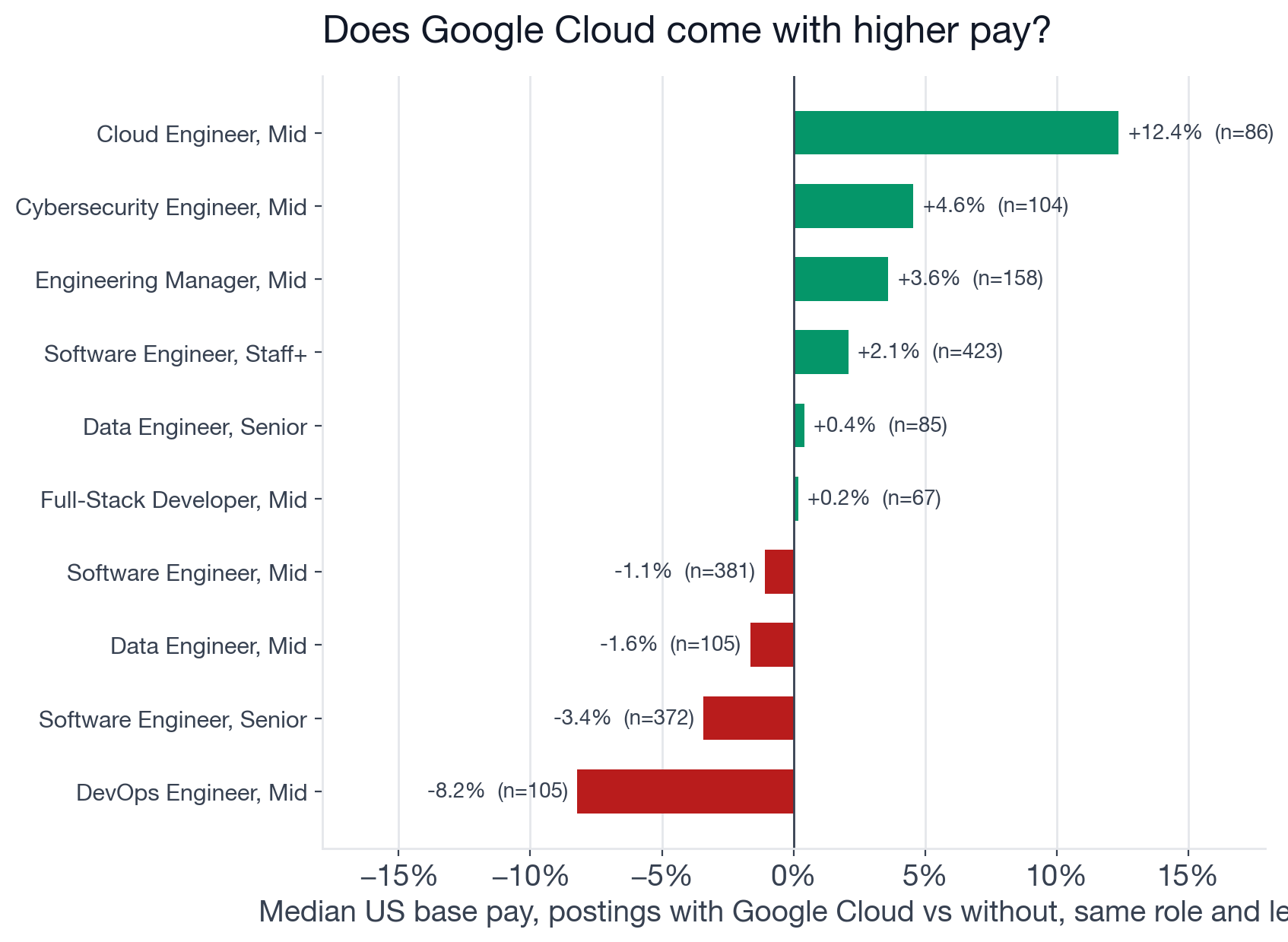
Median US base pay in postings that name Google Cloud versus those that do not, within the same role and level, for selected large groups; n is the count of salaries on the Google Cloud side.
The table is a selection of the larger groups, chosen to show both directions; the 57 in the weighted figure include smaller ones. Three things stand out. A single "Google Cloud pays more" line is false for a mid-level DevOps Engineer, a mid-level Machine Learning Engineer or a senior Software Engineer, where the ads that name it list less. The same role can move both ways: DevOps Engineer is 8.2% lower at mid-level and 11.7% higher at senior. And several of the largest positive gaps sit in Solutions Architect (+25.0%), Cloud Engineer (+12.4%) and Cloud Architect at mid-level (+12.1%), roles where a cloud platform is the job. We do not know why any cell goes the way it does; employer, city and industry are not controlled, and these are advertised medians, so none of this is what the skill pays or what it would add to your offer.
What Should You Learn With Google Cloud?
The strongest pairings are other clouds and the tooling that runs on them, and ranking by how unusual a pairing is points to a different list than ranking by share.
Python appears in 59.4% of Google Cloud ads and SQL in 29.9%, but they appear everywhere (lift 1.7 and 1.5), so they say little about Google Cloud. Ranked by lift, meaning how many times more common a tool is in Google Cloud ads than in all postings, the leaders are Azure (3.9 times, in 64.9% of Google Cloud ads), AWS (3.3 times, 74.0%), Terraform (3.1 times, 23.1%), Kubernetes (2.8 times, 36.2%) and Docker (2.7 times, 26.2%). Kafka (2.6 times), Databricks (2.4 times) and Spark (2.1 times) mark the data-platform side, each in about 1 in 9 ads.
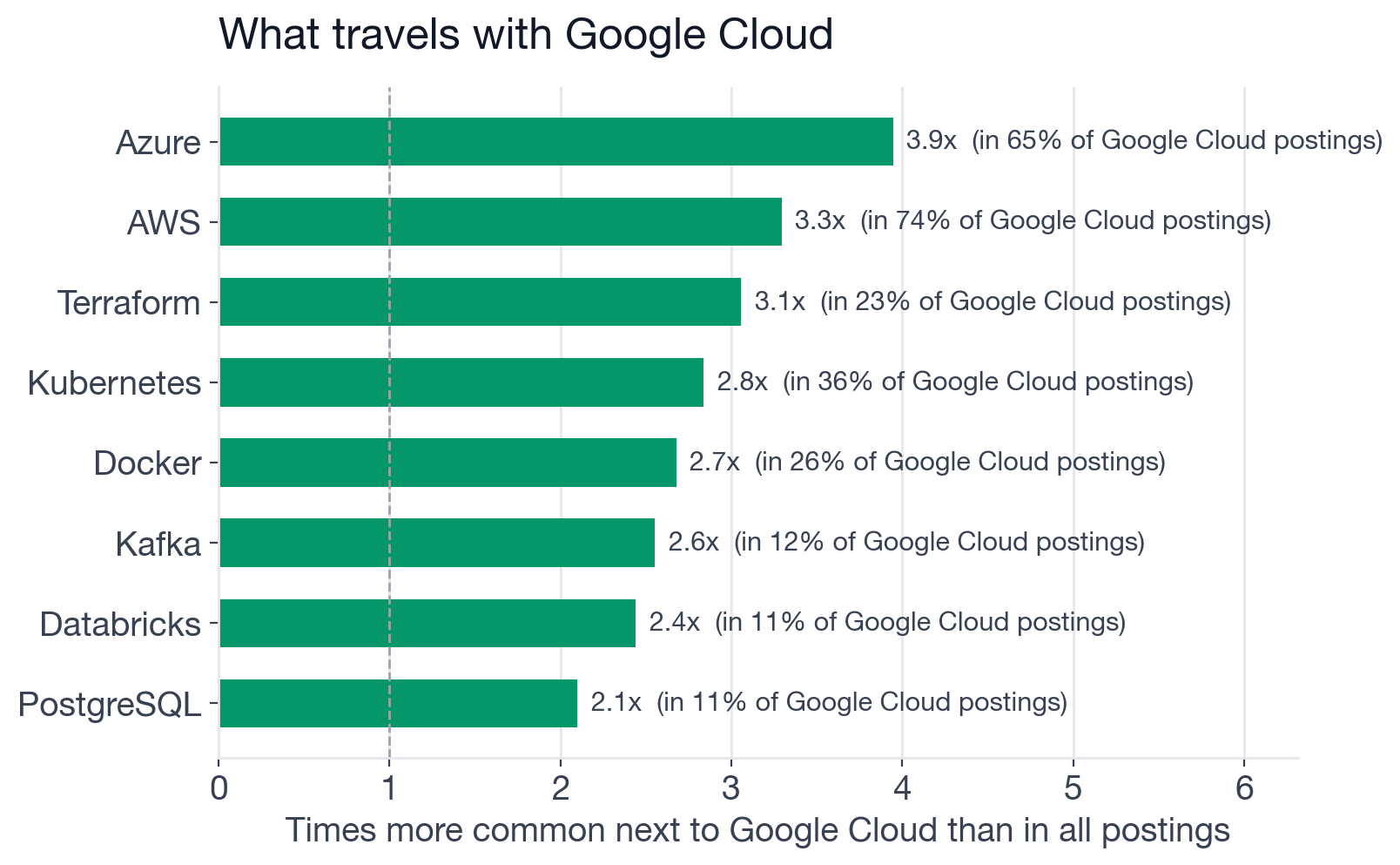
Lift of each tool among Google Cloud postings versus all postings in the 90-day window; the label gives the share of Google Cloud ads that name the tool.
Read that as a stack, not a ladder. The cloud ask is cross-provider (AWS appears in 74.0% of Google Cloud ads, so at most about a quarter name neither AWS nor Azure), the tooling layer is infrastructure as code and containers, and the concepts that travel with it are CI/CD (42.3% of Google Cloud ads), automation (39.6%) and monitoring (34.0%). Those concepts describe the work around the platform: shipping and watching services on it.
Which Employers Name Google Cloud Most?
Google itself, IT services firms and data vendors fill much of the top of the list.
Ranked by distinct openings, not posting rows, Google lists 586 openings that name Google Cloud (3.8% of all 15,547). Accenture follows with 313 (928 posting rows, so heavy reposting) and PricewaterhouseCoopers with 142. Cognizant (100), Booz Allen Hamilton (86) and Kyndryl (65) fill out an IT services and consulting group, Databricks (84) and MongoDB (74) are data vendors, and Thales (72) and Citi (71) are in other industries. Cisco shows up under two labels (78 and 73), about 151 combined. Counts are approximate (a title that differs only by city may count as a separate opening), and this is the mix on our board, not a ranking of who hires the most people.
How to Use This in Your Job Search
Treat Google Cloud as one layer in a cloud stack, and pick the layer by the role you want.
- Aiming at data or platform roles? At roughly 1 in 5 postings for Data Engineer, DevOps Engineer and Cloud Engineer, Google Cloud is worth naming on a resume if you have worked on it; look at those role guides above for what else those ads name.
- Already know AWS or Azure? Google Cloud ads usually name one of them too, so a second platform makes your resume fit more of these ads. Learning Terraform and Kubernetes next fits the pairings above, and both transfer across clouds.
- Do not expect a pay bump to follow. The matched gap is about 4% on average and negative in some groups, so choose by the work and the employers you want.
- Practise the stack, not just the console. Use AI mock interviews to rehearse cloud and infrastructure discussions, the question bank to drill topics such as networking, IAM and CI/CD, and our interactive courses to build the underlying concepts.
- Check live demand yourself on the InterviewStack.io job board before you commit months to a certification.
FAQ
Q. Is Google Cloud worth learning in 2026?
Google Cloud (GCP) is named in 15,547 of 155,348 postings (10.0%) on the InterviewStack.io job board over the 90 days to 22 November 2026, across 37 of 39 roles. It is a common ask in cloud, data and DevOps roles, usually alongside AWS or Azure rather than instead of them. Postings are advertisements, so this measures what employers write, not what they require.
Q. Is Google Cloud demand growing?
On our board the share is flat: 9.7% of postings first seen 61 to 90 days ago, 9.9% for 31 to 60 days, and 10.0% in the last 30 days. Movements under about 2 points are treated as noise, and older windows only contain postings still active, so this is not a long-run trend.
Q. Which roles ask for Google Cloud most often?
As a share of each role's postings, Data Engineer leads at 21.2%, followed by DevOps Engineer (20.3%), Cloud Engineer (20.0%), Security Architect (19.3%, a small role of 662 postings), Cloud Architect (18.8%) and AI Engineer (17.5%). Software Engineer is only 9.9% of its own postings but supplies the most ads overall (3,764, or 24.2% of all Google Cloud postings).
Q. Is Google Cloud required or a nice-to-have?
Where we could locate the wording near the mention (4,832 postings, 31% of Google Cloud ads), 90.7% frame it as preferred and 9.3% as required. In the other ads the wording was not clear enough to classify, so treat the split as a read of a subset. Where an ad uses both kinds of wording, it counts as preferred, so the required share is a floor.
Q. Do postings that name Google Cloud list higher pay?
Slightly, and not everywhere. Comparing US posted base pay inside the same role and title level, ads naming Google Cloud list about 4% more, weighted across 57 role and level groups. 40 groups go up and 9 go down, including DevOps Engineer at mid-level (8.2% lower). This is a correlation in advertisements, not what the skill pays.
Q. What should you learn alongside Google Cloud?
Ranked by how much more often a tool appears next to Google Cloud than in postings overall, the top pairings are Azure (3.9 times, in 65% of Google Cloud ads), AWS (3.3 times, 74%), Terraform (3.1 times, 23%), Kubernetes (2.8 times, 36%) and Docker (2.7 times, 26%).
Where to Start
Google Cloud is a steady, widely named skill that rarely stands alone: pick the role first, add the platform that employers in that role name, and expect Terraform and Kubernetes to matter as much as the console.
Topics
Ready to practice?
Put what you've learned into practice with AI mock interviews and structured preparation guides.