
The Backend Developer Role Now Has Two AI Tracks
Backend development in 2026 hasn't been replaced by AI. It has split. One track continues building APIs, services, and databases much as it always has. The other track does all of that AND integrates LLMs into products, builds the server-side infrastructure that makes AI agents reliable at scale, and wires retrieval pipelines that turn a language model into something a real product can use.
A look at 6,964 active Backend Developer postings on the InterviewStack.io job board as of early June 2026 shows exactly where the split runs. Among US postings with salary data, the "builds AI systems" track pays a median $160,000 in US base salary. The "doesn't build AI systems" track pays $127,400. That $32,600 difference is the financial expression of the split.
The explicit AI requirement sits at 19.5% of postings: roughly 1 in 5 Backend Developer jobs now names generative AI skills. But that number tells only half the story. The JetBrains State of Developer Ecosystem 2025 survey of 24,534 developers across 194 countries found that 85% of developers use AI tools regularly. The question in 2026 is not whether AI matters for backend developers. It is how deep the requirement goes.
Key Findings
- 6,964 active Backend Developer postings analyzed from the InterviewStack.io job board as of June 2026.
- 19.5% of postings (1,355) explicitly require new-wave generative AI skills such as AI Agents, LLMs, RAG, or OpenAI API integration.
- 27.5% of postings (1,914) ask for any AI skill, including traditional machine learning.
- US base salary with new-wave AI skills: $160,000 median (n=169); without AI skills: $127,400 (n=425). Premium: $32,600.
- AI Agents is the top new-wave AI skill demanded from backend developers, appearing in 8.1% of postings (564 of 6,964), ahead of LLMs at 6.7%.
- Staff-level postings have the highest AI rate at 28.7%, versus 19.6% for senior; mid and junior levels sit at 18.0% and 16.5%.
- SaaS leads sector AI adoption at 53.8% of postings; cybersecurity follows at 31.6%; technology at 22.4%.
- 85% of developers use AI tools regularly (JetBrains State of Developer Ecosystem 2025, 24,534 respondents), regardless of whether their job description mentions it.
What the Backend Developer Role Looked Like Before 2023
In 2021 and 2022, a strong backend engineer was defined by a handful of stable expectations: fluency in one or two server-side languages (commonly Java, Python, Node.js, or Go), production command of relational databases and REST API design, familiarity with a major cloud platform, and a working understanding of containers and CI/CD pipelines.
Machine learning existed as a specialty. A backend developer who could serve an ML inference endpoint was doing something genuinely uncommon. Most backend work was deterministic: given an input, produce a predictable output. State was managed explicitly. Failure modes were bounded and well-understood.
That baseline has not disappeared. But a new layer has been added on top. A language model is inherently stateless (it retains nothing between calls), non-deterministic, and slow. It needs different backend engineering: rate limiting for token budgets, latency management for streamed responses, retrieval systems for context injection, agent orchestration for multi-step reasoning chains. These are backend problems, and they need backend engineers to solve them.
The scale of the shift is visible in how backend teams are reorienting their work. Agent-assisted development, where an AI handles boilerplate generation, multi-file refactoring, and cross-service coordination, has moved from experimental to common practice at companies building AI-forward products. Stripe's engineering team has documented how integrating AI coding tools transformed their development process, with agentic sessions spanning multiple files and services becoming the default mode for new feature work. Coordinating that kind of work is quintessentially backend: the tool registries, state machines, and API contracts that keep agents reliable at scale are the same infrastructure challenges backend engineers have always owned, applied to a new class of system.
How Many Backend Developer Postings Actually Require AI Skills?
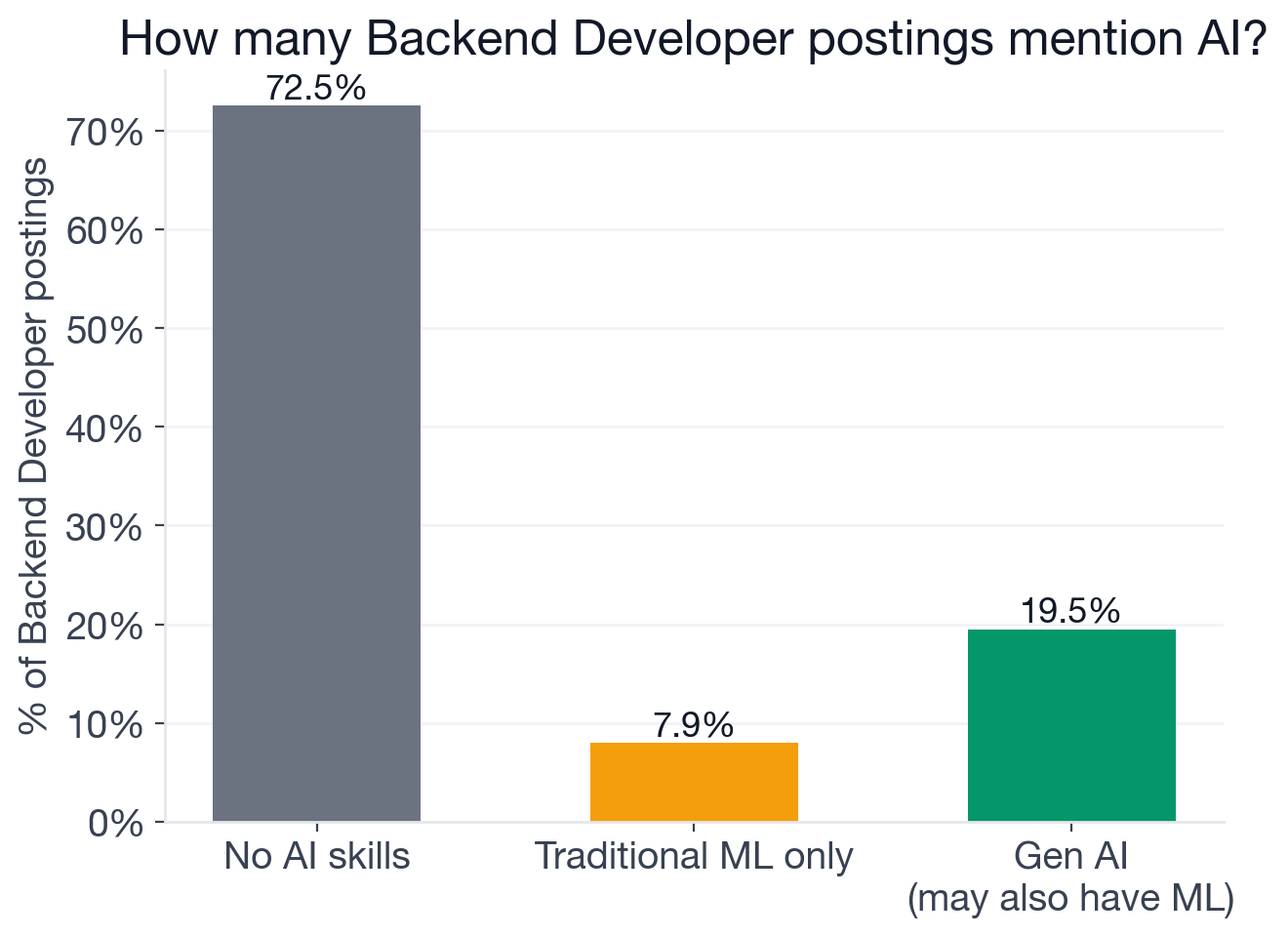
Breakdown of 6,964 Backend Developer postings by AI skill requirement type, June 2026.
The chart shows four categories, which collapse to three logical groups:
No AI requirement (72.5%, 5,050 postings). The majority of Backend Developer jobs still read like 2021 postings: REST APIs, databases, cloud infrastructure, observability, testing. No LLM, no agent framework, no vector database.
Generative AI skills required (19.5%, 1,355 postings). These are postings rewritten for the new era. They ask for LLM integration, agent orchestration, or RAG pipeline design. Some specify platform experience with OpenAI, Anthropic/Claude, or Gemini. Others name the orchestration tooling around those platforms: LangChain, Vector Databases, Prompt Engineering.
Traditional ML only (roughly 8%, 553 postings). A smaller category with a longer history: inference serving, model deployment, MLOps. These requirements predate the generative AI wave and represent an established specialty that has existed in backend postings for years.
Data scope note: the role classifier occasionally captures a very small number of non-software engineering postings where "backend" refers to hardware, manufacturing, or operational contexts rather than software systems. These account for an estimated low single-digit percentage of the dataset, rarely carry software AI requirements, and have a minimal effect on the adoption figures above, meaning the 19.5% figure is a conservative floor rather than an overcount.
The 19.5% is a floor, not a ceiling. GitHub's research on Copilot adoption found that 80% of new developers use Copilot in their first week, and that Copilot now generates 61% of code for Java developers, a number directly relevant to Java-heavy backend shops. GitHub Copilot is deployed at 90% of Fortune 100 companies. Employers writing job descriptions in 2026 don't list "uses GitHub Copilot" any more than a 2015 posting listed "can search the web." The 19.5% is measuring something specific: the fraction of employers who need backend engineers to DESIGN AI systems, not merely use them.
Browse current Backend Developer openings on the job board to see how this breaks down across company types and regions.
The AI Skills Reshaping the Backend Developer Role
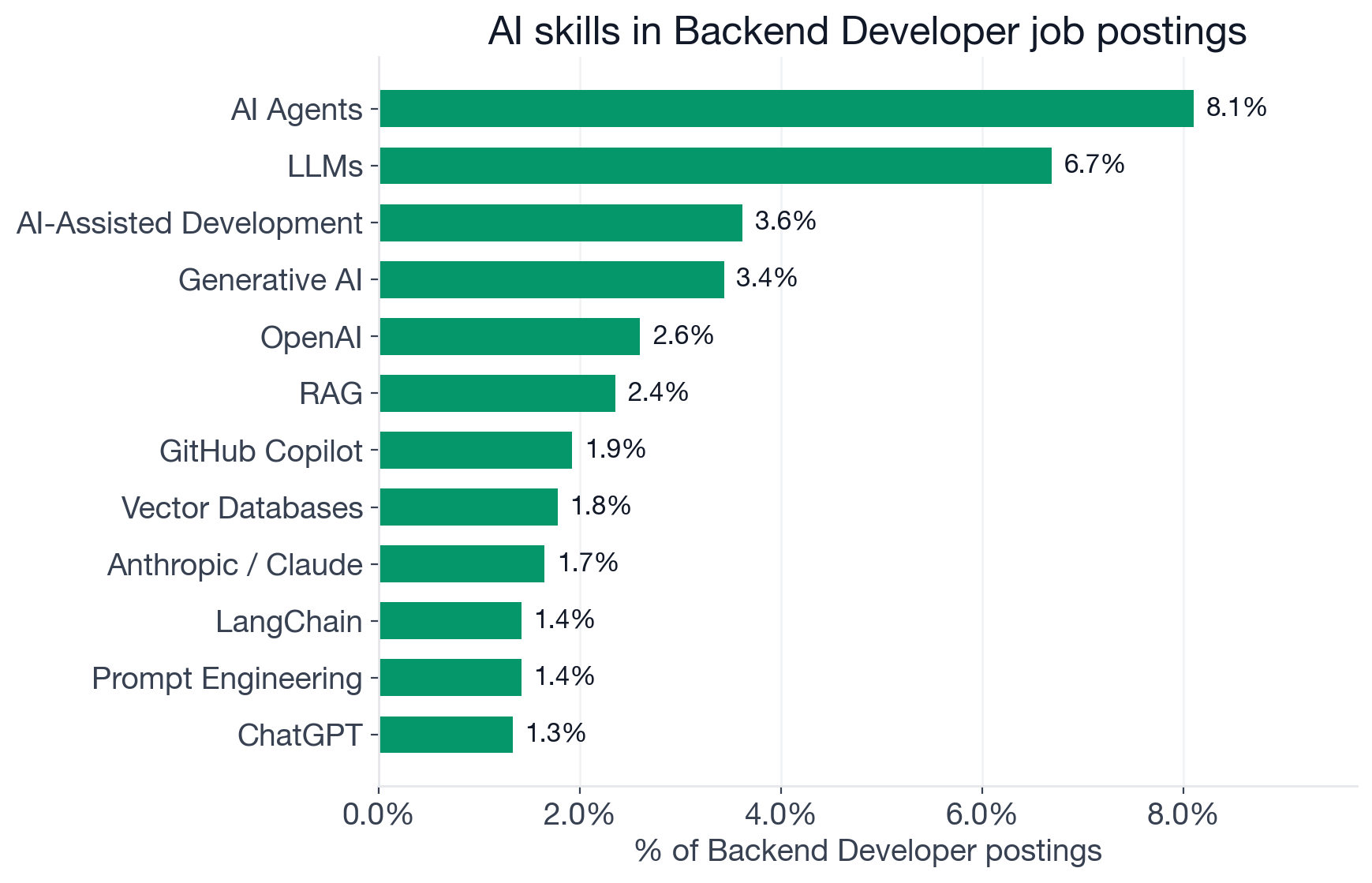
Share of Backend Developer postings mentioning each AI skill, June 2026.
The ranking tells a clear story about what "AI backend work" actually means in practice.
Machine Learning (12.4%) tops the overall list but is mostly traditional: serving ML models, building inference APIs, integrating model outputs into application logic. This specialty has existed in backend postings for years and predates the generative AI wave.
AI Agents (8.1%) is the striking new entry. Demand for backend engineers who can build agent infrastructure, the APIs, the tool registries, the state management, and the orchestration logic, now exceeds demand for LLM skills. This makes intuitive sense: a single LLM API call is a function call; an AI agent is a distributed system that needs to be designed like one. The backend engineer owns the contracts, the retry logic, the timeout handling, and the observability layer.
LLMs (6.7%) rounds out the top three new-wave skills. LLM integration from the backend side means token budgeting, streaming response handling, context window management, and the API contracts between the model and the application layer.
Below those, the skill list maps the full component stack of an AI-powered backend product. RAG (retrieval-augmented generation, a pattern where relevant context is retrieved from a search index and injected into the LLM prompt at query time) appears in 2.4% of postings. Vector Databases (databases that store and search document embeddings numerically rather than by exact match) appear in 1.8%. LangChain (a Python framework for chaining LLM calls, tools, and memory into reusable workflows) sits at 1.4%. Together, these three describe the canonical backend component of an LLM-powered product: a retrieval layer backed by a vector store, orchestrated by a framework, served through an API.
AI-Assisted Development (3.6%) and GitHub Copilot (1.9%) are the explicit tool-use mentions, the small visible tip of the ambient-layer iceberg.
Browse Backend Developer jobs that require LLM integration skills or explore roles specifically requiring AI Agents experience to see what these postings look like in practice.
Does Building AI Systems Actually Move the Salary Needle?
The salary data is restricted to US postings where wage-transparency laws produce consistent disclosure. All figures are US base salary only: equity, bonuses, RSUs, and sign-on are not captured in job-posting disclosures, and total compensation at top tech employers runs meaningfully higher than what these numbers show.
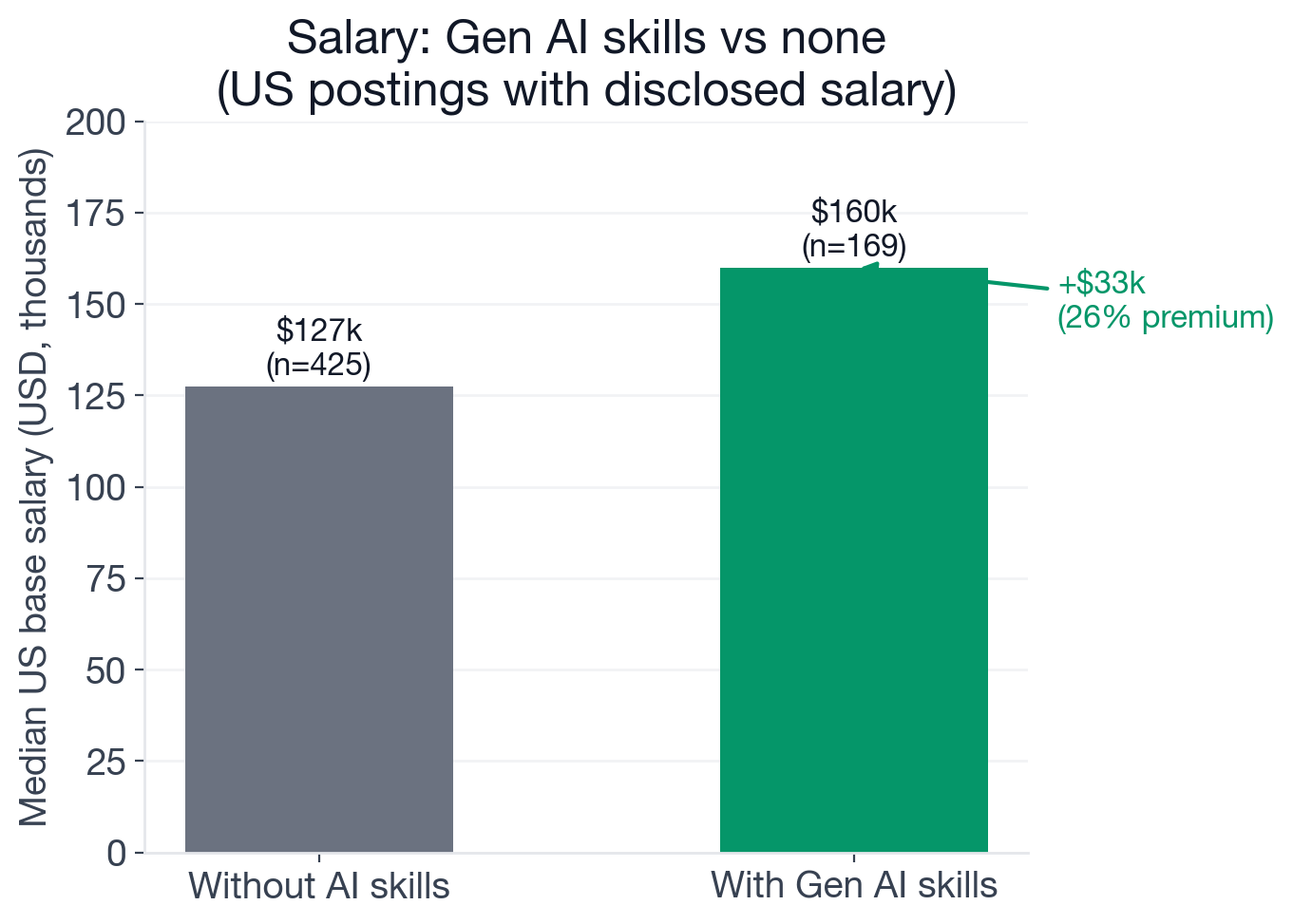
Median US base salary for Backend Developer postings with versus without generative AI skill requirements. US base salary only; equity and bonuses excluded.
The answer is unambiguous: yes, substantially.
Backend developer postings that require new-wave generative AI skills show a median US base salary of $160,000 (n=169). Postings without any AI requirement show $127,400 (n=425). The gap is $32,600, representing roughly a 26% premium over the non-AI baseline.
The premium reflects two real forces. First, scarcity: engineers who can design production-grade LLM integrations and agent orchestration systems are genuinely harder to find than engineers who build conventional REST APIs. Second, output leverage: a GitHub Research controlled study of 4,800 developers found 55% faster task completion for teams using AI coding assistants. Companies hiring engineers who can architect those tools into reliable products are paying for compounding output, not just individual productivity.
One important caveat: the AI-requiring salary sample (n=169) is smaller than the non-AI group (n=425), both drawn from the subset of US postings that disclose salary. The direction is consistent and the magnitude is large enough to be real, but treat $32,600 as a directional estimate rather than a precise market rate.
The practical implication is direct. LLM API integration, RAG pipeline construction, and basic agent orchestration are skills that can be acquired with focused practice. The InterviewStack.io question bank covers LLM integration, system design for AI-powered products, and distributed systems topics that map to what AI-requiring backend roles actually test in interviews.
Where the AI Bar Falls: Seniority and Sector
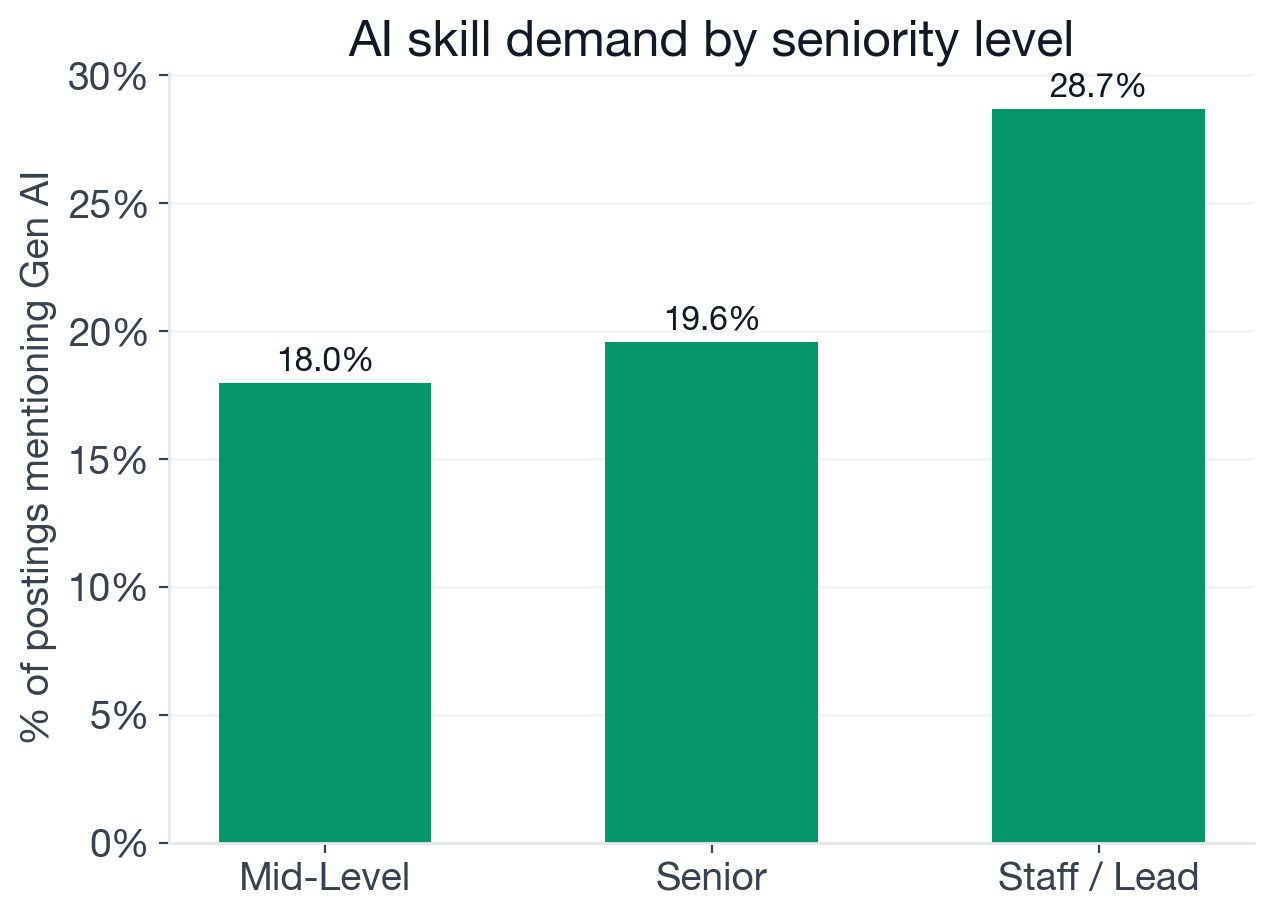
Share of Backend Developer postings with generative AI skill requirements, by seniority level, June 2026.
Staff-level postings have the highest explicit AI rate at 28.7% (76 of 265 postings), roughly 10 points above senior at 19.6%. That gradient makes intuitive sense: staff engineers are expected to define the AI architecture for a team or product. But the high floor at junior (16.5%) and entry (16.0%) is the more notable finding. Companies are writing AI expectations into every tier of the role, not just the top.
The overall seniority distribution reinforces how experience-heavy backend development already is: 71.7% of postings are senior-level (4,993 of 6,964), and entry-level accounts for just 1.4% (94 postings). That is one of the lowest entry-level shares of any tech role. Browse entry-level Backend Developer openings and senior Backend Developer roles to compare how AI requirements are framed at each level.
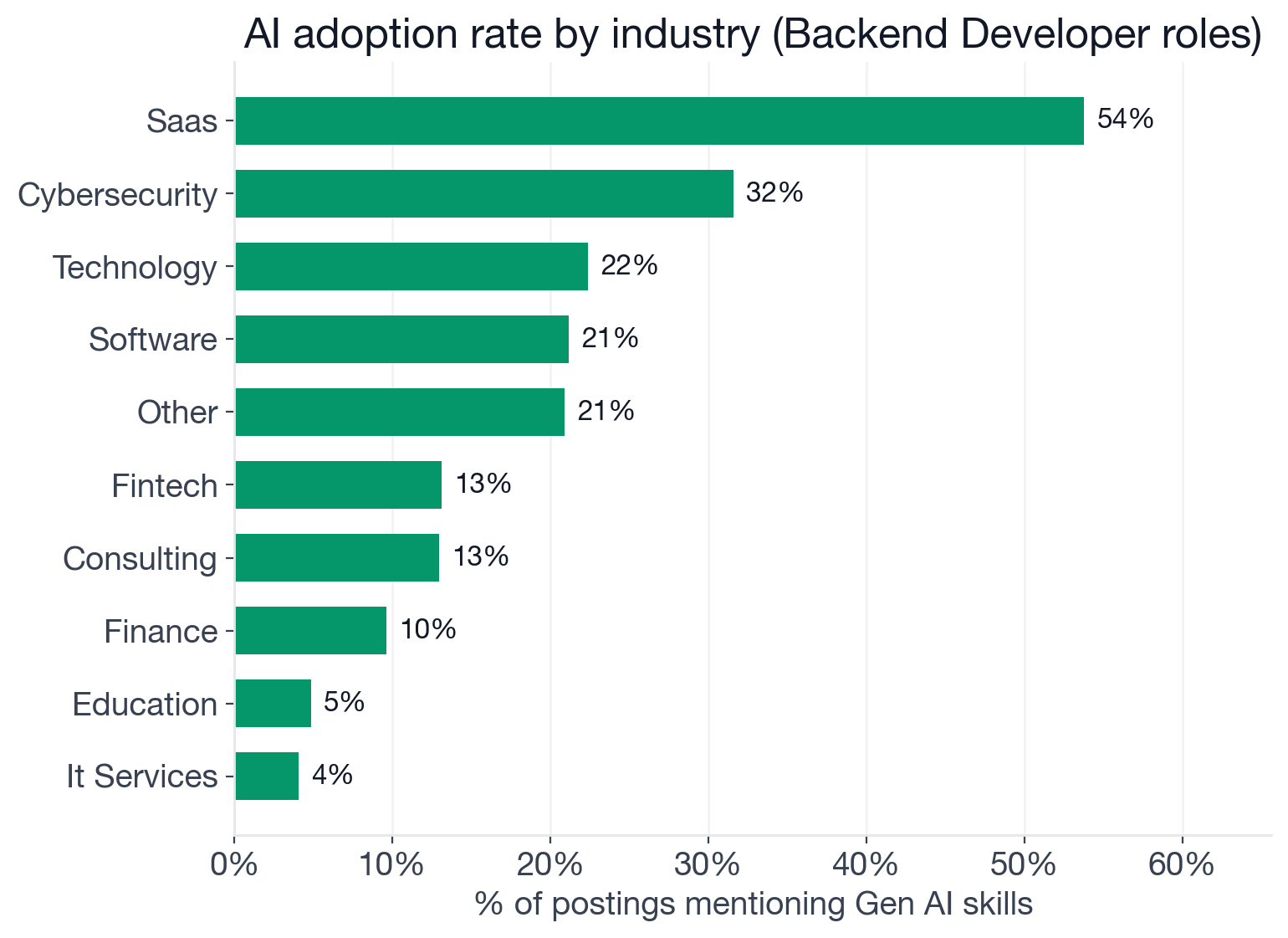
Share of Backend Developer postings with AI skill requirements, by industry. Only industries without single-firm concentration artifacts are shown.
The sector data splits into two clear tiers.
SaaS (53.8% of 106 postings) and cybersecurity (31.6% of 133 postings) lead the field. SaaS companies building LLM-powered features need backend engineers who can own the full server-side stack for those features. Cybersecurity's position is the more interesting signal: AI-powered threat detection, anomaly analysis, and automated response systems have become core product features at security companies, and backend engineers are being recruited specifically to build the inference and alert-routing infrastructure that powers them.
Technology (22.4%) and software (21.1%) sit close together, reflecting the broad market where AI integration is increasingly standard in new feature work.
Fintech (13.1%) is notably lower. Regulatory caution around AI decision-making in financial contexts, combined with a more conservative technology adoption culture at established institutions, pulls the rate down relative to pure-play tech. The ambient AI tool use (Copilot, ChatGPT for developers) is still present; it is the EXPLICIT AI system requirement that fintech firms are slower to advertise.
Note on interpretation: several industries in the underlying dataset were flagged as having AI adoption rates driven primarily by a single firm's posting volume. The sectors cited above do not carry that flag and represent genuine sector-level signals.
How to Use This in Your Job Search
The data points to a clear decision framework.
Decide which track you are building toward. The non-AI postings represent 72.5% of the Backend Developer market and carry a solid $127,400 US base salary median. If you want the $32,600 premium, the skills required are specific and learnable: LLM API integration, RAG pipeline design, and agent orchestration are the core trio. None requires a research background. They require engineering judgment applied to a new class of system. If you are weighing Backend Developer against adjacent specializations, the Backend Developer vs. DevOps Engineer comparison breaks down where the skill sets split and what each path pays.
Practice AI system design questions before the onsite. Backend developer interviews at AI-forward companies now regularly include questions like: design an LLM-powered search feature, explain how you would scale a RAG pipeline, describe how you would make agent orchestration reliable under load. Practice these scenarios with AI mock interviews so you have structured answers before the interview, not improvised ones during it.
Drill the technical foundations systematically. AI Agents, LLM integration, distributed systems, and vector database concepts now show up in backend interview loops at companies with high AI adoption. Use the InterviewStack.io question bank to work through these topics one at a time, and use interactive courses to fill gaps in system design or distributed systems fundamentals before going deeper into the AI layer.
Target sectors with the highest AI bar. SaaS and cybersecurity carry the highest AI adoption rates and, correspondingly, the highest salary potential for AI-capable backend engineers. Browse current Backend Developer openings and combine skill and industry filters to find the right intersection for your current stack.
FAQ
Q. How is AI changing the backend developer role in 2026?
Two shifts are happening simultaneously. Explicitly, 19.5% of backend developer postings (1,355 of 6,964) now require generative AI skills such as AI Agents, LLMs, RAG pipelines, or OpenAI API integration. Those postings pay a median US base salary of $160,000 versus $127,400 for postings without AI skills, a $32,600 gap. At the ambient level, developer surveys show 85% of engineers across all specializations use AI tools like GitHub Copilot or ChatGPT regularly, whether or not their job description mentions it.
Q. What AI skills do backend developers need in 2026?
The most demanded explicit AI skills in backend developer postings are Machine Learning (12.4% of postings, mostly traditional ML for inference pipelines), AI Agents (8.1%), LLMs (6.7%), AI-Assisted Development (3.6%), Generative AI (3.4%), OpenAI API integration (2.6%), and RAG (2.4%). LangChain appears in 1.4% of postings and Vector Databases in 1.8%, signaling demand for backend engineers who can build full retrieval-augmented generation pipelines from scratch.
Q. What is the salary premium for backend developers with AI skills in 2026?
Among US job postings with disclosed salary data, backend developers in roles requiring new-wave generative AI skills earn a median of $160,000 in US base salary (n=169), versus $127,400 for postings without AI requirements (n=425). That is a $32,600 premium, or roughly 26% above the non-AI baseline. Equity, bonuses, and sign-on are not captured in job-posting salary disclosures, so total compensation at top employers is higher than these figures.
Q. Which industries have the highest AI adoption in backend developer hiring?
SaaS companies have the highest explicit AI adoption rate for backend developer roles at 53.8% (57 of 106 postings), followed by cybersecurity at 31.6% (42 of 133), technology at 22.4% (178 of 795), and software at 21.1% (144 of 681). Fintech sits at 13.1% (51 of 389). Industries like finance (9.6%) and IT services (4.1%) have lower explicit AI requirements, though ambient AI tool use is expected across all sectors.
Q. Do backend developer AI requirements vary by seniority?
Staff-level backend developer postings have the highest AI adoption rate at 28.7% (76 of 265 postings), notably higher than senior at 19.6% (977 of 4,993). Mid-level, junior, and entry-level postings show AI adoption rates of 18%, 16.5%, and 16% respectively. The relatively consistent AI rate across entry-to-mid levels suggests companies are beginning to weave AI expectations into the role at every tier, not just at the top.
Q. How many backend developer jobs explicitly require AI skills in 2026?
Of 6,964 active Backend Developer postings analyzed in May-June 2026, 1,355 (19.5%) explicitly require new-wave generative AI skills. A broader 1,914 postings (27.5%) ask for any AI skill including traditional machine learning. The remaining 72.5% of postings do not explicitly mention AI, but this does not mean AI literacy is optional: developer surveys show that 85% of engineers already use AI tools in their daily workflow regardless of job description language.
Q. How is AI agent development changing backend developer work?
AI Agents is now the top new-wave AI skill in Backend Developer postings at 8.1% (564 of 6,964). Companies want backend engineers who can design the server-side infrastructure that hosts, routes, and coordinates AI agents: the message queues, the tool registries, the state machines, and the API contracts that make agents useful in production. This is quintessentially backend work, requiring the same reliability and scalability thinking as any distributed system, applied to a new class of stateful AI processes.
The Two-Track Future Is Already Here
The Backend Developer market in 2026 is best understood as two parallel markets running under the same title. One pays around $127,400 US base salary for engineers who build and maintain services, APIs, and databases. The other pays around $160,000 for engineers who can also architect the server-side infrastructure that makes AI systems production-ready. The skills separating the two tracks are specific, learnable, and in short supply. The ambient AI baseline will keep rising, and the explicit AI requirement will keep extending to lower seniority levels. Building toward the "builds AI systems" track now is an investment with a predictable return. For a broader look at how this shift is playing out across engineering roles, see how AI is changing Software Engineering in 2026.
Topics
Ready to practice?
Put what you've learned into practice with AI mock interviews and structured preparation guides.