
The Frontend Developer Job Has Two AI Realities in 2026
Look at job posting data alone and the AI transformation of frontend development seems modest. 12.7% of active Frontend Developer postings mention generative AI skills explicitly, roughly 1 in 8. To someone scanning requirements docs, that might read as "most frontend jobs don't involve AI yet."
That reading is incomplete. Among the 6,235 active Frontend Developer postings on the InterviewStack.io job board as of June 2026, the 12.7% captures only the roles where companies need someone to build AI features: chat interfaces, LLM-backed search, RAG-powered recommendations, AI agent frontends. The other 87% assume something that has become as invisible to employers as internet access was in 2005: that every developer on the team already uses AI tools.
The JetBrains AI Pulse Survey (January 2026) found 90% of developers using at least one AI tool at work. Stack Overflow's 2025 Developer Survey put daily AI tool usage at 51%. According to GitHub Copilot statistics via Panto, 90% of Fortune 100 companies are on GitHub Copilot. Somewhere between the 12.7% that postings list and the 85-90% that surveys reveal is the real AI adoption picture for frontend work: almost everyone uses AI tools; a growing fraction is hired specifically to build AI systems.
The salary data puts a dollar figure on that distinction: $38,100.
Key Findings
- 6,235 active Frontend Developer postings analyzed on the InterviewStack.io job board as of June 2026.
- 12.7% of postings (791 of 6,235) explicitly require new-wave generative AI skills. Developer surveys show 85-90% of engineers use AI tools regularly, a 7x gap from what postings list.
- AI Agents is the top explicit AI skill at 4.7% (291 postings), ahead of Machine Learning (4.5%) and AI-Assisted Development (4.3%), signaling that the explicit demand is about building AI-powered interfaces.
- GitHub Copilot appears in just 1.8% of postings but is in active use at 90% of Fortune 100 companies, the clearest illustration of the gap between what postings list and what teams assume.
- US base salary: $150,000 median for postings with new-wave AI requirements (n=117) vs. $111,900 without (n=602). The premium is $38,100.
- Entry-level postings show 0.7% AI adoption (8 of 1,143). Senior and staff postings run at 16-18%, where the expectation is to architect AI features, not just use AI tools.
- Technology companies have the highest AI adoption rate at 24%, followed by software at 22.5%. IT services lags at 5.6%.
- Senior roles make up 56% of the market (3,508 of 6,235 postings). Entry-level is 18%.
What the Frontend Role Looked Like Before Copilot and ChatGPT
Four years ago, a competitive Frontend Developer job description had a predictable shape: React (or Vue, or Angular), TypeScript, CSS, REST APIs, Git, responsive design. Some roles added testing frameworks, accessibility requirements, or a preferred state management library. AI was not part of the vocabulary at all, not because developers avoided productivity tools, but because "uses a linter" and "searches documentation" were never job requirements either.
The shift accelerated sharply in 2023. GitHub Copilot grew from a technical preview in mid-2021 to millions of paid subscribers by early 2026. Tools purpose-built for frontend AI workflows emerged: Vercel v0, which generates React and Next.js components from plain-text descriptions; Cursor, an AI-native code editor that can read and edit across an entire codebase; and AI-native design tools that compressed the Figma-to-code handoff. Per the GitHub Octoverse 2025 report, TypeScript overtook Python as GitHub's most-used language in August 2025, a shift partly attributed to AI coding assistants steering developers toward strongly typed code. LLM SDK repositories on GitHub grew 178% year over year, with 693,867 new repos integrating LLMs in a single year.
The time savings are not marginal. A 2025 longitudinal study (arXiv 2509.20353) found developers completed JavaScript tasks 55% faster with GitHub Copilot. The JetBrains Developer Ecosystem 2025 survey (24,534 developers across 194 countries) found the top-reported AI benefits: increased productivity (74%), faster repetitive tasks (73%), faster coding (69%). Boilerplate component scaffolding, CSS generation, and documentation lookup are exactly the tasks frontend developers do most, and AI tools accelerate all three.
None of this is in job postings, because none of it needs to be asked for. It is assumed.
What Do Companies Explicitly Require Now?
When companies do call out AI in a Frontend Developer posting, the pattern is consistent: they are building AI into their product, not just their workflow.
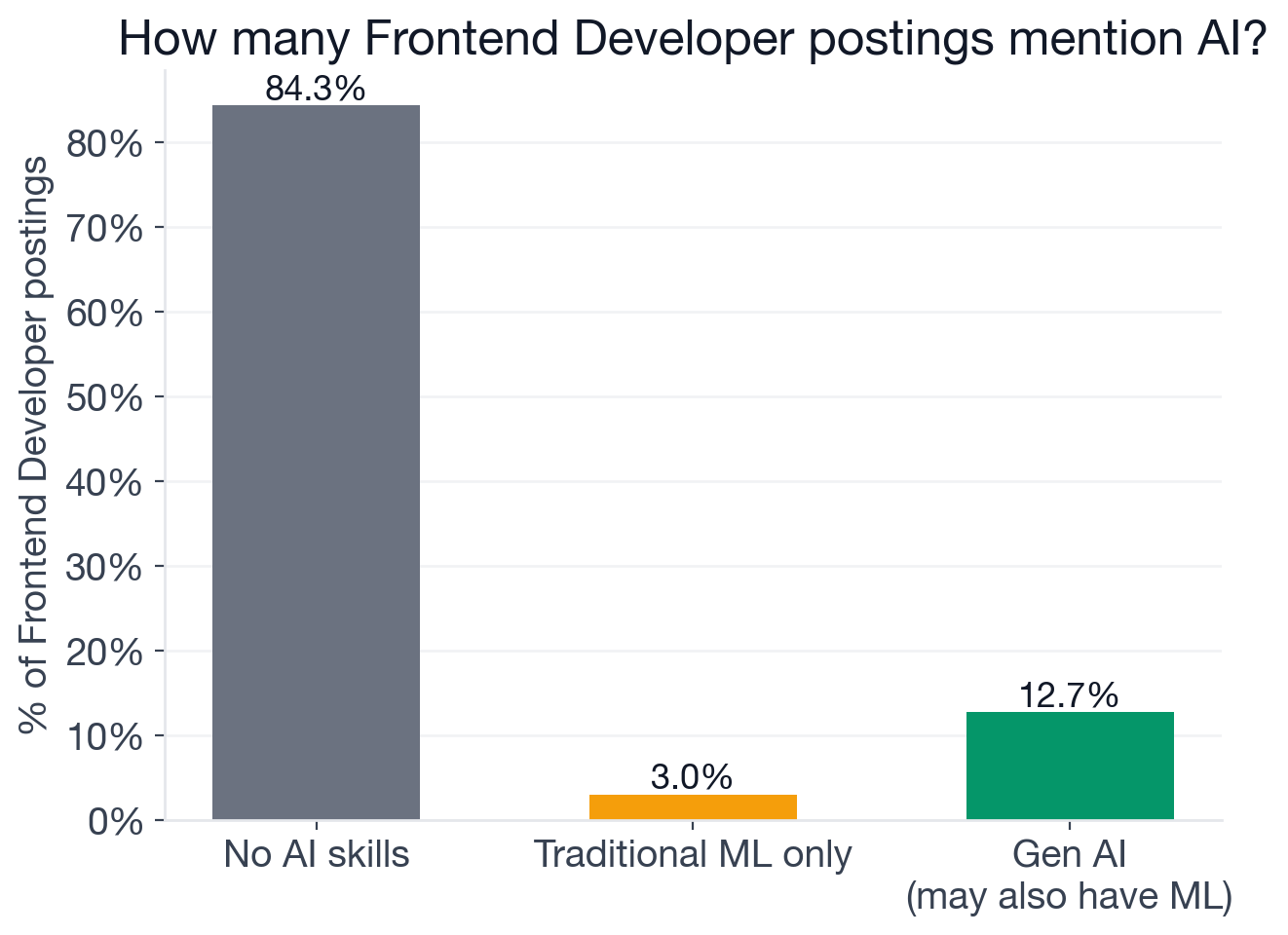
Share of 6,235 active Frontend Developer postings mentioning AI skills, broken down by type.
The 12.7% new-wave AI requirement covers roles building AI-powered features from the UI layer. Traditional ML (4.8%) adds some overlap, mostly roles integrating ML models into the interface. About 1.8% of postings require both, typically at companies doing end-to-end AI product work where the frontend developer also touches inference pipelines or evaluation tooling.
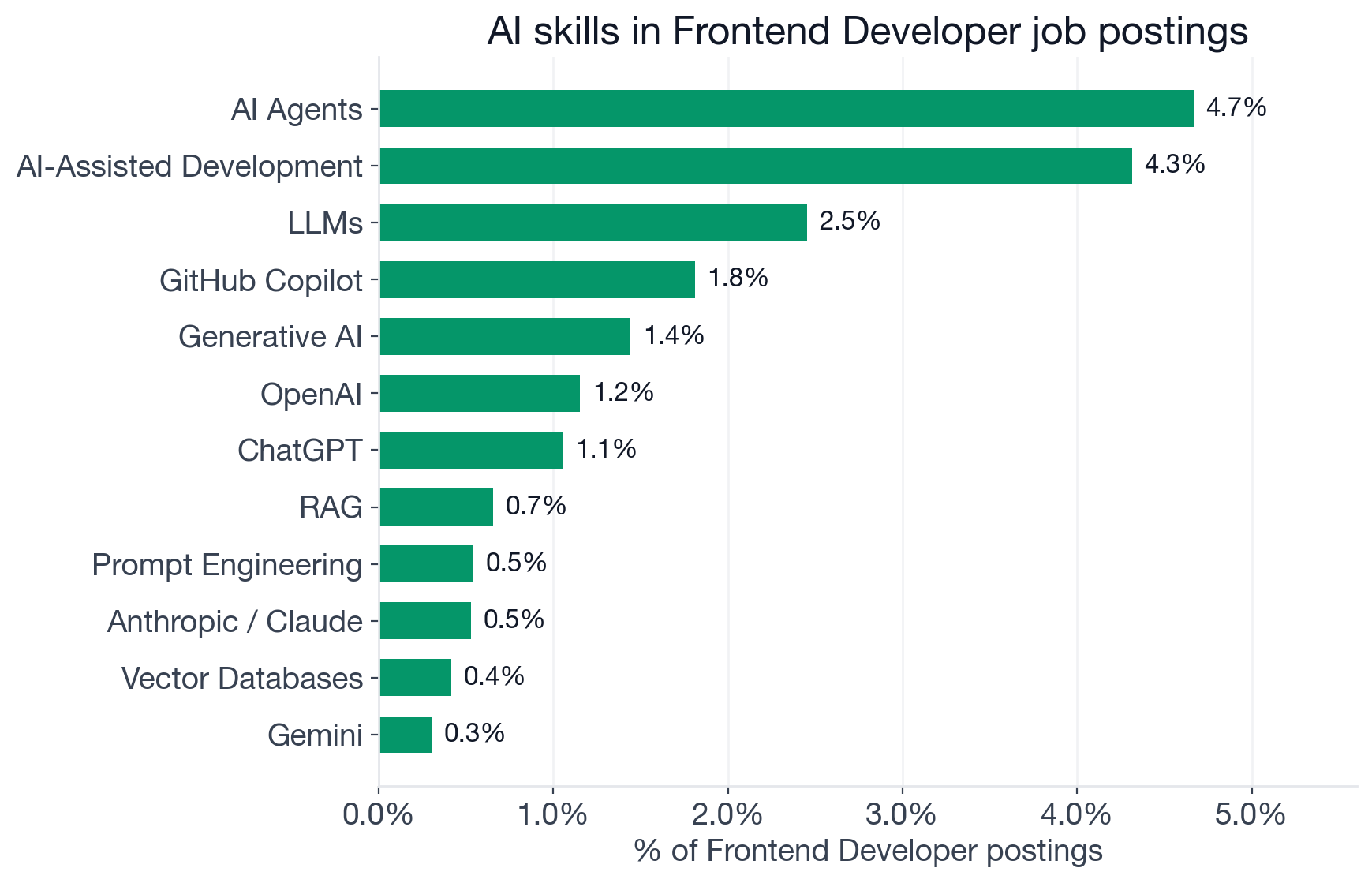
Individual AI skill mentions across all 6,235 Frontend Developer postings, new-wave and traditional combined.
The skill ranking tells a sharper story than the aggregate percentage. AI Agents (4.7%) is the leading explicit skill, slightly ahead of Machine Learning (4.5%) and AI-Assisted Development (4.3%). That ordering is significant: the top explicit AI demand for a role defined by building user interfaces is building AI agent UIs. In practice that means chat interfaces wired to LLMs, streaming response handlers, RAG pipelines (RAG, or Retrieval-Augmented Generation, grounds LLM outputs in specific data sources rather than relying on the model's training alone) surfaced through search or autocomplete, and multi-turn conversation flows with tool-calling backends.
GitHub Copilot appearing in just 1.8% of postings is the starkest illustration of the ambient vs. explicit gap. Copilot has millions of paid subscribers. It is not listed in 98% of job descriptions because listing it would be like listing "uses keyboard."
The $38,100 Split: What Building AI Features Actually Pays
Among US postings where base salary is disclosed (US-only figures; equity, bonuses, and sign-on are not captured in postings and meaningfully increase total compensation at top employers), the gap between AI-requiring and non-AI-requiring roles is $38,100.
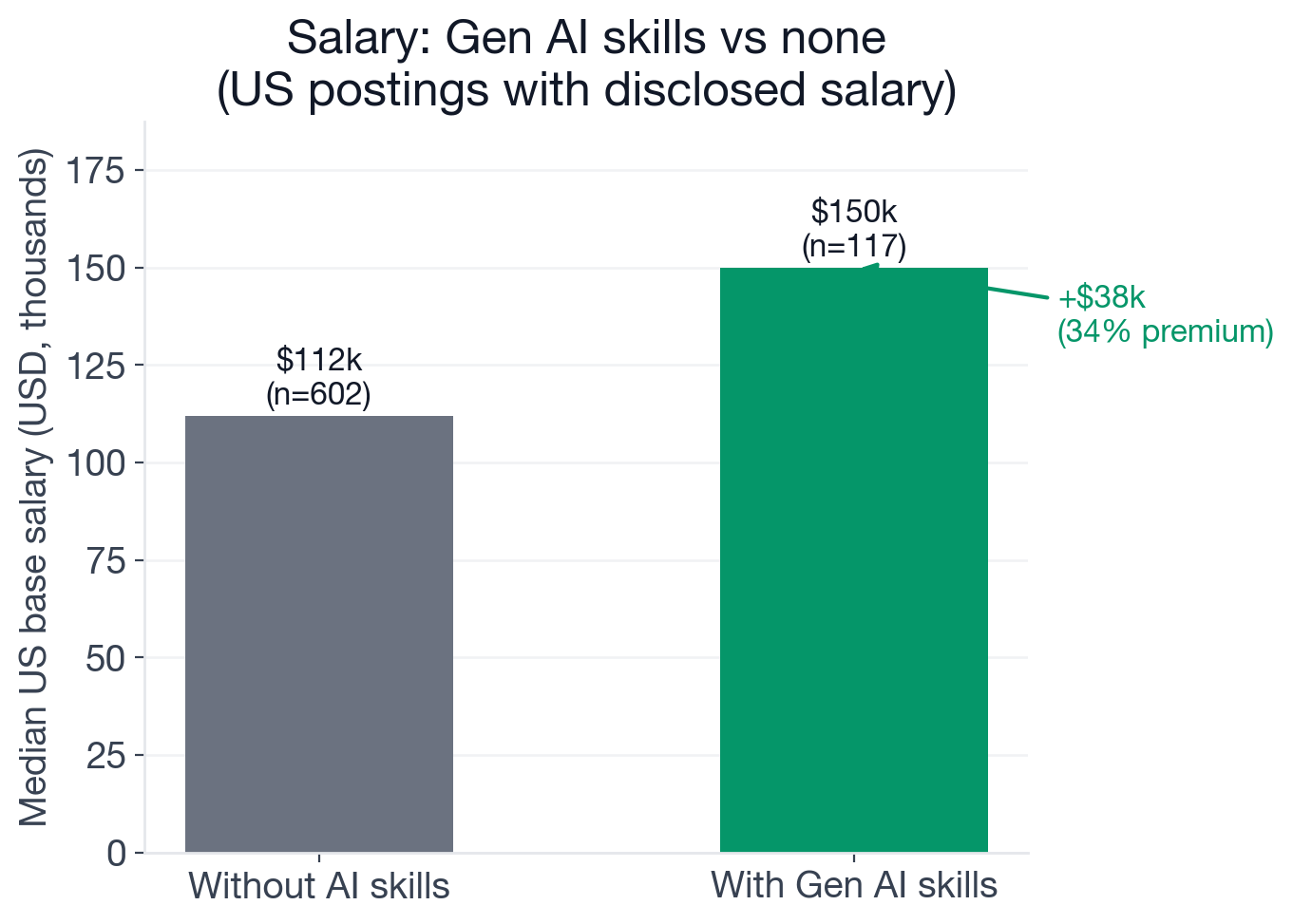
US base salary medians for Frontend Developer postings with and without new-wave AI skill requirements. Equity and bonuses excluded.
The $150,000 median for AI-requiring roles reflects what these jobs actually require. A frontend developer building a production LLM integration manages streaming APIs, handles token limits and rate errors gracefully in the UI, designs stateful conversation components, and collaborates with backend teams on prompt engineering and retrieval pipelines. That is a meaningfully different skill profile from building a React form, and the market prices the difference accordingly.
The $111,900 non-AI baseline is still strong relative to most engineering roles nationally. And the sample of 117 AI-postings with US salary data is smaller than the 602 in the non-AI group, so the $150,000 figure carries some uncertainty. The direction of the premium is not uncertain: the global dataset shows a $35,000+ spread between postings with any AI skill ($130,000 median, n=225) and those without ($95,000 median, n=786), consistent with the US pattern.
For anyone choosing between deepening React expertise and building genuine LLM integration skills, the salary data clearly favors the latter where both can be deployed.
Who Faces the Highest AI Bar?
The explicit AI requirement in Frontend Developer postings is concentrated at the senior end of the career ladder, and concentrated in tech-product companies rather than services firms.
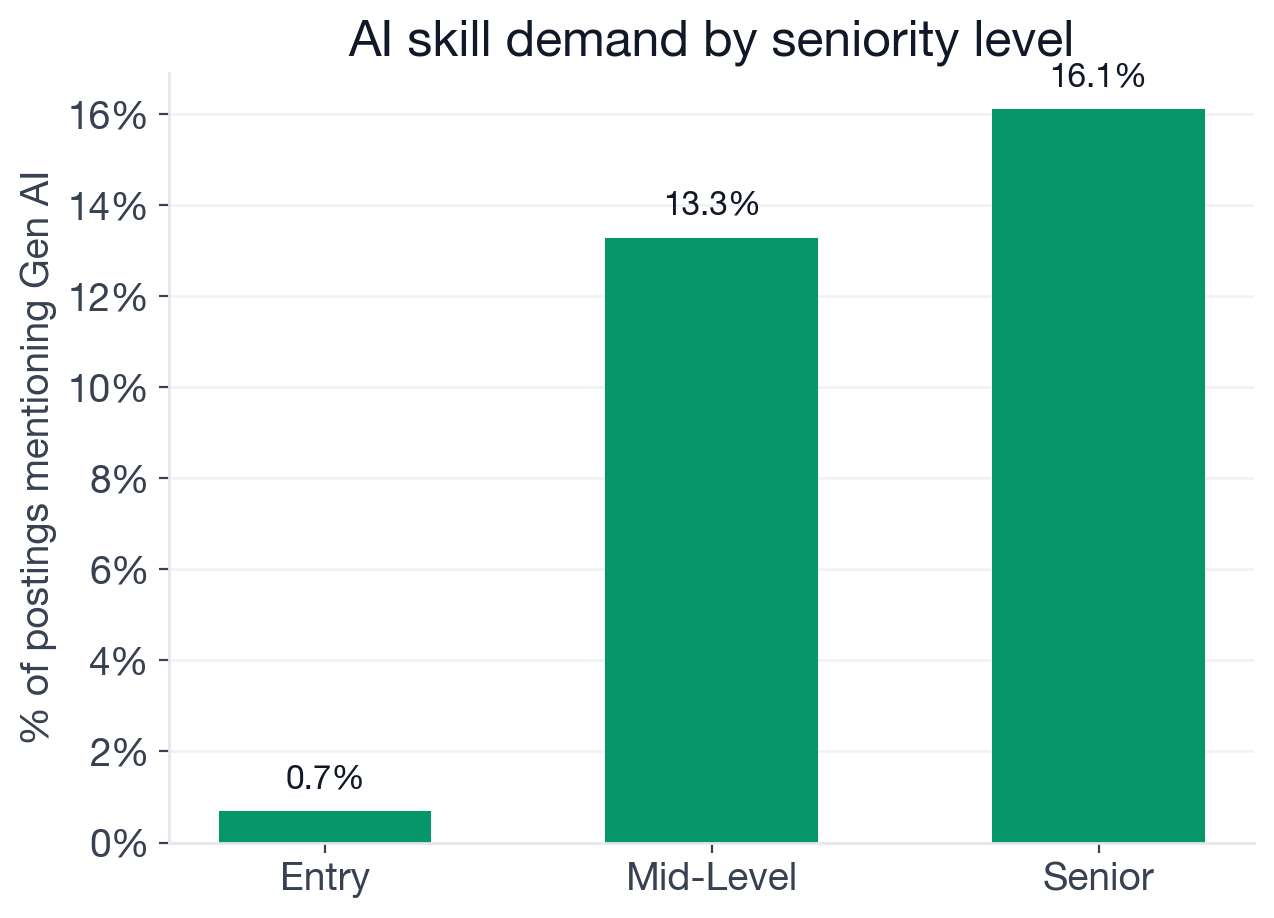
Percentage of Frontend Developer postings at each seniority level that explicitly require new-wave AI skills.
Entry-level roles have almost no AI requirement at all: 0.7%, or 8 of 1,143 postings. Note that a large retail employer accounts for a significant share of entry-level volume in this dataset, which likely understates what a non-retail entry-level market would show. The jump from entry to junior (13.6%) is still the sharpest transition at any point on the ladder: once companies move past the "prove you can ship a feature" stage, they start expecting familiarity with the AI-powered tooling and features that define the product.
Senior and staff roles sit at 16-18%. That is where the work shifts from implementation to architecture, and where the expectation to design AI-integrated systems is highest. Senior roles are also 56% of all Frontend Developer postings (3,508 of 6,235), so this is both the most common level in the market and the level where the AI bar is highest.
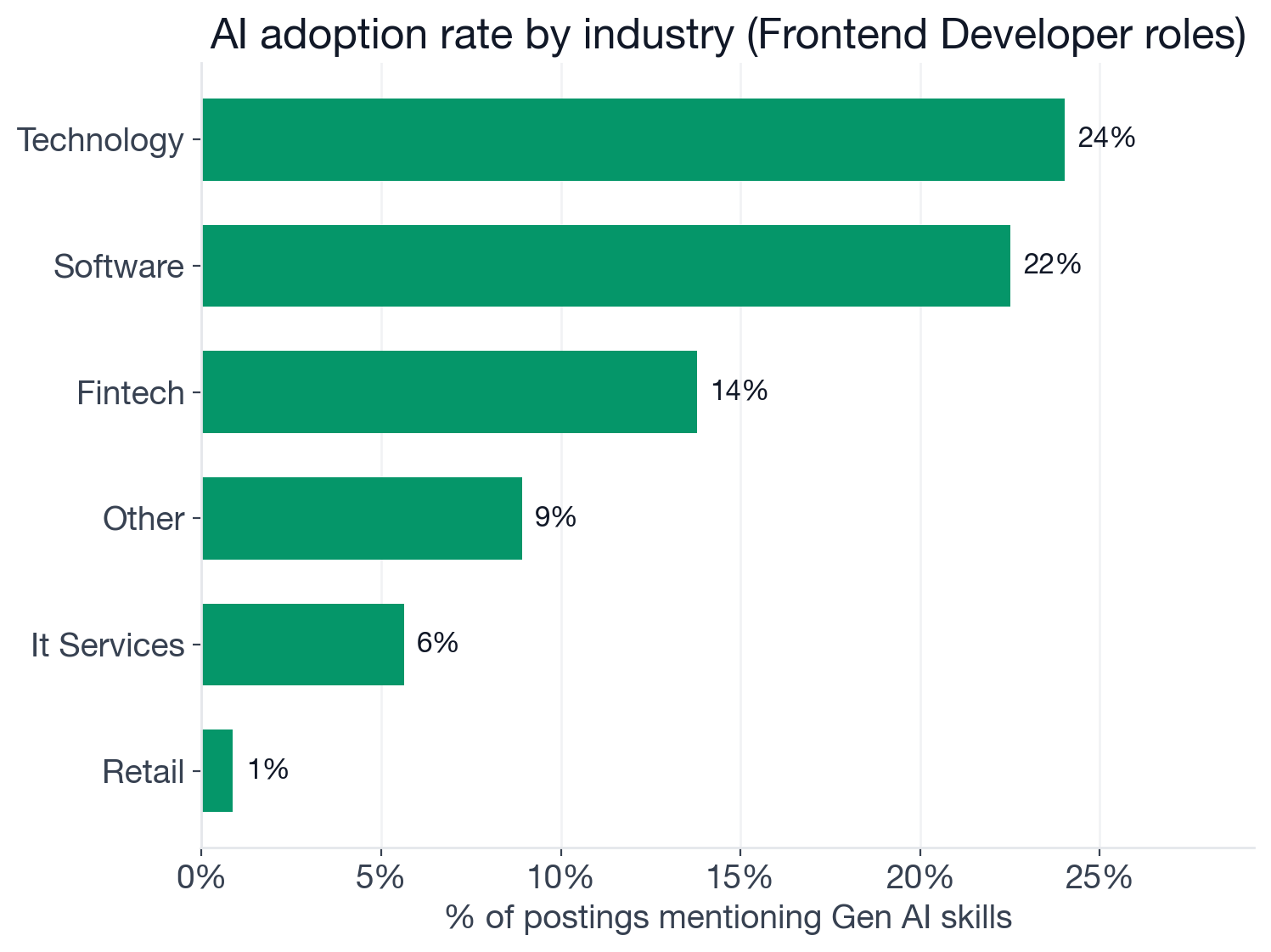
AI adoption rate in Frontend Developer postings across key industry segments.
Technology (24%) and software companies (22.5%) lead, reflecting sectors actively building AI-powered products and hiring frontend developers to surface those capabilities in the UI. Fintech at 13.8% reflects steady adoption: fraud detection dashboards, robo-advisor flows, and AI-assisted KYC interfaces all live in the frontend layer. IT services firms at 5.6% are mostly building what clients specify, and their clients are not yet embedding AI requirements at scale.
One note on the data composition: Albertsons Companies accounts for 16.5% of distinct postings in this dataset. The grocery chain's large volume of frontend developer postings represents internal web application development that does not typically involve AI features. This retail concentration does pull down the headline 12.7% overall AI adoption figure: the AI rate across tech, software, and fintech sectors in isolation would be meaningfully higher. The sector-specific adoption rates (technology 24%, software 22.5%, fintech 13.8%) are computed within each industry and are not distorted by the retail volume.
How to Use This in Your Job Search
If you're a Frontend Developer evaluating where AI fits in your career, the data supports two distinct moves.
For the ambient layer: AI tool fluency is a practical baseline regardless of what your job posting says. Browse current Frontend Developer openings and most postings will not mention AI at all, yet the teams behind them expect you to arrive with Copilot, Cursor, or a comparable tool in your workflow. Sharpening AI-assisted development skills is not optional at this point; it's just not always listed.
For the explicit layer: If you want to compete for the $150,000-median roles, build a real LLM integration project. The specific skills companies list explicitly (AI Agents, LLM integration, RAG pipelines, OpenAI API, streaming component design) are learnable and demonstrable. Showing a portfolio project with a working AI chat interface or a RAG-backed search UI is the fastest way to move into that tier. Practice with AI mock interviews to get comfortable explaining AI-related architectural decisions, since senior-level interviews at AI-adopting companies will go well past "have you used ChatGPT?"
For foundational concepts, our interactive courses cover API integration, system design, and the engineering principles that underpin AI feature work. The question bank has frontend interview questions organized by topic, including component architecture, async patterns, and API design, all relevant to roles that require building AI-powered UIs.
To target the highest-signal roles directly, filter Frontend Developer jobs requiring AI agent skills on the job board to surface postings where the premium is most likely to apply.
For context on how this role fits the broader engineering landscape, the Frontend Developer vs Software Engineer comparison covers where the two roles diverge in skills and salary. The parallel analysis for adjacent roles is in how AI is changing Software Engineering in 2026.
FAQ
Q. How many Frontend Developer job postings explicitly require AI skills in 2026?
12.7% of active Frontend Developer postings (791 of 6,235 analyzed in June 2026) explicitly mention new-wave generative AI skills such as LLMs, AI agents, AI-assisted development, or specific tools like GitHub Copilot or the OpenAI API. The remaining 87% still expect developers to use AI tools for productivity. They simply don't list it, the same way no 2015 job ad listed "uses Google."
Q. What is the salary premium for Frontend Developers with AI skills in 2026?
The median US base salary for Frontend Developer postings that explicitly require new-wave AI skills is $150,000 (n=117 postings with disclosed US salary). Postings without AI requirements show a median of $111,900 (n=602). The difference is $38,100. These figures are US base salary only; equity and bonuses are not disclosed in job postings.
Q. What AI skills do Frontend Developer job postings ask for most in 2026?
The top explicit AI skills in Frontend Developer postings are AI Agents (4.7% of postings, 291 jobs), Machine Learning (4.5%, 282 jobs), AI-Assisted Development (4.3%, 269 jobs), LLMs (2.5%, 153 jobs), and GitHub Copilot (1.8%, 113 jobs). The demand for AI Agents reflects a shift toward frontend developers building chat interfaces, RAG-backed search, and LLM-powered UX components.
Q. Do entry-level Frontend Developer jobs require AI skills?
Barely. Only 0.7% of entry-level Frontend Developer postings (8 of 1,143) mention AI skills explicitly, the lowest rate of any seniority level. The AI requirement is concentrated at senior (16.1%) and staff (18%) levels, where developers are expected to architect and integrate AI features, not just use AI tools for productivity.
Q. Which industries have the highest AI adoption in Frontend Developer hiring?
Technology companies lead at 24% AI adoption in Frontend Developer postings, followed by software companies at 22.5% and fintech at 13.8%. IT services firms show much lower adoption at 5.6%. The gap reflects where companies are actively building AI-powered products versus deploying standard web applications.
Q. Do most Frontend Developers use AI tools even if their job posting doesn't mention it?
Yes. Developer surveys from JetBrains and Stack Overflow show 85-90% of developers use AI tools regularly in 2025-2026, and 90% of Fortune 100 companies use GitHub Copilot. Job postings only capture the roughly 13% of roles that require developers to build AI features. The ambient layer (Copilot, Cursor, ChatGPT for code review, v0.dev for component scaffolding) is expected across virtually all frontend roles, just not stated.
Q. Is Senior Frontend Developer the best level to target for AI-heavy roles?
Senior is where AI requirements concentrate most. At 56% of all Frontend Developer postings and a 16.1% AI adoption rate, senior is the largest and most AI-relevant tier. Staff roles have the highest AI rate at 18% but represent only 2.4% of postings. Entry-level roles show only 0.7% AI adoption, meaning the explicit AI bar is almost exclusively a senior-and-above expectation in 2026.
Where Frontend Work Is Actually Headed
The 12.7% explicit AI figure will keep rising, but the more significant shift is already complete: AI tools are now part of the professional baseline for frontend development, the same way terminal fluency and version control once were. What the posting data captures is where companies pay a $38,100 premium, specifically for developers who can turn a language model into a product feature that users interact with. That skill set is narrow enough to be genuinely differentiating and learnable enough to be worth targeting deliberately. The ambient layer is table stakes. The explicit layer is the opportunity.
Topics
Ready to practice?
Put what you've learned into practice with AI mock interviews and structured preparation guides.