
The Governance Gap Is Bigger Than the Adoption Gap
Only 12.5% of Security Architect postings ask for AI skills explicitly, one of the lowest explicit-AI hiring rates of any technical role we track. Read alone, that would suggest AI has barely touched this job. It hasn't. We looked at 920 active Security Architect postings on the InterviewStack.io job board over a 90-day window through July 2026, and the honest read of that 12.5% is not "AI doesn't matter here." The role has split into a small explicit tier hired to build and secure AI systems, and a much larger implicit mandate to govern AI that everyone else is shipping faster than anyone can secure it.
A note on scope: the "Security Architect" postings analyzed here span a mix of titles beyond narrowly-scoped architecture roles, including some security management and information security officer postings that get grouped into the same hiring category on job boards. Treat the figures below as representative of the broader security-architecture hiring market rather than a title-exact match on "Architect."
That mandate shows up in industry surveys, not job postings. Ninety percent of organizations are implementing or planning LLM use cases, but only 5% feel highly confident in their AI security posture, and just 24% have a dedicated AI security governance team (Aikido 2026). Only 14.4% of organizations report all of their AI agents going live with full security and IT approval (Gravitee 2026), and 92% of security professionals say they are specifically concerned about AI agents (Darktrace 2026). That's the demand curve Security Architects are hired against, and it barely correlates with whether a posting mentions AI at all.
The twist: the people hired to close that gap are not, themselves, especially heavy AI users. Only about 30% of cybersecurity professionals report using AI tools in their own work (ISC2 2025), well below the 84 to 85% adoption among developers generally (Stack Overflow, JetBrains, both 2025). Most roles in this series hide a huge ambient-usage layer behind a small explicit-hiring number. Security Architect is different: a cautious profession asked to govern a technology it is still deciding how much to trust.
Key Findings
- 920 active Security Architect postings analyzed over a 90-day window through July 2026.
- 12.5% of postings explicitly require new-wave generative AI skills (115 of 920); 18.5% require any AI including traditional machine learning.
- AI Agents is the top new-wave AI skill at 7.6% of postings (70), ahead of Generative AI (5.5%) and LLMs (4.9%).
- $18,275 US base salary premium for postings requiring new-wave AI skills ($184,450 vs. $166,175), though the AI sample is modest (n=32).
- Staff-level postings carry the highest AI adoption rate at 20.7%, nearly triple mid-level's 7.8%.
- Israel shows a 42.9% AI adoption rate (directional, n=14), the highest of any country measured; India (18.8%) edges out the US (15.7%) despite far higher US posting volume.
- Only 30% of cybersecurity professionals use AI tools in their own work (ISC2 2025), versus 84 to 85% for developers generally (Stack Overflow, JetBrains).
- 90% of organizations are implementing or planning LLM use cases, but only 5% feel highly confident in their AI security posture (Aikido 2026), and just 14.4% of AI agents go live with full security approval (Gravitee 2026).
What Security Architecture Looked Like Before the Agent Era
Three or four years ago, a Security Architect's job was defined by a known, mostly static set of assets: network segmentation, zero-trust access design, identity and access management, PKI (public key infrastructure for issuing and validating digital certificates), cloud security posture management, and compliance work against frameworks like SOC 2, ISO 27001, and NIST. The threat model was hard, but the systems being modeled behaved predictably. Attack surfaces were large but enumerable.
Generative AI broke that assumption. An LLM's output is probabilistic, not deterministic, so the old playbook of "list every input, validate every input" no longer fully applies. An AI agent that can call tools and take multi-step actions on its own introduces a permission-scope problem that barely existed before: what happens when the system you're securing can decide, on its own, to do something you never explicitly authorized. A RAG (retrieval-augmented generation) pipeline, which pulls external or internal data into an LLM's context at query time, adds a data-exfiltration risk through the retrieval layer itself. None of this replaced the old job; it stacked on top of it, which is why 92% of security professionals report specific concern about AI agents rather than generative AI in the abstract.
How Many Security Architect Postings Actually Require AI Skills?
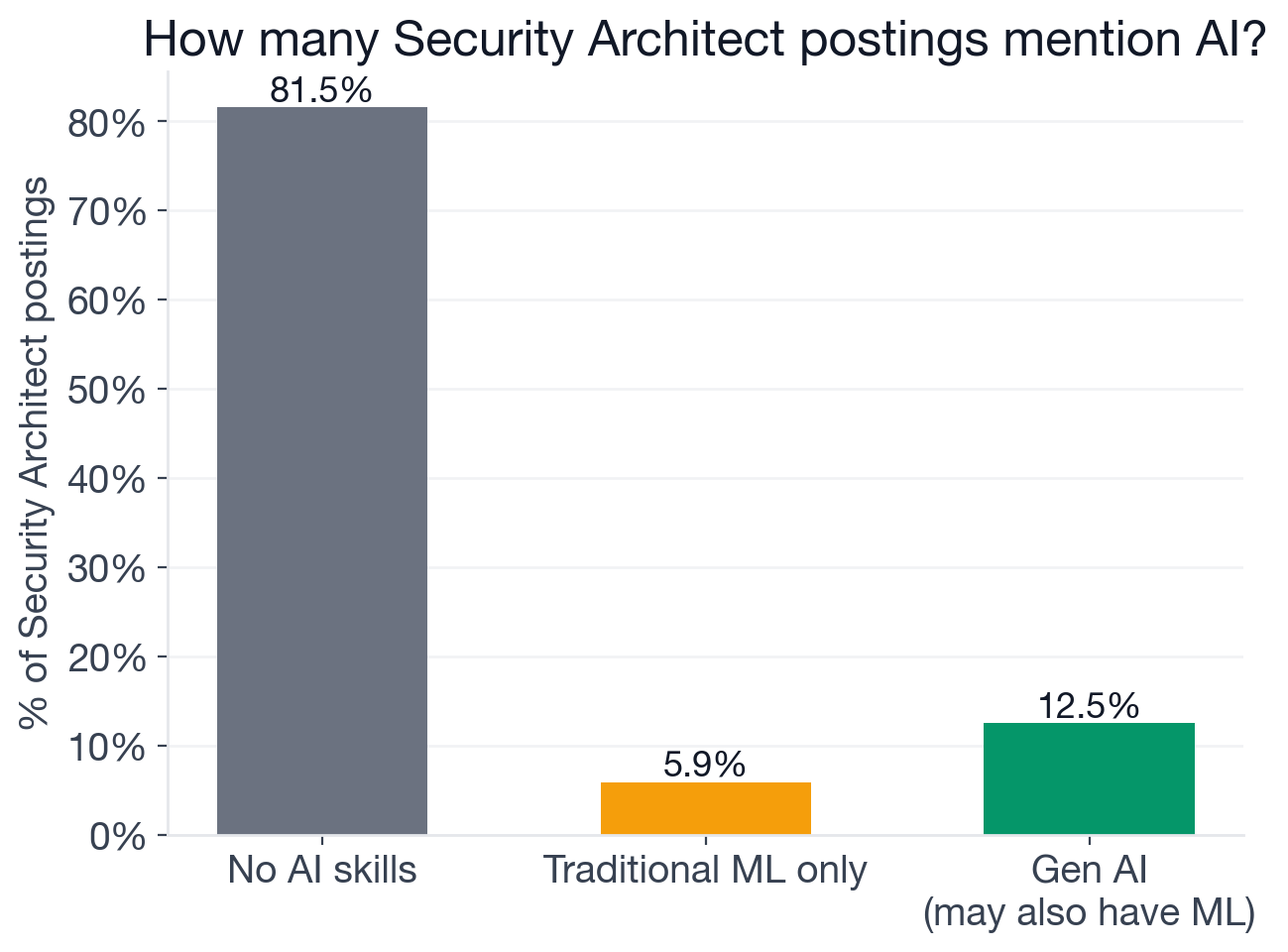
Share of Security Architect postings requiring new-wave generative AI, traditional ML, both, or no AI skills at all.
The 12.5% figure counts postings that explicitly name generative-AI-era skills: LLMs, AI agents, RAG, prompt engineering, and similar. Add traditional ML and deep learning and the any-AI rate reaches 18.5%. Notice how close traditional ML (12.2%) sits to new-wave AI (12.5%): unlike most engineering roles, where generative AI skills have raced far ahead of legacy machine learning, Security Architect postings still lean almost as heavily on old-guard ML work (fraud detection, anomaly scoring, behavioral analytics) as on anything from the last three years. That balance is a signal in itself: this role's AI story isn't purely a generative AI story.
The remaining 81.5% is not evidence that AI is irrelevant to most Security Architect jobs. It's the ambient layer, and for this role specifically that layer is smaller and more cautious than the 84 to 85% developer-tool adoption typical of engineering roles in this series. What isn't smaller is the governance mandate behind it: 78% of organizations already use generative AI in at least one business function (Aikido 2026), and somebody has to own the security posture of all of it, whether or not "AI" appears in their job title.
Which AI Skills Do Security Architects Actually Need?
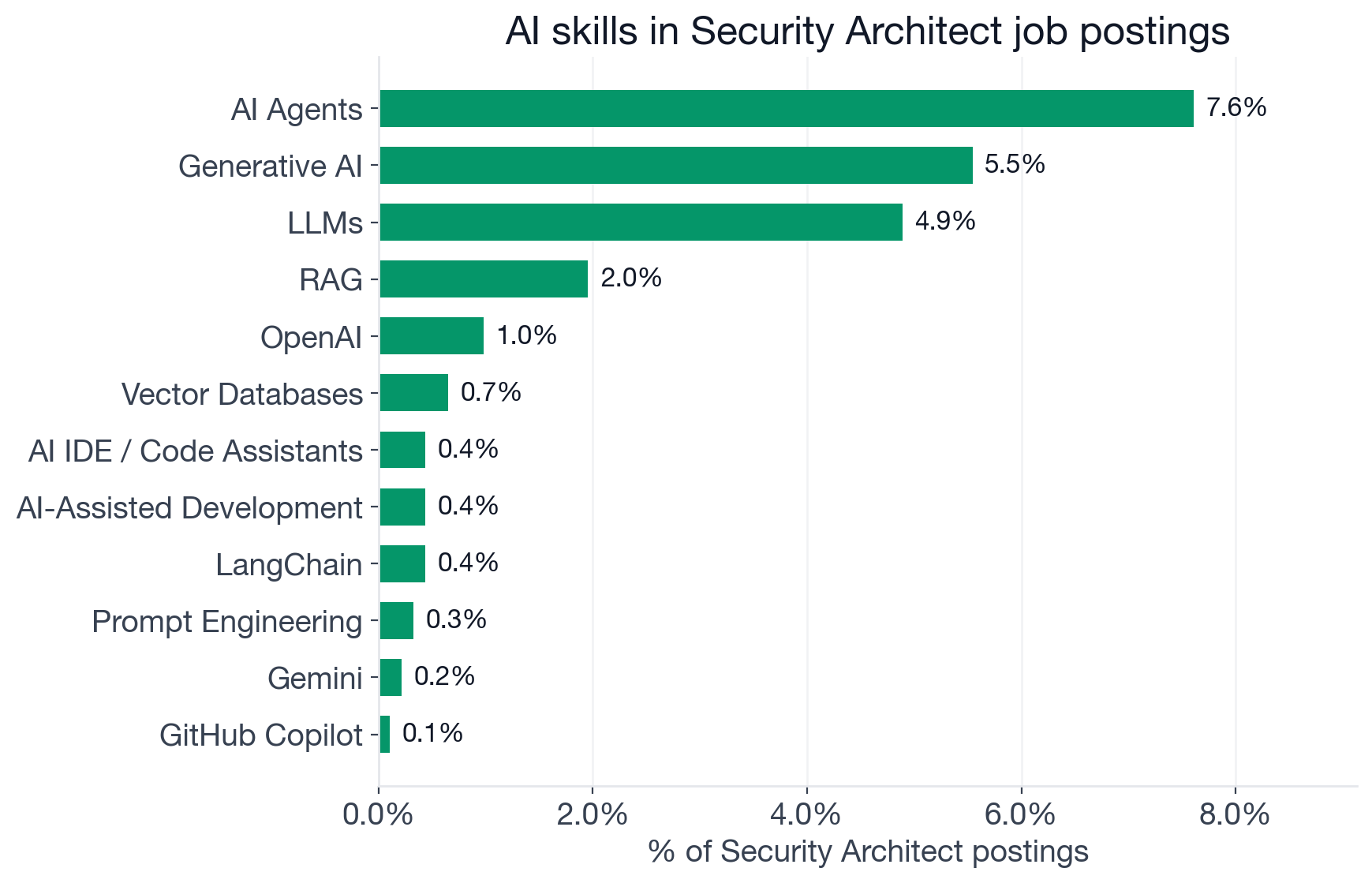
Percentage of 920 Security Architect postings mentioning each AI skill. Machine Learning is a traditional, pre-2023 skill; the rest are new-wave generative AI era.
| AI Skill | % of Postings | Category |
|---|---|---|
| Machine Learning | 12.1% | Traditional ML |
| AI Agents | 7.6% | New-wave |
| Generative AI | 5.5% | New-wave |
| LLMs | 4.9% | New-wave |
| RAG | 2.0% | New-wave |
| MLOps | 1.2% | Traditional/infra |
| OpenAI | 1.0% | New-wave (platform) |
| Vector Databases | 0.7% | New-wave (infra) |
Machine Learning's lead is a legacy signal, not a generative AI one: it mostly describes architects supporting fraud detection or anomaly-scoring pipelines that predate the current wave. More revealing is what leads the new-wave category. AI Agents (7.6%) outranks both Generative AI (5.5%) and LLMs (4.9%), the opposite order you'd expect if this were mainly about chatbots. Companies naming "AI Agents" in a posting want someone who can threat-model a system that takes autonomous, multi-step actions: an agent's tool permissions, its ability to chain calls unexpectedly, and the blast radius when it does something nobody told it to do. Browse Security Architect postings that list AI Agents and the pattern holds: these are governance and threat-modeling roles, not model-building roles.
RAG at 2.0% points to a specific new attack surface: retrieval pipelines that pull internal documents or customer data into an LLM's context introduce a data-exfiltration risk a traditional application never had. Vector Databases (0.7%) shows that same infrastructure layer starting to become its own hiring criterion, still rare but a leading indicator of where the specialization is heading.
Does Governing AI Systems Pay More?
Among US postings with disclosed salary, yes. (All figures below are US base salary only; equity, bonuses, and sign-on are not captured in job posting disclosures and are excluded from this analysis.)
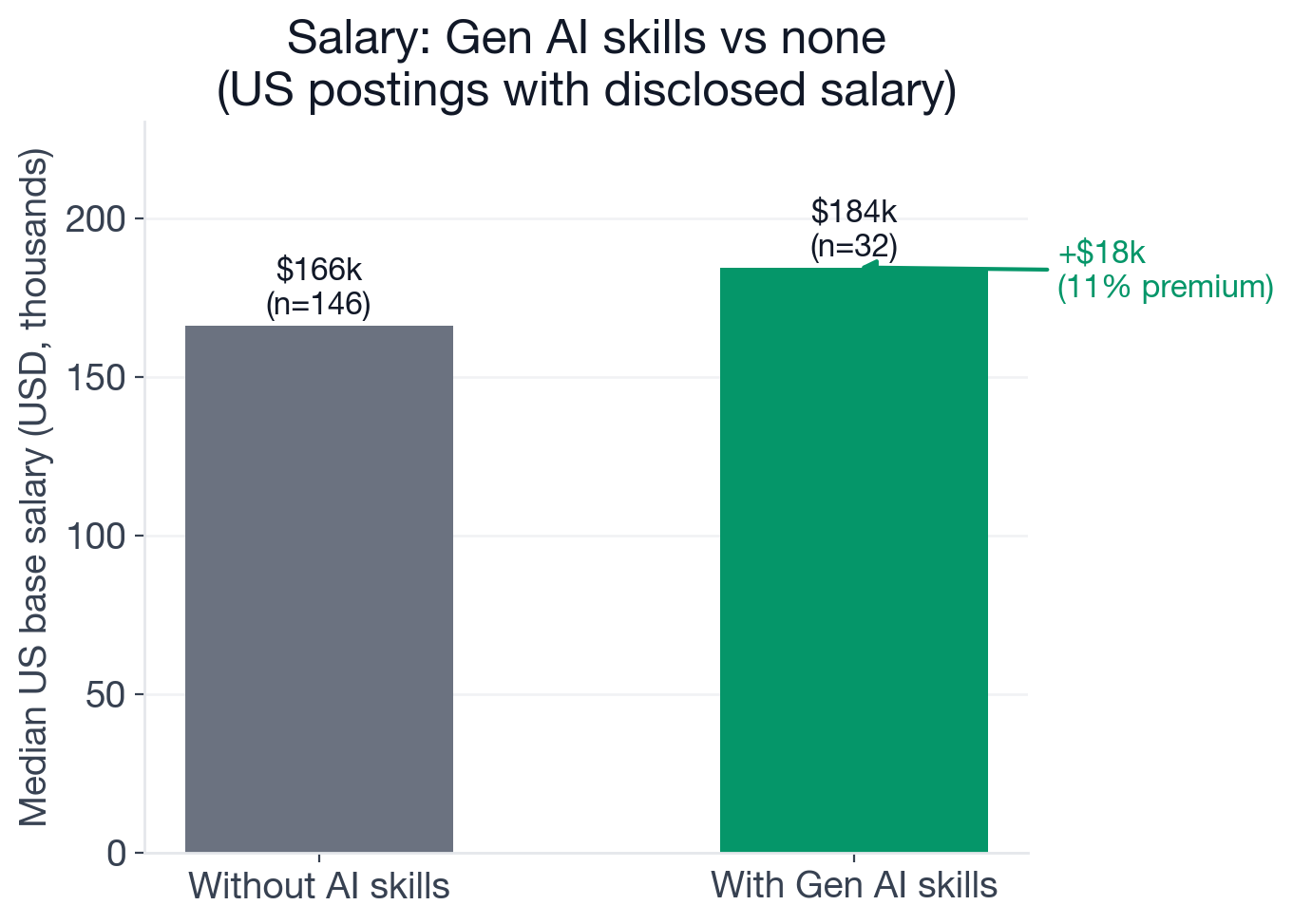
US median base salary for Security Architect postings with and without new-wave generative AI skill requirements. US base salary only; equity and bonuses excluded.
Postings requiring new-wave AI skills show a median US base of $184,450, versus $166,175 for postings without, a premium of $18,275. With n=32 US postings carrying both an AI requirement and disclosed salary, this is a directional signal rather than a precise number, but it points the same direction as the rest of the data: companies specific enough to name AI governance or AI-agent skills in a Security Architect posting are also paying a real premium above an already senior-skewed baseline.
The AI Mandate Concentrates at Staff Level
Staff-level Security Architect postings carry the highest AI adoption rate at 20.7%, nearly triple mid-level's 7.8% and well above senior's 12.4%. Entry (7.7%) and junior (9.1%) postings look similar on paper, but each rests on just 13 and 11 total postings with a single AI-flagged posting apiece, too small to read as a trend. Senior postings alone make up 77.4% of the entire market, so the picture that matters is simple: the more senior the posting, the more likely it carries an explicit AI governance mandate, peaking clearly at staff.
That concentration shows up at the company level too, on a sample thin enough to treat as illustrative rather than a ranking. IQVIA, a healthcare data and clinical-research company, posted 8 AI-flagged roles out of 9; Royal Bank of Canada posted 6 out of 18. Both are plausible hiring patterns for organizations handling heavily regulated data, but each is under 2% of total postings here, so read them as an early signal of where staff-level AI governance hiring shows up first, not a ranking of who's leading the market.
Where Are Security Architect AI Roles Concentrated?
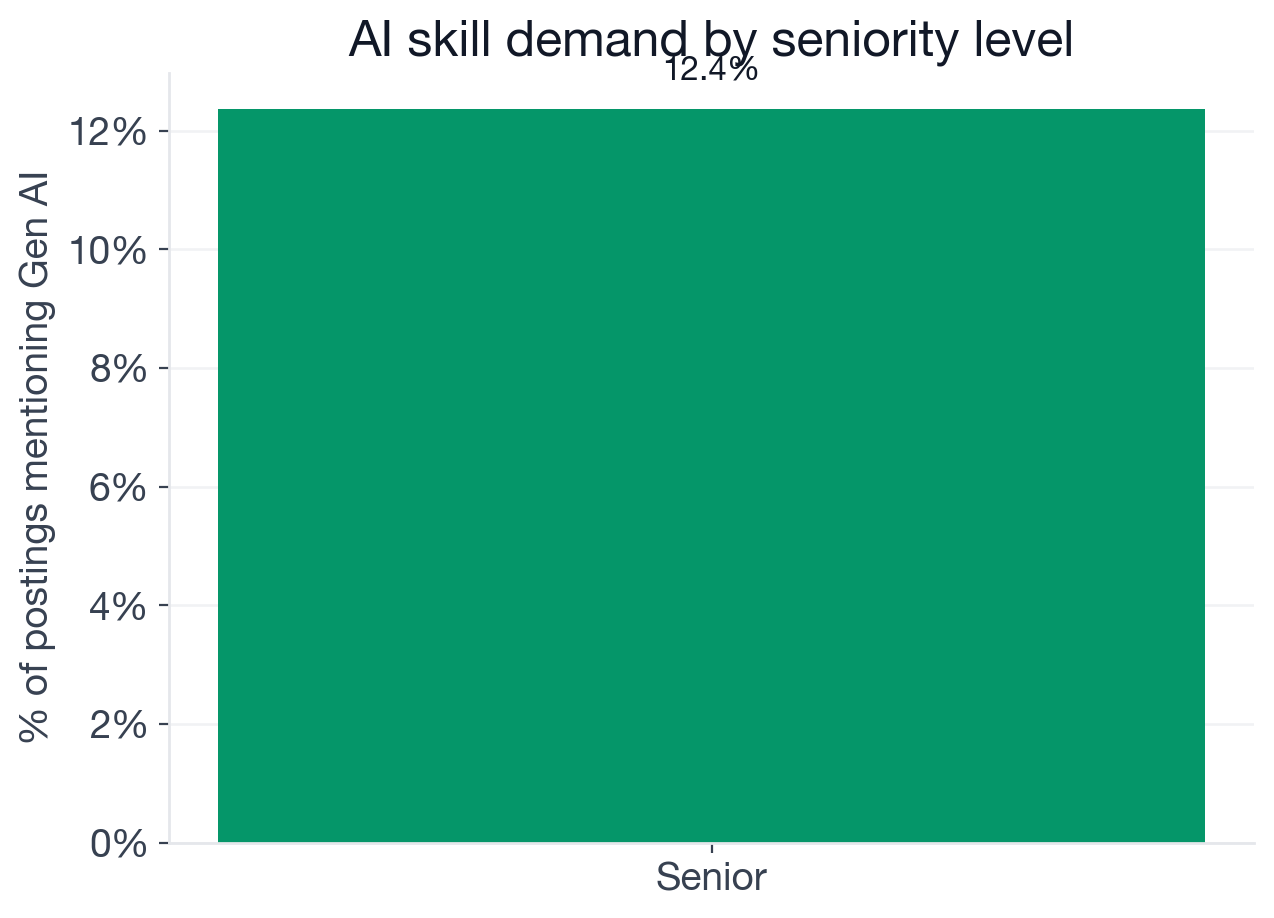
Percentage of Security Architect postings at each seniority level that require AI skills. Staff-level carries by far the highest rate; entry and junior samples are too small (13 and 11 postings) to be reliable.
Geography shows AI governance demand running ahead of posting volume in some markets. The US accounts for 35.2% of all Security Architect postings, the largest single market, but its AI adoption rate of 15.7% actually trails India's 18.8% (on 12.7% of volume). Israel is the clear outlier at 42.9%, though on a base of just 14 postings that should be read as directional, not as evidence that nearly half of Israeli Security Architect roles require AI. Canada and the UK both sit modestly above the global rate at roughly 17 to 18%. Germany stands out at the other end: just 2.3% of its 44 postings mention AI, well below the 12.5% global new-wave average despite meaningful volume.
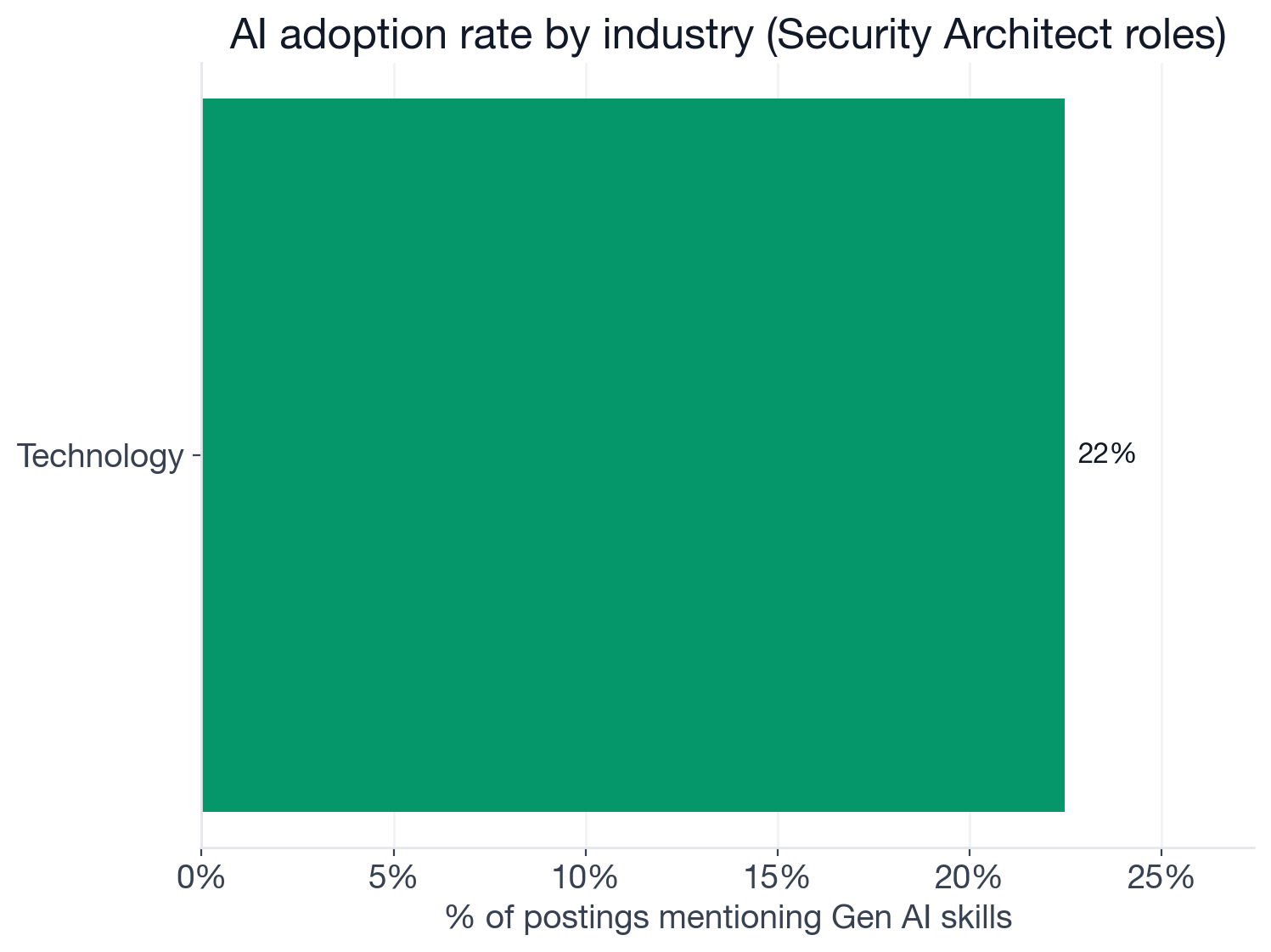
AI adoption rate in Security Architect postings by industry. Technology is the only sector with a large enough sample (129 postings) to report reliably in this dataset.
At the industry level, technology is the only sector with enough posting volume to report with confidence: 129 postings, 22.5% of which require new-wave AI skills, comfortably above the 12.5% global new-wave average, a gap of roughly 10 percentage points. That lines up with broader survey findings that industrial and IT-services firms currently lead AI security tool adoption, while financial services and the public sector lag (ISC2 2025), but with only one industry meeting the sample threshold here, treat it as one confirmed data point rather than a full sector ranking.
How to Use This in Your Job Search
The clearest job-search implication: the explicit AI tier in Security Architecture rewards governance thinking over model-building. Build and demonstrate AI agent threat modeling, LLM-specific risk assessment, RAG pipeline data-flow review, and AI security compliance frameworks, layered on top of the zero-trust and IAM fundamentals that still define most of the role.
For interview preparation, AI mock interviews can run through AI-agent and LLM threat-modeling scenarios at the depth these postings actually test. The question bank organizes security architecture, cloud security, and AI governance topics by difficulty. If the AI or ML concepts behind these postings are new to you, interactive courses cover the underlying fundamentals without requiring you to become a model builder.
To see how these skills cluster in live postings, compare Security Architect openings listing AI Agents against the full Security Architect board. If you're weighing an adjacent security path, our Information Security Analyst AI post covers a similar governance-versus-adoption split.
FAQ
Q. How is AI changing the Security Architect role in 2026?
Only 12.5% of Security Architect postings explicitly require new-wave generative AI skills (AI Agents, LLMs, RAG, and similar), rising to 18.5% once traditional machine learning is included. But that low explicit rate understates what's happening: 90% of organizations are actively deploying large language model use cases while only 5% feel confident in their AI security posture (Aikido 2026), and just 14.4% of AI agents go live with full security sign-off (Gravitee 2026). Security Architects are increasingly the people hired to close that governance gap, whether or not the job posting spells out AI.
Q. Do Security Architects actually use AI tools themselves?
Less than you might expect for a technical role. Only about 30% of cybersecurity professionals report using AI tools in their own work (ISC2 2025 AI Pulse Survey), well below the 84 to 85% adoption rate seen among developers generally (Stack Overflow, JetBrains 2025). Security professionals are more cautious adopters of AI tooling, even as demand to secure other teams' AI systems grows quickly.
Q. What AI skills do Security Architect postings require most?
Machine Learning leads at 12.1% of postings (111 of 920), reflecting legacy ML security work like anomaly detection and fraud modeling. Among new-wave generative AI skills specifically, AI Agents ranks highest at 7.6% (70 postings), ahead of Generative AI (5.5%), LLMs (4.9%), and RAG (2.0%). AI Agents outranking Generative AI and LLMs signals that companies are hiring architects to secure autonomous, multi-step AI systems, not just chatbots.
Q. Is there a salary premium for AI skills in Security Architect roles?
Yes. Among US postings with disclosed salary, those requiring new-wave AI skills show a median base of $184,450 versus $166,175 for postings without, an $18,275 premium. The AI-skill sample is modest (n=32), so this should be read as a directional signal rather than a precise figure.
Q. At what seniority level is AI demand highest for Security Architects?
Staff-level postings show the highest AI adoption rate at 20.7%, compared to 12.4% at senior and 7.8% at mid-level. Senior postings dominate the overall market at 77.4% of the role, so the AI-fluent tier is concentrated at the most experienced end of an already senior-heavy role.
Q. Which countries have the highest AI adoption in Security Architect hiring?
Israel shows the highest rate at 42.9%, though on a small sample (6 of 14 postings) that should be treated as directional. India (18.8% of 117 postings) edges out the US (15.7% of 324 postings) despite the US having nearly three times India's posting volume. Germany is a notable outlier on the low end at just 2.3% (1 of 44 postings).
Q. How should a Security Architect prepare for AI-related demands in 2026?
Focus on the governance layer, not just the technical layer: AI agent security review, LLM threat modeling, RAG pipeline data-flow risk, and AI-specific compliance frameworks are where explicit hiring demand is concentrated. Use the InterviewStack.io job board filtered to Security Architect to see which AI skills appear together in real postings, and pair that with mock interview practice on AI and agentic security scenarios.
The Real Job Description
The job posting rarely says it, but the real brief for a growing share of Security Architects is: secure the AI that everyone else already deployed. Ninety percent of organizations are building on LLMs; only 5% feel confident about the security of what they built. That gap does not close because a job posting adds the word "AI." It closes because someone with the title Security Architect sits down and does the threat modeling nobody else in the organization is positioned to do. Whether or not that person uses an AI coding assistant on their own machine is almost beside the point.
Topics
Ready to practice?
Put what you've learned into practice with AI mock interviews and structured preparation guides.