
The Test Suite Runs on AI Long Before the Req Admits It
Look at what SDET job postings name explicitly, and the picture is modest: 17.1% ask for new-wave generative AI skills. Look at what testing teams actually do day to day, and the picture is nearly universal: 81% already use AI somewhere in their workflow, according to Rainforest QA's 2025-2026 survey of 625 software developers. That gap, not a single scary percentage, is the real story of AI and the Software Development Engineer in Test role in 2026. We looked at 829 distinct SDET postings active on the InterviewStack.io job board over a trailing 90 days (831 total postings before deduplication), tagging each for explicit AI and machine learning mentions, seniority, industry, and salary. One methodology note: "SDET" and "automation" as search terms also catch some postings from unrelated automation fields (industrial/manufacturing automation, financial-planning automation, business-process automation) that use similar title language without being software testing roles. Treat the percentages below as directionally accurate for the SDET title family rather than lab-precise, especially for the smaller AI-skill subsets.
The postings that do name AI skills are not asking for Copilot fluency. They're asking for people who can test AI agents, evaluate LLM output, and build the harnesses that catch a model when it's confidently wrong. That's a different hire than "SDET who happens to use ChatGPT," and it's why the explicit numbers below look small next to how much AI already runs through SDET work in practice.
Key Findings
- 17.1% of SDET postings (142 of 831) explicitly require new-wave generative AI skills; 20.6% require any AI including traditional machine learning.
- AI Agents is the top explicit AI skill at 7.5% of postings (62 jobs), ahead of LLMs (6.6%) and traditional Machine Learning (5.8%).
- Postings naming AI-system concepts (agents, LLMs, generative AI, RAG) outnumber postings naming a specific productivity tool (Copilot, ChatGPT, AI-assisted dev) by roughly 2 to 1.
- Only 20 US SDET postings both disclose salary and require new-wave AI, below the 25-posting floor needed to report a reliable median; the non-AI US baseline is $117,500 (n=111).
- Staff-level postings require AI most often, at 28.9%; entry-level (23.5%) far outpaces junior-level (2.7%).
- Technology-sector (32.7%) and software-sector (24.5%) postings require AI at roughly double the SDET role-wide rate.
- Rainforest QA finds 81% of testing teams already use AI somewhere in their workflow, nearly 5x the explicit hiring rate.
What an SDET's Job Looked Like Before Generative AI
Three or four years ago, the SDET title meant something fairly specific: build and maintain automation frameworks (Selenium, Appium, Cypress, or an internal equivalent), write test cases by hand against a spec, triage flaky tests, and keep CI pipelines green. Machine learning existed in the toolbox for a narrow slice of the field (test-impact analysis, some visual-regression tooling) but it was a specialty, not an expectation. The job was fundamentally about verifying deterministic systems: given input X, does the system produce expected output Y, every time.
Generative AI breaks that premise in two directions at once, and both show up in the data. First, AI-assisted development tools (Copilot, ChatGPT, AI IDE assistants) started doing a meaningful share of the test-writing SDETs used to do by hand. Second, and more consequentially for the role's future, the systems SDETs are asked to test increasingly include AI components themselves: an LLM-backed feature, a support chatbot, an autonomous agent making decisions. You can't test "does the system produce expected output Y, every time" against a model that's non-deterministic by design. That second shift is why AI Agents, not a coding assistant, tops the skill list below.
How Many SDET Postings Actually Require AI Skills?
The explicit number is 17.1%: 142 of 831 SDET postings name a new-wave generative AI skill outright. Widen the lens to include traditional machine learning and deep learning (the pre-2023 baseline) and the figure rises to 20.6%, or 171 postings. Neither number should be read as "how many SDETs use AI," because job postings only capture skills a company chose to write down as a hiring requirement, not the tools an engineer picks up on the job.
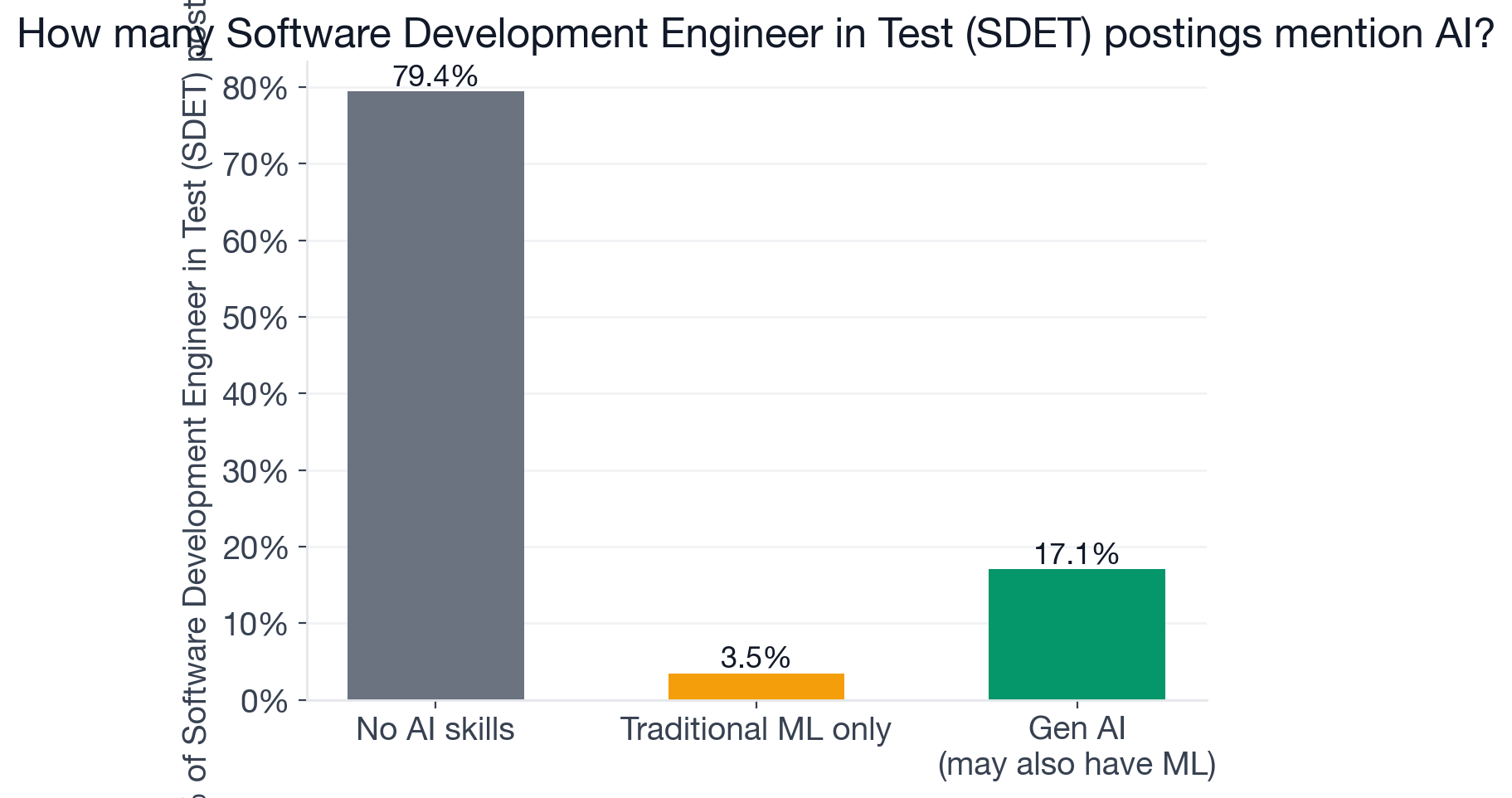 20.6% of SDET postings mention any AI skill; 17.1% specifically require new-wave generative AI, separate from the smaller traditional-ML slice.
That's the distinction that matters here: Build AI is what the posting data measures, the share of SDETs hired specifically to architect, test, or harden AI-driven systems. Use AI is the ambient layer that surveys, not job postings, capture: Rainforest QA's 2025-2026 survey of 625 software developers found 81% of teams already use AI somewhere in their testing workflow, whether that's generating test cases, drafting test plans, or triaging failures. General developer-survey data points the same direction: Stack Overflow's 2025 survey put AI tool usage at 84% among all developers (up from 76% in 2024), and JetBrains found 85% use AI tools regularly. A reader should not walk away from either the 17.1% or the 81% figure alone; the honest read is that a small and growing share of SDET postings hire specifically to build or test AI systems, while using AI tools day to day is fast becoming a baseline expectation regardless of what any single posting says.
One caution from the data, not a contradiction: several 2025-2026 QA-industry sources describe a 5-8x gap between teams that say they plan to use AI in testing and teams that have actually shipped it into production test workflows (a secondary blog source; treat as directional). That "adoption chasm" is a useful counterweight to reading 81% as "AI is fully load-bearing everywhere already." It is real, it is rising fast (Gartner projects enterprise adoption of AI-augmented testing tools climbing from 15% in 2023 to 80% by 2027), and it is still, in places, more aspiration than daily practice.
Which AI Skills Are Showing Up in SDET Postings?
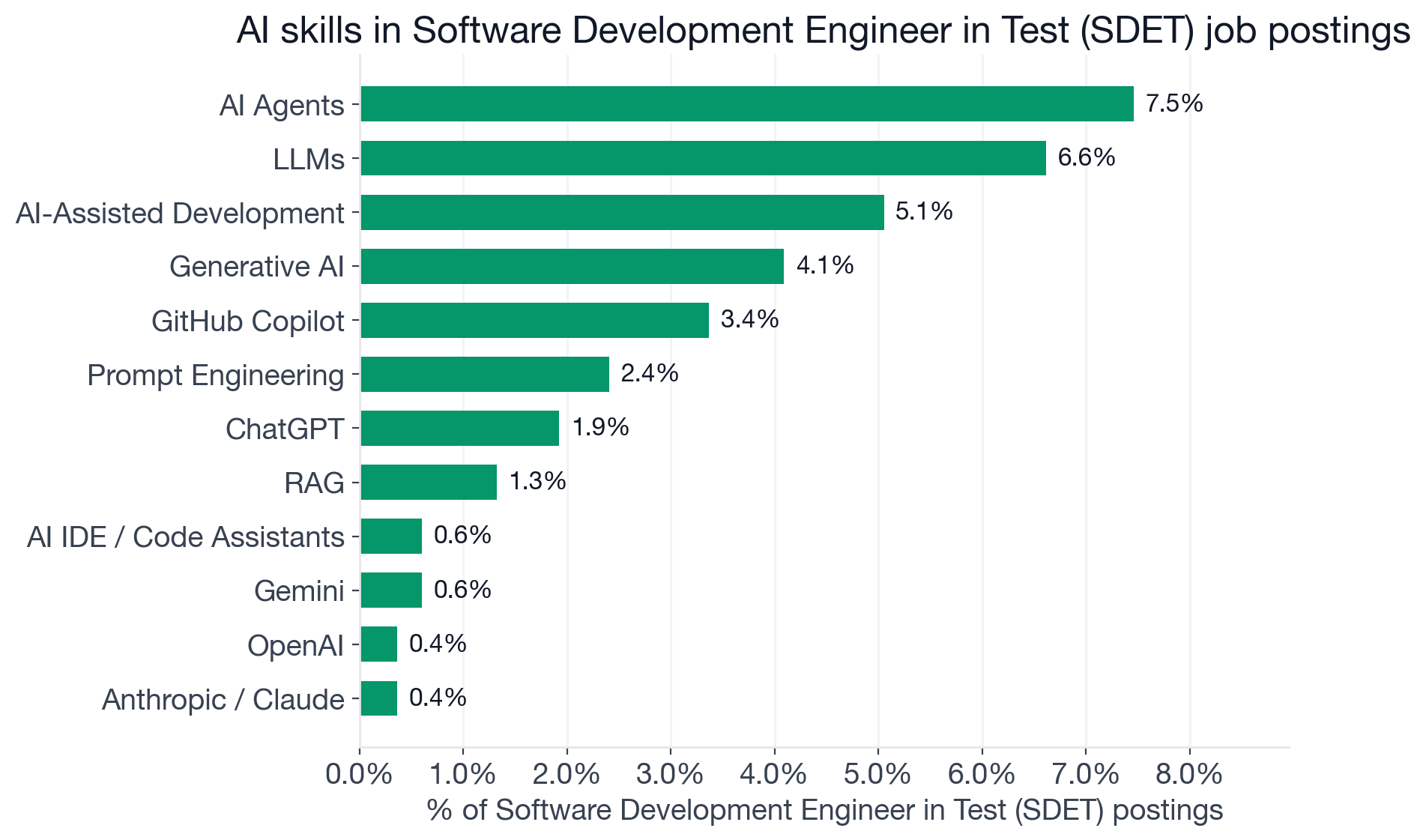 AI Agents (7.5%) and LLMs (6.6%) lead explicit AI skill demand in SDET postings, ahead of traditional Machine Learning (5.8%) and productivity tools like GitHub Copilot (3.4%).
| AI skill | % of postings | Postings |
|---|---|---|
| AI Agents | 7.5% | 62 |
| LLMs | 6.6% | 55 |
| Machine Learning (traditional) | 5.8% | 48 |
| AI-Assisted Development | 5.1% | 42 |
| Generative AI | 4.1% | 34 |
| GitHub Copilot | 3.4% | 28 |
| Prompt Engineering | 2.4% | 20 |
| ChatGPT | 1.9% | 16 |
| RAG (retrieval-augmented generation, where a model pulls in outside data before answering) | 1.3% | 11 |
The shape of that list is the tell. Group the skills by what they're actually asking for: postings naming an AI-system concept (AI Agents, LLMs, Generative AI, Prompt Engineering, RAG) total roughly twice the mentions of postings naming a specific productivity tool (AI-Assisted Development, GitHub Copilot, ChatGPT, AI IDE tools). Companies hiring for explicit AI skills in an SDET role mostly want someone who can test AI agents and LLM-backed features, not someone who can prove they've used Copilot to speed up their own scripting. Traditional Machine Learning still sits third, a reminder that some of this demand is standard ML-pipeline testing that predates the generative-AI wave entirely rather than a brand-new category.
Is There an AI Pay Premium for SDETs?
Among US postings with disclosed salary, base pay is what we can measure, not total compensation. Equity, bonus, and sign-on are not disclosed in job postings and aren't part of any figure below. The non-AI US baseline for SDET roles is $117,500 (n=111). We can't report a matching AI-skill median for the US: only 20 US postings both disclose salary and require new-wave AI, below the 25-posting floor we use for a stable figure. That's not a null result, it's a data-maturity result: too few US employers are simultaneously hiring explicitly for AI skills and disclosing pay for this specific role yet. Globally, where the AI-tagged sample is large enough to measure, a premium clearly exists; it just can't yet be confirmed at the US-only level.
Globally, where sample sizes are larger but currencies and cost-of-living norms mix together (not apples-to-apples with a US figure), postings requiring any AI skill show a $160,000 median versus $112,500 for postings without (n=44 vs n=129), a $47,500 gap. Narrow that to new-wave generative AI specifically and it's $145,000 versus $112,500 (n=29 vs n=129), a $32,500 gap. Treat both as directional signal that a premium likely exists, not as a number to negotiate against. The market is clearly willing to pay more somewhere for SDETs who work with AI systems; it just hasn't generated enough disclosed US data points yet to say exactly how much.
| Comparison | Median base salary | Sample size |
|---|---|---|
| US, non-AI postings | $117,500 | n=111 |
| US, new-wave AI postings | Not reportable (below 25-posting floor) | n=20 |
| Global, no AI requirement | $112,500 | n=129 |
| Global, any AI requirement | $160,000 | n=44 |
| Global, new-wave AI specifically | $145,000 | n=29 |
Who's Leading This Shift?
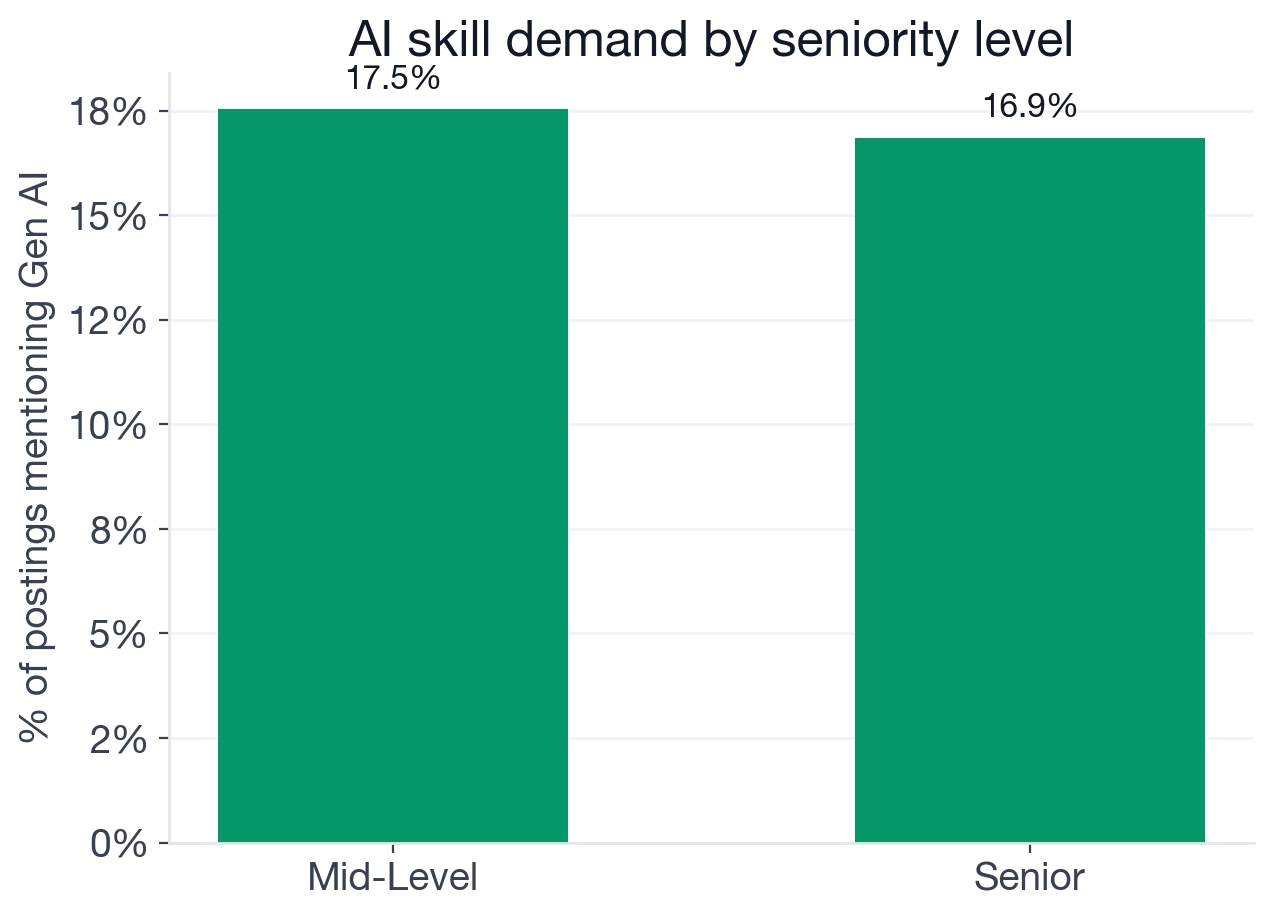 AI requirement rates by seniority don't rise in a straight line: staff (28.9%) and entry-level (23.5%) postings require AI more often than junior-level ones (2.7%).
Seniority doesn't move in a straight line here. Staff-level postings require AI most often, at 28.9% (11 of 38), which fits a pattern seen elsewhere: the people trusted to define how a team tests AI systems tend to be more senior. What breaks the pattern is the entry-level rate: 23.5% (4 of 17), well above junior-level's 2.7% (1 of 37) and close to staff. With only 17 entry-level and 37 junior-level postings in the dataset, that inversion should be read as a small-sample signal rather than a confirmed trend, but it's consistent with a role where some entry-level hires are being brought on specifically for AI-native automation work, while the mainstream junior tier still centers on classical automation. The bigger structural fact either way: senior postings alone make up 63.5% of the dataset, and entry plus junior combined are just 6.5%. This is not a role with a wide-open entry ramp, AI-related or otherwise.
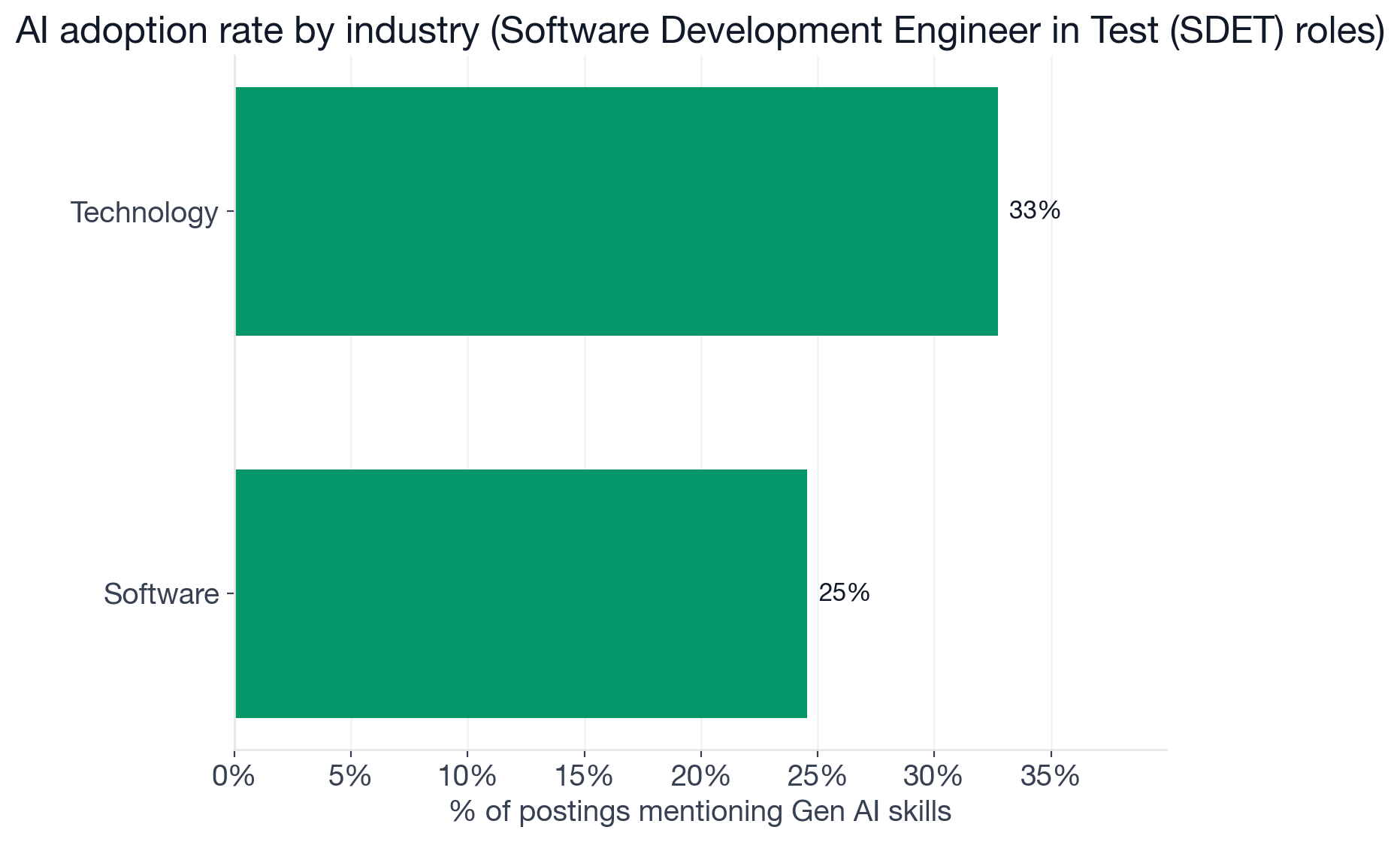 Technology (32.7%) and software (24.5%) postings require AI at roughly double the SDET role-wide rate of 17.1%.
Industry follows a more predictable pattern: technology-sector SDET postings require AI at 32.7% (36 of 110) and software-sector postings at 24.5% (27 of 110), both well ahead of the 17.1% role-wide rate. Geography adds a wrinkle worth flagging rather than glossing over: the US, despite carrying the largest share of postings (33.1% of the total), requires AI at just 12.4%, below India's 22.0% and well below a directional 45.5% spike in Mexico (n=22, too small to treat as a firm trend). At the company level the data is thin, only a handful of employers post enough SDET roles to compare meaningfully: NVIDIA requires new-wave AI in 63.6% of its 11 postings and Amazon in 50% of its 10, while the remaining employers in the dataset are largely IT staffing and services firms whose postings reflect contractor placements rather than one company's hiring strategy, so we're not presenting a ranked "top employers" table from this slice.
How to Use This in Your Job Search
If you're already an SDET, the fastest way to close the gap between "AI is 17.1% of postings" and "AI is 81% of daily testing work" is to make the ambient layer legible on your resume: name the AI-assisted testing you already do, and go a step further into evaluating AI-system output, not just generating test cases with a chatbot. Browse current SDET openings to see how individual companies phrase their AI requirements, and compare that against roles that pair SDET work with LLM testing specifically.
For interview prep, our AI mock interviews let you rehearse explaining how you'd design a test strategy for a non-deterministic system, a question that's increasingly common once "AI Agents" or "LLMs" appears anywhere in a posting. If you need to build the underlying concepts first, prompt evaluation, agent behavior testing, RAG pipelines, our interactive courses cover the foundations, and the question bank has focused drills on both classical test-automation topics and the newer AI-testing questions companies are starting to ask.
For a broader view of what SDET hiring looks like beyond the AI slice, our SDET skills companies want in 2026 post covers the full skill stack, and our QA Engineer vs SDET comparison is useful if you're weighing which title fits your background.
FAQ
Q. How many SDET job postings actually require AI skills in 2026?
17.1% of active Software Development Engineer in Test postings (142 of 831 analyzed, 829 distinct) explicitly require new-wave generative AI skills such as AI agents, LLMs, or prompt engineering. Broaden that to include traditional machine learning and deep learning, and the share rises to 20.6% (171 postings). That 17.1% is a floor, not a ceiling: it counts only postings that name AI skills outright, not the AI tools most SDETs already use day to day.
Q. What's the most in-demand AI skill for SDETs right now?
AI Agents, appearing in 7.5% of postings (62 of 831), ahead of LLMs (6.6%, 55 postings) and traditional Machine Learning (5.8%, 48 postings). Postings that name AI-system concepts like agents, LLMs, generative AI, and RAG outnumber postings naming a specific productivity tool like GitHub Copilot or ChatGPT by roughly two to one, a sign companies are hiring SDETs to test AI systems, not just to use AI to write tests faster.
Q. Does AI experience pay more for SDETs?
The US-only comparison can't be measured reliably yet: only 20 US SDET postings both disclose salary and require new-wave AI skills, below the 25-posting floor needed to report a stable median. The non-AI US baseline sits at $117,500 (n=111). Globally, postings requiring any AI skill show a $160,000 median versus $112,500 for postings without, a $47,500 gap, but that figure blends currencies and regions and should be read as directional, not a confirmed US premium.
Q. Is AI adoption higher for senior SDETs than for people starting out?
Not in a straight line. Entry-level SDET postings require AI at 23.5% (4 of 17), far above junior-level postings at just 2.7% (1 of 37). Mid-level (17.5%) and senior (16.9%) sit close together, and staff-level postings require AI most often, at 28.9% (11 of 38). The bigger structural story: senior postings alone make up 63.5% of all SDET postings, while entry and junior combined are just 6.5%.
Q. Which industries and companies are hiring AI-fluent SDETs?
Technology-sector SDET postings require AI at 32.7% (36 of 110) and software-sector postings at 24.5% (27 of 110), both well above the 17.1% role-wide rate. At the company level, only a handful of employers post enough SDET roles to compare meaningfully: NVIDIA requires new-wave AI in 63.6% of its 11 postings, and Amazon in 50% of its 10, while smaller staffing and services firms in the data mostly reflect contractor placements rather than a single employer's hiring pattern.
Q. Will AI replace the SDET role?
The evidence points to redefinition, not replacement. Rainforest QA's 2025-2026 survey of 625 software developers found 81% of teams already use AI somewhere in their testing workflow (planning, writing, or maintaining tests), while Gartner projects enterprise adoption of AI-augmented testing tools climbing from 15% in 2023 to 80% by 2027. Industry sources describe the shift as SDETs moving from writing test scripts by hand to deciding what should be tested and verifying an AI agent's output, a supervisory skill rather than a disappearing one.
Q. Is AI usage among SDETs actually as common as it is for developers generally?
Directionally yes, but SDETs may be trailing slightly on daily, load-bearing use. General developer surveys put AI tool usage at 84-85% and daily use at 51% (Stack Overflow, JetBrains, 2025). QA-specific sources report a similar high-water mark for AI reaching into testing workflows (Rainforest QA's 81%), but also describe a 5-8x gap between teams that say they plan to use AI in testing and teams that have actually deployed it in production test workflows (a secondary source; treat as directional), a gap worth keeping in mind before assuming universal daily adoption.
What to Build While the Market Catches Up
The posting data and the pay data will keep lagging the actual work for a while yet, that's what the 20-posting gap in the US salary numbers tells us. The move for SDETs is to build the AI-system testing skill now, agent evaluation, LLM output verification, non-deterministic test design, rather than wait for a job title or a salary band to catch up and confirm it's worth learning.
Topics
Ready to practice?
Put what you've learned into practice with AI mock interviews and structured preparation guides.