
Automation Is Everywhere in SDET Postings. It Isn't What Pays.
Automation is the one skill nearly every Software Development Engineer in Test (SDET) posting names outright, appearing in 87.0% of listings, one of the highest table-stakes rates we've measured across roles in this series. If you're wondering whether you need it, the answer is: obviously, everyone already has it on their resume. That's exactly why it barely moves your offer.
We looked at every active SDET posting on the InterviewStack.io job board as of July 2026, 1,027 listings, with skills extracted from descriptions and synonyms collapsed. The pattern that falls out is a role where the entry ticket (automation, plus a testing framework) is nearly universal and cheap, while the pay ladder runs through a different set of skills entirely: cloud, CI/CD infrastructure, and pipeline ownership.
Key Findings
- Automation appears in 87.0% of SDET postings (894 of 1,027), the only skill to cross the 50% table-stakes threshold.
- Median US base salary is $130,000 across 181 postings with US salary disclosed.
- AWS carries the largest premium of any skill: $171,000 median (+$41,000 over baseline), though only 16.3% of postings ask for it.
- CI/CD, Jenkins, Docker, and automated testing each add $25,000 to $29,000 over baseline; automation itself adds just $6,500.
- Java and Selenium co-occur at 2.26x the rate chance would predict, the strongest skill pairing in the dataset.
- Only 2.4% of postings are entry-level (97.6% are mid-level or above), one of the more experience-gated roles in this dataset.
- Onsite remains the dominant work mode at 54.8%; only 15.0% of postings are tagged remote.
- India accounts for 22.5% of postings, the second-largest country behind the US at 34.8%.
A note on that 87% automation figure. Our classifier matches on title and description keywords, and "automation" also shows up in industrial and controls-engineering job titles, electrical automation, manufacturing automation, controls specialists, that have nothing to do with software testing. A random sample of postings behind this dataset turned up a handful of exactly those titles. That means 87.0% likely overstates pure software test-automation demand somewhat. It doesn't change the direction of the finding: the software-specific signal (Selenium, Playwright, CI/CD, Jenkins, test automation as a named discipline) is consistent and unaffected by that overlap, and it's what the rest of this post is built on.
Which SDET Skills Actually Pay More Than the Baseline?
Salary figures below cover US postings only (where wage-transparency laws produce consistent disclosure) so they're directly comparable. The numbers are base salary: equity, bonus, and sign-on aren't disclosed in postings and aren't in this dataset, so total compensation at large tech and aerospace employers runs meaningfully higher than what we report here.
The median US base salary across all SDET postings is $130,000 (n=181). Against that baseline, the highest-paying skills aren't the testing frameworks, they're the cloud and pipeline infrastructure a smaller share of postings actually ask for.
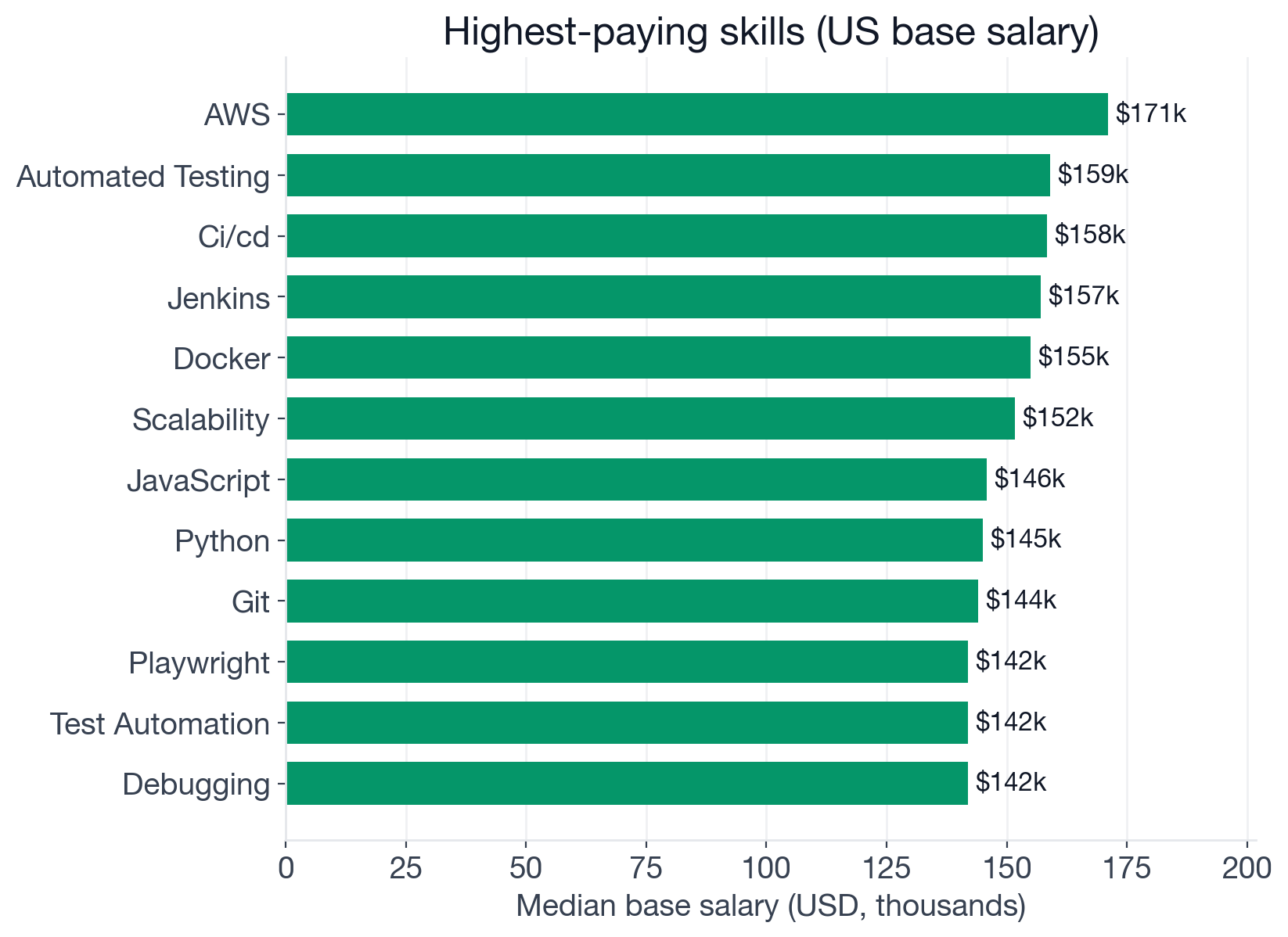
Median US base salary in USD for postings that mention each skill, among US SDET postings with structured salary data.
| Skill | Median US base salary | Premium over baseline | Sample size |
|---|---|---|---|
| AWS | $171,000 | +$41,000 | 27 |
| Automated Testing | $159,000 | +$29,000 | 31 |
| CI/CD | $158,300 | +$28,300 | 72 |
| Jenkins | $157,100 | +$27,100 | 48 |
| Docker | $155,000 | +$25,000 | 41 |
| Scalability | $151,600 | +$21,600 | 34 |
| JavaScript | $145,800 | +$15,800 | 28 |
| Python | $145,000 | +$15,000 | 85 |
| Git | $144,000 | +$14,000 | 30 |
| Playwright | $141,900 | +$11,900 | 26 |
Now compare that to the skills nearly every SDET already has on their resume. Automation itself, the skill in 87% of postings, sits at $136,500 (+$6,500, n=160). Agile is $136,000 (+$6,000, n=49). Selenium, still the most-named testing framework by raw count, is $134,300 (+$4,300, n=35). Quality Assurance as a named skill sits exactly at the $130,000 baseline (+$0, n=44).
The shape is consistent: skills that show up in almost every posting have flat salary distributions because they're the price of entry, not a differentiator. AWS, at just 16.3% of postings, is rare enough that companies pay for it: $41,000 above baseline, a 31.5% premium, the single largest gap in this dataset. Browse SDET openings that ask for AWS if that's the direction you want to take.
What Does the SDET Skill Stack Actually Look Like?
Group individual skills into families and two clusters effectively tie for the top spot. A testing-and-pipeline tooling cluster, CI/CD, test automation, Selenium, Jenkins, Playwright, API testing, and quality assurance, touches 90.6% of postings. A general developer-infrastructure cluster, Git, Docker, GitHub, Jira, monitoring, Kubernetes, touches 90.4%.
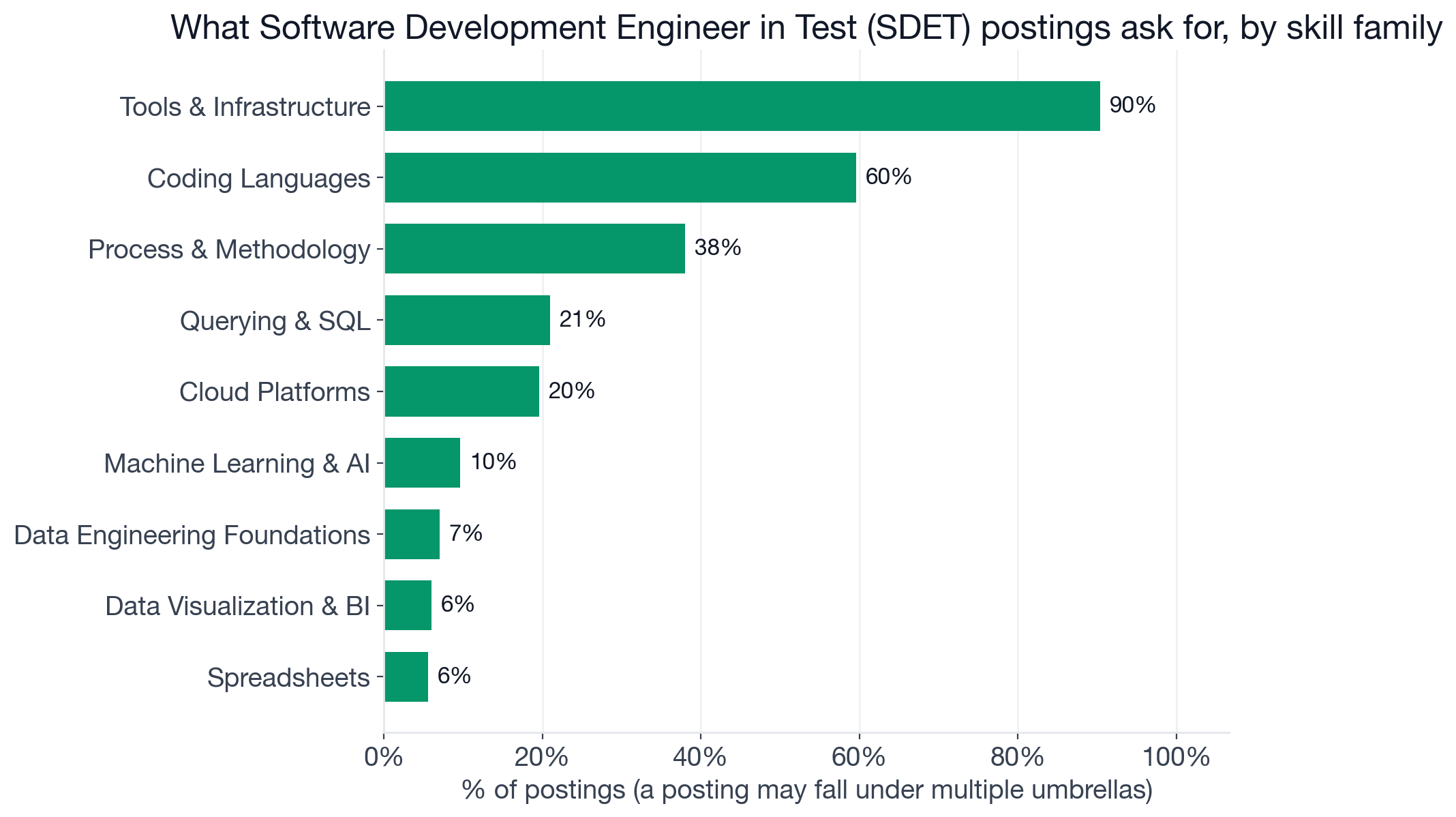
Share of SDET postings that ask for at least one skill in each family. A posting that mentions both Jenkins and GitHub Actions counts once under its tooling family.
That second number is misleading if you read it as a broad infrastructure requirement. Automation alone drives nearly all of that 90.4%: strip it out and the rest of that family, Git, Docker, GitHub, Jira, monitoring, Kubernetes, each show up individually in just 9-15% of postings. The 90% headline is really one dominant skill plus a long, thin tail.
Below those two testing clusters: Coding Languages at 59.6% (Python 40.8%, Java 27.4%, JavaScript 19.2%, TypeScript 14.0%, C# 9.1%), Process & Methodology at 38.0% (mostly Agile and Scrum), Querying & SQL at 20.9% (almost entirely SQL itself), and Cloud Platforms at 19.6% (AWS, Azure, Google Cloud). The coding-language mix confirms SDET is still a Python-and-Java role first, with JavaScript and TypeScript trailing behind for teams testing web-heavy products.
What Are the Three Tiers of SDET Skills in 2026?
Individual skills split cleanly into three bands once you rank them by how many postings mention them.
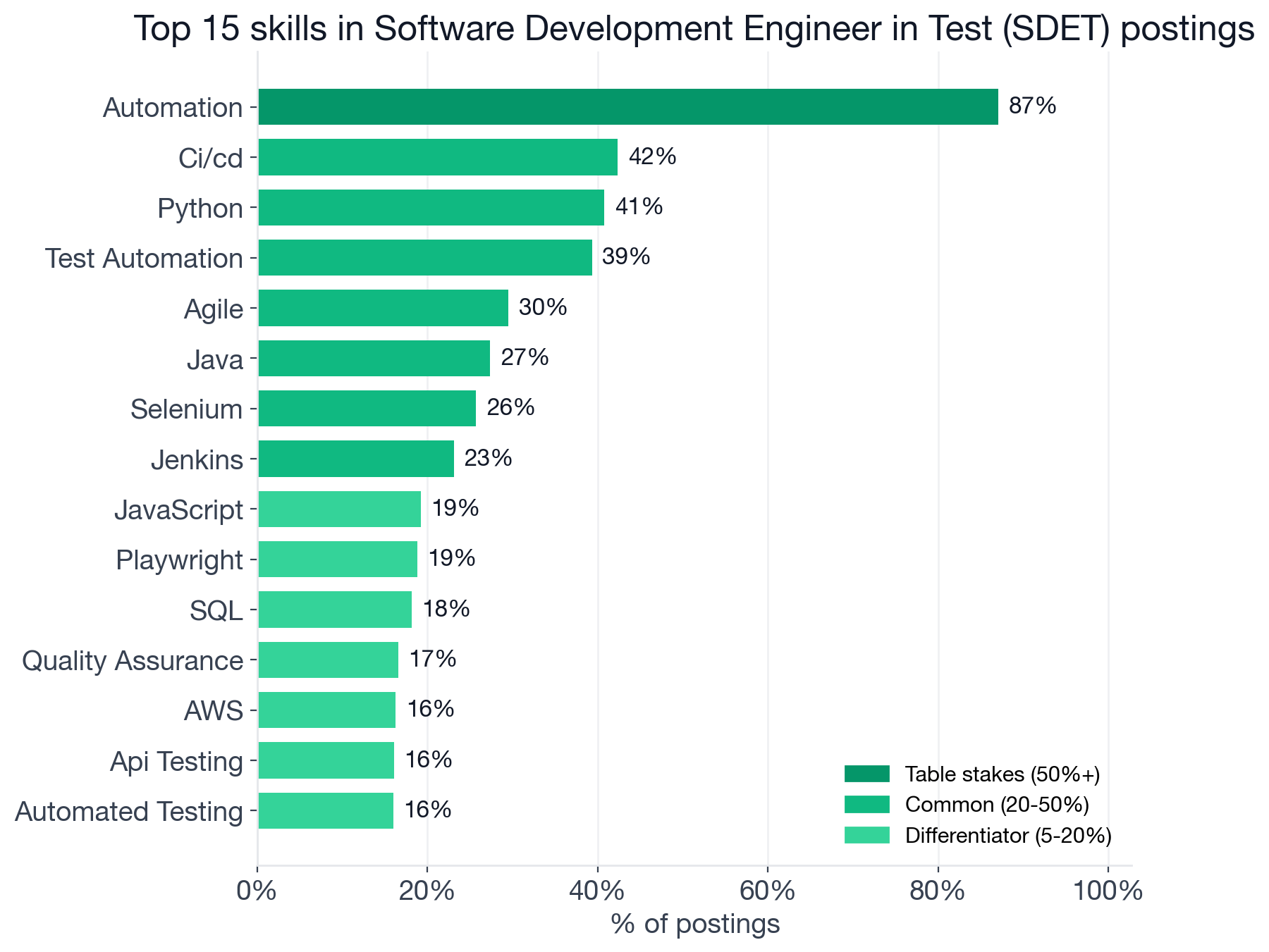
Top individual skills in SDET postings, by share of listings that mention them. Skills above 50% are table stakes; 20-50% are common; 5-20% are differentiators.
Table stakes (50%+): Automation, 87.0%, is the only skill in the entire dataset to clear this line. Nothing else, not a specific testing framework, not a specific language, comes close.
Common (20-50%): CI/CD (42.4%), Python (40.8%), Test Automation (39.3%), Agile (29.5%), Java (27.4%), Selenium (25.7%), and Jenkins (23.1%). This is the practical floor for a competitive SDET resume: a pipeline tool, a language, a named test-automation discipline, and one specific framework.
Differentiators (5-20%): A wide band of 42 skills, from JavaScript (19.2%) and Playwright (18.8%) down to Load Testing (6.8%). The most useful ones to know by name: SQL (18.1%), Quality Assurance as an explicit label (16.6%), AWS (16.3%), API Testing (16.1%), Automated Testing (16.0%), Git and Docker (15.5% each), GitHub (15.3%), Debugging (14.2%), TypeScript (14.0%), Kubernetes (10.9%), Cypress (9.6%), and C# (9.1%). None of these are required to get past a resume filter, but this is exactly the band the salary data says companies pay extra for.
Java and Selenium Still Define the Enterprise Test Stack
Computing every two-skill co-occurrence among the top 25 skills surfaces two distinct stacks hiding inside the same job title.
The strongest single pairing in the dataset is Java + Selenium, at a co-occurrence lift of 2.26 (163 postings, 15.9%): postings that ask for Java are more than twice as likely as chance would predict to also ask for Selenium. That's the classic enterprise QA-automation combination, and it's still the dominant enterprise pattern in 2026, not a legacy holdover.
The second cluster is built around pipeline ownership: CI/CD + Jenkins (lift 2.05, 20.1%), CI/CD + Playwright (lift 1.97, 15.7%), Jenkins + Test Automation (lift 1.79, 16.3%), and CI/CD + Java (lift 1.68, 19.5%). Playwright (Microsoft's browser-automation framework, positioned as Selenium's modern successor) shows up paired with CI/CD more strongly than it shows up alone, meaning postings that mention it are usually describing an engineer who owns the pipeline, not just the test scripts.
That distinction lines up directly with the salary data above. Java + Selenium is the resume that gets you an interview. CI/CD + Jenkins or CI/CD + Playwright is the resume that gets you the $25K-28K premium, because it signals you can build and maintain the pipeline the tests run in, not just write the tests themselves.
AI Testing Tools Aren't in the Job Post, But They're in the Workflow
Only about 9.6% of SDET postings even touch the Machine Learning & AI category (99 of 1,027), and none of those resolve to a specific named AI skill, no LLM, no prompt engineering, no MLOps line item anywhere in the top 50 skills. Treat 9.6% as a loose ceiling, not a clean measurement: these are postings where AI shows up adjacently, as a system under test or a testing target, not as a hard requirement to build AI systems. That's the expected reading for a testing role. SDETs are hired to verify what other teams build, not to build AI models themselves.
But job postings only capture what's stated as a requirement, not what's assumed. The testing industry runs its own annual survey of that gap, and it tells a different story. Capgemini's World Quality Report 2025-26 found 89% of quality-engineering organizations are already piloting or running GenAI-augmented QE workflows (37% in production, 52% still piloting). Developers broadly report similar numbers: 84% use or plan to use AI tools and 51% use them daily, according to the Stack Overflow 2025 Developer Survey; 85% of developers report using AI regularly per JetBrains' 2025 ecosystem survey.
Read together, the honest framing is this: postings screen for Selenium, Playwright, CI/CD, and Python because those are what a hiring manager can verify on a resume. AI-assisted test generation, self-healing automation, and Copilot-style completion inside test scripts are increasingly the water SDETs swim in day to day, whether or not the posting spells it out.
Who's Getting Hired, and at What Level?
Entry-level SDET postings are scarce.
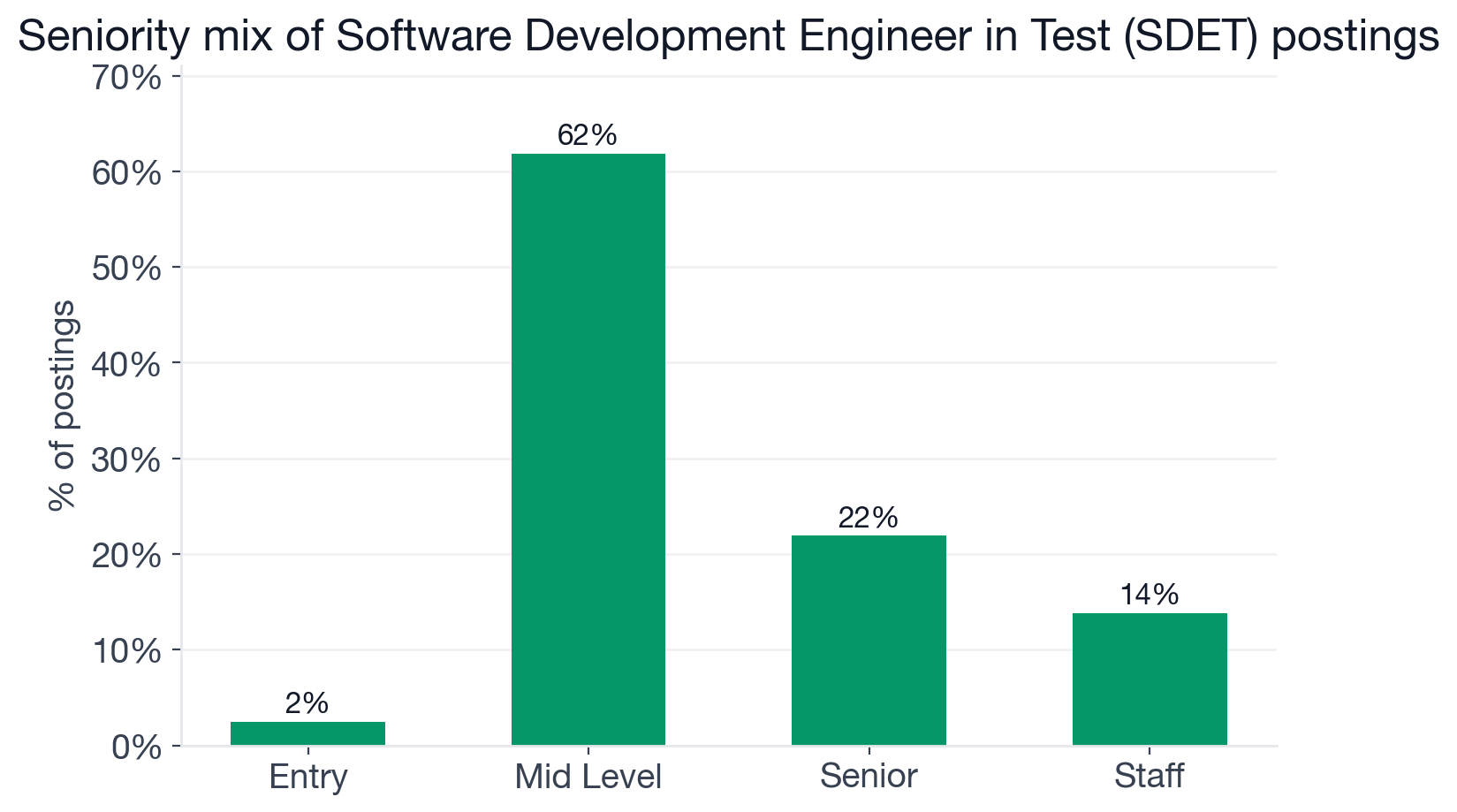
Seniority distribution of SDET postings, inferred from title keywords.
- Entry: 2.4% (25 postings)
- Mid-level: 61.8% (635)
- Senior: 21.9% (225) (senior SDET openings)
- Staff: 13.8% (142)
Combined, 97.6% of SDET postings are mid-level or above, roles that typically assume you already know how to design and own an automation framework before you walk in the door. There's no meaningful junior on-ramp here the way there is for some engineering roles; companies expect candidates to arrive with production automation experience, usually from a QA analyst, manual-testing, or junior developer role that built up automation skills on the side.
Where Are SDET Jobs, and Are They Remote?
SDET is one of the more globally distributed roles we've analyzed.
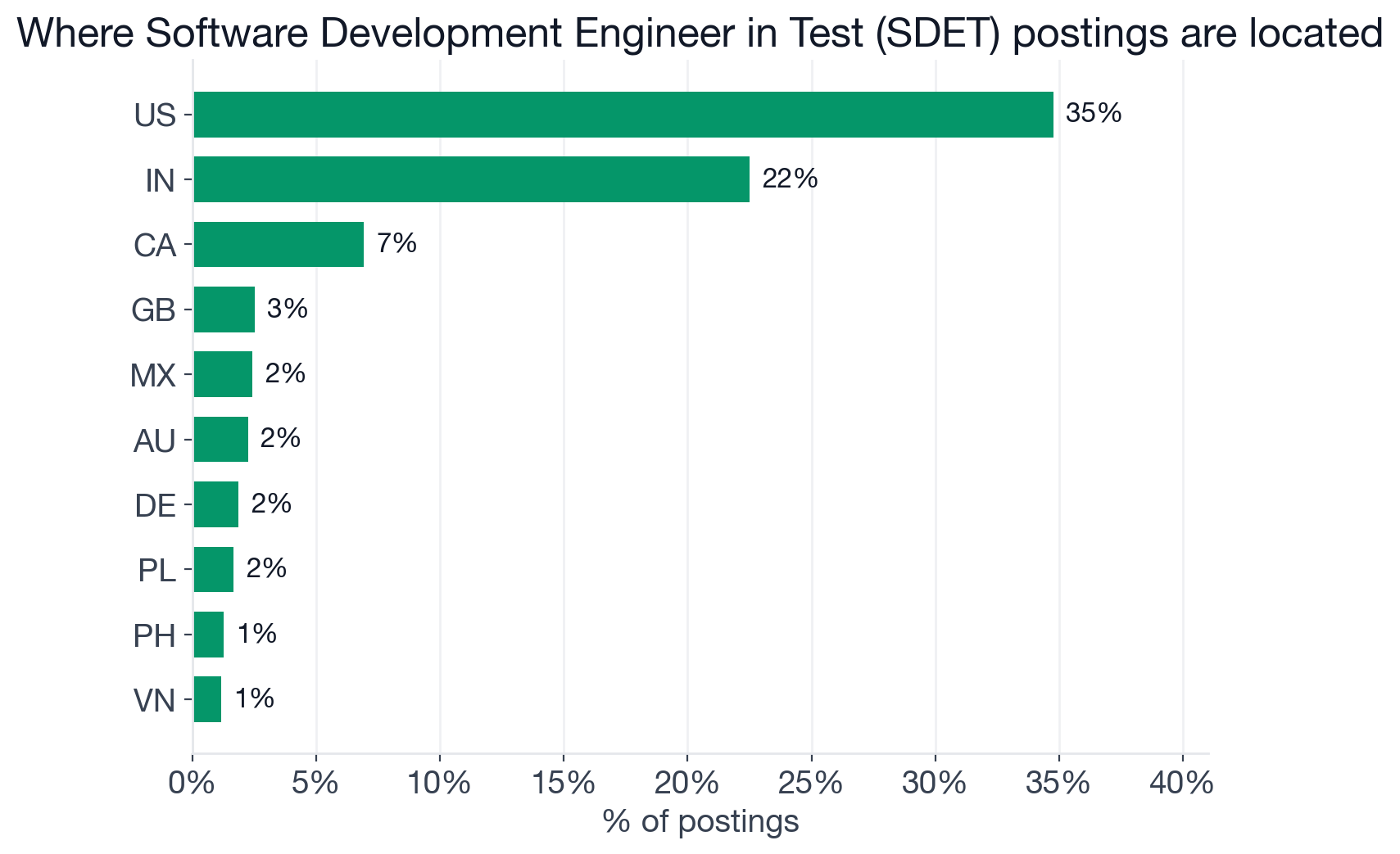
Top countries by share of SDET postings, excluding postings with no resolvable location.
- United States: 34.8% (357)
- India: 22.5% (231)
- Canada: 6.9% (71)
- United Kingdom: 2.5% (26)
- Mexico: 2.4% (25)
- Australia: 2.2% (23)
India's 22.5% share is a much larger second market than most tech roles in this series show, a reflection of how much test-automation work has moved to offshore engineering hubs and global capability centers over the last several years.
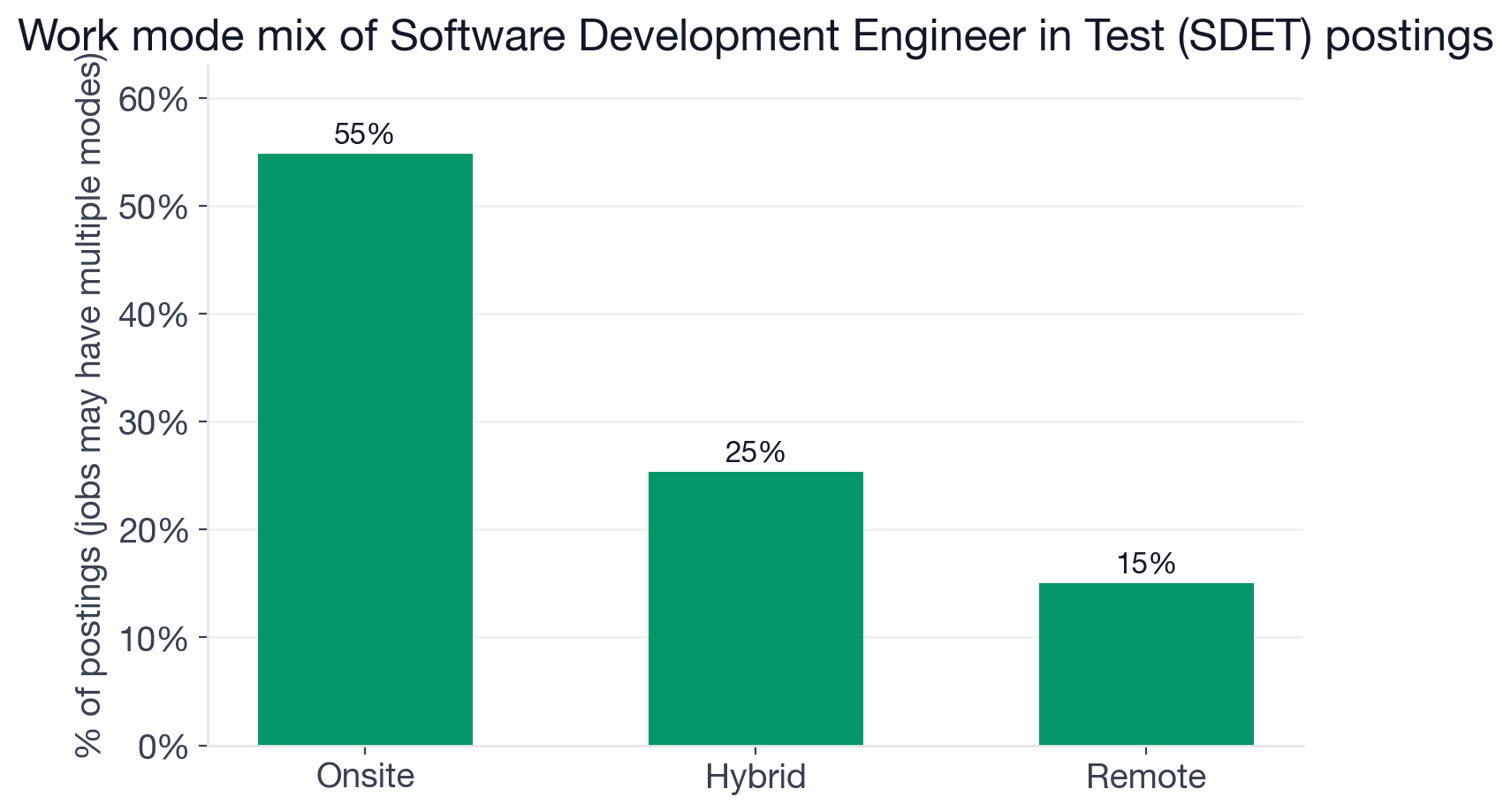
Share of SDET postings tagged with each work mode.
- Onsite: 54.8% (563)
- Hybrid: 25.3% (260)
- Remote: 15.0% (154) (fully-remote SDET openings)
Only 15.0% of SDET postings are tagged remote, one of the more onsite-heavy roles in our data. That fits the profile: SDETs frequently test hardware, regulated systems, or on-prem infrastructure that isn't practical to validate from a home office. If you're comparing this role against its close cousin, the QA Engineer title spans a much wider range of industries and pays less on average; SDET stays closer to a pure software-engineering discipline.
The Real Employers Behind the SDET Numbers
Ranking by distinct openings rather than raw posting count, and setting aside staffing and nearshore-services firms whose "openings" are really contractor placements, a credible top-12 emerges:
| Company | Distinct SDET openings |
|---|---|
| Accenture | 26 |
| Sony Interactive Entertainment | 22 |
| SpaceX (Space Exploration Technologies Corp.) | 14 |
| Apple | 13 |
| NVIDIA | 11 |
| Amazon | 10 |
| Akamai Technologies | 8 |
| Abbott Laboratories | 8 |
| Comcast | 8 |
| HighLevel | 7 |
| GE Vernova | 7 |
| DTCC | 7 |
Gaming and hardware (Sony Interactive Entertainment, SpaceX, Apple, NVIDIA) sit alongside consulting (Accenture), cloud infrastructure (Akamai), and regulated industries (Abbott, Comcast, DTCC) rather than clustering around one sector. That spread tracks with the geography and remote data above: SDET demand is broad-based, not concentrated in any single industry vertical.
How to Use This in Your Job Search
If you're preparing an SDET job search, the data points to a specific sequence, not a longer skill list.
Confirm the floor, then move past it. Automation, a testing framework (Selenium or Playwright), Python or Java, and CI/CD are what get your resume past the first filter. If you're missing one of those four, fix that before anything else.
Pick the pipeline-ownership track over the framework-depth track. The salary data is unambiguous: a second or third testing framework barely moves your offer, but AWS, Jenkins, Docker, and CI/CD ownership add $25,000 to $41,000 over the baseline. If you have to choose where to spend your next few months of study, spend it on owning a pipeline end to end, not on learning a fourth automation library.
Treat AI-assisted testing as a baseline skill, not a bonus. It rarely appears as a named requirement in postings, but 89% of quality-engineering organizations are already running or piloting it. Being fluent with AI-assisted test generation and self-healing automation is quickly becoming assumed, the same way Git and CI/CD became assumed a decade ago.
Drill the material, then practice under real conditions. Our interview-prep courses cover the CI/CD, cloud, and automation-architecture foundations that show up in SDET interview loops. The question bank lets you drill test-design, debugging, and system-design topics one at a time. AI mock interviews let you rehearse a full round under realistic conditions, with feedback specific to test-architecture and debugging questions.
Filter the job board for your stack. Browse current SDET openings and layer on skill filters to match your target, for example SDET + AWS or SDET + Python. The board updates daily.
FAQ
Q. What is the median salary for a Software Development Engineer in Test (SDET) in 2026?
Among US postings with disclosed pay, the median base salary for a Software Development Engineer in Test (SDET) is $130,000 (n=181). Equity, bonus, and sign-on are not disclosed in postings, so total compensation at top employers runs higher than this baseline.
Q. Does knowing Selenium or Playwright pay more as an SDET?
Not by much. Selenium carries a median US base salary of $134,300 (+$4,300 over baseline, n=35) and Playwright $141,900 (+$11,900, n=26). Framework choice barely moves pay; the larger premiums sit in cloud and pipeline skills like AWS and Jenkins.
Q. What SDET skills pay the most in 2026?
AWS commands the largest premium at $171,000 median US base salary (+$41,000 over the $130,000 baseline, n=27), followed by automated testing (+$29,000), CI/CD (+$28,300), Jenkins (+$27,100), and Docker (+$25,000).
Q. Is automation a required skill for SDET jobs?
Yes, effectively. Automation appears in 87.0% of active SDET postings (894 of 1,027 analyzed), the only skill in this dataset to cross the 50% table-stakes threshold, though that figure is likely inflated slightly by industrial/controls-engineering postings that also use the word automation. Despite being nearly universal, it adds just $6,500 to the median baseline salary.
Q. How much of the SDET job market is entry-level?
Very little. Just 2.4% of SDET postings (25 of 1,027) are entry-level, while 61.8% are mid-level, 21.9% are senior, and 13.8% are staff. This is one of the more experience-gated roles in InterviewStack's job-market data.
Q. Are SDET jobs remote?
Mostly not. 54.8% of SDET postings are onsite, 25.3% are hybrid, and only 15.0% are remote, reflecting the role's ties to hardware, regulated industries, and on-prem test infrastructure at many employers.
Q. Do SDET job postings require AI or machine learning skills?
Explicitly, rarely: only about 9.6% of postings even touch the Machine Learning & AI category, and none resolve to a specific named AI skill. That undercounts real usage. The QA industry's own World Quality Report 2025-26 found 89% of quality-engineering organizations are already piloting or running AI-augmented testing workflows, meaning AI-assisted test generation is increasingly assumed even when job postings don't mention it.
The Ceiling Is in the Pipeline, Not the Test Suite
Automation got you into the room; 87% of your competition has it too. The postings and the salary data both point the same direction: the next skill worth learning as an SDET isn't a fourth testing framework, it's ownership of the cloud and pipeline infrastructure those tests run inside. That's where the $25K-41K premiums live, and it's where the market is telling you to spend your next round of study.
Topics
Ready to practice?
Put what you've learned into practice with AI mock interviews and structured preparation guides.