
AI Requirements Show Up Only After You're Already Senior
None of the 29 entry-level UI Designer postings in our sample explicitly ask for an AI skill. Not one. Junior postings barely clear it, at 2.0%. The rate only becomes visible once you reach mid-level (7.1%) and senior (15.7%) roles. Read literally, that gradient tells a new UI designer that AI doesn't matter until they've already built a career.
That reading is wrong, and the gap between what the reading suggests and what's actually true is the story here. We looked at every active UI Designer posting on the InterviewStack.io job board over a 90-day window, 796 listings, and checked each one for explicit AI or machine learning skill mentions. Separately, the 2026 State of AI in Design report shows 91% of designers now use AI tools weekly, up from 54% just a year earlier. Job postings are a lagging signal for a habit that's already close to universal.
The honest way to read this role in 2026 is as two separate questions with two separate answers. "Does this posting require AI?" mostly still says no, especially near the entry point. "Does this job require you to already be comfortable with AI tools?" almost certainly says yes, whether the posting says so or not.
Key Findings
- 9.7% of the 796 UI Designer postings analyzed (77 postings) explicitly require a generative AI skill; 10.2% require any AI, including traditional machine learning.
- AI Agents is the single most-requested AI skill at 4.8% of postings (38), double Generative AI (2.4%, 19) and over three times ChatGPT (1.4%, 11).
- Zero of 29 entry-level postings explicitly require AI skills; the rate is 2.0% at junior, 7.1% at mid-level, and 15.7% at senior, the highest reliable figure tracked.
- The US non-AI median base salary is $107,500 (n=109 postings with disclosed salary); only 11 AI-tagged US postings disclose salary, too few to compute a reliable premium.
- The 2026 State of AI in Design report puts weekly AI tool use among designers at 91%, up from 54% in 2025, one of the fastest single-year adoption jumps recorded in any professional survey we reviewed.
- Roughly three in four designers report using AI tools daily per the same report, and 72% report using generative AI directly inside their workflow, per Figma's design statistics.
- The US accounts for 32.2% of postings (256 of 796) but only a 9.0% explicit AI rate, below several smaller markets like India (18.9%) and Poland (27.3%), though those samples are too small to call a trend.
What UI Design Looked Like Before AI Became a Baseline
Three or four years ago, a UI Designer's toolchain was settling, not shifting. Figma had mostly finished displacing Sketch as the default interface tool, component libraries and design systems were the skill investment everyone was making, and handoff to engineering ran through specs and redlines inside the design tool itself. Image generators like Midjourney and DALL-E existed by 2022, but they lived at the edges of the job, useful for moodboards and concept art, never a listed requirement and rarely part of the daily production workflow.
What changed wasn't a single product launch. It was a compounding shift across 2024 and 2025 as AI features moved from standalone novelty tools into the design surface itself: generative fill inside raster editors, AI-assisted layout and content generation inside Figma, and copy-drafting and prototyping tools that sit directly in the file a designer is already working in. The jump the State of AI in Design report shows, weekly AI use among designers going from 54% to 91% in a single year, lines up with that timeline. This wasn't a gradual decade-long creep. It was a fast, recent snap from optional to default, and job postings simply haven't finished catching up to it.
How Many UI Designer Postings Actually Require AI Skills?
The headline number is 9.7%: of the 796 active UI Designer postings analyzed, 77 explicitly name a new-wave generative AI skill (AI Agents, Generative AI, ChatGPT, LLMs, and similar). Widen that to include traditional machine learning and deep learning skills, and it climbs slightly to 10.2% (81 postings). Traditional ML appears in 1.3% of postings overall (10), but most of that overlaps with a generative AI mention already counted above (6 of the 10); isolate postings that ask for traditional ML with no generative AI in sight and the rate drops to just 0.5% (4 of 796), which tells you this role's AI story is almost entirely a generative-AI story, not a machine-learning-background story.
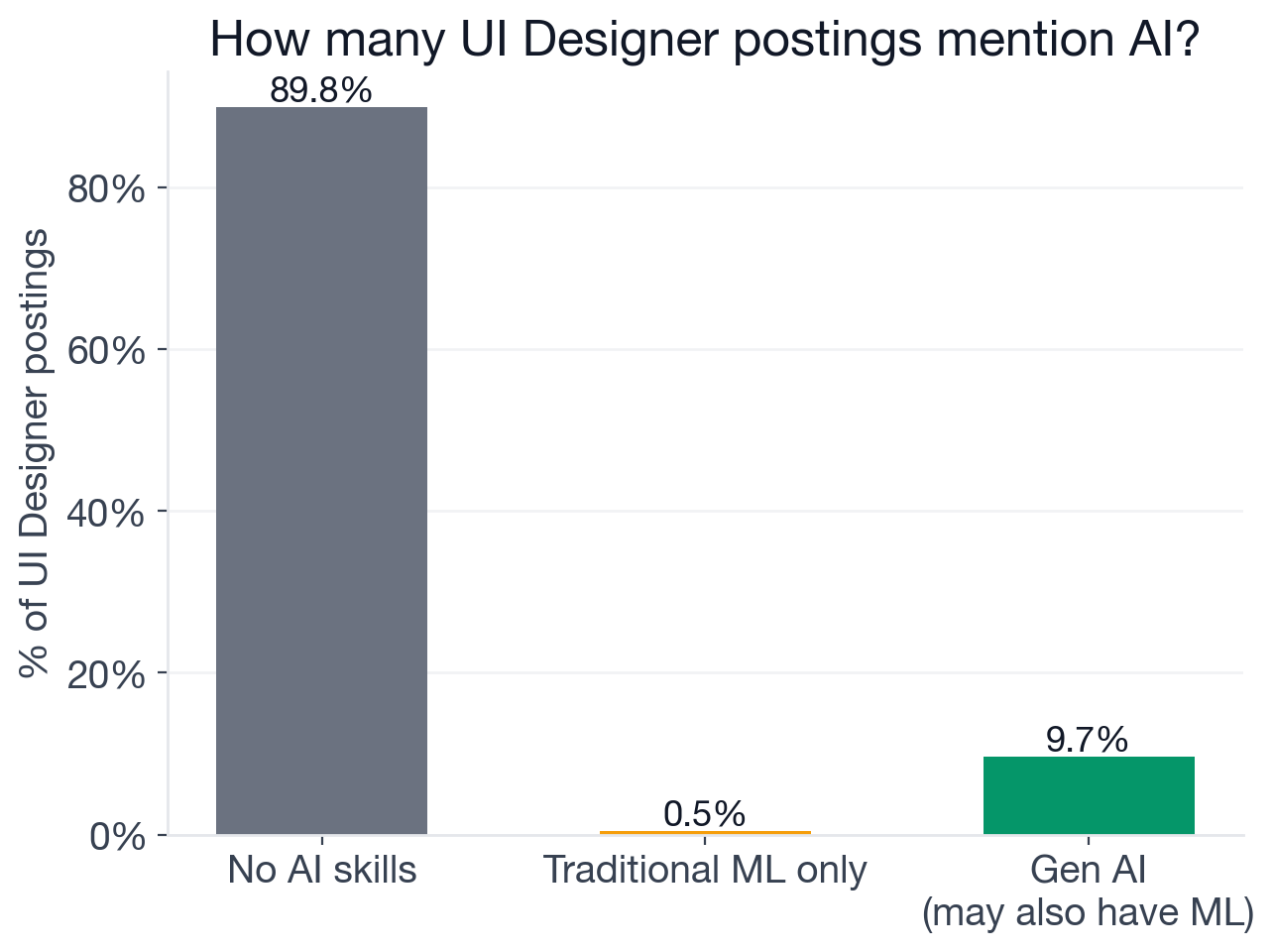
Roughly 1 in 10 active UI Designer postings names an AI skill explicitly. Almost all of that 1 in 10 is generative-AI language, not a machine-learning background requirement.
Treat that 9.7% as a floor, not a ceiling, on what AI fluency actually means for this role. It measures postings that name an AI skill as a requirement, the "build or work directly with AI systems" layer. It does not measure, and structurally cannot measure, the ambient layer: the assumption that a designer already opens Figma AI, ChatGPT, or Claude as part of a normal workday, the same way "email" or "internet access" stopped being listed as job requirements once they became universal. The 91% weekly-use figure from the 2026 State of AI in Design report is the better estimate of that second layer, and it's the number that should actually shape how a UI Designer prepares for 2026, regardless of what any single posting says.
One data-scope caveat worth naming directly: the 796-posting sample is built from role-title matching, and a look at a random sample of titles shows it captures the broader visual/product-design hiring pool rather than a narrowly-scoped "UI Designer" title alone, Visual Designer, Web Designer, Digital Designer, and Marketing Designer titles all appear alongside dedicated UI/UX Designer postings. That breadth doesn't change the direction of the seniority or AI-skill patterns above, but it means the percentages in this post describe how AI shows up across adjacent visual-design hiring, not a single, tightly-defined job title.
Which AI Skills Are Employers Actually Naming?
When a UI Designer posting does name an AI skill, it isn't reaching for the generic "use ChatGPT" language you'd expect. AI Agents, autonomous systems that carry out multi-step tasks with limited human input rather than a single-turn chatbot exchange, is the top explicit AI skill by a wide margin.
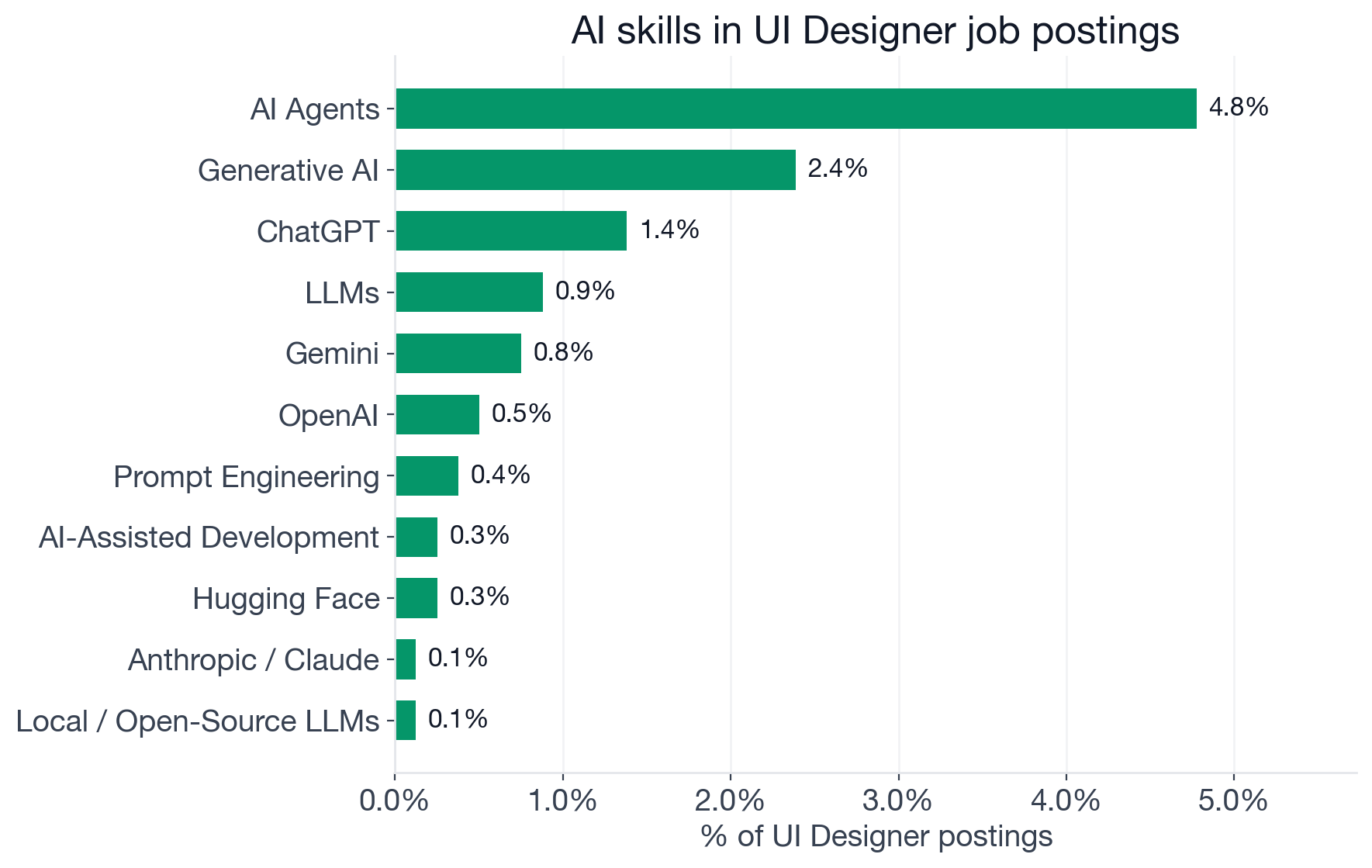
AI Agents outranks Generative AI and ChatGPT combined among explicit skill mentions in UI Designer postings, a signal that companies naming AI want designers shaping agentic products, not just using AI tools personally.
| Rank | Skill | Share of postings | Jobs |
|---|---|---|---|
| 1 | AI Agents | 4.8% | 38 |
| 2 | Generative AI | 2.4% | 19 |
| 3 | ChatGPT | 1.4% | 11 |
| 4 | Machine Learning (traditional) | 1.3% | 10 |
| 5 | LLMs | 0.9% | 7 |
| 6 | Gemini | 0.8% | 6 |
| 7 | OpenAI | 0.5% | 4 |
| 8 | Prompt Engineering | 0.4% | 3 |
Machine Learning (traditional) is tracked separately from the new-wave generative AI skills above and isn't part of the chart, which charts new-wave AI skills only; it's included here for the complete AI/ML skill picture.
AI Agents alone accounts for close to half of all explicit AI mentions in the dataset. That's a meaningfully different requirement than "comfortable with AI tools." It reads as companies building agentic products (AI copilots, autonomous assistants, multi-step automation interfaces) hiring UI Designers to design the surface those agents live inside, the same distinction that shows up in Product Designer and UX Designer postings elsewhere on the job board. The remaining named tools, ChatGPT, Gemini, OpenAI, sit well below it and look more like general-purpose AI literacy than a specialized hiring signal.
What the Salary Data Can (and Can't) Tell You Yet
Every salary figure in this post is a US base salary only. Equity, bonus, and sign-on are not disclosed in job postings and aren't part of this dataset, so total compensation at top employers runs higher than what's reported here.
With that scope set: the US median base salary for UI Designer postings without any AI skill mention is $107,500, based on 109 postings with disclosed salary. We can't report a comparable AI-tagged median, because only 11 US postings that explicitly require new-wave AI skills also disclose a salary, well short of the 25-posting floor needed for a number we'd stand behind. That sample gap holds outside the US too: only 15 AI-tagged postings worldwide disclose salary, too thin to compute any reliable figure, let alone a US-comparable one.
That data gap is itself informative. It means the market hasn't yet built a visible, negotiated salary tier for "UI Designer who explicitly works with AI," the way it clearly has for AI-heavy engineering roles. Two explanations are both plausible and not mutually exclusive: AI fluency is priced into the baseline expectation for this role rather than treated as an add-on, or the explicit-AI posting pool is still too small and too recent for salary data to have caught up. Either way, a UI Designer shouldn't wait for a posting to name a premium before building AI fluency; browse current UI Designer openings and you'll see the skill line named far less often than it's actually expected.
AI Requirements Climb With Seniority, Not With Job Title
The seniority pattern is the cleanest signal in the dataset, and it's a genuine gradient, not noise.
| Level | Total postings | AI-tagged | AI rate |
|---|---|---|---|
| Entry | 29 | 0 | 0.0% |
| Junior | 50 | 1 | 2.0% |
| Mid-level | 407 | 29 | 7.1% |
| Senior | 293 | 46 | 15.7% |
| Staff | 17 | 1 | 5.9% (small sample) |
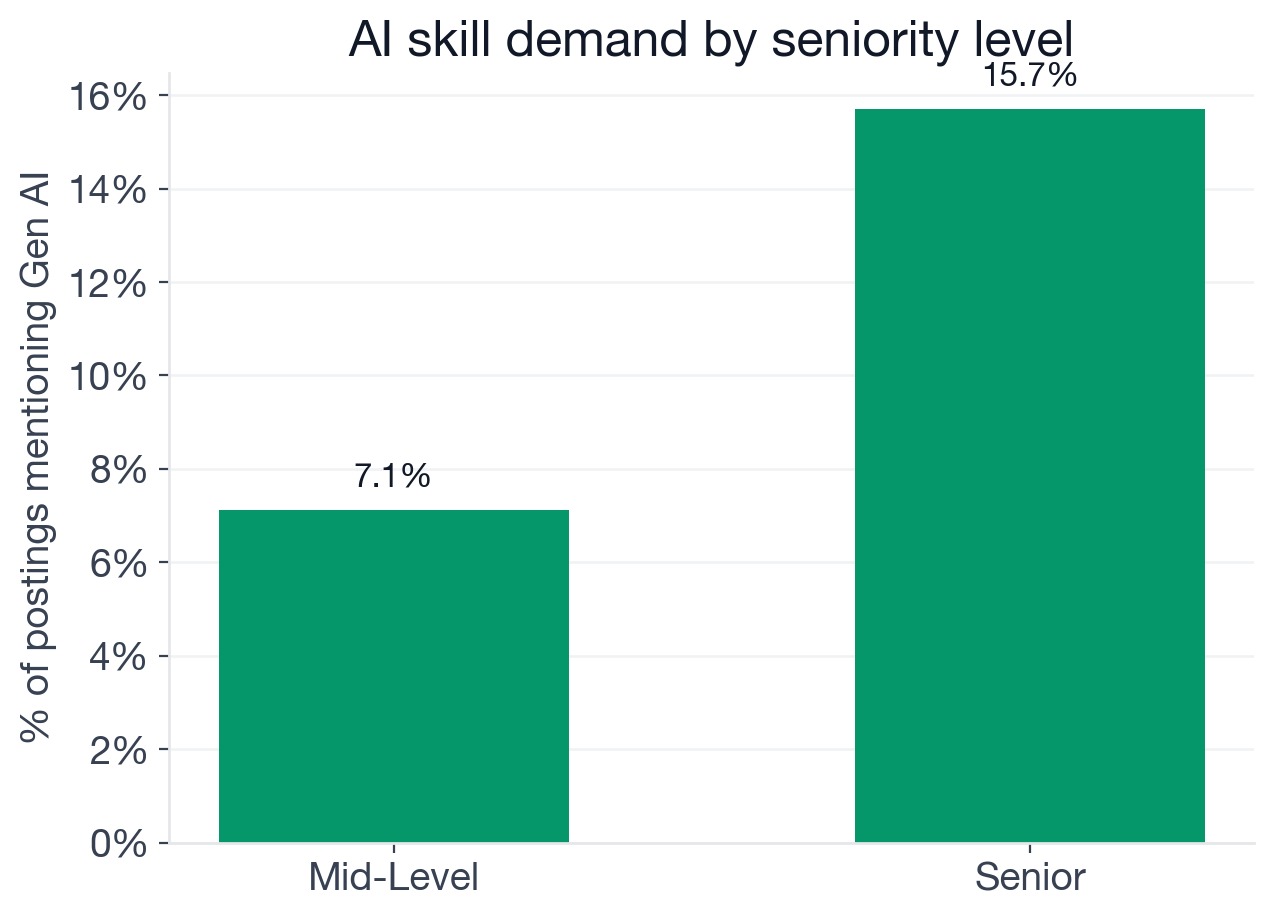
The chart shows only Mid-Level and Senior, the two tiers with enough volume (407 and 293 postings) to chart reliably. The full Entry-through-Staff gradient, including the near-zero entry and junior rates and the small-sample staff dip, is in the table above.
Senior postings, the most reliable large-sample tier in the dataset, are more than twice as likely as mid-level ones to name AI explicitly, and over seven times as likely as junior postings. That's consistent with how new capabilities usually enter a hiring pipeline: companies write AI requirements into roles they trust to lead adoption, own the AI-product surface, or set direction, and those tend to be senior roles by default. It is not evidence that AI fluency is unimportant for someone starting out; it's evidence that postings encode "own this" before they encode "know this." Senior UI Designer roles that name AI explicitly are a useful preview of where junior requirements are headed.
Geography adds one more piece of context, mostly as a caveat against over-reading small samples. The US is the largest single market at 32.2% of postings (256 of 796) but sits at a middling 9.0% explicit AI rate. A handful of smaller markets, India (18.9% of 37 postings), Poland (27.3% of 11), and Mexico (31.3% of 16), post higher AI rates, but each of those is a small enough sample that one or two AI-tagged postings swings the percentage significantly. Treat those as directional curiosities, not confirmed regional trends; the US figure, backed by 256 postings, is the number worth planning around.
We didn't publish a "who's hiring" table for this post. Only one company, VML, shows any meaningful AI-tagged volume (19 postings), and that single company accounts for roughly a quarter of all AI-tagged postings in the entire dataset (19 of 81, about 23%). A single agency driving that much of the AI-adoption signal isn't a hiring landscape, it's one employer's hiring cycle skewing a still-small sample.
How to Use This in Your Job Search
If you're already senior or aiming there, treat the 15.7% figure as a floor for what interviewers will probe, not a ceiling. Practice walking through how you'd use AI tools inside an actual design workflow, ideation, first-draft layouts, content generation, with AI mock interviews that simulate the kind of scenario-based questions these postings are starting to ask.
If you're earlier in your career, don't take a quiet job posting as permission to skip AI fluency. The habit is already close to universal among practicing designers; build it now so it's not the gap that shows up in a portfolio review or a live interview later. Our interactive courses cover the design-process fundamentals that AI tools accelerate rather than replace, and the Question Bank has focused drills on design-system and workflow questions that come up regardless of whether a posting mentions AI by name.
Either way, start with what's actually being asked for right now: browse active UI Designer openings and filter by the AI-related skills that matter to you, or compare how this role's AI story sits next to an adjacent one in our UI Designer skills breakdown and our Product Manager vs. UI Designer comparison.
FAQ
Q. Do UI Designer jobs require AI skills in 2026?
Explicitly, not many. Only 9.7% of the 796 active UI Designer postings analyzed (77 postings) name a generative AI skill like AI Agents, Generative AI, or ChatGPT. Any AI, including traditional machine learning, appears in 10.2% (81 postings). That explicit rate is a floor, not a ceiling: the 2026 State of AI in Design report puts weekly AI tool use among designers at 91%, up from 54% in 2025.
Q. Which AI skill do UI Designer postings ask for most?
AI Agents leads at 4.8% of all postings (38 of 796), double Generative AI (2.4%, 19 postings) and over three times ChatGPT (1.4%, 11 postings). That ranking suggests companies hiring explicitly for AI want designers who can shape agentic and AI-product interfaces, not just designers who personally use AI tools.
Q. Does knowing AI tools pay more as a UI Designer?
The postings data cannot answer that reliably yet. Only 11 US UI Designer postings with disclosed salary explicitly required new-wave AI skills, below the 25-posting floor needed for a defensible median. The non-AI baseline US median is $107,500 (n=109). Until more AI-tagged postings accumulate salary disclosure, no formal AI premium can be measured for this role.
Q. At what seniority level do UI Designer AI requirements start?
None of the 29 entry-level postings in the sample explicitly required AI skills (0%), and only 1 of 50 junior postings did (2.0%). The rate climbs to 7.1% at mid-level (29 of 407) and 15.7% at senior (46 of 293), the highest reliable figure in the dataset.
Q. Where are UI Designer AI job postings concentrated?
The US is the largest single market at 32.2% of postings (256 of 796) with a 9.0% explicit AI rate. Several smaller markets, including India (18.9%, n=37) and Poland (27.3%, n=11), show higher AI rates on much smaller sample sizes, directional signals rather than confirmed trends.
Q. Should an entry-level UI Designer candidate learn AI tools even if the job posting doesn't mention them?
Yes. A zero explicit requirement at entry-level does not mean AI is irrelevant there; it means job postings haven't caught up to what's already expected day to day. The 2026 State of AI in Design report shows 91% of designers use AI tools weekly and roughly three in four use them daily, a baseline that applies regardless of what the job description says.
Q. Is the "who's hiring" data reliable for UI Designer AI jobs?
Not for a company ranking. Only one company (VML, 19 postings) appears in the AI-tagged company breakdown, and those 19 postings alone account for about 23% of the 81 AI-tagged postings in the dataset (19 of 81), too concentrated in a single employer to represent a broader hiring trend, so we did not publish a company table for this post.
Build the Habit Before the Job Posting Demands It
The postings say AI is a senior problem. The survey data says AI is already everyone's problem. A UI Designer who waits for a job description to name the requirement is optimizing for the slower of the two signals. The faster one, weekly AI use among designers jumping from 54% to 91% in a single year, is the one worth building toward now.
Topics
Ready to practice?
Put what you've learned into practice with AI mock interviews and structured preparation guides.