
Figma Is Now the Baseline, Not the Bar
For most of the past decade, knowing Figma gave you a real edge in a UI Designer application. In 2026, it gets you into the room.
Of the 937 active UI Designer postings analyzed on the InterviewStack.io job board in June 2026, Figma appears in 60.5%, the only skill to clear the 50% table-stakes threshold. That majority-tier presence carries a consequence: it barely moves salary. Figma earns just $2,200 above the $105,300 US median. Adobe Creative Suite, present in 26.6% of postings, earns $15,300 below it. The distinction matters because the tool you lead with signals which segment of the UI Designer market you are targeting, and those segments pay very differently.
Key Findings
- 937 active UI Designer postings analyzed as of June 2026.
- Figma is the only table-stakes skill at 60.5%, the sole skill clearing the 50% threshold. No other individual skill comes close.
- US median base salary: $105,300 (n=124 postings with US salary disclosed). All salary figures are US base only; equity and bonuses are excluded.
- Adobe Creative Suite (26.6% of postings) pays $90,000 US median, $15,300 below the $105,300 baseline.
- Design Systems (35.1% of postings) pays $115,200 US median, the top premium at +$9,900 above baseline.
- CSS and HTML carry the highest co-occurrence lift in the dataset at 5.59: when one appears in a posting, the other nearly always follows, marking a distinct designer-who-codes segment.
- Entry-level is 7.4% (69 of 937 postings); mid-level dominates at 64%.
- 49% of postings are onsite, 28% remote, less flexible than most software engineering roles.
Dataset note: These 937 postings include roles classified as UI Designer alongside adjacent titles such as Visual Designer, Digital Designer, and Web Designer. A small proportion appear to represent retail visual merchandising positions rather than digital product UI design; this modestly affects skill frequencies for marketing-adjacent terms and salary figures for print/brand-heavy tools like Adobe Creative Suite.
Which Skills Pay Above the $105K Baseline?
Among US postings with disclosed salary (n=124), the divide between skill clusters is stark. All figures below are US base salary only, derived from posting disclosures. Total compensation at top employers is higher once equity and bonuses are counted.
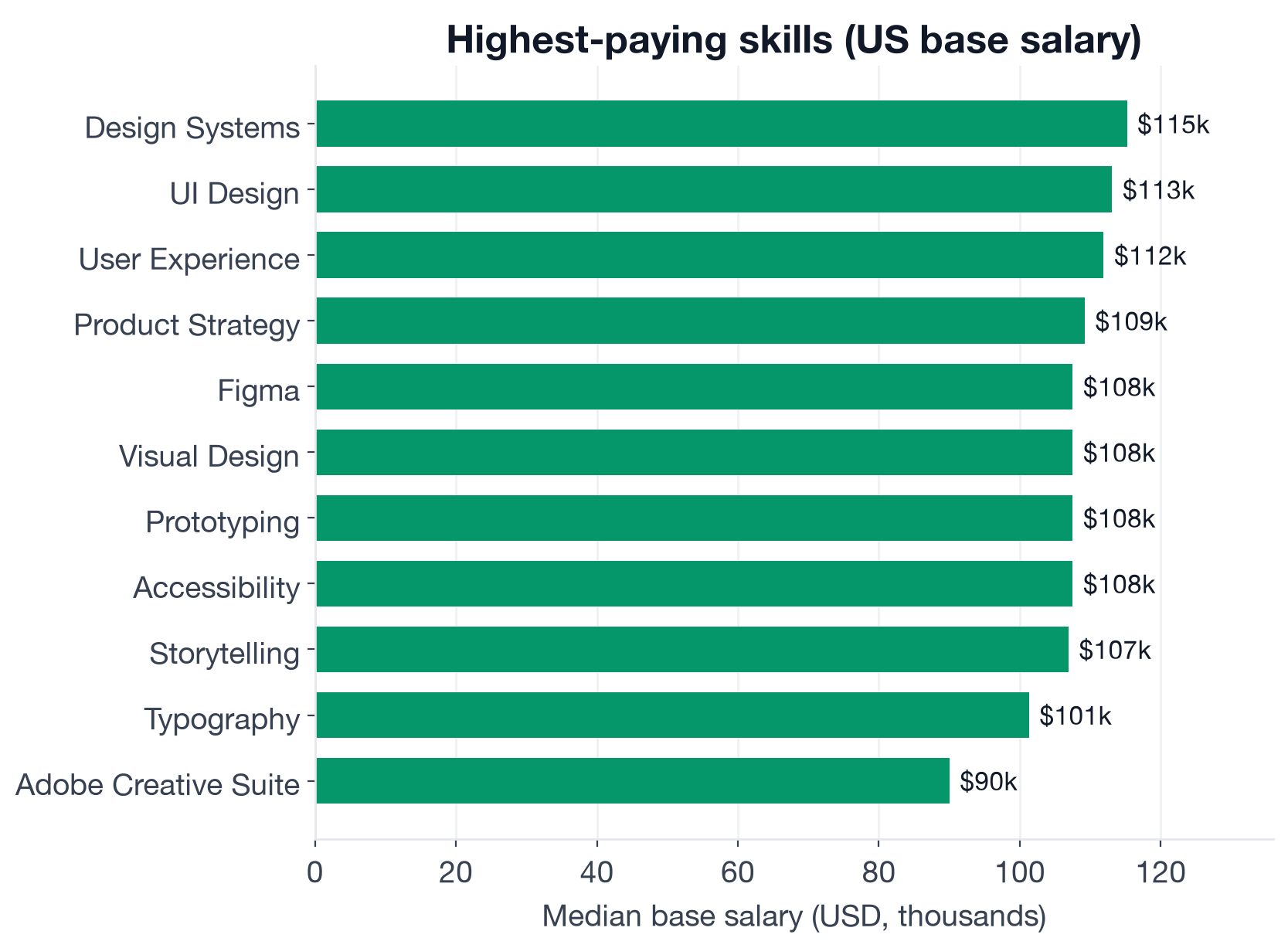
Base salary by skill for UI Designer roles (global-mixed figures shown for broader sample size; US-only medians discussed in text). Skills with fewer than 25 US salary data points are excluded.
At the top of the salary table, three related skills cluster together: Design Systems ($115,200), UI Design proficiency ($113,100), and User Experience fluency ($111,900). These are not separate tools: they signal a designer who thinks in systems and interaction patterns rather than individual visual decisions. Design Systems is $9,900 above the $105,300 baseline, and it appears in 35% of postings. Meaningful demand plus a real premium is what defines a salary lever.
Figma ($107,500), Visual Design ($107,500), Prototyping ($107,500), and Accessibility ($107,500) all cluster just above baseline, each earning roughly $2,200 in premium. These are expected competencies: enough candidates have them that they no longer move pay on their own.
The clearest negative signal: Adobe Creative Suite. At $90,000 US median, it pays $15,300 below the $105,300 baseline despite appearing in more than a quarter of postings. This is not a data anomaly. Adobe Creative Suite in a UI Designer posting typically tracks brand, print, or marketing work: roles that sit in a lower pay band than product UI design. If your portfolio centers on Adobe tools, you are most likely competing in that segment, and the $15,300 gap is structural, not incidental.
Typography ($101,300) also sits below baseline at -$4,000, reinforcing the same pattern: pure visual craft skills are expected without earning a premium in the product UI segment.
| Skill | US Median | vs. Baseline | Sample |
|---|---|---|---|
| Design Systems | $115,200 | +$9,900 | n=44 |
| UI Design | $113,100 | +$7,800 | n=28 |
| User Experience | $111,900 | +$6,600 | n=32 |
| Product Strategy | $109,200 | +$3,900 | n=33 |
| Figma | $107,500 | +$2,200 | n=71 |
| Visual Design | $107,500 | +$2,200 | n=53 |
| Prototyping | $107,500 | +$2,200 | n=30 |
| Accessibility | $107,500 | +$2,200 | n=30 |
| Storytelling | $106,900 | +$1,600 | n=40 |
| Role baseline | $105,300 | n=124 | |
| Typography | $101,300 | -$4,000 | n=46 |
| Adobe Creative Suite | $90,000 | -$15,300 | n=40 |
The practical read: listing Figma gets you interviews; demonstrating Design Systems ownership and UX rigor gets you toward the top of the pay range.
The UI Designer Skill Stack
Group individual skills by family and the role's structure comes into focus. Visual and UX design skills are the core of nearly every posting. The secondary signals reveal what kind of team you are joining.
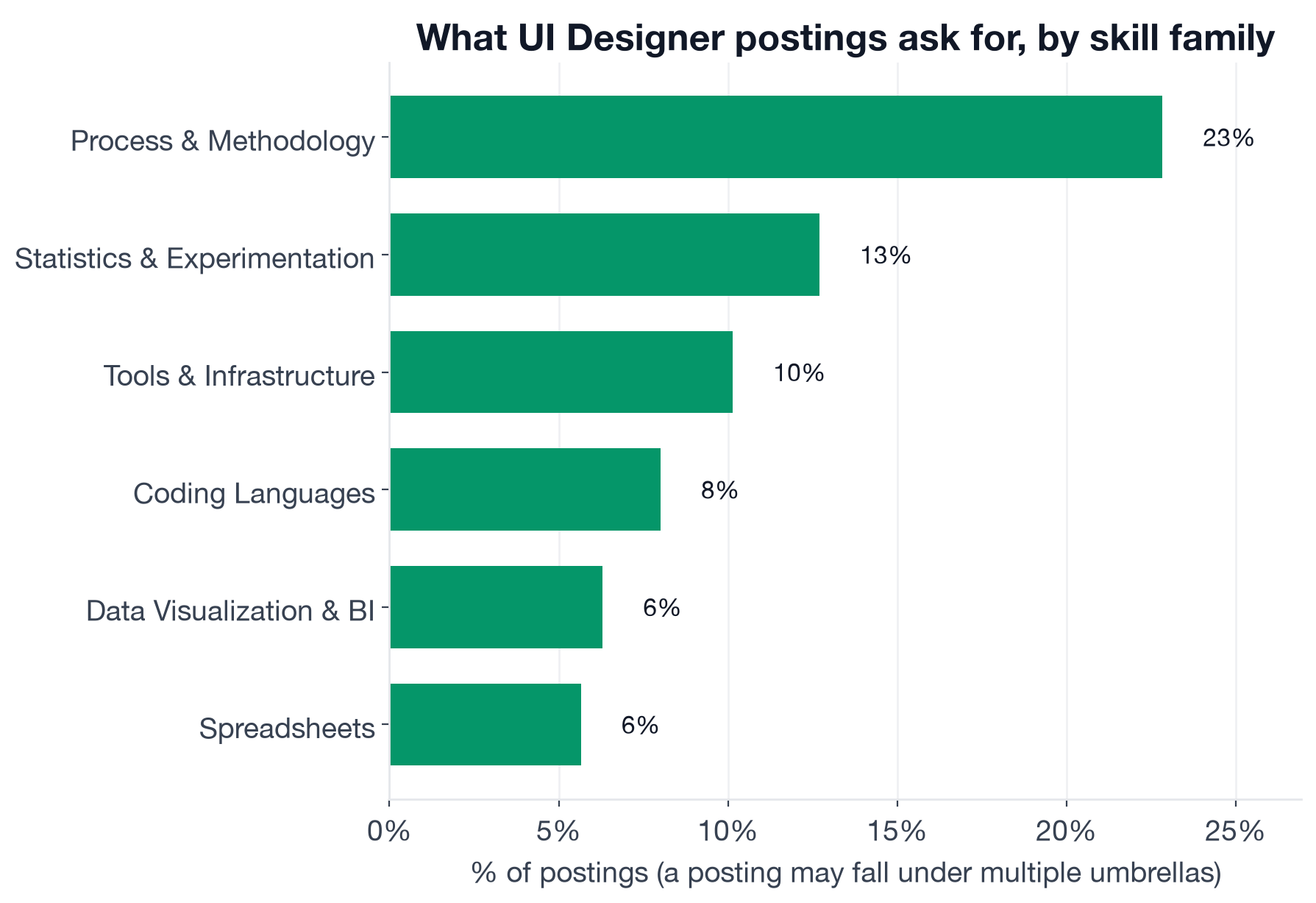
Share of UI Designer postings that ask for at least one skill in each family. A posting that mentions both Figma and Adobe Creative Suite counts once under the design-core group.
Because the analytics taxonomy groups most visual and UX skills into a single broad bucket, the chart concentrates at the top. The interesting signal is in the secondary families:
- Process & Methodology at 22.8%: Agile appears in 15% of postings, Project Management in 6%. Nearly 1 in 4 postings expects some cross-functional process fluency.
- Statistics & Experimentation at 12.7%: Almost entirely A/B Testing. About 1 in 8 UI Designer roles expects the designer to participate in experiment design or interpret test results, a signal of product-driven, data-informed teams.
- Coding Languages at 8.0%: Largely JavaScript at 6.6%. A meaningful minority of roles expect light coding, particularly at agencies and startups.
- Machine Learning & AI at 3.7%: The explicit AI requirement is low (35 of 937 postings). But that 3.7% measures only roles where building or integrating AI capabilities is the deliverable, not roles where using AI tools is simply assumed.
On that last point: the AI in Design 2026 Report (906 designers across 60+ countries, by Designer Fund and Foundation Capital) found that 91% of designers now use AI tools and 75% do so every single day, up from 54% weekly users in 2025. The 3.7% explicit mention rate does not mean 96% of UI Designer roles skip AI. It means 96% of postings treat AI tool use as a given rather than a qualification to screen for. Figma, the top required skill, ships AI features directly in the canvas. A designer working in Figma in 2026 is almost certainly using its AI capabilities too. The explicit adoption figure is a floor on who is building AI products, not a ceiling on who is using AI in their daily workflow.
Which Skills Are Expected vs. Which Stand Out?
Three tiers structure the landscape.
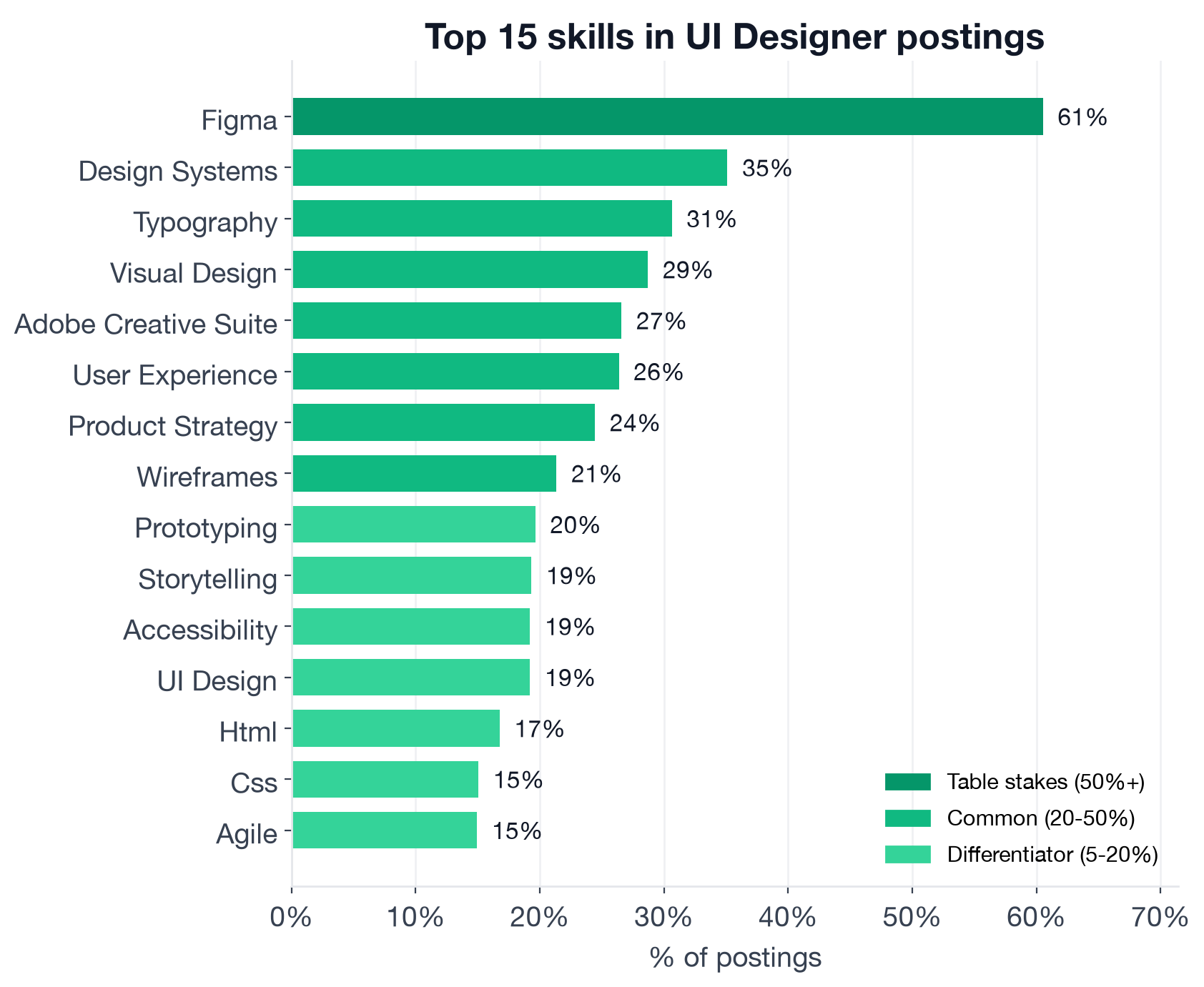
Individual UI Designer skills by share of postings. Table stakes (50%+): expected on every competitive application. Common (20-50%): expected on many roles. Differentiator (5-20%): meaningful signal, not universal.
Table Stakes (50%+ of postings)
One skill occupies this tier: Figma at 60.5%. Three of every five postings require it. If your toolkit is Adobe-only, this is the most immediate gap to address before applying to product UI roles.
Common Expectations (20-50% of postings)
Seven skills sit in the common tier. None is required on every role, but you should be able to credibly claim three to four on any given application:
- Design Systems: 35.1% (top salary earner)
- Typography: 30.6% (expected but below-baseline salary signal)
- Visual Design: 28.7%
- Adobe Creative Suite: 26.6% (penalty-zone pay)
- User Experience: 26.4%
- Product Strategy: 24.4%
- Wireframes: 21.3%
Differentiators (5-20% of postings)
A wide set of skills separates candidates: Prototyping (19.6%), Storytelling (19.3%), Accessibility (19.2%), HTML (16.8%), CSS (15.0%), Agile (14.9%), User Research (13.3%), Interaction Design (12.5%), A/B Testing (12.1%), Sketch (12.0%), Motion Design (11.2%), and Branding (11.1%).
Accessibility is worth singling out in this tier. At 19.2% of postings, it earns $107,500 US median, matching the salary of Figma (60.5%) despite appearing in less than a third as many postings. The companies requiring Accessibility as an explicit skill are paying the same rate as those requiring the industry's most universal tool. They are different markets with aligned compensation. For a candidate who genuinely specializes in accessible design, that convergence is a real opportunity.
The Coding Niche Inside UI Design
The most striking statistical fact in this dataset is not a salary number. It is a co-occurrence lift.
CSS and HTML together carry a lift of 5.59, the highest pair in the entire analysis. Lift measures how much more often two skills appear together than chance would predict. A lift of 5.59 means the pair co-occurs 5.59 times more often than their individual frequencies alone would suggest. In practice: when a UI Designer posting mentions CSS, HTML almost always appears alongside it. The two are treated as a single package, not independent skills.
| Skill Pair | Co-occurrence | Lift | Signal |
|---|---|---|---|
| CSS + HTML | 14.1% of postings | 5.59 | Designer-who-codes package |
| UI Design + Wireframes | 10.1% | 2.47 | Structured, process-driven design |
| User Experience + Wireframes | 11.2% | 1.99 | UX-to-delivery workflow |
| Accessibility + Design Systems | 12.3% | 1.82 | Systems + inclusive design |
| Design Systems + Figma | 30.2% | 1.42 | Core product UI stack |
The CSS + HTML block defines a discrete segment: UI Designers who bridge design and frontend implementation. These roles appear most often at agencies, startups, and companies without dedicated frontend engineers where the designer is also expected to prototype or deliver production-ready markup. JavaScript at 6.6% extends the coding expectation further on some postings.
The next-highest pair, UI Design + Wireframes at lift 2.47, captures a different signal: structured, process-visible design work where wireframing is a delivered artifact rather than a mental step. Companies requiring both tend to want to see the thinking, not just the final visual.
Design Systems + Figma at 30.2% co-occurrence and lift 1.42 forms the dominant product UI stack, present in nearly 3 in 10 postings. This is the core credential for product-tier UI work.
How Hard Is It to Break Into UI Design?
The entry gate is narrower than most candidates assume, but wider than in pure engineering roles.
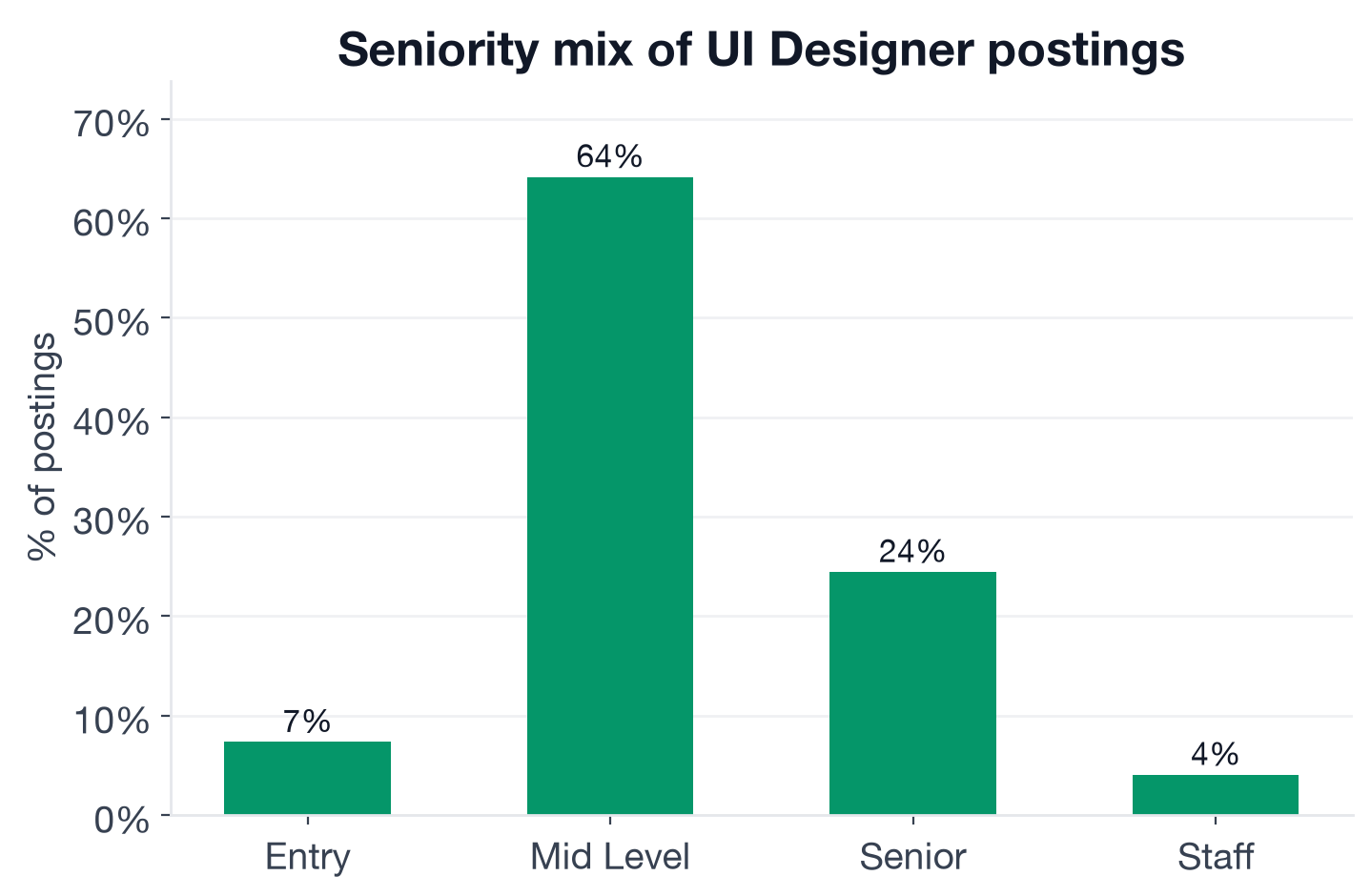
Seniority distribution across 937 UI Designer postings. Mid-level is the dominant tier; entry-level is 7.4%.
Entry-level is 7.4% of the market (69 of 937 postings). That is meaningfully more accessible than Cloud Architect (under 1%), Security Architect (under 2%), or Test Automation Engineer (2%), but well below what candidates tend to assume. Mid-level dominates at 64%, senior at 24%.
The portfolio matters more in this role than in most. Hiring managers can evaluate the work directly before reading the resume. A candidate with four or five thoughtful case studies showing process, iteration, and shipped Figma deliverables will outcompete a mid-level candidate with a stale or thin portfolio. Entry-level UI Designer postings routinely expect portfolio links alongside the application.
Staff-level is just 4.1%, a thin ceiling compared with software engineering, where the staff and principal IC track extends meaningfully. UI design tends to top out at senior or design lead rather than building a deep individual contributor ladder.
Where UI Designers Work
The US accounts for 28.6% of postings (268 of 937), making this one of the more globally distributed design roles on the board. Canada (6.4%), India (5.7%), Germany (4.9%), and the UK (4.6%) each have a real presence. For a design discipline that can often be executed anywhere with a screen and internet access, the geographic spread is notable.

Geographic distribution of 937 active UI Designer postings. Postings with unknown location (12%) are excluded from the chart.
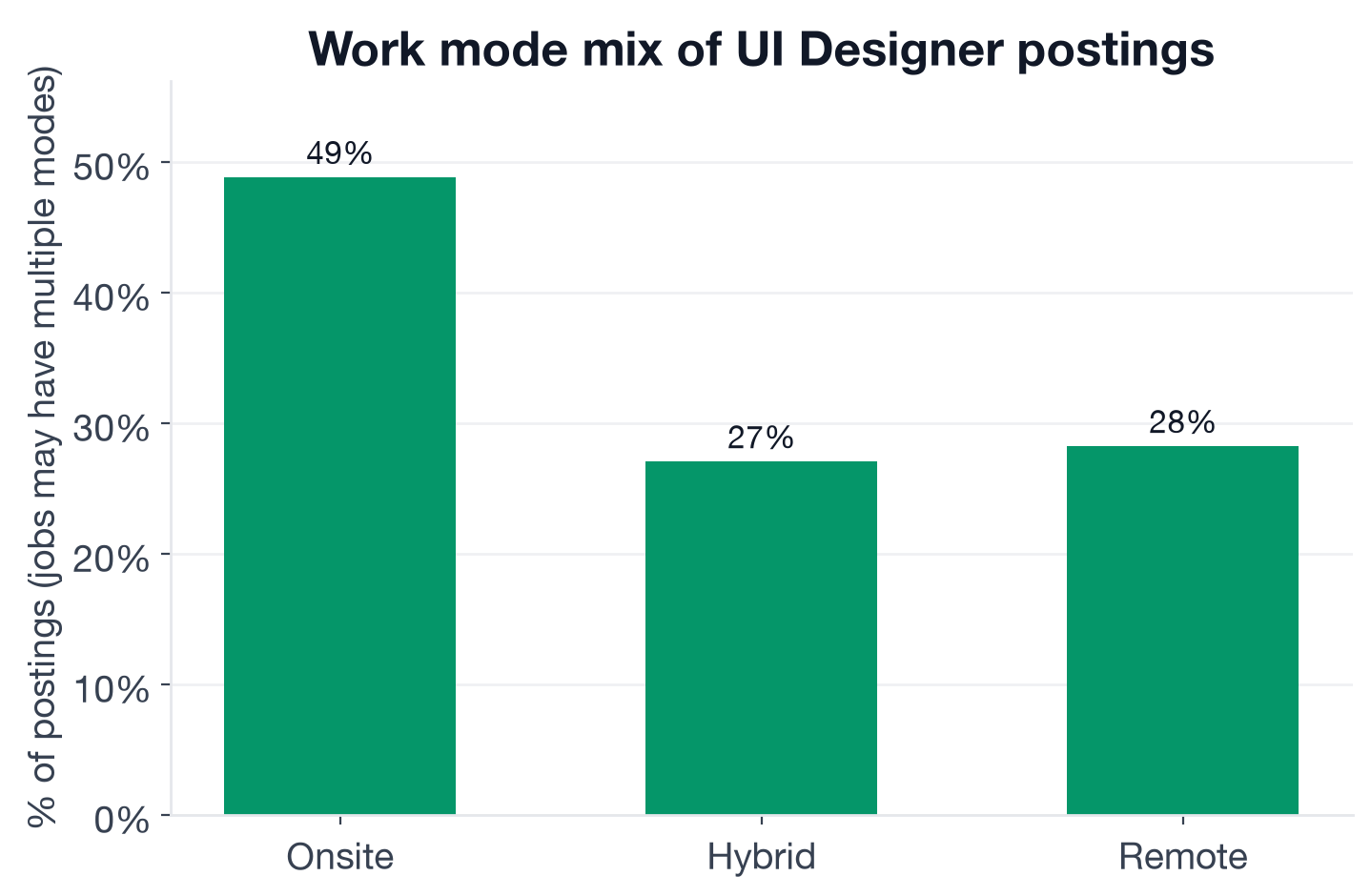
Work mode split across all 937 postings. Onsite is the plurality despite the role's remote-compatible nature.
On work mode: 49% onsite, 28% remote, 27% hybrid. (Note: some postings are tagged with more than one work mode, so percentages sum above 100%.) The onsite share is higher than the role's remote compatibility might suggest. Design reviews, cross-functional whiteboarding, and feedback loops with PMs and engineers appear to drive a preference for proximity even at companies that could support remote design work. If remote-first matters to you, filtering to remote UI Designer postings surfaces 265 active openings.
Who's Hiring
Agencies, technology services, and enterprise employers lead the roster: a cross-industry mix that reflects how broadly digital UI design has diffused.
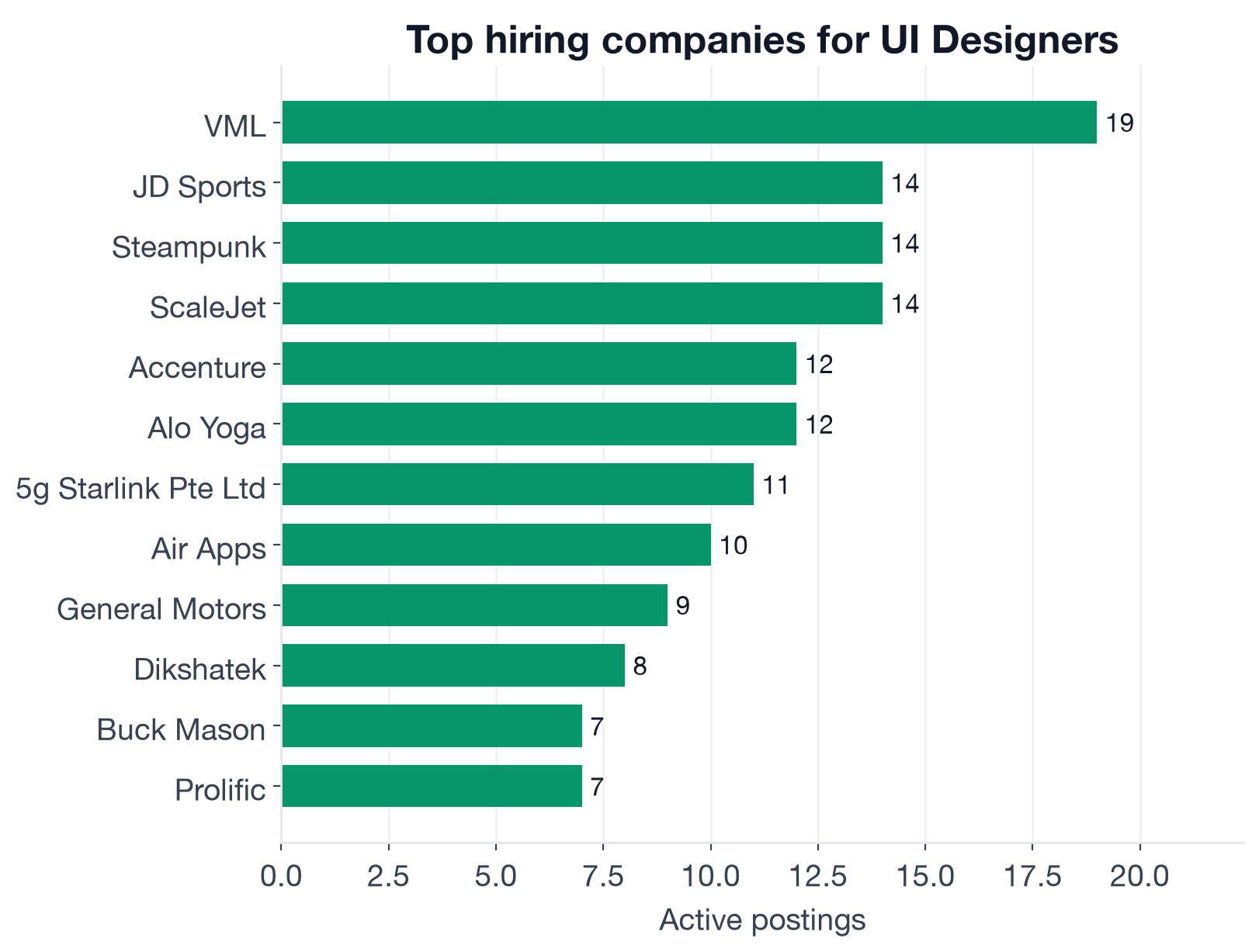
Top UI Designer employers by distinct openings. Staffing firms, design marketplaces, and retail-sector employers whose postings appear to be in-store visual merchandising roles rather than digital UI design are excluded.
| Company | Postings | Sector |
|---|---|---|
| VML | 19 | Creative and marketing agency |
| Steampunk | 14 | Technology services |
| Accenture | 12 | Consulting |
| Air Apps | 10 | Software |
| General Motors | 9 | Automotive |
| Buck Mason | 7 | Apparel (ecommerce) |
| Prolific | 7 | Research platform |
| Bamboo Works | 7 | Financial media |
| LBG | 6 | Financial services |
| Konrad Group | 6 | Digital agency |
| DEPT | 5 | Digital agency |
| FYST | 5 | Fintech |
Creative agencies (VML, Konrad Group, DEPT) dominate the top, alongside enterprise and technology employers (Accenture, Steampunk, General Motors, LBG) and digital product companies (Air Apps, Prolific). The sector spread aligns with what the skill data shows: UI design is a discipline that every industry building a digital product or interface now hires for.
How to Use This in Your Job Search
Mock Interviews. The portfolio walkthrough opens most UI Designer interviews, but process and judgment questions follow: how you handled a conflicting stakeholder review, how you approached an accessibility problem, how you built or contributed to a design system. Practice these scenarios in context with AI mock interviews before the real conversation.
Question Bank. Design Systems, Interaction Design, Accessibility, and A/B Testing surface repeatedly across UI Designer interviews. The question bank covers these topics for design roles and helps you prepare concrete, specific answers rather than generic process descriptions.
Courses. If your Figma skills are solid but your Design Systems fluency is thin, that is the highest-leverage gap to close: it commands the top salary premium in the dataset. Our interactive courses cover design systems, accessibility, and product thinking fundamentals.
Job Board. Browse all active UI Designer postings, or narrow to the segment you are targeting: Design Systems roles, remote openings, or entry-level positions.
FAQ
Q. What is the median salary for a UI Designer in 2026?
The median US base salary across 124 UI Designer postings with disclosed salary data is $105,300. All figures are base only; equity and bonuses are not captured in posting data. Globally-mixed figures (n=172) produce a lower median of $94,400 due to international market mixing.
Q. What skills do companies require for UI Designer roles in 2026?
Figma is the only table-stakes skill, appearing in 60.5% of postings. The common tier (20-50%) includes Design Systems (35%), Typography (31%), Visual Design (29%), Adobe Creative Suite (27%), User Experience (26%), Product Strategy (24%), and Wireframes (21%). Differentiators below 20% include HTML, CSS, Agile, Prototyping, A/B Testing, Storytelling, and Interaction Design.
Q. Which UI Designer skills pay the most in 2026?
Design Systems leads at $115,200 US median, $9,900 above the $105,300 baseline. UI Design proficiency earns $113,100 (+$7,800) and User Experience $111,900 (+$6,600). At the other end, Adobe Creative Suite pays $90,000, which is $15,300 below baseline, signaling a different, lower-compensated market segment.
Q. How much does Figma knowledge affect UI Designer salary?
Figma is required in 60.5% of postings but earns a US median of $107,500, just $2,200 above the $105,300 baseline. Because Figma is now table stakes, listing it does not meaningfully differentiate a candidate. The salary signal comes from what sits above Figma: Design Systems, UX fluency, and accessibility.
Q. How hard is it to get an entry-level UI Designer job?
7.4% of UI Designer postings (69 of 937) are explicitly entry-level. Mid-level roles dominate at 64%. The role is more accessible than Security Architect or Cloud Architect (both under 2% entry-level), but a strong portfolio of shipped digital work is expected even for junior positions.
Q. Is UI Designer a remote-friendly role in 2026?
Modestly. 28% of postings (265 of 937) are tagged remote, with 27% hybrid and 49% onsite. UI design is more remote-accessible than embedded engineering or test automation, but onsite and hybrid together account for three-quarters of openings.
Q. Which companies hire the most UI Designers in 2026?
Top digital UI design employers include VML (19 postings), Steampunk (14), Accenture (12), Air Apps (10), General Motors (9), and Buck Mason (7). The mix spans creative agencies, technology services, and enterprise employers. Note: some postings in this dataset come from retail apparel brands whose listings appear to be in-store visual merchandising roles rather than digital UI design positions and are excluded from this table.
What the Tool Stack Is Actually Telling You
The UI Designer market in 2026 is shaped by one central fact: Figma has become infrastructure. It appears in 3 of 5 postings and earns a $2,200 premium, nearly invisible in salary terms. The differentiation has shifted entirely to what you build with Figma. Design Systems ownership (+$9,900) and UI Design fluency (+$7,800) sit $7,000 or more above baseline. UX rigor adds $6,600 and accessible component thinking adds $2,200: meaningful gains, but in a different tier from the top earners. Adobe Creative Suite sits $15,300 below it.
That gap is a market map. Product UI design and brand or print design are paying differently, and the skills you emphasize in your portfolio and resume will route you into one or the other. For candidates positioned toward product UI work, the signal in the pairs data is also worth noting: CSS and HTML co-occur at a lift of 5.59, the highest in the dataset. The designer-who-codes subset is a real and distinct niche, not a resume novelty. The combination of systems thinking, interaction fluency, and even light markup capability is where the role appears to be growing most distinctly in 2026.
Topics
Ready to practice?
Put what you've learned into practice with AI mock interviews and structured preparation guides.