
JavaScript Is Common in Frontend Ads and Named in a Minority Almost Everywhere Else
JavaScript is tagged or named in 12,872 of 152,278 active postings (8.5%) on the InterviewStack.io job board (all countries; only the pay comparison is limited to the US), counted over the 90 days to 23 November 2026, and that share was flat across the three 30-day windows (8.4%, 8.6%, 8.6%). Older windows only contain postings that are still active, so they undercount postings that have since closed; treat this as a rough check, not a trend. Among US postings that disclose base pay and sit in the same role and title level, the ones naming JavaScript list about 7.6% less on average, and the gap is negative in 23 of 37 role-and-level cells.
Those two facts split readers. If you are aiming at frontend work, JavaScript appears in about 4 in 10 of the ads for the role. If you are aiming at general Software Engineer work, it is named in about 1 in 6 ads, and the ads that name it list less base pay at every level we can compare. A posting is an advertisement, so every share below is how often ads use a word, not what a job requires or what anyone earns.
Key Findings
- 12,872 postings (8.5% of 152,278) name JavaScript, and all 39 roles on the board name it at least once.
- The share was 8.4%, 8.6% and 8.6% in the three 30-day windows of the last 90 days: flat within this period.
- 44.0% of Frontend Developer postings (898) and 37.3% of Full-Stack Developer postings (1,918) name it, against 15.4% of Software Engineer postings (5,789).
- Software Engineer is 45.0% of all JavaScript postings, because that role is so large.
- Within the same role and title level, the weighted gap in US posted base pay is about -7.6% across 37 cells: 9 up, 23 down.
- All four Software Engineer cells go down: -17.5% for titles with no level word, -10.3% senior, -7.6% entry, -2.1% staff.
- Where required or preferred wording can be read (3,758 mentions), 20.4% say required and 79.6% say preferred.
- Among the 15 tools named most often alongside JavaScript, Angular (5.8x), TypeScript (5.3x), React (4.9x) and Node.js (4.9x) have the highest lift; 40.6% of JavaScript postings also name TypeScript.
Which Roles Name JavaScript Most?
Software Engineer ads supply the most JavaScript postings, but Frontend and Full-Stack Developer ads are where it comes closest to a default.
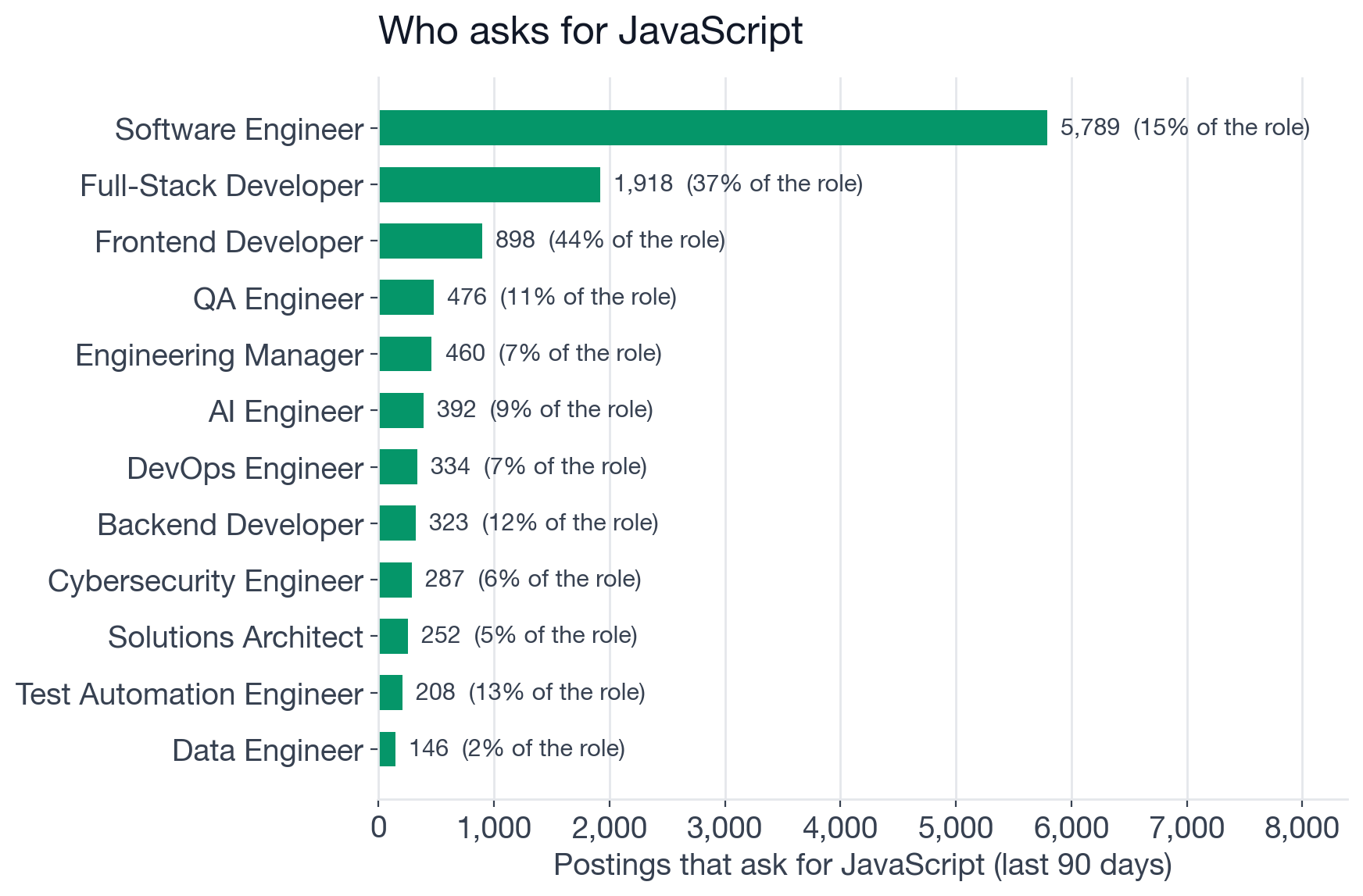
Postings naming JavaScript by role on the InterviewStack.io job board, last 90 days; the percentage is the share of that role's own postings.
| Role | Postings naming JavaScript | Share of the role's postings | Share of all JavaScript postings |
|---|---|---|---|
| Software Engineer | 5,789 | 15.4% | 45.0% |
| Full-Stack Developer | 1,918 | 37.3% | 14.9% |
| Frontend Developer | 898 | 44.0% | 7.0% |
| QA Engineer | 476 | 10.8% | 3.7% |
| Engineering Manager | 460 | 6.6% | 3.6% |
| AI Engineer | 392 | 8.9% | 3.0% |
| DevOps Engineer | 334 | 6.6% | 2.6% |
| Backend Developer | 323 | 11.6% | 2.5% |
Read the last two columns together. Software Engineer is the largest source of JavaScript postings by count, yet about 85% of its ads do not name it. Unnamed is not unused, since a skill can be assumed without being written, so these shares count ads that write it, not how much it is used. Frontend and full-stack are the reverse: smaller roles where it is named in close to half or more than a third of ads. Test-focused roles sit in between (17.3% of SDET and 13.0% of Test Automation Engineer postings), and in data roles it barely registers: 2.0% of Data Engineer, 1.8% of Data Scientist and 1.6% of Data Analyst postings.
For the wider skill picture in each of the top three roles, see our posts on Software Engineer skills, Full-Stack Developer skills and Frontend Developer skills.
Does JavaScript Come With Higher Pay? In Most Same-Role Checks, No
Pay is where a "learn JavaScript for a raise" story finds no support: the ads that name it list less base pay than comparable ads in most role-and-level cells.
A scope note first. Pay here is US posted base salary on postings that disclose it, so equity, bonus and undisclosed pay are not in it, and it says nothing about what anyone is paid. The comparison is between postings that name JavaScript and postings that do not, inside the same role and the same title level (level is read from title words, and titles with no level word are pooled into one group that can mix plain, manager and director jobs), using cells with at least 15 salaries on each side. Those 37 cells cover 88.4% of the JavaScript postings.
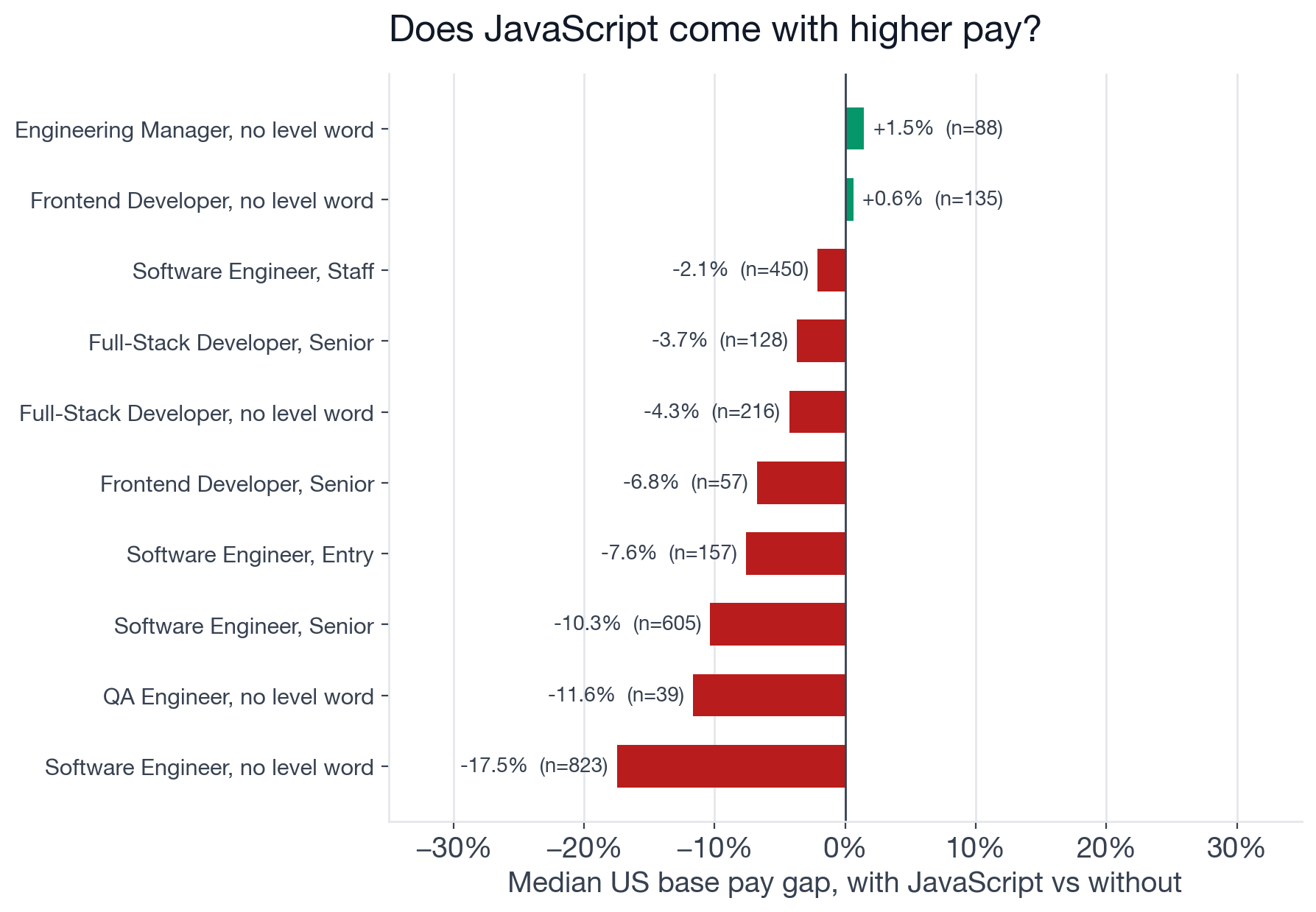
Difference in median US base pay between postings naming JavaScript and postings that do not, within the same role and title level, for the largest cells; n is the number of JavaScript postings with pay in that cell.
| Role and title level | Median with JavaScript | Median without | Gap | Postings with / without |
|---|---|---|---|---|
| Software Engineer, entry | $86,500 | $93,600 | -7.6% | 157 / 423 |
| Software Engineer, no level word | $139,500 | $169,050 | -17.5% | 823 / 4,466 |
| Software Engineer, senior | $165,000 | $184,000 | -10.3% | 605 / 3,043 |
| Software Engineer, staff | $210,000 | $214,500 | -2.1% | 450 / 2,175 |
| Full-Stack Developer, no level word | $142,400 | $148,750 | -4.3% | 216 / 214 |
| Full-Stack Developer, senior | $163,750 | $170,000 | -3.7% | 128 / 180 |
| Frontend Developer, no level word | $135,875 | $135,000 | +0.6% | 135 / 118 |
| Frontend Developer, senior | $155,000 | $166,250 | -6.8% | 57 / 64 |
| Engineering Manager, no level word | $209,000 | $206,000 | +1.5% | 88 / 1,436 |
| QA Engineer, no level word | $103,113 | $116,700 | -11.6% | 39 / 503 |
Across all 37 cells, weighted by how many JavaScript postings sit in each, the gap averages about -7.6%, with 9 cells up and 23 down. The largest cells are Software Engineer cells, and every one of them goes down. Full-stack cells go down too, and so does senior frontend; the one frontend cell that is up, titles with no level word, is a rounding error at +0.6%. For a reader aiming at Software Engineer, full-stack or QA work, "JavaScript comes with higher pay" is not what these ads show.
Among the cells with a positive gap that we list here, the biggest gaps are in small groups: Cybersecurity Engineer titles with no level word (+19.4%, 48 postings with JavaScript), staff Engineering Manager (+7.7%), Test Automation Engineer titles with no level word (+6.8%, 26 postings) and AI Engineer titles with no level word (+3.3%). Treat those as prompts to look at the postings, not as rates. We did not measure why any cell goes the way it does. These are medians of two groups of advertisements that can differ in employer, city, company type and what the job really is, so a gap says nothing about what JavaScript is worth to you.
Is JavaScript Required or Preferred When the Wording Can Be Read?
In the minority of postings (3,758 of 12,872) where the wording can be read, about 4 in 5 JavaScript mentions are framed as preferred.
Of the 12,872 postings, 3,758 have required or preferred wording close enough to the mention to classify. In that subset, 20.4% say required (768 postings) and 79.6% say preferred (2,990). The rest, including 8,663 with no such wording nearby, are outside the split, and "preferred" wins when both appear, so read the 80% as a ceiling on how often the ask is soft. A skill can be assumed and left unwritten, and a posting that lists JavaScript among many tools is not saying it is optional. The practical reading: most ads that frame it at all frame it as a plus, and about 1 in 5 say it is needed.
On titles, the level mix of postings naming JavaScript is close to the rest of the board: 28.6% carry a senior word against 24.8% for postings that do not, and 6.0% are entry-level titles against 4.7%, with fewer in the group of titles that carry no level word. Titles with no level word are counted in the middle group, so the junior and senior shares count only titles that say so.
What Should You Learn Alongside JavaScript?
Of the 15 tools named most often alongside JavaScript, Angular, TypeScript, React and Node.js appear far more often next to it than anywhere else on the board.
Raw share misleads here. Python is named in 49.7% of JavaScript postings and Java in 42.9%, but Python is named in so many postings across the board that its lift is only 1.4x. Lift divides a tool's share among JavaScript postings by its share across all postings, so a 5x tool is named far more often with JavaScript than elsewhere.
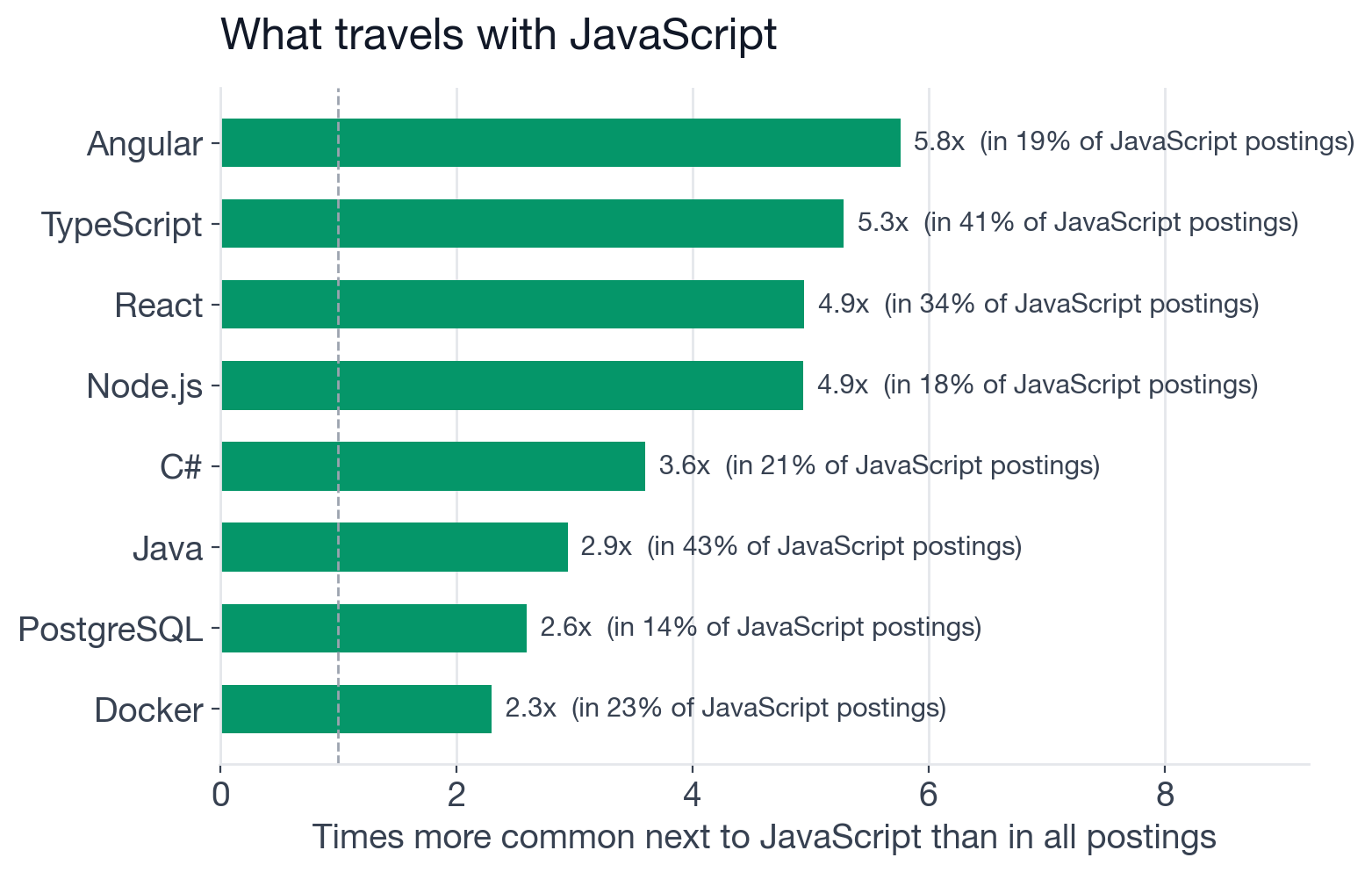
The 15 tools named most often in JavaScript postings, ranked by lift against the whole board.
| Tool | Share of JavaScript postings | Lift |
|---|---|---|
| Angular | 18.6% | 5.8x |
| TypeScript | 40.6% | 5.3x |
| React | 34.3% | 4.9x |
| Node.js | 18.2% | 4.9x |
| C# | 20.7% | 3.6x |
| Java | 42.9% | 2.9x |
| PostgreSQL | 13.6% | 2.6x |
| Docker | 22.5% | 2.3x |
The top of the list is the web stack: a UI framework (Angular or React), TypeScript and a server runtime (Node.js). Angular and React are separate framework families, so check which one the roles you want name. C# and Java show up with lifts of 3.6x and 2.9x, which points to ads that pair JavaScript with a back-end language (we did not check what kind of employer posts them); if you are heading that way, the Java skills post covers that side. Our TypeScript skills post covers one of the highest-lift web-stack partners. TypeScript is named in 40.6% of JavaScript postings, third by share after Python (49.7%) and Java (42.9%). Beyond tools, the concepts named most often with JavaScript are CI/CD (41.9%), Agile (37.3%) and APIs (36.2%), with HTML at 23.5% and CSS at 22.8%. Lift is only computed against other tools in our catalog, so the concept shares are context, not pairings.
Which Employers Name JavaScript Most?
No single industry owns JavaScript demand on this board, but technology majors, banks, IT services firms and federal contractors all sit near the top.
Ranked by distinct openings (a repeated title at one employer counts once), the leaders are Microsoft (222), Google (142), Citi (101), Booz Allen Hamilton (101), Accenture (98), Amazon (94), Leidos (76), Cognizant (76), PricewaterhouseCoopers (70) and CACI International (62). Four of the top 15 are federal contractors (Booz Allen Hamilton, Leidos, CACI and General Dynamics Information Technology, 47), and three more are consulting or IT-services firms (Accenture, Cognizant, PwC). These are the employers with the most openings on our board, not a ranking of who hires most, and the counts are approximate. The list is a long tail: the top employer is about 1.7% of the 12,872 postings.
How we counted. JavaScript is detected from the skills extracted from each posting, so a posting that mentions it only in passing may be missed, and about 3.5% of tagged postings do not name it in the text we searched. Pay uses US posted base salary only, and the 37-cell comparison is between two groups of advertisements, not a measure of what any person earns.
Picking Your Stack From These Numbers
Decide by the role you want, then use the ads to check the stack.
- Aiming at frontend or full-stack work: expect to see JavaScript often, since 44.0% of Frontend and 37.3% of Full-Stack postings name it (a minority of ads, not most). Pair it with TypeScript, React or Angular, and Node.js.
- Aiming at general Software Engineer roles: learn it for access to the roughly 15% of ads that name it. This data gives no sign that naming it goes with higher posted pay: matched Software Engineer ads that name it list less at entry, senior and staff levels and among titles with no level word, for reasons we did not measure.
- Aiming at data, product or analyst roles: it is rare there (under 2.1% of Data Engineer, Data Scientist and Data Analyst postings), so other skills come first (a low share counts ads that write it, not roles that never use it).
- Reading a posting: about 4 in 5 readable mentions are framed as preferred, but that covers only about 3 in 10 postings, and about 1 in 5 of the readable mentions say required.
- Checking other roles: the roles index shows what else each role asks for.
FAQ
Q. How many job postings ask for JavaScript in 2026?
JavaScript is named in 12,872 of 152,278 active postings (8.5%) on the InterviewStack.io job board, counted over the 90 days to 23 November 2026. The share was 8.4%, 8.6% and 8.6% in the three 30-day windows, so it was flat within this period. All 39 roles on the board name it at least once.
Q. Which roles ask for JavaScript most?
By volume, Software Engineer leads with 5,789 postings, 45.0% of all JavaScript postings. By how standard it is inside a role, Frontend Developer is highest at 44.0% of its postings (898), then Full-Stack Developer at 37.3% (1,918). Only 15.4% of Software Engineer postings name it, and under 2.1% of Data Engineer, Data Scientist and Data Analyst postings do.
Q. Does JavaScript come with higher pay?
Mostly not in this data. Comparing US posted base pay for postings with and without JavaScript inside the same role and title level, the weighted gap is about -7.6% across 37 cells, with 9 cells up and 23 down. All four Software Engineer cells go down, from -2.1% at staff to -17.5% for titles with no level word. This is a correlation between ads, not what JavaScript pays.
Q. Is JavaScript required or just preferred in job postings?
Where the wording near the mention could be read (3,758 of 12,872 postings), 20.4% say required and 79.6% say preferred. The other mentions carry no nearby required or preferred wording, so this is a split of a subset, not of all postings.
Q. What should you learn alongside JavaScript?
Among the 15 tools named most often alongside JavaScript, ranked by how much more often a tool appears in JavaScript postings than in the whole board (lift), Angular (5.8x), TypeScript (5.3x), React (4.9x) and Node.js (4.9x) are highest; Angular and TypeScript are close to a tie. Python appears in 49.7% of JavaScript postings but with a lift of only 1.4x, because it is named in many postings everywhere.
The Bottom Line for a JavaScript Learner
JavaScript is named in about 44% of frontend ads and about 1 in 6 Software Engineer ads. Learn it for the postings that name it. This data gives no reason to expect a pay bump from it: in same-role, same-level comparisons the ads that name it list less base pay in 23 of 37 cells, including every Software Engineer cell.
Topics
Ready to practice?
Put what you've learned into practice with AI mock interviews and structured preparation guides.