
JNCIA Rarely Appears Without CCNA Beside It
Juniper's JNCIA (Juniper Networks Certified Associate) is mentioned in 98 of 6,667 active Network Engineer and Systems Engineer postings, or 1.5%: about 1 in 68. The more telling number is next to it: 89 of those 98 postings (90.8%) also name Cisco's CCNA. We scanned every active Network Engineer and Systems Engineer posting on the InterviewStack.io job board from the last 90 days, and every comparison below is against other postings in those same two roles, not against the whole market.
That pairing is the finding. JNCIA is a small signal, and it almost never stands alone as the networking certification an employer names. Our data cannot tell us whether employers treat Juniper and Cisco as interchangeable or as a stack; what it does show is that a posting naming Juniper's associate cert has nearly always named Cisco's too.
Key Findings
- 98 of 6,667 Network Engineer and Systems Engineer postings mention JNCIA: 1.5%, about 1 in 68.
- 89 of 98 JNCIA-mentioning postings (90.8%) also mention CCNA; 59 (60.2%) also mention CCNP.
- Network Engineer postings mention JNCIA 3.2% of the time (88 of 2,787), about 12 times the 0.3% rate for Systems Engineer (10 of 3,880).
- Of the 64 mentions where the wording is clear, 58 (90.6%) are preferred and 6 (9.4%) are required; 34 more do not say either way.
- At mid-level, the only seniority band with enough US salary data, JNCIA postings advertise a median base of $134,200 (n=37) versus $130,000 (n=1,521).
- Across all levels the gap reverses: $123,113 (n=54) versus $139,150 (n=2,711), because only 19.4% of JNCIA postings are senior or staff versus 36.7% of the rest.
- Four federal IT contractors account for 40 of the 98 mentions (40.8%).
Network Engineer Postings Supply 9 in 10 JNCIA Mentions
Network Engineer postings are 41.8% of the postings we scanned but 89.8% of the JNCIA mentions. Systems Engineer is the larger role by posting count (3,880 versus 2,787) and contributes only 10 mentions.
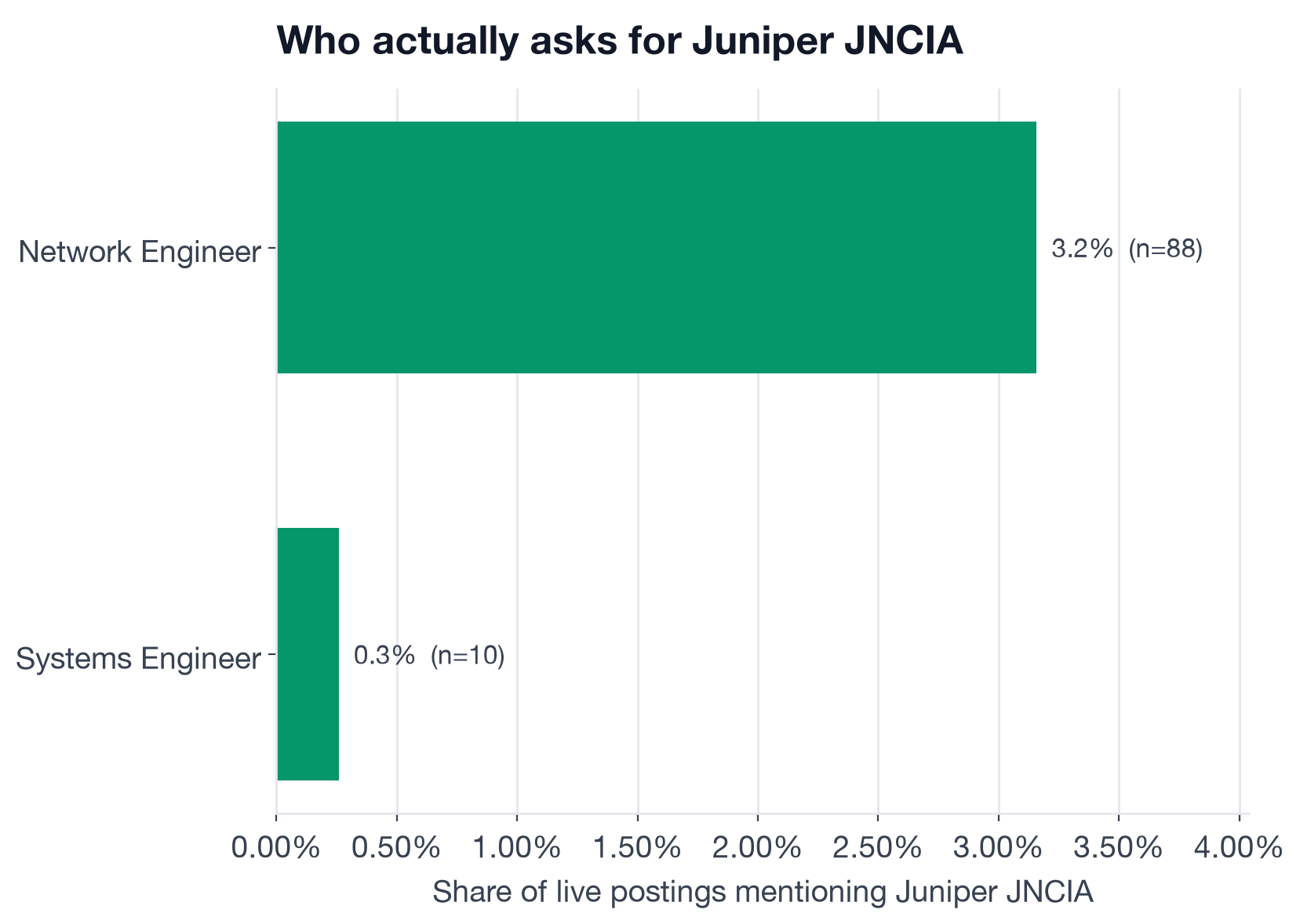
The chart makes the ordering unmistakable: JNCIA demand lives in the network-engineering role, and in Systems Engineer postings it is close to absent. We do not have a dataset-backed reason beyond the obvious one that routing and switching are the Network Engineer's daily work. If your target is Network Engineer openings, JNCIA is at least a name you will see; if it is Systems Engineer, you will rarely meet it.
Only 6 of 64 Classified Mentions Say Required
For JNCIA the answer to "do I need it?" is mostly no. We read the wording within a short window of each mention. For 64 of the 98 mentions the intent is clear: 58 say preferred or a plus (90.6%) and 6 say required (9.4%). The other 34 mentions appear without either signal, for example in a plain list of certifications, so we leave them out of that ratio.
About 1 in 11 of the classified mentions is a hard requirement. A missing JNCIA will rarely end an application; the posting is usually describing a tiebreaker.
Only Mid-Level Pay Is Measurable, and There the Gap Is Small and Positive
Salary figures here are US-only and cover advertised base pay on postings that disclose it. Equity, bonuses and other compensation are not in postings, so total pay at many employers is higher. Medians are suppressed when a group has fewer than 25 postings, which is why most rows below carry no JNCIA figure.
Seniority has to come first, because JNCIA postings skew less senior than the rest of the two roles: 19.4% are senior or staff versus 36.7% of postings without a JNCIA mention, and 74.5% are mid-level versus 60.3%. Seniority here is inferred from title keywords, and postings with no explicit level word (a bare "Network Engineer", for instance, which is common in this dataset) default to mid-level, so the true senior share on both sides is probably higher than measured and the exact gap between them should be read loosely.
| Level | JNCIA postings, US base median | Other postings, US base median | Gap | Salary-disclosed postings (JNCIA / other) |
|---|---|---|---|---|
| Entry | Not reportable (n=5) | $77,843 | N/A | 5 / 69 |
| Mid-level | $134,200 | $130,000 | +3.2% | 37 / 1,521 |
| Senior | Not reportable (n=11) | $146,400 | N/A | 11 / 712 |
| Staff | Not reportable (n=1) | $174,600 | N/A | 1 / 409 |
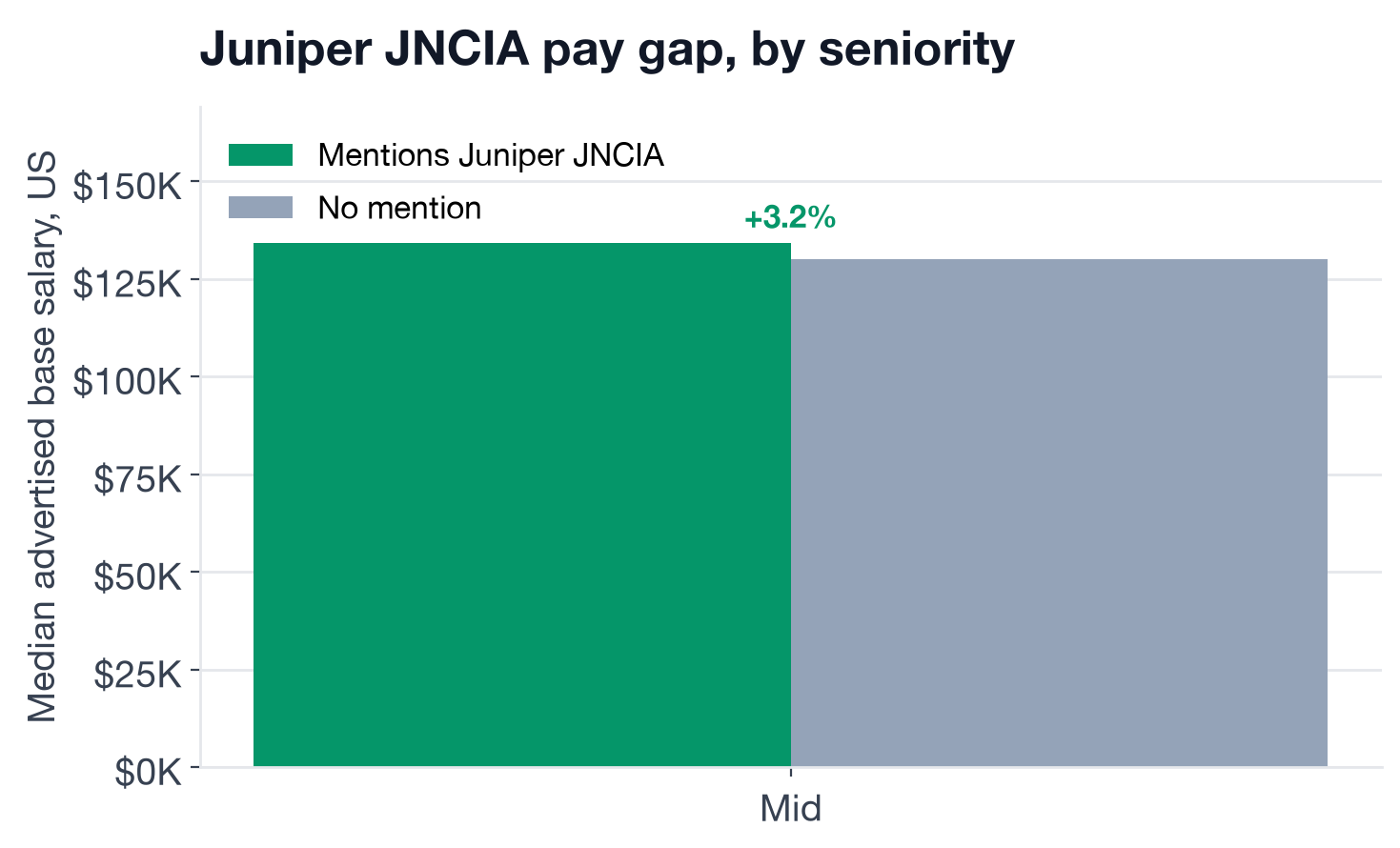
Only mid-level has enough data on both sides, and there postings that mention JNCIA advertise about $4,200 more than other mid-level postings in these roles. That is a small gap on 37 salary-disclosed postings, and it describes which jobs ask for the cert, not what the exam pays.
Mix everything together and the picture inverts: $123,113 for JNCIA postings versus $139,150 for the rest, 11.5% lower. That is the number you would see if you ignored level, and it is substantially a seniority-mix effect. The senior and staff postings that pull the comparison group upward are mostly missing from the JNCIA side. Senior and staff cannot be compared directly here at all: the JNCIA side has 11 and 1 salary-disclosed postings.
Federal IT Contractors Supply 4 in 10 Mentions
Merging the duplicate General Dynamics Information Technology listings (one appears as a raw system label), four federal IT contractors lead the employer list:
| Employer | JNCIA mentions |
|---|---|
| General Dynamics Information Technology | 13 |
| Peraton | 10 |
| Leidos | 10 |
| CACI | 7 |
| Astreya | 6 |
| Motorola Solutions | 6 |
| AT&T | 3 |
| NTT | 3 |
Those four contractors account for 40 of the 98 mentions (40.8%). The next four on the list are an IT services firm, a public-safety communications company, a telecom carrier and a global network-services provider, so the cert is not only a government-contractor phenomenon, but the top of the table is one. We cannot say from this data why those employers name Juniper; it is consistent with large government and carrier networks that run a mix of vendors, which is also where an associate-level vendor cert and a CCNA would sit side by side.
Which Other Certifications and Skills Appear in a JNCIA Posting?
Cisco dominates the company JNCIA keeps. Beyond CCNA (90.8%) and CCNP (60.2%), the most frequent companions are CompTIA Security+ (36.7%), CompTIA Network+ (22.4%), CISSP (19.4%) and CCIE (14.3%). If you are building toward these roles, our CCNA demand analysis and CCNP demand analysis show how those two certs behave in the same market.
The skills tell the same story from the technical side. Monitoring appears in 60.2% of JNCIA postings, BGP in 51.0%, OSPF in 50.0% and firewalls in 44.9%. Automation (31.6%), DNS (30.6%) and MPLS (26.5%) follow, with Python at 14.3%. This is a routing-protocol-and-operations profile: the jobs ask you to run and watch networks, and the cert is one line among several. You can see current demand for the underlying work in mid-level Network Engineer postings.
Where to Spend Prep Time if Juniper Is on Your Target List
Start with the foundation the postings name most often. If CCNA-level routing and switching is not solid, drill it first with our Question Bank and the interactive courses on networking fundamentals; BGP and OSPF are the two protocols that appear in about half of JNCIA postings. When you can explain route selection and failure modes out loud, practice with AI mock interviews before real screens.
Then decide on JNCIA from the posting in front of you, not from the aggregate. Roughly 9 in 10 classified mentions call it preferred, so it matters most when a specific employer runs Juniper gear. Browse current Network Engineer and Systems Engineer openings, search for the vendors your target employers use, and add the exam when the shortlist names Juniper.
FAQ
Q. How many job postings ask for the Juniper JNCIA certification?
98 of 6,667 active Network Engineer and Systems Engineer postings on the InterviewStack.io job board over the last 90 days mention JNCIA, or 1.5% (about 1 in 68).
Q. Is JNCIA required or preferred in job postings?
Mostly preferred. Among the 64 mentions where the wording makes the intent clear, 58 (90.6%) treat JNCIA as preferred and 6 (9.4%) as required. Another 34 mentions do not say either way.
Q. Which roles ask for JNCIA most often?
Network Engineer postings, at 3.2% (88 of 2,787), versus 0.3% for Systems Engineer (10 of 3,880). Network Engineer postings are 41.8% of the postings scanned but 89.8% of the JNCIA mentions.
Q. Do postings that mention JNCIA advertise higher salaries?
Only at mid-level, the one seniority band with enough data. Among US postings with salary disclosed, mid-level postings mentioning JNCIA advertise a median base of $134,200 (n=37) versus $130,000 (n=1,521) for other mid-level postings in the same two roles. Across all levels the gap reverses (-11.5%) because JNCIA postings skew less senior. Neither number says what the exam pays.
Q. What certifications do JNCIA postings ask for alongside it?
CCNA appears in 90.8% of JNCIA-mentioning postings (89 of 98), followed by CCNP (60.2%), CompTIA Security+ (36.7%) and CompTIA Network+ (22.4%).
Q. Who is hiring for JNCIA?
Federal IT contractors lead. General Dynamics Information Technology (13 mentions), Peraton (10), Leidos (10) and CACI (7) together account for 40 of the 98 mentions (40.8%).
Read JNCIA as a Second Line, Not a First One
The mention pattern is consistent: JNCIA is asked for by a small slice of Network Engineer postings, mostly as a preference, and almost always beside CCNA. Treat Cisco fundamentals as the base and Juniper as the add-on when a target employer runs it, and let the specific posting, not the average, decide when to book the exam.
Topics
Ready to practice?
Put what you've learned into practice with AI mock interviews and structured preparation guides.