
The Kubernetes Pay Gap Points Up for SREs and Down for Senior Software Engineers
Kubernetes appears in 18,108 of the 144,935 active postings on the InterviewStack.io job board (12.5%, in the 90 days to 17 November 2026), and that share has held flat across three 30-day windows (older windows under-count churned postings, but the shares differ by only 0.5 points). Postings that ask for it advertise US base pay 1.6% higher on average than comparable postings without it, but that average hides 32 role and level cells that go up and 16 that go down, including senior and staff Software Engineers.
So the honest answer to "is it worth learning" depends on which job you want. For a DevOps or SRE path, Kubernetes shows up in 52.8% of DevOps postings and the same-level pay gap is mostly positive (the exception in our data is staff-level DevOps, at -2.7%). For a Software Engineer, it is a common nice-to-have that does not separate higher-paid postings from lower-paid ones. We compared postings inside the same role and seniority, because comparing across the whole board mostly measures which jobs happen to ask for Kubernetes, not what the tool adds.
Key Findings
- 18,108 postings (12.5% of 144,935) mention Kubernetes, across 36 of 39 roles.
- Demand is flat: 12.8%, 12.7% and 12.3% of postings across the three 30-day windows.
- 52.8% of DevOps Engineer postings ask for it (2,562 of 4,852), versus 16.2% of Software Engineer postings.
- 88.5% of mentions with clear wording say preferred; only 11.5% say required (3,806 classified mentions).
- Same-role, same-level US base pay gap: +1.6% weighted average, up in 32 cells and down in 16.
- Site Reliability Engineer postings with Kubernetes advertise a median of $177,500 at senior level versus $159,076 without.
- Senior Software Engineer postings with it advertise $178,500 versus $184,000 without (-3.0%).
- Docker (52.1% of Kubernetes postings, lift 5.4) and Terraform (34.2%, lift 4.7) are the strongest pairings.
Which Roles Ask for Kubernetes, and How Standard Is It?
Kubernetes is a standard mention in exactly one role, DevOps Engineer, and an optional extra in most of the others. More than half of DevOps postings name it (52.8%), while roughly one in three Cloud Engineer, Backend Developer and SRE postings do.
Software Engineer is where the volume sits, with 5,285 postings or 29% of all Kubernetes demand, but that is a size effect: it is the biggest role on the board, and only about 1 in 6 of its postings mentions Kubernetes. Think of Kubernetes as infrastructure plumbing. Platform-facing roles are expected to run it, application-facing roles are expected to deploy onto it.
| Role | Postings asking | Share of that role's postings |
|---|---|---|
| Software Engineer | 5,285 | 16.2% |
| DevOps Engineer | 2,562 | 52.8% |
| Full-Stack Developer | 1,126 | 24.1% |
| Cloud Engineer | 936 | 34.1% |
| Engineering Manager | 878 | 12.7% |
| Backend Developer | 869 | 31.5% |
| Site Reliability Engineer (SRE) | 827 | 31.3% |
| Cybersecurity Engineer | 768 | 16.2% |
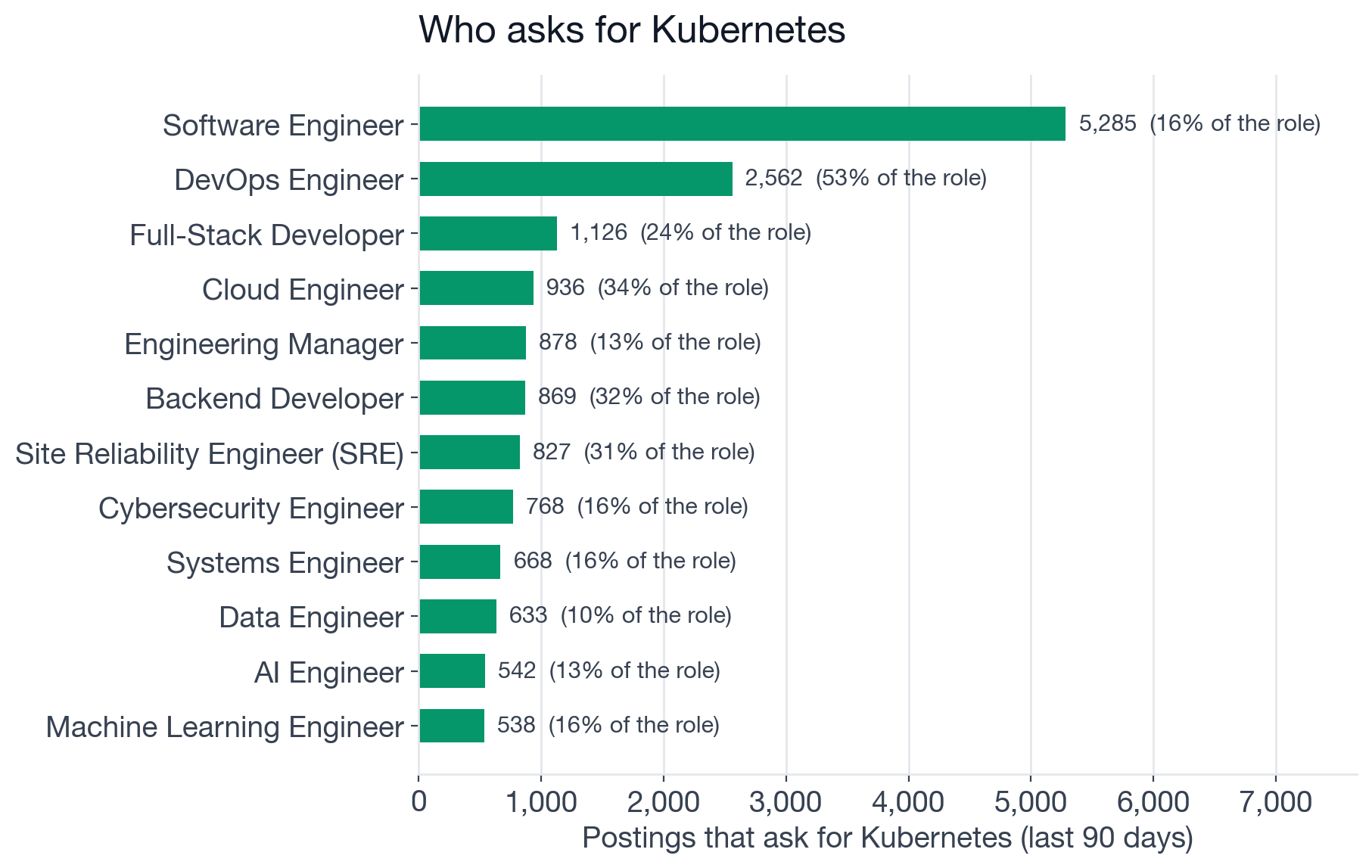
The chart makes the split visible: the largest bars are big generalist roles, while the highest shares belong to infrastructure roles. If you want the full skill picture for those paths, see our posts on Software Engineer skills, DevOps Engineer skills and Cloud Engineer skills.
Is Kubernetes Required or a Nice-to-Have?
It is a nice-to-have far more often than a hard requirement. Of the 3,806 mentions where the surrounding wording makes the call clear, 3,370 (88.5%) read as preferred and 436 (11.5%) as required, so roughly 1 in 9 Kubernetes mentions is a hard gate.
Treat that split with care. Only about one mention in five (3,806 of 18,108) carries clear required or preferred wording near it, and "preferred" wins ties in our classifier, so the real required share is probably somewhat higher than 11.5%. The safe reading is that Kubernetes more often widens the set of postings you qualify for than it blocks you from one. It also skews senior: 52% of Kubernetes postings are senior or staff level, against 38% of postings without it, and only 2.5% are entry-level (5.5% without). Kubernetes is rarely a first-job skill. (Seniority is inferred from title keywords and untagged titles default to mid-level, so treat these shares as directional.)
Does Kubernetes Come With Higher Pay?
Not consistently, and it depends on your role. The comparison here is US advertised base pay, on postings that disclose it, with each posting measured against postings in the same role and seniority that do not mention Kubernetes. Equity and bonus are not in the data, so total compensation at larger employers is higher than these figures. Across 55 role and level cells covering 94% of Kubernetes postings, the weighted gap is +1.6%, which is small, and it is the product of two very different groups.
Where postings with Kubernetes advertise more:
- SRE, mid-level: $142,500 versus $111,790 (+27.5%).
- Systems Engineer, mid-level: $158,100 versus $129,550 (+22.0%).
- SRE, senior: $177,500 versus $159,076 (+11.6%).
- Cybersecurity Engineer, mid-level: $165,750 versus $150,000 (+10.5%).
- DevOps Engineer, mid-level and senior: about +6.6% and +5.3%.
Where they advertise less or the same:
- Software Engineer: -7.5% at mid-level ($155,000 versus $167,500), -3.0% at senior ($178,500 versus $184,000), -2.3% at staff.
- Full-Stack Developer and Backend Developer, senior: about -7.8% and -7.7%.
- Solutions Architect, mid-level: -26.7% ($118,207 versus $161,294).
- DevOps Engineer, staff: -2.7%.
- Full-Stack Developer and Engineering Manager, mid-level: no gap.
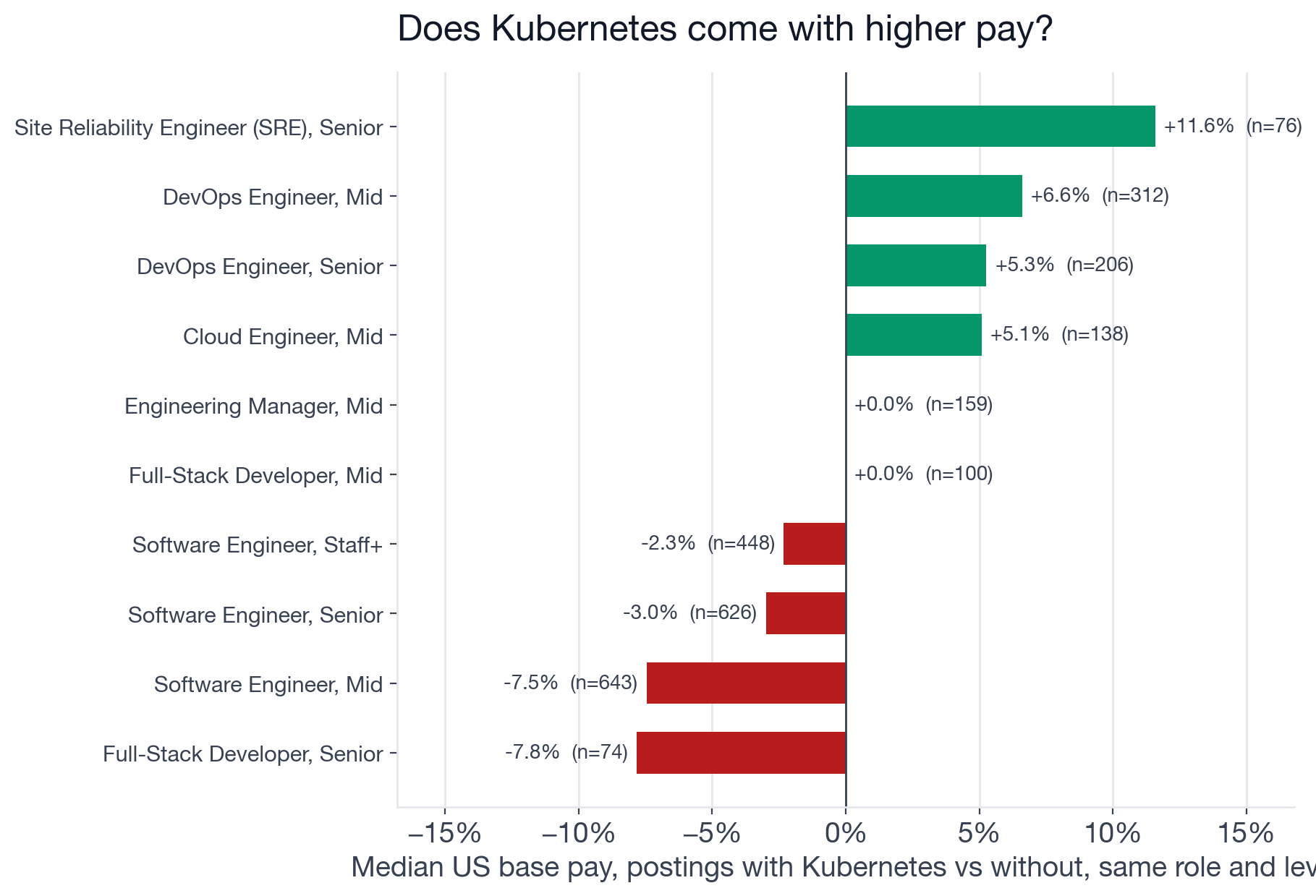
This chart shows US base salary gaps within the same role and level, and it is a correlation: it describes what postings advertise, not what learning Kubernetes will do to your offer. The data does not explain why senior Software Engineer postings with Kubernetes advertise less, so we will not guess. The practical point is narrower: if you are an application engineer, expect Kubernetes to help you qualify for more postings, not to lift your number. If you are heading into SRE or platform work, the cells that point up are the ones to look at, with the caveat that sample sizes in those cells run from the tens to a few hundred salaries per side.
What Should You Learn With Kubernetes?
Docker and Terraform are the pairings to lead with, because they are over-represented in Kubernetes postings far beyond their normal rate. The table is a selection of the high-lift tools (lift is how much more often a tool shows up next to Kubernetes than across the whole board), not raw share, since the most common tools appear next to everything.
| Tool | Share of Kubernetes postings | Lift |
|---|---|---|
| Docker | 52.1% | 5.4 |
| Grafana | 16.1% | 5.4 |
| Terraform | 34.2% | 4.7 |
| Kafka | 17.5% | 3.9 |
| Jenkins | 16.0% | 3.9 |
| Bash | 15.7% | 3.5 |
| Google Cloud | 27.9% | 2.9 |
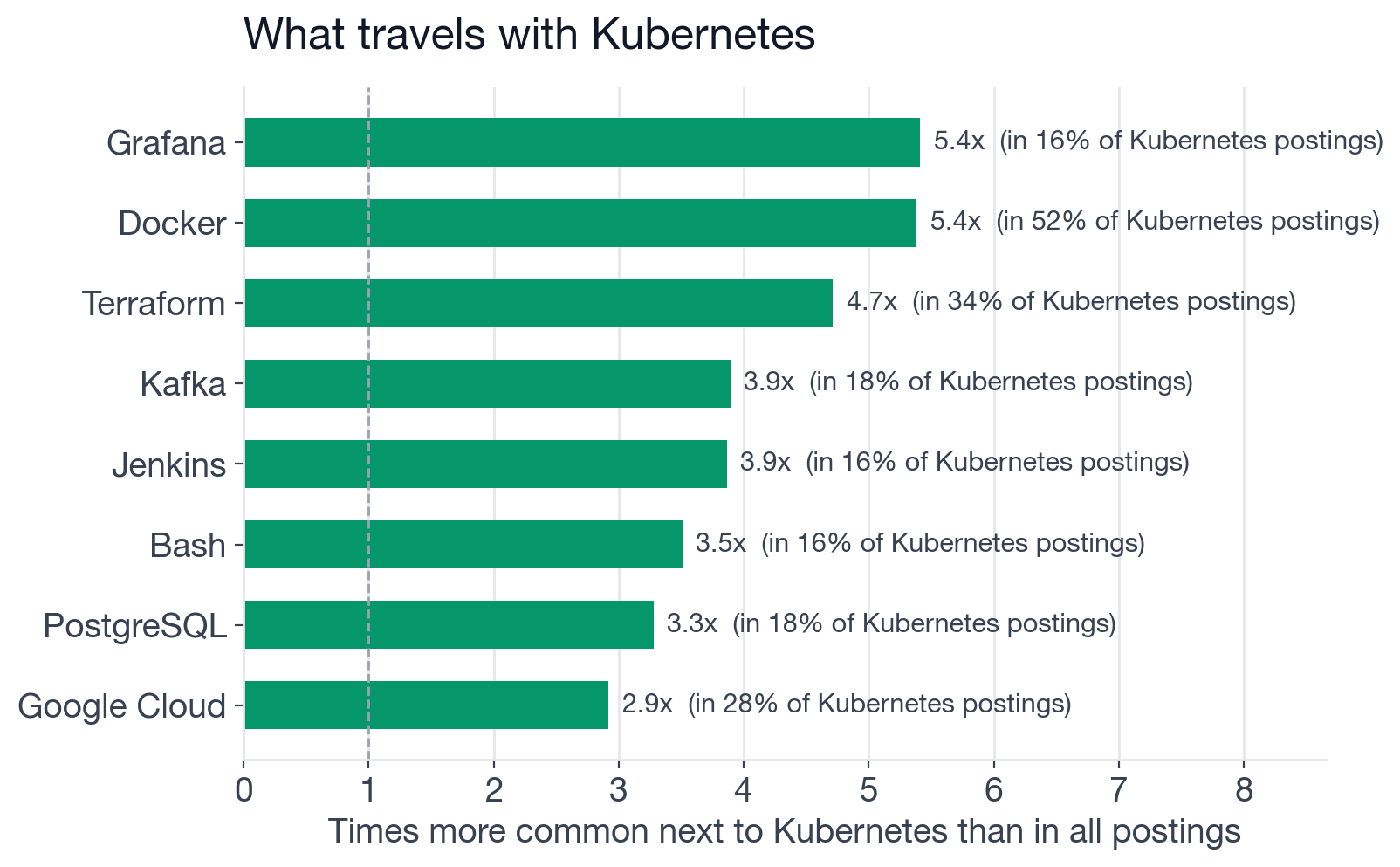
AWS (55%) and Python (57%) have bigger shares than any row above, but their lifts are 2.5 and 1.7, which is high share with only moderate lift: they are common in postings generally. Learn them, but they set you apart less than the tools above. The tools with the highest lift describe the actual job: containers (Docker), infrastructure as code (Terraform), dashboards (Grafana) and pipelines (Jenkins). On the concept side, CI/CD shows up in 59% of Kubernetes postings, observability in 39% and infrastructure as code in 27%. A sensible order is Docker, then Terraform, then an observability stack, and only then a second cloud.
Who Is Hiring for Kubernetes Skills?
Large enterprises and federal contractors lead, and that cluster is part of the story. By distinct openings, the top of the list is Citi (197), NVIDIA (196), Cisco (about 264 once its two company labels are merged), Booz Allen Hamilton (135), UnitedHealth Group (105), Leidos (91) and CACI (87). Northrop Grumman (86), Peraton (78) and General Dynamics Information Technology (67) also make the top 15, alongside Thales, Oracle, Cognizant and Amazon.
At least six of the top 15 names (Booz Allen Hamilton, Leidos, CACI, Northrop Grumman, Peraton, General Dynamics Information Technology) are defense, intelligence or government contractors, and Thales, a defense and security group, makes it seven. The data does not say why they post so many Kubernetes roles, and we did not test whether it explains the pay pattern above, so read it as a hiring map rather than a pay story. Counts are approximate, because the same employer can appear under more than one label.
How to Use This in Your Job Search
Match your plan to the role. If you target DevOps, SRE or cloud work, Kubernetes belongs on the resume and in your interview prep; start by browsing the current openings on the job board and the role index to see how the requirement reads for your target title. If you are a Software Engineer, spend your first hours on Docker and deployment basics, which are cheaper to learn and show up in more postings.
For practice, run AI mock interviews to rehearse explaining how you would debug a failing deployment or design a rollout, and drill the underlying concepts in the Question Bank. If you need to build the foundations first, our interactive courses cover the cloud and systems concepts that sit under Kubernetes.
FAQ
Q. How many job postings ask for Kubernetes in 2026?
18,108 of 144,935 active postings on the InterviewStack.io job board (12.5%) mention Kubernetes, across 36 of the 39 roles we track, in the 90 days to 17 November 2026. The share was 12.8%, 12.7% and 12.3% across the three 30-day windows, which is flat.
Q. Is Kubernetes required or just preferred?
Mostly preferred. Among the 3,806 mentions where the posting wording makes the call clear, 88.5% say preferred or nice to have and 11.5% say required. The other 14,302 mentions carry no clear required or preferred wording nearby, so treat the split as a subset, not the whole market.
Q. Do postings that ask for Kubernetes advertise higher pay?
Only for some roles. Comparing postings with and without Kubernetes inside the same role and seniority (US advertised base pay), the weighted average gap is +1.6%. It is up in 32 role and level cells and down in 16. Senior Software Engineer postings with Kubernetes advertise a median of $178,500 versus $184,000 without it. This is a correlation, not proof that Kubernetes raises pay.
Q. Which roles ask for Kubernetes most often?
DevOps Engineer postings ask for it most: 52.8% of 4,852 postings. Cloud Engineer (34.1%), Backend Developer (31.5%) and Site Reliability Engineer (31.3%) follow. Software Engineer is the largest source of Kubernetes postings in absolute terms (5,285, or 29% of all of them) but only 16.2% of Software Engineer postings ask for it.
Q. What should you learn alongside Kubernetes?
Docker and Terraform are the strongest pairings. Docker appears in 52.1% of Kubernetes postings (5.4 times its corpus-wide rate) and Terraform in 34.2% (4.7 times). Grafana, Kafka and Jenkins also pair at roughly 4 to 5 times their normal rate. AWS and Python are common but are everywhere, so they do not distinguish Kubernetes roles.
Q. Who hires for Kubernetes skills?
Large enterprises and federal contractors lead by distinct openings: Citi (197), NVIDIA (196), Cisco (about 264 across two company labels), Booz Allen Hamilton (135), UnitedHealth Group (105), Leidos (91) and CACI (87). Northrop Grumman, Peraton and General Dynamics Information Technology also make the top 15, so defense and government contracting is a clear cluster.
Where to Start
Kubernetes is worth learning if your target role is on the infrastructure side, where it is expected and the same-level pay gap leans positive. For application engineers it is a useful second skill, not a pay lever. Pick the role first, then let the lift table above set the order: Docker, Terraform, observability.
Topics
Ready to practice?
Put what you've learned into practice with AI mock interviews and structured preparation guides.