
The Skills That Define Each Role Get Priced in Opposite Directions
Machine Learning Engineer and Applied Scientist look like they should be the same job wearing two different name tags. Both anchor on Python and Machine Learning at nearly identical rates, and more than half of each role's top-30 skill set overlaps with the other's. We pulled every active posting for both roles on the InterviewStack.io job board as of August 2026, 5,665 for Machine Learning Engineer and 1,708 for Applied Scientist, and compared them skill by skill and dollar by dollar.
Look at what each role's own exclusive skills do to pay, though, and the two jobs split cleanly in half. Machine Learning Engineer's defining skills, MLOps, CI/CD, Kubernetes, Docker, mostly do not move the role's own salary at all. Applied Scientist's defining skills, C++, Java, Reinforcement Learning, NLP, add a consistent premium of over $11,000 each.
| Machine Learning Engineer | Applied Scientist | |
|---|---|---|
| Median US base salary | $190,000 | $185,500 |
| Active postings | 5,665 | 1,708 |
| Top skill | Machine Learning (68.2%) | Machine Learning (64.1%) |
| Remote share | 20.5% | 16.0% |
| Entry-level share | 4.4% | 7.4% |
| Skill overlap (Jaccard) | 54% shared (pairwise) | 54% shared (pairwise) |
Key Findings
- Machine Learning Engineer and Applied Scientist share a Jaccard skill overlap of 0.54, well above the mid-range typical of this comparison series.
- Median US base salary sits within $4,500 of each other: $190,000 for Machine Learning Engineer versus $185,500 for Applied Scientist, a 2.4% gap.
- Machine Learning Engineer carries 3.32x the posting volume: 5,665 active listings versus 1,708 for Applied Scientist.
- Eight of Machine Learning Engineer's nine exclusive skills price at or below its own $190,000 baseline; only Google Cloud clears it, by $1,300.
- Six of Applied Scientist's seven exclusive skills add $11,100 to $11,400 over its own $185,500 baseline; the one outlier, Linux, prices $17,500 below it.
- Entry-level share runs higher for the smaller role: 7.4% of Applied Scientist postings versus 4.4% for Machine Learning Engineer.
- Amazon alone accounts for 14.5% of Applied Scientist's distinct openings in this snapshot, the largest single-employer concentration in this data.
What a Machine Learning Engineer and an Applied Scientist Actually Do
A Machine Learning Engineer spends most of the week making models survive contact with production traffic: packaging a trained model behind an API, wiring it into a CI/CD pipeline, monitoring it once live, and scaling the infrastructure on AWS, Azure, or Google Cloud. The exclusive skill list, MLOps, Docker, Kubernetes, CI/CD, reads like a deployment checklist. Browse live Machine Learning Engineer postings and that pattern holds across most listings.
An Applied Scientist works further upstream: designing the model, running the experiments (A/B Testing shows up in 17.2% of postings) that decide whether it's good enough to ship, and often writing performance-critical code in C++ or Java. Reinforcement Learning and NLP round out a skill set closer to a research curriculum than a deployment one. Browse live Applied Scientist postings to see the pattern.
One data-quality note: "Applied Scientist" is a broader title than "Machine Learning Engineer," and this dataset's sample includes some postings from adjacent scientific-research fields, bioinformatics, clinical research, geophysics, academic research fellowships, that use the same job title without doing applied ML work. The skill and salary figures below still skew cleanly toward ML/AI terms (Python, Machine Learning, Statistics, C++), so the aggregate numbers hold up, but expect some non-ML science roles mixed into the raw posting count if you browse the board directly.
Which Skills Do Both Roles Actually Share?
Python and Machine Learning anchor both roles at almost the same frequency, and that's the clearest true overlap in the data.
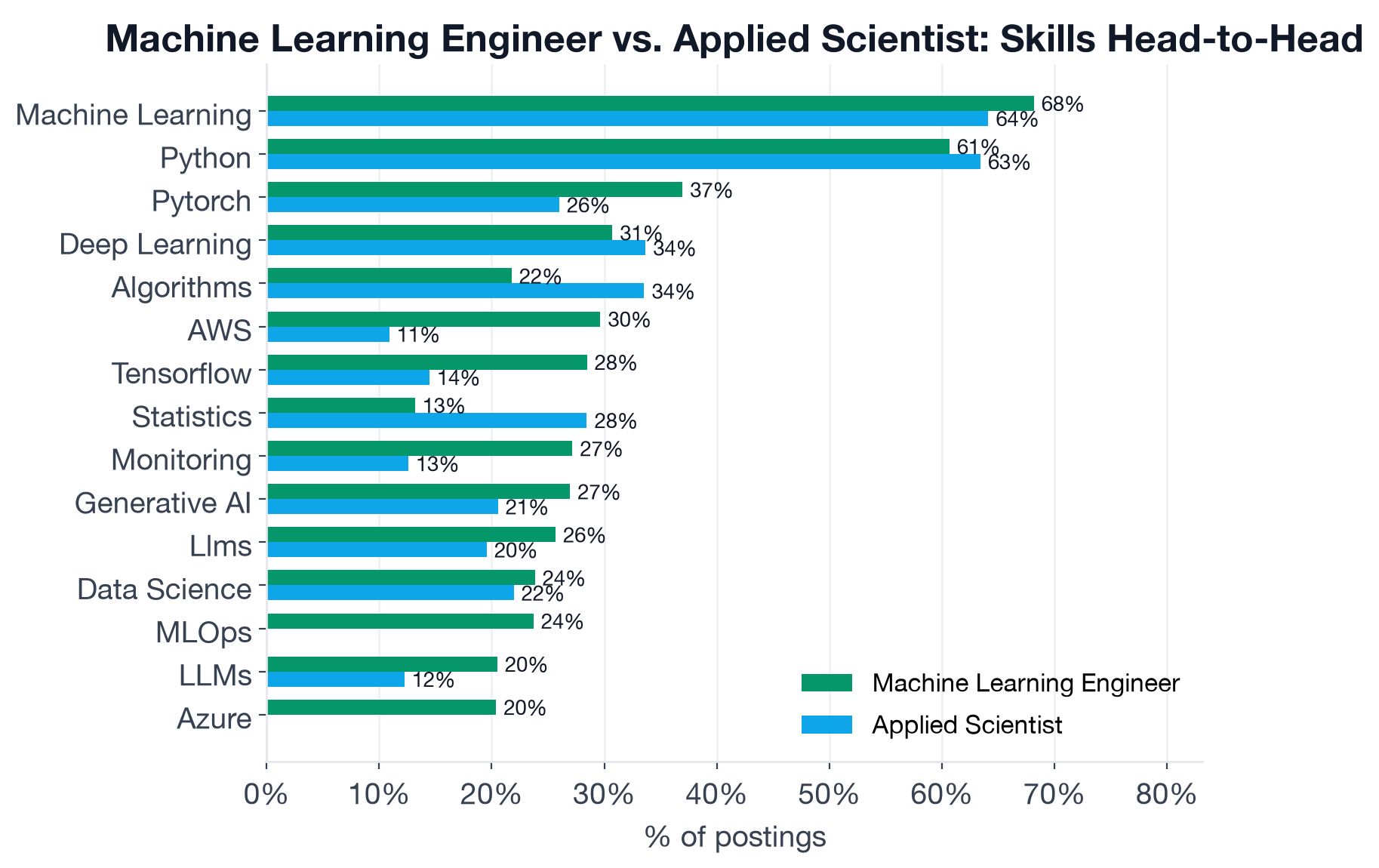 Machine Learning and Python sit at nearly identical rates on both sides; nearly everything else that clears the "shared skill" bar still leans toward one role or the other.
| Skill | Machine Learning Engineer | Applied Scientist |
|---|---|---|
| Machine Learning | 68.2% | 64.1% |
| Python | 60.7% | 63.4% |
| PyTorch | 36.9% | 26.0% |
| Deep Learning | 30.7% | 33.7% |
| Algorithms | 21.8% | 33.5% |
| Statistics | 13.2% | 28.5% |
| AWS | 29.7% | 10.9% |
| Generative AI | 27.0% | 20.6% |
Machine Learning and Python are the genuine bridge, close enough on both sides that switching roles wouldn't require relearning either one. Everything else tilts hard: Statistics runs more than twice as common for Applied Scientist (28.5% versus 13.2%), while AWS runs nearly three times as common for Machine Learning Engineer (29.7% versus 10.9%). Clearing the shared-skill threshold doesn't mean both roles lean on a skill the same way.
Generative AI and LLM-tagged skills sit well below Machine Learning itself for both roles (27.0% and 25.7% for Machine Learning Engineer, 20.6% and 19.6% for Applied Scientist). That gap measures who's explicitly hired to build AI systems, not who uses AI tools at all, postings only tag Generative AI or LLM skills when a role requires building or shipping one. Stack Overflow's 2025 Developer Survey puts general AI tool adoption at 84% of developers, with roughly half using AI tools daily, so the honest read is that both roles use AI tooling constantly; Machine Learning Engineer's modest tilt just reflects its more deployment-facing, RAG-and-API-heavy skill set.
Where Do Machine Learning Engineer and Applied Scientist Skills Diverge?
Machine Learning Engineer's exclusive skills describe how you ship a model. Applied Scientist's describe how you build one.
| Exclusive to Machine Learning Engineer | Freq. | Exclusive to Applied Scientist | Freq. |
|---|---|---|---|
| MLOps | 23.7% | C++ | 20.1% |
| Azure | 20.4% | Java | 16.2% |
| CI/CD | 19.8% | Reinforcement Learning | 15.0% |
| Google Cloud | 17.6% | NLP | 11.0% |
| Docker | 15.9% | Linux | 8.5% |
| Kubernetes | 15.7% | Apache Spark | 8.1% |
The Machine Learning Engineer column (MLOps, CI/CD, Kubernetes, Docker) reads as a production-infrastructure checklist: package it, deploy it, scale it, keep it alive. The Applied Scientist column runs the opposite direction: C++ and Java signal performance-critical model code, Reinforcement Learning and NLP signal research specialization, and Apache Spark signals offline experimentation over an always-on service.
Which Role Pays More?
Barely either one, at least at the headline level, but the skills behind each median tell very different stories. These are US-only base salaries; equity, bonus, and sign-on pay are not disclosed in postings, so total compensation at top employers runs higher than either figure below.
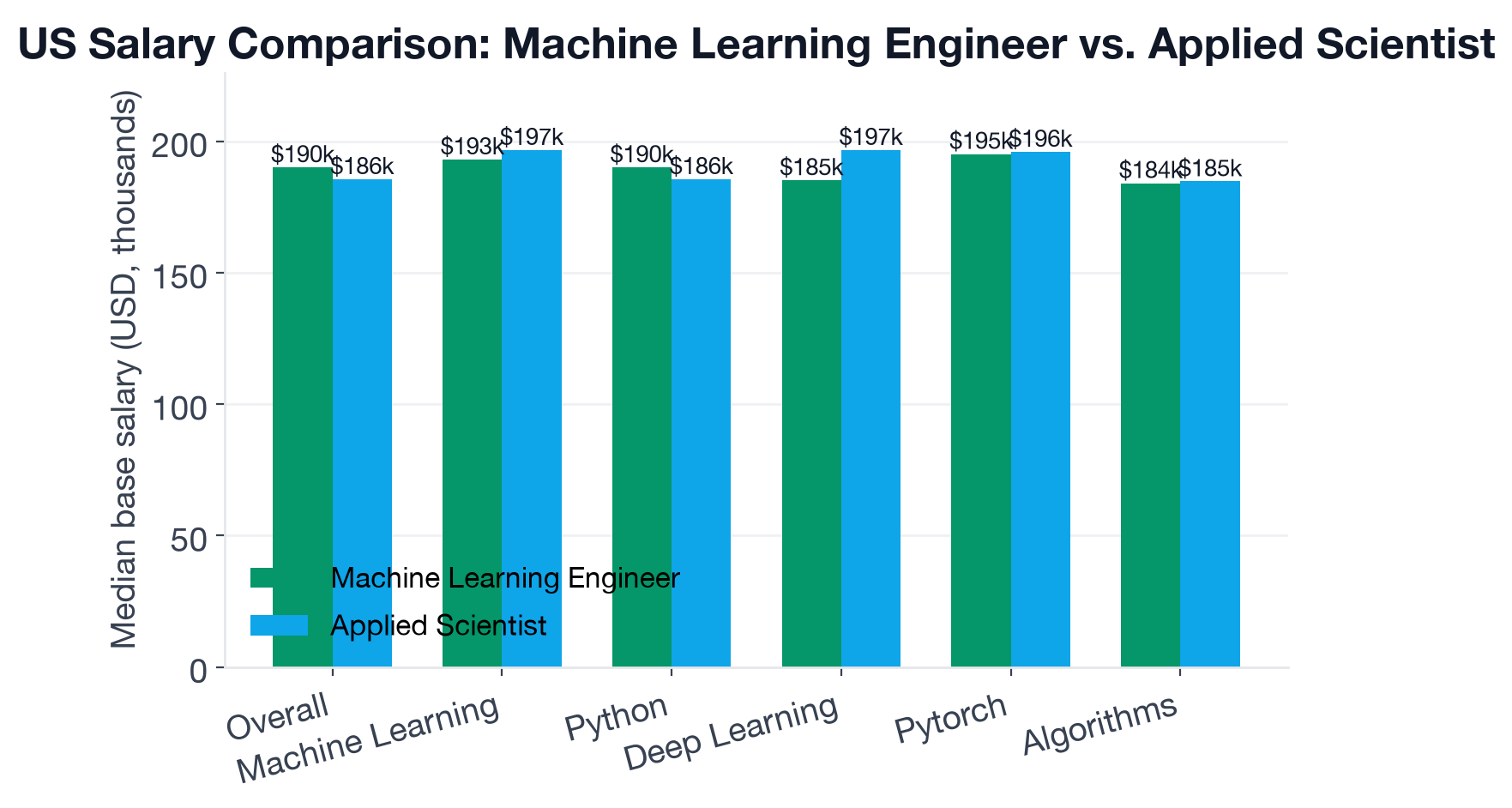 Machine Learning Engineer's median US base salary sits $4,500 above Applied Scientist's, close enough that the two roles are effectively tied at the median.
Machine Learning Engineer's median US base salary is $190,000 across 1,481 postings with salary disclosed, versus $185,500 for Applied Scientist across 673 postings, a $4,500 (2.4%) gap, close enough to call a statistical tie.
The premium logic underneath is where the two roles split. On Machine Learning Engineer's own salary data, eight of its nine exclusive skills sit at or below the role's baseline: MLOps (-$5,200), Azure (-$14,500), CI/CD (-$6,000), Docker (-$16,000), RAG (-$2,500), APIs (-$9,000), Scalability (-$500), and Kubernetes (flat). Only Google Cloud clears it, by $1,300. The skills that define the job title don't buy a raise; they're table stakes for a much larger job market.
On Applied Scientist's own data, the pattern flips. C++, Java, Reinforcement Learning, and NLP (under both that tag and its full name, Natural Language Processing) each add $11,100 to $11,400 over the role's $185,500 baseline, and Apache Spark matches it. The one exception is Linux, which prices $17,500 below baseline. For Applied Scientist, the skills that define the job also get paid for.
Neither role's biggest premium comes from its own exclusive list, though. On Applied Scientist's data, JAX, a high-performance array-computing library, adds $46,400 to the role's baseline (n=48), the largest single-skill premium either role's data supports. On Machine Learning Engineer's data, JAX still pays, $24,000 over baseline (n=124), but RLHF pays more: $45,600 (n=43), nearly double JAX's premium for this role. Either way, the pattern holds: the biggest raises trace to shared AI specialties, not the toolkit that defines either job title.
Which Role Has More Job Openings?
Machine Learning Engineer posts 3.32x the volume: 5,665 active listings versus 1,708 for Applied Scientist. That size gap doesn't translate into an easier entry bar, though.
| Machine Learning Engineer | Applied Scientist | |
|---|---|---|
| Entry-level | 4.4% | 7.4% |
| Mid-level | 56.1% | 53.5% |
| Senior | 22.4% | 21.9% |
| Staff | 17.1% | 17.2% |
| Remote | 20.5% | 16.0% |
| Hybrid | 26.2% | 25.5% |
| Onsite | 58.4% | 64.0% |
Entry-level share is actually higher for the smaller, more research-heavy role (7.4% of Applied Scientist postings versus 4.4% for Machine Learning Engineer), so the larger job market isn't the easier one to break into. Geography adds a wrinkle: Applied Scientist runs more US-concentrated (56.8% versus 44.8%, with Machine Learning Engineer drawing a meaningfully larger share from India at 16.7%) and more onsite (64.0% versus 58.4%). Part of that traces to concentration: Amazon alone accounts for 14.5% of Applied Scientist's distinct openings here, the largest single-employer share for either role, so read its onsite and US-geography figures as leaning toward that employer's policies, not a flat market average.
Which Role Should You Choose?
Choose Machine Learning Engineer if you:
- Want the larger, more open job market (3.32x the postings) and would rather build deployment expertise than a deep research background
- Are drawn to the production side of ML: shipping, monitoring, and scaling models rather than designing them from scratch
- Can accept that your core toolset (MLOps, CI/CD, Kubernetes) is table stakes rather than a pay lever; your ceiling comes from layering scarcer specialties like JAX or distributed training on top
Choose Applied Scientist if you:
- Already have, or want to build, a deeper algorithmic and statistical foundation (Algorithms at 33.5% of postings, Statistics at 28.5%) alongside systems languages like C++ and Java
- Want your specialization to translate directly into pay: C++, Java, Reinforcement Learning, and NLP each add roughly $11,100 to $11,400 over the role's baseline
- Are comfortable with a smaller, more concentrated, more onsite-heavy job pool in exchange for research-facing work and a nearly identical median salary
How to Use This in Your Job Search
If Applied Scientist's deeper bar (Algorithms, Statistics, C++) stands between you and that premium, InterviewStack's interactive courses cover the ML theory, statistics, and systems-programming foundations most postings assume. Already comfortable there? Practice with AI mock interviews built around real ML system-design and applied-research loops, and drill the Question Bank on MLOps pipelines, reinforcement learning, and NLP. When you're ready to apply, browse live Machine Learning Engineer openings or Applied Scientist openings.
For a full breakdown of either role on its own, see Machine Learning Engineer Skills in 2026 and Applied Scientist's entry-level breakdown. If AI Engineer or Data Scientist are also on your shortlist, AI Engineer vs Applied Scientist and Data Scientist vs Machine Learning Engineer cover two more angles on the same fork.
FAQ
Q. What is the salary difference between Machine Learning Engineer and Applied Scientist in 2026?
Machine Learning Engineer's median US base salary is $190,000 (n=1,481 postings with US salary disclosed), just $4,500 (2.4%) above Applied Scientist's $185,500 median (n=673). Equity, bonus, and sign-on pay are not disclosed in postings and are not part of these figures.
Q. Do Machine Learning Engineer and Applied Scientist share the same skills?
More than half. The two roles have a Jaccard overlap of 0.54 on their top-30 skills, one of the higher overlap scores in InterviewStack's role-comparison data. Machine Learning (68.2% of Machine Learning Engineer postings, 64.1% of Applied Scientist postings) and Python (60.7% versus 63.4%) anchor both roles at nearly identical rates.
Q. Which skills are exclusive to Machine Learning Engineer postings?
MLOps (23.7% of postings), Azure (20.4%), CI/CD (19.8%), Google Cloud (17.6%), Docker (15.9%), Kubernetes (15.7%), RAG (13.9%), APIs (13.7%), and Scalability (13.0%) all post often enough in Machine Learning Engineer listings to count as real differentiators, and too rarely in Applied Scientist listings to register there.
Q. Which skills are exclusive to Applied Scientist postings?
C++ (20.1% of postings), Java (16.2%), Reinforcement Learning (15.0%), NLP (11.0%, or 8.6% under the full term Natural Language Processing), Linux (8.5%), and Apache Spark (8.1%) all post often enough in Applied Scientist listings to count as real differentiators, and too rarely in Machine Learning Engineer listings to register there.
Q. Do Machine Learning Engineer's or Applied Scientist's differentiator skills pay more?
Applied Scientist's do, by a wide margin. On Applied Scientist's own salary data, C++, Java, Reinforcement Learning, and NLP each add roughly $11,100 to $11,400 over the role's $185,500 baseline. On Machine Learning Engineer's own salary data, its defining skills (MLOps, Azure, CI/CD, Docker, APIs) mostly sit at or below the role's $190,000 baseline; only Google Cloud clears it, and only by $1,300.
Q. Which role has more open positions, Machine Learning Engineer or Applied Scientist?
Machine Learning Engineer, by a wide margin: 5,665 active postings versus 1,708 for Applied Scientist, a 3.32x volume gap. Entry-level share actually runs higher for Applied Scientist (7.4% versus 4.4%), so the smaller role isn't the harder one to break into at the bottom.
Q. Do both roles require generative AI or LLM skills?
Both show a gap between explicit posting language and real-world AI tool use. Generative AI appears in 27.0% of Machine Learning Engineer postings and 20.6% of Applied Scientist postings, with LLM-tagged skills running similarly higher for Machine Learning Engineer. But Stack Overflow's 2025 Developer Survey puts general AI-assisted tool adoption at 84% of developers overall, so most practitioners in both roles are almost certainly using AI tools daily regardless of what any single job posting states.
The Real Choice Isn't About Pay
Machine Learning Engineer and Applied Scientist land within $4,500 of each other at the median and share more than half their top skill set, so pay alone won't settle which one to pursue. The real fork is what your specialization buys you. Machine Learning Engineer's defining skills, MLOps, CI/CD, Kubernetes, are table stakes for a job market 3.32x the size, not a salary lever. Applied Scientist's defining skills, C++, Java, Reinforcement Learning, NLP, consistently add over $11,000 each in a smaller, more concentrated, more onsite pool. Pick the skill set whose logic matches how you want to be paid, not just what the paycheck says today.
Topics
Ready to practice?
Put what you've learned into practice with AI mock interviews and structured preparation guides.