
A Certification Microsoft Stopped Offering in 2021 Still Shows Up in Job Postings
Microsoft retired the MCSE, Microsoft Certified Solutions Expert (originally launched under the same acronym as Microsoft Certified Systems Engineer, before a 2012 rebrand), certification track in 2021, folding it into a lineup of role-based Azure and Microsoft 365 credentials. Nobody can walk into a testing center and earn a new MCSE today. And yet, across Systems Administrator, Systems Engineer, and Network Engineer postings on the InterviewStack.io job board, 9,367 active listings analyzed over a trailing 90-day window, MCSE still shows up in 88 of them, 0.94%, or about 1 in every 106 postings.
That's not a large number, but it's also not zero five years after the exam stopped existing. The more useful question isn't whether MCSE survives in job postings; it clearly does. It's what an employer means when they type it. The required-vs-preferred split below suggests most of them don't mean "you must hold this," because holding it is no longer something a candidate can go do. It reads more like inherited shorthand for a specific, dated skill set: Windows Server, Active Directory, and on-premises infrastructure administration, carried forward in job descriptions that may not have been rewritten since the certification itself was retired.
Key Findings
- MCSE appears in just 0.94% of Systems Administrator, Systems Engineer, and Network Engineer postings (88 of 9,367 analyzed over a 90-day window), five years after Microsoft retired the certification.
- Only 22.6% of the 53 classifiable mentions treat MCSE as required; 77.4% list it as preferred, and 35 mentions (39.8% of all 88) don't specify either way.
- Postings that mention MCSE advertise a median US base salary of $120,000, about 7.4% below the $129,575 median for postings in the same three roles that don't mention it.
- Systems Administrator postings mention MCSE at a 1.18% rate, the highest of the three roles and about 1.6 times Network Engineer's 0.73% rate.
- CCNA is the single most common certification to appear alongside MCSE, in 39.8% of MCSE-mentioning postings, ahead of every Microsoft credential on the list.
- Windows, VMware, and Active Directory anchor the associated skill set, appearing in 53.4%, 51.1%, and 45.5% of MCSE postings respectively.
- Once General Dynamics Information Technology's two listing variants are combined, GDIT edges out Leidos as the top named employer, 9 mentions to 8.
Why Do So Few MCSE Postings Actually Require It?
Of the 88 total MCSE mentions, 53 (60.2%) use language specific enough to classify as required or preferred; the remaining 35 (39.8%) sit inside general certification lists or "nice to have" phrasing that doesn't resolve either way. Within that classified set, MCSE reads overwhelmingly as a plus, not a gate: 41 mentions (77.4%) call it preferred, and only 12 (22.6%) call it required outright.
That skew makes sense given the certification no longer exists as something a candidate can pursue. A hard requirement for an unobtainable credential would disqualify most of the market by definition, including every early-career candidate who started their career after 2021. Treating MCSE as a bonus rather than a gate is the only version of this requirement that makes practical sense for an employer still writing it into a job description.
Which Role Leans on MCSE the Hardest?
| Role | Active postings | Mention MCSE | Mention rate |
|---|---|---|---|
| Systems Administrator | 2,804 | 33 | 1.18% |
| Systems Engineer | 3,808 | 35 | 0.92% |
| Network Engineer | 2,755 | 20 | 0.73% |
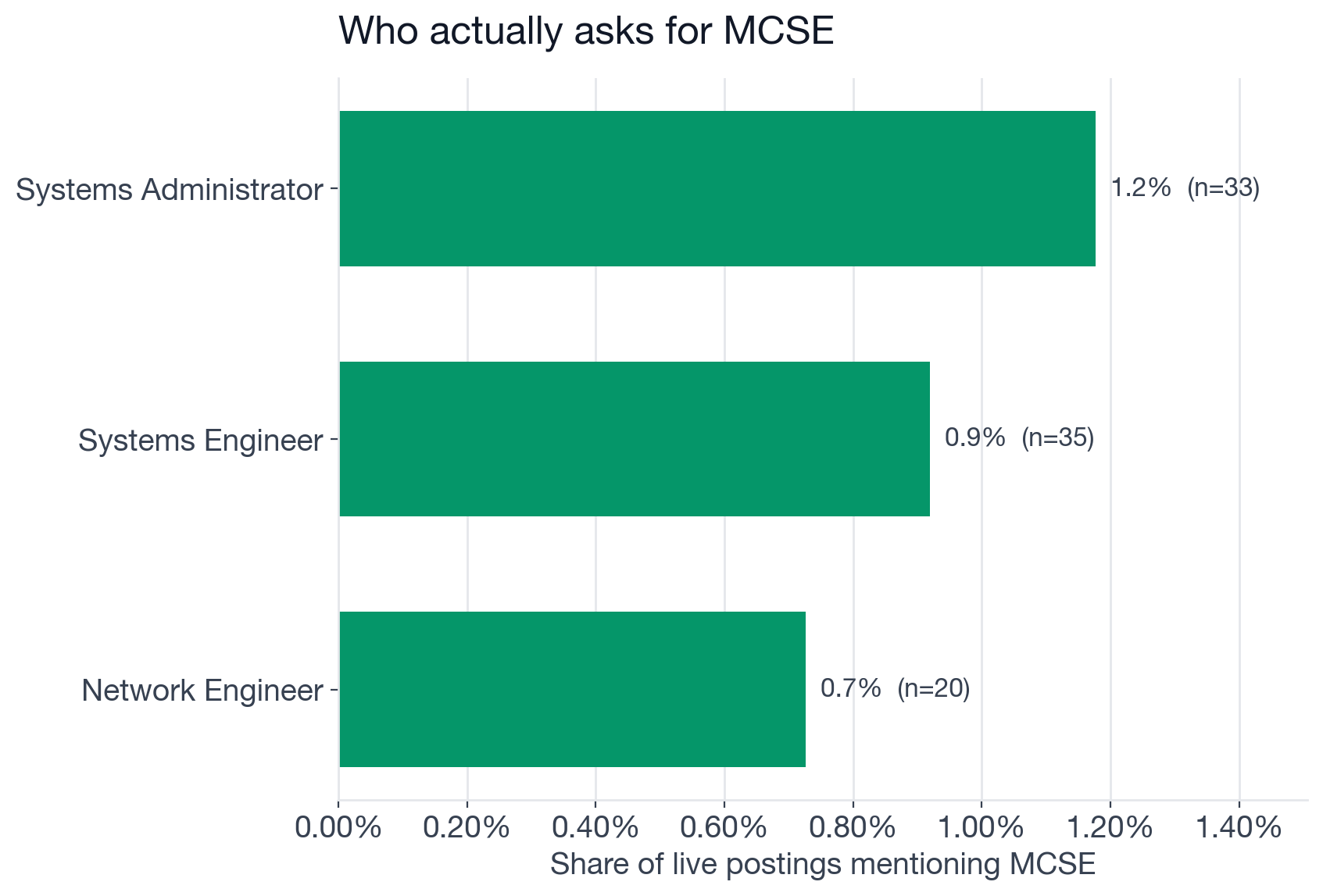 Systems Administrator postings name MCSE at nearly 1.6 times Network Engineer's rate, consistent with MCSE's original focus on server and directory administration rather than networking.
Systems Administrator supplies 29.9% of postings in this scope but 37.5% of MCSE mentions (33 of 88), an over-index of roughly 1.25x. Systems Engineer sits close to parity: 40.7% of postings, 39.8% of mentions. Network Engineer is the clear laggard, 29.4% of postings but only 22.7% of mentions, an under-index of about 0.77x, and its 0.73% mention rate is the lowest of the three.
That split tracks the certification's own history. MCSE certified server, directory, and infrastructure administration, not routing and switching, and the associated skills below (Windows Server, Active Directory, DHCP, DNS) line up with Systems Administrator work far more than with Network Engineer work. It's a plausible explanation grounded in what MCSE actually certified, not a claim the data proves on its own.
MCSE Postings Pay Less, and Seniority Mix Isn't Why
The comparison below covers only postings that disclose a US base salary, and it compares MCSE-mentioning postings against other postings in this same three-role scope, not the broader job market. Equity, bonus, and other compensation aren't disclosed in job postings and aren't part of this comparison.
Postings that mention MCSE advertise a median US base salary of $120,000 across 45 postings with US salary disclosed, 7.4% below the $129,575 median for the 3,812 other postings in the same role scope that disclose a US salary, a gap of $9,575. At mid-level, the only seniority band with enough MCSE-mentioning postings to compare directly (25 with the cert, 2,458 without), the gap is slightly wider: 8.8% ($110,850 vs. $121,552.50). Entry, senior, and staff levels don't have enough MCSE-mentioning postings with disclosed salary to report a median (1, 14, and 5 respectively, all below the 25-posting floor this analysis requires), but the one band that does clear the floor tells a consistent story with the aggregate, not a contradictory one.
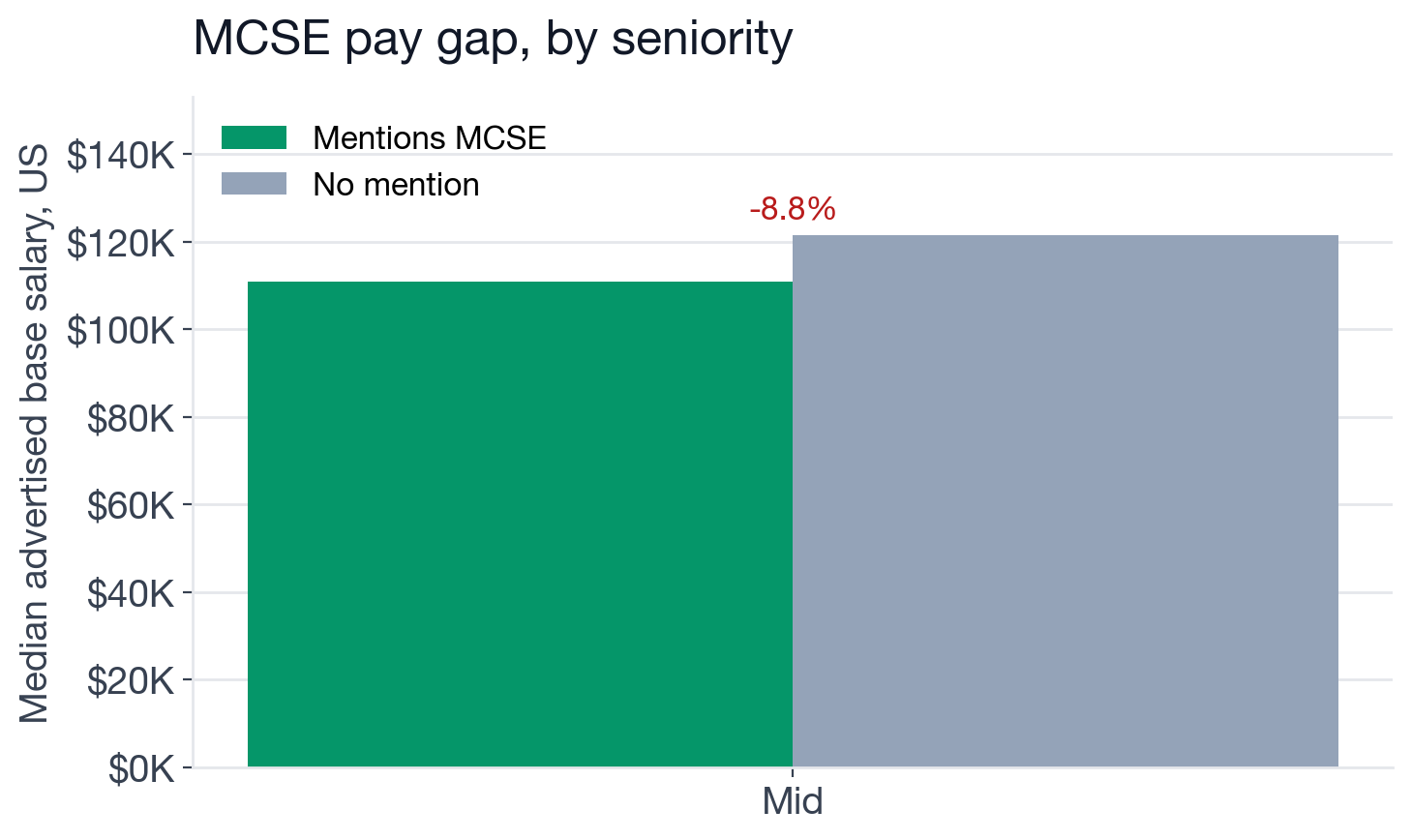 Mid-level is the only band with enough MCSE-mentioning postings to compare directly, and its 8.8% discount is close to the 7.4% aggregate discount, not a different story.
This isn't a seniority-composition artifact. MCSE-mentioning postings skew very slightly more senior than the rest of the scope, not less: 31.8% land at senior or staff level, versus 30.8% for postings that don't mention MCSE, and the mean seniority level is marginally higher for MCSE postings (1.375 vs. 1.362). If seniority mix were driving the discount, correcting for it would typically narrow the gap, not widen it, since a slightly more senior mix should push the median up, not down. Instead the discount holds. One caveat on that comparison: seniority here is inferred from title keywords, and a posting with no explicit level signal defaults to mid-level, which compresses the measured spread for both groups equally rather than favoring one side. As with every salary comparison in this series, this measures which postings ask for MCSE, not what the certification itself is worth: a retired credential mentioned in a job posting today is often carried-forward language from an older labor-category list rather than a live, market-priced requirement, and that inherited-language pattern shows up more in the employer roster below than in any seniority effect.
Why Does a Cisco Certification Pair With MCSE More Than Any Microsoft One?
| Certification | Co-occurs with MCSE |
|---|---|
| CCNA | 39.8% |
| CompTIA Security+ | 34.1% |
| CCNP | 23.9% |
| CompTIA Network+ | 20.5% |
| VMware VCP | 13.6% |
| CompTIA A+ | 10.2% |
| CISSP | 9.1% |
| RHCE | 5.7% |
| CCIE | 5.7% |
| AWS Solutions Architect Associate | 2.3% |
CCNA, Cisco's associate-level networking certification, appears in 39.8% of MCSE-mentioning postings (35 of 88), ahead of CompTIA Security+ (34.1%) and CCNP (23.9%), and ahead of every other Microsoft credential in the co-occurring list. That's a mild surprise for a certification built around Windows Server and Active Directory: the postings that still ask for MCSE are more likely to also ask for a Cisco networking credential than for anything else in Microsoft's own catalog. It reads as further evidence that these postings describe a broad, general-purpose infrastructure role rather than a narrowly Microsoft-specialist one, someone expected to touch servers, directories, and the network gear connecting them, not a single vendor stack.
The skill data tells a matching story. Windows appears in 53.4% of MCSE postings, VMware in 51.1%, Active Directory in 45.5%, Linux in 42.0%, and Windows Server specifically in 39.8%, alongside core networking fundamentals: DHCP (38.6%), DNS (36.4%), and Firewalls (34.1%). PowerShell (31.8%) and Azure (30.7%) round out a profile that spans on-premises Windows administration, virtualization, and a growing cloud layer, not a single-platform specialty.
| Skill | Share of MCSE postings |
|---|---|
| Monitoring | 54.5% |
| Windows | 53.4% |
| VMware | 51.1% |
| Active Directory | 45.5% |
| Linux | 42.0% |
| Windows Server | 39.8% |
| DHCP | 38.6% |
| DNS | 36.4% |
| Firewalls | 34.1% |
| PowerShell | 31.8% |
Merge the Duplicate Listings and GDIT, Not Leidos, Leads MCSE Hiring
| Employer | Postings mentioning MCSE |
|---|---|
| General Dynamics Information Technology (GDIT) | 9 |
| Leidos | 8 |
| Entarian | 5 |
| CACI International | 4 |
| UTAC | 2 |
| MUFG Investor Services | 2 |
| Motorola Solutions | 2 |
| Empower AI Inc. | 2 |
| Ibex | 2 |
| J5 Consulting | 2 |
General Dynamics Information Technology's job-board footprint is split across two listing labels, its own name (4 mentions) and a raw career-site token (5 mentions). Combined, GDIT accounts for 9 MCSE mentions, edging out Leidos at 8 for the top spot once the split is undone. MCSE isn't a Department of Defense 8570/8140 baseline security certification the way CompTIA Security+ or CISSP are, so its presence here isn't a compliance checkbox for cybersecurity roles the way those certifications' government-contractor concentration usually is. GDIT, Leidos, CACI International, and Empower AI Inc. together account for 23 of the 88 total mentions, about 26%, which lines up with a simpler explanation: these are exactly the kind of employers that run large, long-lived Windows infrastructure estates and recompete government IT contracts using labor-category descriptions that can go years between rewrites, the sort of document that would still list a retired certification without anyone updating it.
The rest of the roster is smaller and more varied: MUFG Investor Services (financial services), Motorola Solutions (communications hardware), Ibex (business process outsourcing), and a handful of smaller IT consultancies. None of it points to a second industry cluster the way the top four do.
Where This Leaves You, MCSE or Not
If you already hold an MCSE, the data says it's still worth listing, just not worth leaning on. It shows up almost exclusively as a preferred signal (77.4% of classified mentions) inside a broader infrastructure-generalist profile that also expects Active Directory, virtualization, and increasingly Azure and scripting. If you don't hold one and are wondering whether to pursue an equivalent, the honest answer is that you can't pursue this one; Microsoft's current Azure Administrator and related role-based credentials are the live path into the same kind of work these postings describe.
Either way, the skills behind the old credential are what actually get tested in an interview. InterviewStack's interactive courses build foundations in Windows Server administration, Active Directory, and infrastructure automation, and the Question Bank has focused drilling on those same topics plus networking fundamentals. Once you've targeted a specific role, a mock interview will surface gaps a certification line alone won't reveal. To see what's actually open right now, browse active openings across all three roles in this scope, or narrow to Systems Administrator postings specifically, where MCSE's mention rate runs highest.
FAQ
Q. Is the MCSE certification still available in 2026?
No. Microsoft retired the MCSE (Microsoft Certified Solutions Expert) certification track in 2021 as part of a shift toward role-based Azure and Microsoft 365 credentials. No one can sit a new MCSE exam today; every mention of it in a 2026 job posting refers to a legacy credential someone already holds.
Q. How often do Systems Administrator, Systems Engineer, and Network Engineer postings still mention MCSE?
MCSE appears in 88 of 9,367 active postings across those three roles on the InterviewStack.io job board over a trailing 90-day window, about 0.94%, or roughly 1 in every 106 postings.
Q. Is MCSE usually a required credential or just preferred?
Preferred. Of the 53 mentions specific enough to classify, 77.4% (41) read as preferred and only 22.6% (12) read as a hard requirement. The other 35 mentions, about 40% of all 88, don't specify either way.
Q. Do postings that mention MCSE pay more than postings that don't?
No. Postings that mention MCSE advertise a median US base salary of $120,000, about 7.4% below the $129,575 median for other postings in the same three-role scope. The gap doesn't shrink once seniority is controlled for either: MCSE-mentioning postings skew very slightly more senior, not less, so the discount isn't an artifact of comparing junior MCSE postings against a more senior baseline.
Q. Which role is most likely to ask for MCSE?
Systems Administrator, at a 1.18% mention rate, the highest of the three roles in scope and about 1.6 times Network Engineer's 0.73% rate. Systems Engineer sits close to the overall average at 0.92%.
Q. What certification shows up most often alongside MCSE?
CCNA, Cisco's associate-level networking certification, appears in 39.8% of MCSE-mentioning postings, ahead of CompTIA Security+ (34.1%) and CCNP (23.9%), and ahead of every Microsoft credential in the co-occurring list.
Q. Which companies post the most MCSE-mentioning jobs?
General Dynamics Information Technology (GDIT) leads with 9 mentions once its two listing variants are combined, narrowly ahead of Leidos at 8. Both are defense and government IT contractors; the largest four such contractors together account for about a quarter of all MCSE mentions in the dataset.
A Certification Can Retire. The Skills Behind It Don't.
Microsoft stopped issuing MCSE credentials in 2021, but the infrastructure work it used to certify, Windows Server, Active Directory, on-premises virtualization, is still being hired for today, sometimes under a certification name nobody can earn anymore. That gap between a retired exam and a living job description says less about MCSE specifically than about how job postings age: a labor-category list or a job template can outlive the certification program it references by years. For a candidate, the practical takeaway isn't to chase a credential that no longer exists. It's to notice which underlying skills a retired name was always standing in for, and make sure those are the ones on the resume.
Topics
Ready to practice?
Put what you've learned into practice with AI mock interviews and structured preparation guides.