
The Design Job Out-Earns the 'Technical' One by $12,000
Put "Technical" in a product title and most people assume it comes with a pay bump over the design counterpart down the hall. The data says otherwise. Across every active Product Designer posting (3,576) and Technical Product Manager posting (1,037) on the InterviewStack.io job board as of August 2026, Product Designer's median US base salary runs $12,000 ahead of Technical Product Manager's, not behind it. These are base salaries only; equity, bonus, and sign-on pay aren't captured in job postings, so total compensation at senior levels likely runs higher than either figure here.
The two roles barely resemble each other on paper either: a 13% Jaccard overlap across their top-30 skill lists, low enough that switching means learning a mostly new toolkit, not refining an adjacent one. Neither role's own headline skill, Figma for Product Designer, Product Management for Technical Product Manager, explains where the money actually goes.
A note on data quality: the Product Designer classifier matches broadly on the word "designer." Close to half the title sample pulls in adjacent-but-different design disciplines rather than digital UX/UI work: industrial and physical-product designers (CAD Design, toy and packaging design, aerospace hardware titles) and brand/graphic designers (Brand Designer, Media & Graphics Design, Email Designer). Figma, Product Design, and Design Systems each still clear 44% of postings, a frequency a graphic or industrial designer's job post wouldn't drive, so digital product design is genuinely the dominant cohort behind the numbers below, but the mix likely nudges work-mode, seniority, and entry-level figures away from a pure digital-design read. Technical Product Manager's title sample isn't fully clean either: a handful of titles are hardware/aerospace "Technical Designer" roles and Product Marketing postings that aren't product management at all, though its top skills (Product Management, APIs, Product Roadmap) stay concentrated and don't show the same drift. Treat the frequencies in this post as directionally right, not postings-are-100%-on-target precise. Our Product Designer skills breakdown has more on this scope question.
| Product Designer | Technical Product Manager | |
|---|---|---|
| Median US base salary | $166,500 | $154,500 |
| Active postings | 3,576 | 1,037 |
| Top skill | Figma (45.2%) | Product Management (48.9%) |
| Remote share | 29.4% | 28.4% |
| Entry-level share | 4.4% | 1.8% |
| Skill overlap (Jaccard) | 13% shared (pairwise) | 13% shared (pairwise) |
Key Findings
- Product Designer and Technical Product Manager share just a 13% Jaccard skill overlap across their top-30 lists.
- Product Designer's median US base salary ($166,500, n=913) runs $12,000 (7.8%) above Technical Product Manager's ($154,500, n=315).
- Neither role's own headline skill carries much of a premium: Figma (Product Designer's top skill, 45.2% of postings) prices $100 below baseline; Product Management (Technical Product Manager's top skill, 48.9%) adds just $7,500.
- The real premiums sit in strategy work, not craft or code: Design Strategy adds $43,500 to Product Designer's baseline (n=86); Program Management adds $31,700 to Technical Product Manager's (n=25).
- Product Designer posts 3.45x more active openings than Technical Product Manager (3,576 versus 1,037).
- Entry-level access is thin on both sides: 4.4% for Product Designer, 1.8% for Technical Product Manager.
- Technical Product Manager mentions AI or LLM skills in roughly 1 of every 13 postings versus under 1 in 16 for Product Designer, a gap about product scope, not who actually uses AI.
- Project Management and A/B Testing, the two most evenly shared skills between the roles, price in opposite directions: Project Management sits $21,500 (Product Designer) and $12,500 (Technical Product Manager) below baseline, while A/B Testing adds roughly $10,000 for both.
The Design Seat and the Technical Seat Aren't Interchangeable
A Product Designer's week is anchored in an artifact: research a problem, translate it into wireframes and prototypes, defend the interface in review, and keep a design system consistent as the product grows. A Technical Product Manager's week is anchored in a decision: turn business goals and engineering constraints into a roadmap, write user stories an engineer can build from, negotiate scope when something won't scale, and own the trade-offs once a feature ships. Both sit in the same sprint. Neither does the other's job.
The Seven Skills Both Roles List
Seven skills clear the 5%-shared-frequency bar in both roles' postings, and most don't split evenly. Product Management appears in 7.9% of Product Designer postings but 48.9% of Technical Product Manager postings, roughly six times the rate; Agile and Product Strategy tilt the same direction. User Experience runs the other way: 26.0% for Product Designer versus 11.9% for Technical Product Manager.
What's more telling is how these shared skills price. Product Strategy is the standout, adding $20,500 to Product Designer's own baseline (n=147) and $8,000 to Technical Product Manager's (n=81), the single biggest shared-skill premium on either side. Project Management runs the opposite way: it prices $21,500 below Product Designer's baseline and $12,500 below Technical Product Manager's, the worst-priced skill in the entire comparison for both roles. Agile is mildly negative for both too. A skill both postings mention isn't automatically a skill either one pays for.
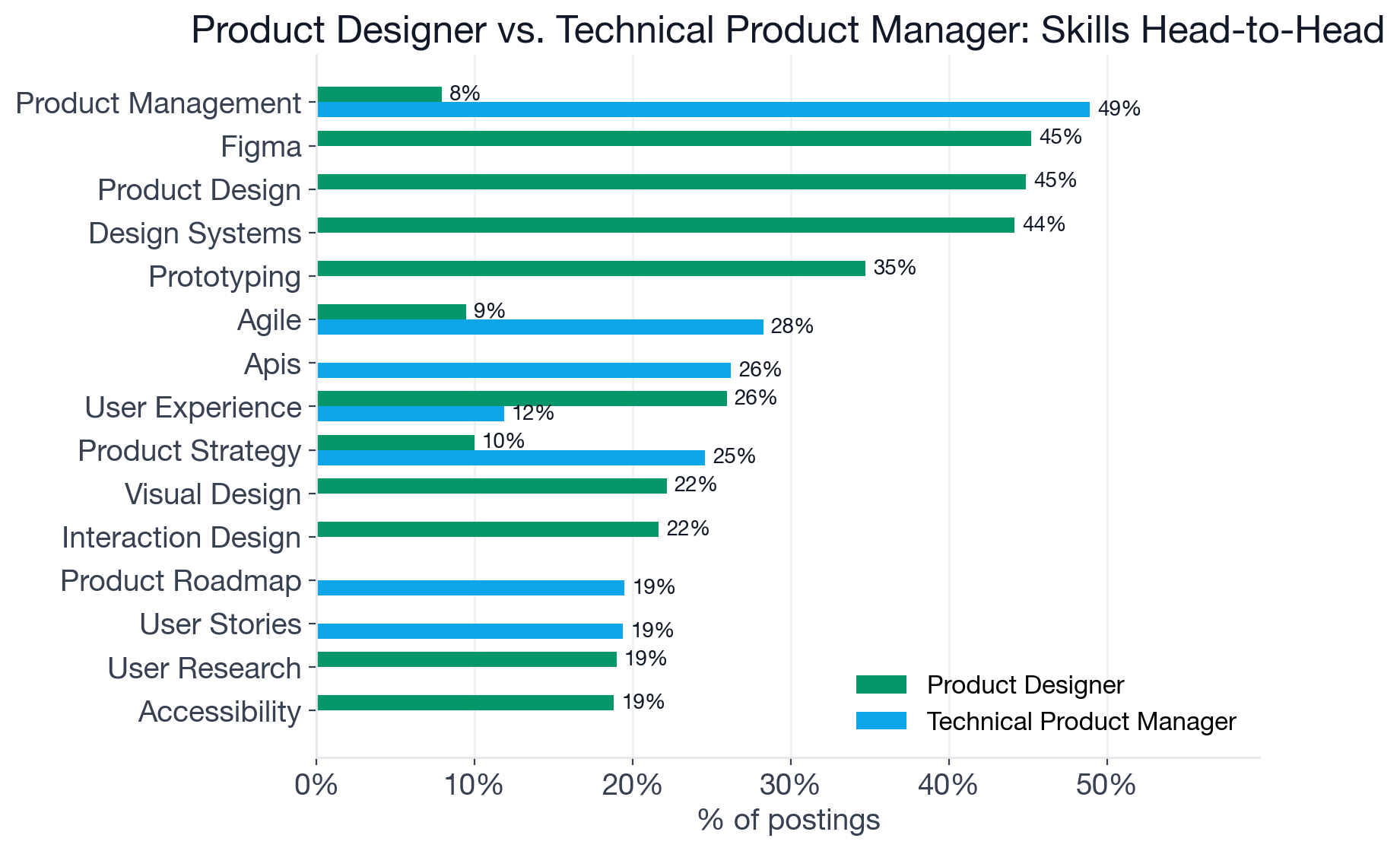 Product Designer's top skills cluster around craft (Figma, Product Design, Design Systems); Technical Product Manager's cluster around delivery and strategy (Product Management, APIs, Product Strategy). The two bar sets barely overlap.
Where the Two Skill Stacks Split
Product Designer's exclusive cluster: Figma (45.2%), Product Design (44.9%), Design Systems (44.2%), Prototyping (34.7%), Visual Design (22.1%), Interaction Design (21.6%), User Research (19.0%), Accessibility (18.8%), Storytelling (16.4%), and Typography (15.8%), a coherent craft stack for shaping and validating what a user sees and touches.
Technical Product Manager's exclusive cluster: APIs (26.2%), Product Roadmap (19.5%), User Stories (19.4%), Stakeholder Management (15.1%), Scalability (13.7%), SQL (13.2%), Monitoring (12.6%), Scrum (11.9%), Jira (10.5%), and Go To Market (9.9%), a stack for turning constraints into a shippable, defensible plan rather than a shippable interface.
Neither cluster borrows meaningfully from the other; a Product Designer moving into a Technical Product Manager role is picking up SQL and APIs from close to zero, not extending a design skill.
The one place both roles brush against the same trend is AI, though posting language undersells it on both sides. Generative AI and LLM skills don't clear Product Designer's top-30 list at all (under 6%), while Technical Product Manager names one in roughly 1 of every 13 postings. Both numbers measure who's hired to ship an AI-powered feature, not who uses AI tools day to day: Figma's 2026 survey puts generative-AI adoption at 72% among designers, and Productboard finds 94-96% among product professionals, both far above either posting-language figure.
Why Doesn't Either Role's Own Headline Skill Pay a Premium?
Product Designer's median US base salary, $166,500 versus $154,500, runs $12,000 (7.8%) above Technical Product Manager's. The more useful story is where the money sits. Figma, Product Designer's most common skill, prices $100 below the role's own baseline (n=431); Product Management, Technical Product Manager's headline skill at 48.9% of postings, adds only $7,500 (n=193). Neither role's defining skill is what a company actually pays extra for.
The real premiums sit one layer up in strategy scope. Design Strategy, too thin at 6.2% of Product Designer postings to count as a true exclusive, still carries the role's best-paid median: $210,000, a $43,500 premium (n=86). Program Management doesn't even crack Technical Product Manager's top-30 skill list, but it's the single highest-paid skill in the role's data: $186,200, a $31,700 premium (n=25, thin but directional). Product Strategy backs up the pattern from inside the shared-skill list: +$20,500 for Product Designer, +$8,000 for Technical Product Manager.
| Shared skill | Product Designer premium (own $166,500 baseline) | Technical Product Manager premium (own $154,500 baseline) |
|---|---|---|
| Product Strategy | +$20,500 (n=147) | +$8,000 (n=81) |
| User Experience | +$8,000 (n=280) | +$13,200 (n=46) |
| A/B Testing | +$10,000 (n=130) | +$10,500 (n=29) |
| Product Management | +$10,000 (n=117) | +$7,500 (n=193) |
| Automation | +$400 (n=86) | -$4,500 (n=63) |
| Agile | -$6,900 (n=77) | -$4,500 (n=91) |
| Project Management | -$21,500 (n=63) | -$12,500 (n=27) |
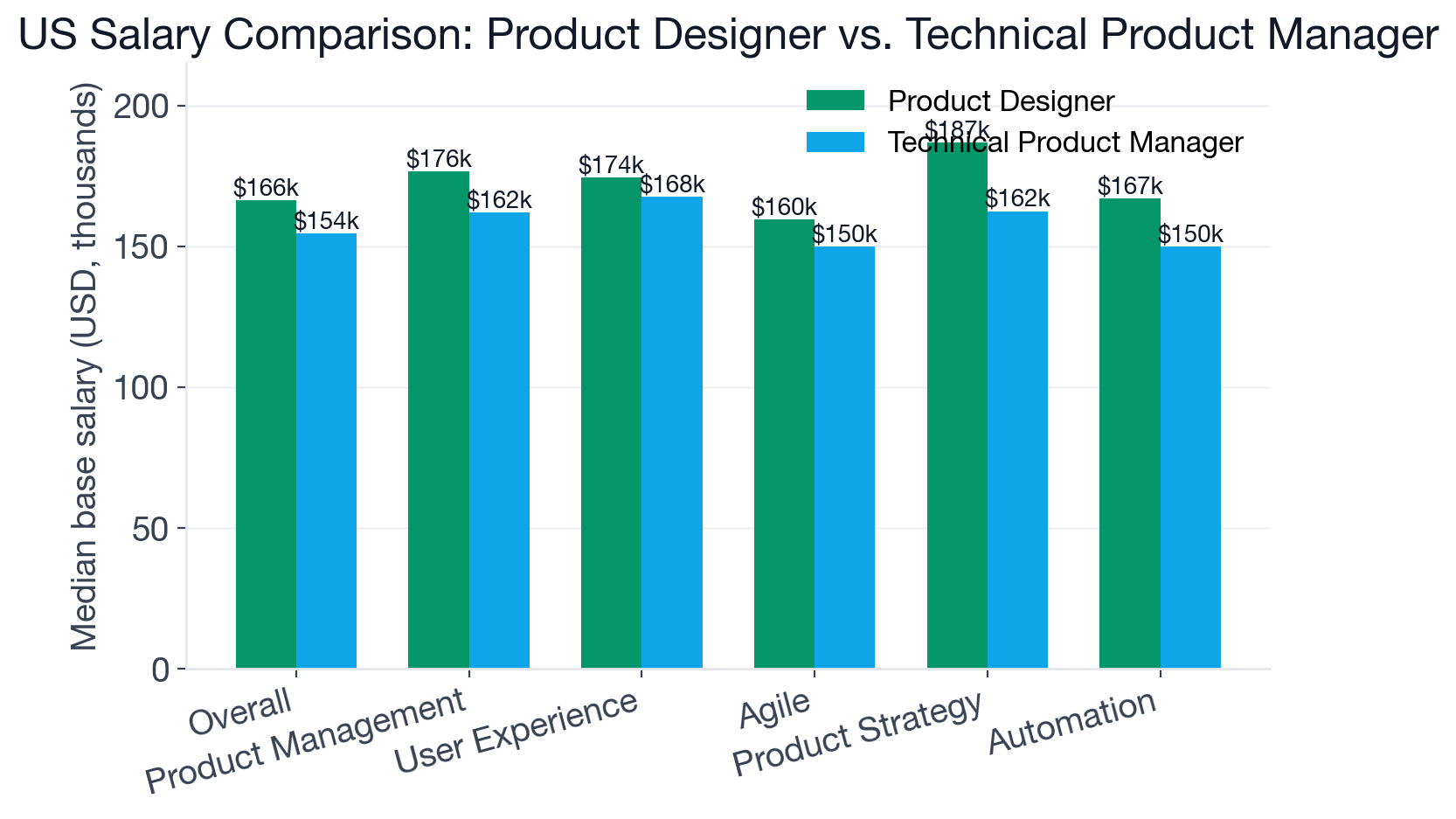 Product Designer's US base salary median sits $12,000 above Technical Product Manager's; both roles' own headline skills price flat or near-flat, with the real premiums a layer up in strategy work.
Which Role Has More Open Jobs, and Who Can Actually Get Hired?
Product Designer posts 3.45x more active openings than Technical Product Manager (3,576 versus 1,037), and its entry-level share (4.4%) is more than double Technical Product Manager's (1.8%), though both markets are built overwhelmingly for people who already have the job.
Seniority splits further apart than the "Technical" and "Manager" language would suggest. Technical Product Manager concentrates hard in the middle, 63.2% mid-level and just 9.9% staff, while Product Designer runs flatter: 47.3% mid-level, but a much larger 19.9% staff share and 28.4% senior. Combine senior and staff and Product Designer actually skews the more senior of the two roles (48.2% versus 35.0%), the opposite of what the job titles imply.
Geography and flexibility tell a smaller story. Technical Product Manager is more US-concentrated (50.9% versus 45.1%) and edges out Product Designer on flexibility, 29.2% hybrid versus 24.2% and 38.4% onsite versus 43.3%, though remote share is nearly identical (28.4% versus 29.4%). These gaps compound with the seniority numbers into the same picture: Technical Product Manager is the more concentrated, mid-level-heavy market of the two.
So Which Seat Should You Take?
Choose Product Designer if you:
- Want to spend your day producing and defending a concrete artifact (wireframes, prototypes, a design system), not a roadmap document.
- Already have craft experience in Figma, prototyping, or user research, these carry directly into a stack that clears 40%+ frequency across the market.
- Want 3.45x more open roles, a real shot at staff-level scope (19.9% of postings clear that bar), and the higher of the two medians ($166,500).
Choose Technical Product Manager if you:
- Want to sit at the intersection of engineering and the business, writing specs and owning what ships rather than how it looks.
- Have or want technical fluency, APIs and SQL show up in roughly a quarter and an eighth of postings, this isn't a role you can do without reading a system diagram.
- Value hybrid flexibility (29.2% of postings, versus 24.2% for Product Designer) and a tighter, faster path through mid-level hiring, even at a lower pay ceiling.
FAQ
Q. Does Product Designer or Technical Product Manager pay more in 2026?
Product Designer, by a modest margin. Its median US base salary is $166,500 versus $154,500 for Technical Product Manager, a $12,000 gap (7.8% above the Technical Product Manager baseline), based on 913 and 315 US salary data points respectively. Both figures are base pay only; equity, bonus, and sign-on aren't captured in job postings.
Q. How much skill overlap is there between Product Designer and Technical Product Manager?
Very little. The two roles share a 13% Jaccard overlap on their top-30 skill lists. Only seven skills clear the 5%-shared-frequency threshold in both roles' postings: Product Management, User Experience, Agile, Product Strategy, Automation, A/B Testing, and Project Management.
Q. Which role has more job openings, Product Designer or Technical Product Manager?
Product Designer, by a wide margin. The dataset analyzed 3,576 active Product Designer postings versus 1,037 for Technical Product Manager, a 3.45x volume advantage for Product Designer.
Q. What skills does Technical Product Manager require that Product Designer doesn't?
APIs (26.2% of postings), Product Roadmap (19.5%), User Stories (19.4%), Stakeholder Management (15.1%), and Scalability (13.7%) are Technical Product Manager's clearest exclusives, all business or engineering-adjacent skills that are absent from Product Designer's top-30 list.
Q. What skills does Product Designer require that Technical Product Manager doesn't?
Figma (45.2% of postings), Product Design (44.9%), Design Systems (44.2%), Prototyping (34.7%), and Visual Design (22.1%) define the Product Designer stack and rarely appear in Technical Product Manager postings.
Q. Is entry-level access easier for Product Designer or Technical Product Manager?
Product Designer, though neither role is easy to break into. Entry-level share sits at 4.4% for Product Designer versus 1.8% for Technical Product Manager, meaning both are overwhelmingly mid-level-and-up hiring markets.
Q. Do Product Designer or Technical Product Manager postings explicitly require AI skills?
Technical Product Manager mentions generative AI or LLM skills more often, roughly 7-8% of postings versus under 6% for Product Designer (absent from its top-30 list). That gap reflects which role is hired to build AI-powered features, not who uses AI tools day to day: independent 2026 surveys put generative-AI adoption at 72% among designers (Figma, State of the Designer 2026) and 94-96% among product professionals (Productboard), regardless of what the job posting states.
Titles Lie About Where the Money Sits
"Technical" doesn't win this comparison, and neither role's own headline skill explains why it lost. Figma prices flat against Product Designer's baseline; Product Management adds just $7,500 to Technical Product Manager's. The real premiums sit a layer up, in Product Strategy and Design Strategy on the design side, in Go To Market (+$18,000, n=40) and Program Management on the product side, strategy and business scope, not the tools or acronyms printed on the job title. If you're choosing between these two paths, weigh the actual work (craft versus translation) over what either title implies about seniority or pay. Browse live Product Designer or Technical Product Manager postings on InterviewStack.io, read our Technical Product Manager skills breakdown for more on that exclusive list, and if a broader Product Manager path is also on your shortlist, our Product Manager vs Product Designer comparison covers that decision too. Practice with AI mock interviews or work through our interactive courses to close whichever skill gap you're choosing to cross.
Topics
Ready to practice?
Put what you've learned into practice with AI mock interviews and structured preparation guides.