
Python Shows Up in About a Third of Tech Postings, Mostly as a Preference
Python is asked for in 48,116 of 152,183 active tech postings (31.6%) on the InterviewStack.io job board over the last 90 days, and that share has not moved: 31.4%, 31.6% and 31.5% across the three 30-day windows. Where the posting discloses US base pay, comparing the same role and seniority, postings that ask for Python advertise 4.2% more on average, but that gap is positive in 54 role-and-level groups and negative in 25, so there is no single Python premium.
That is the short answer to "is Python worth learning?" Yes for breadth, with a catch: when a posting spells out how much it wants Python, 4 in 5 mentions are "preferred" rather than "required." Python behaves like a door-opener across 39 roles, not a hard gate, and what it signals about pay depends heavily on which role you are in. Counts below come from active postings with the tool extracted from the skills field; pay is US advertised base only, so equity and bonus are not included.
Key Findings
- Python appears in 48,116 of 152,183 active postings (31.6%), and in all 39 roles tracked, over the last 90 days.
- Demand is flat: 31.4%, 31.6% and 31.5% of postings in the three 30-day windows.
- Software Engineer is 24.8% of all Python postings (11,922), but Python is only in 37.9% of Software Engineer postings; in Data Engineer it is 64.9% and in Applied Scientist 69.1%.
- Of 11,090 mentions with required-or-preferred wording nearby, 20.2% are required and 79.8% are preferred.
- Same role and seniority, US advertised base pay is 4.2% higher on average for Python postings (92 groups, covering 97% of Python postings), but 54 groups go up and 25 go down.
- Mid-level Data Engineer postings that ask for Python advertise a $133,156 median versus $148,400 without it (-10.3%); mid-level QA Engineer goes the other way, $117,500 versus $92,500 (+27.0%, likely label noise).
- Bash (2.8x), Databricks (2.2x) and Terraform (2.1x) are the tools most over-represented next to Python; AWS and SQL are common but only 1.7x and 1.8x.
- Entry-level is 6.7% of Python postings versus 6.1% of non-Python postings, so Python is not an entry-level barrier, though senior and staff titles are somewhat more common with it (42.8% versus 36.3%).
Who Asks for Python? Software Engineering by Volume, Data and AI by Habit
The volume story and the standard-practice story point at different roles. Software Engineer contributes the most Python postings by far, yet only just over a third of its openings mention it. In data and AI roles, Python is close to a default.
| Role | Postings asking for Python | Share of that role's postings |
|---|---|---|
| Software Engineer | 11,922 | 37.9% |
| Data Engineer | 4,068 | 64.9% |
| Data Scientist | 3,465 | 63.4% |
| DevOps Engineer | 2,642 | 55.4% |
| AI Engineer | 2,451 | 62.9% |
| Data Analyst | 2,316 | 42.2% |
| Machine Learning Engineer | 2,077 | 66.0% |
| QA Engineer | 1,920 | 16.1% |
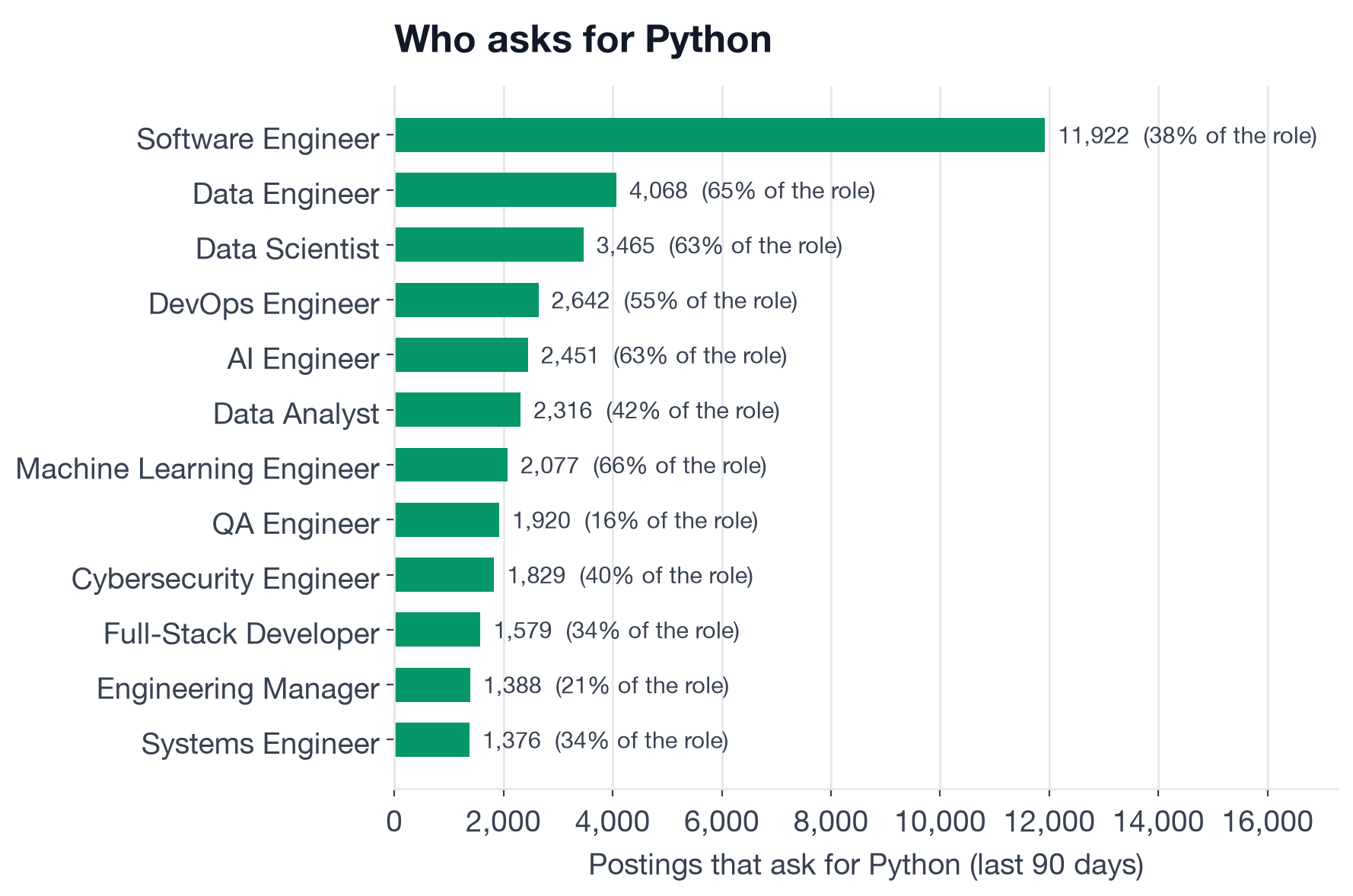
Python is the working language of data and ML roles and one of several options in general software engineering, so which language to learn depends on the role you are targeting. If you are aiming at the first group, see our deeper breakdowns for Data Engineer and Data Scientist skills; for the biggest pool, see Software Engineer skills.
Is Python Required or a Nice-to-Have?
Mostly a nice-to-have: 79.8% of classified mentions are preferred and 20.2% required. This split covers a subset only. Of 48,116 Python mentions, 11,090 have required or preferred wording within a short window of the mention, 30,363 have none, and 6,663 could not be located in the text, so read it as indicative rather than exact.
For a job seeker, that means a missing Python line on a resume rarely disqualifies you outright, but it removes a signal that postings in data and infrastructure roles frequently name. Python reads as a tiebreaker, and in roles where about two-thirds of postings mention it, being without it puts you in a minority.
The Pay Picture Splits by Role, Not by Tool
Postings that ask for Python do advertise slightly more on average, but the average hides a split. Pay figures here are US advertised base salary on postings that disclose it, compared within the same role and seniority; equity and bonus are not included. This is a correlation in what employers advertise, not evidence that learning Python changes what you will be paid.
Across 92 role-and-level groups covering 97% of Python postings, the weighted gap is +4.2%, positive in 54 groups and negative in 25. The table shows the largest groups with at least 100 salaries on each side:
| Role and level | With Python (median) | Without (median) | Gap |
|---|---|---|---|
| QA Engineer, mid-level | $117,500 | $92,500 | +27.0% |
| AI Engineer, mid-level | $155,000 | $126,800 | +22.2% |
| Data Scientist, mid-level | $143,000 | $124,275 | +15.1% |
| Software Engineer, entry | $97,760 | $86,000 | +13.7% |
| Data Analyst, mid-level | $112,450 | $100,000 | +12.5% |
| Software Engineer, senior | $182,500 | $178,175 | +2.4% |
| Data Engineer, senior | $154,625 | $159,050 | -2.8% |
| Machine Learning Engineer, mid-level | $160,500 | $167,525 | -4.2% |
| Software Engineer, mid-level | $152,500 | $160,000 | -4.7% |
| DevOps Engineer, mid-level | $131,000 | $139,775 | -6.3% |
| Data Engineer, mid-level | $133,156 | $148,400 | -10.3% |
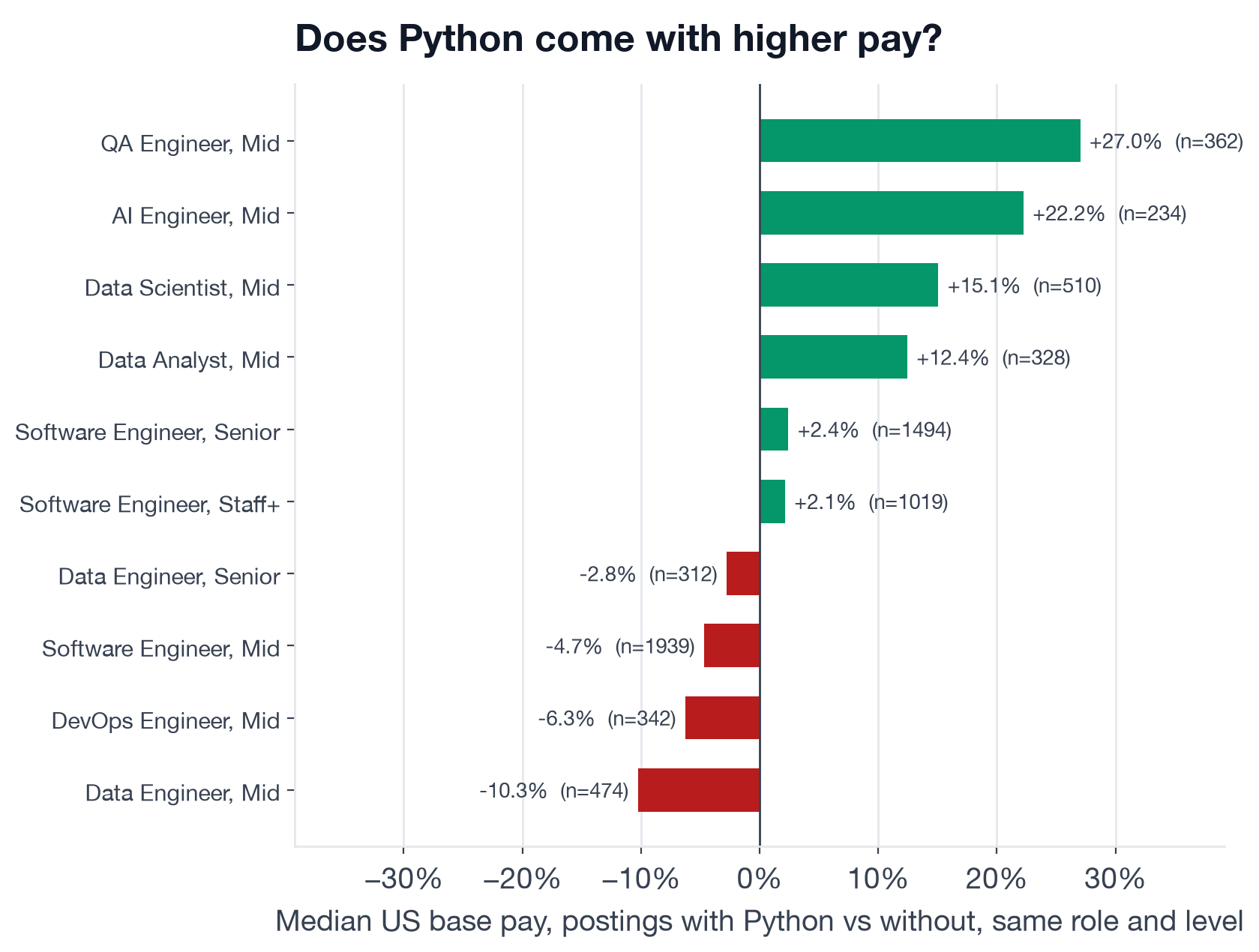
One caution on the biggest gap: the QA Engineer label can also catch quality roles outside software, so the +27.0% likely partly reflects Python postings skewing toward test-automation work rather than Python itself. Two readers get opposite answers. In QA, AI, analyst and entry-level software groups, Python postings advertise clearly more. In mid-level Data Engineer, DevOps, ML Engineer and Software Engineer postings, and in senior Data Engineer postings, the ones that ask for Python advertise less, and "Python comes with higher pay" would be false. The data does not say why, so we do not guess; the practical read is to check your own role-and-level row instead of trusting the headline. The largest cells are solid: mid-level Data Engineer rests on 474 salaries with Python and 211 without.
What Should You Learn Next With Python?
Rank by lift, not by share. AWS (34.2% of Python postings) and SQL (33.4%) look like the obvious partners, but both are common everywhere, so their lift is only 1.7x and 1.8x. The tools that really cluster with Python are further down the list.
| Tool | Share of Python postings | Lift vs all postings |
|---|---|---|
| Bash | 12.1% | 2.8x |
| Databricks | 8.8% | 2.2x |
| Terraform | 14.4% | 2.1x |
| Apache Spark | 9.7% | 2.0x |
| C++ | 12.7% | 2.0x |
| Google Cloud | 16.9% | 1.9x |
| Docker | 17.3% | 1.9x |
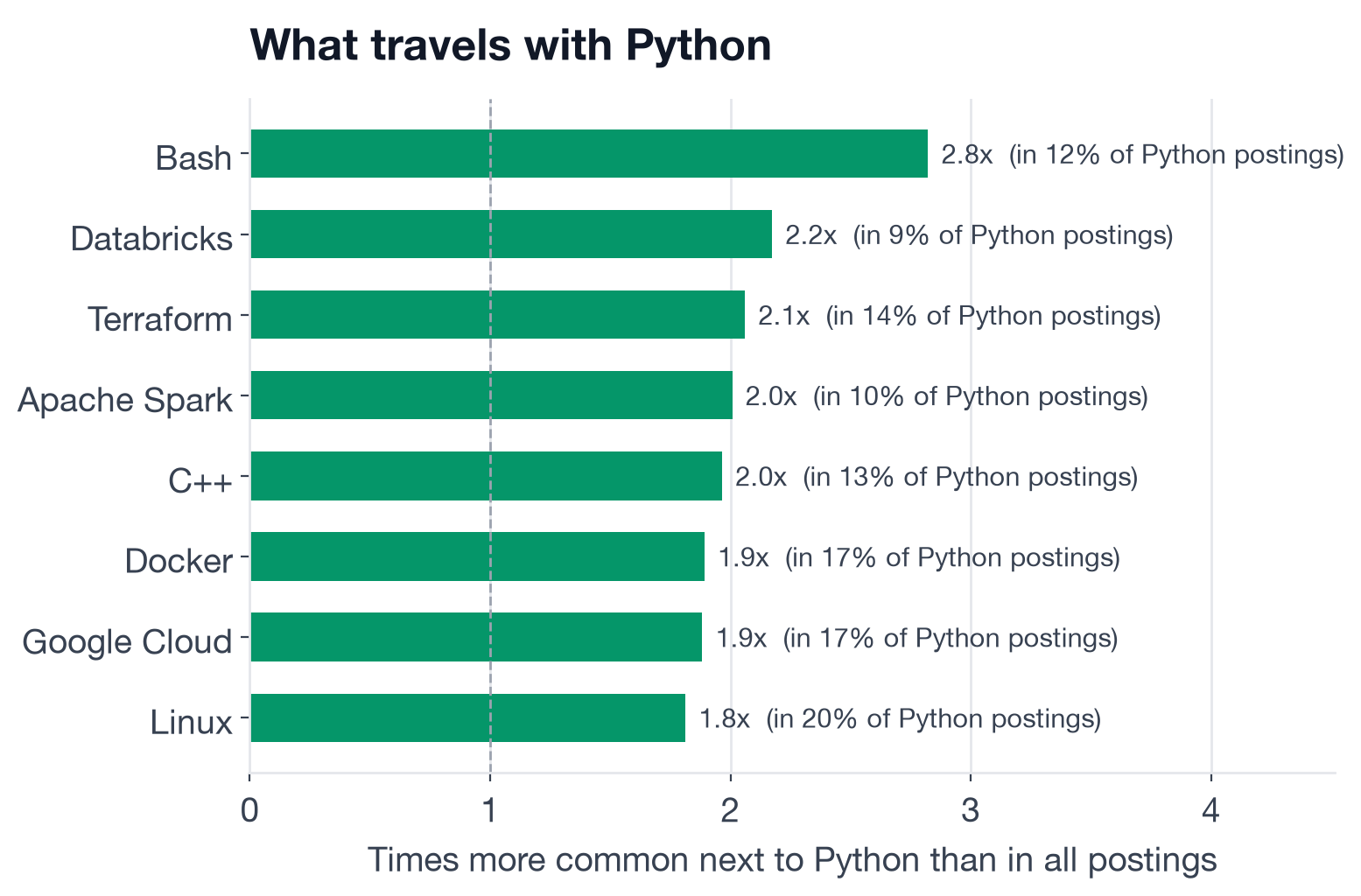
The pattern is a pull in two directions. Bash, Terraform and Docker point toward automation and infrastructure work, and Databricks and Spark toward data platforms. Python alone is common; Python plus one of these is a more specific profile. On the skill-pairing side, the most frequent non-tool concepts in Python postings are Automation (42.1%), CI/CD (32.5%) and Data Analysis (32.2%). Machine Learning shows up in 21.4%, so Python in this market is as much a scripting and pipeline language as an ML one.
Which Employers Hire for Python?
The list is broad, led by large technology employers, with a visible defense and government-contractor cluster. By distinct openings (not repostings), the top Python employers are Amazon (781), NVIDIA (526), Google (462), Microsoft (359) and Qualcomm (336). Cisco appears under two labels ("Cisco" at 235 and "Cisco Systems, Inc." at 228), so its combined count is roughly 463, and counts should be read as approximate.
Below those, PricewaterhouseCoopers (290) and Citi (238) represent consulting and finance. The defense and government cluster is notable: Booz Allen Hamilton (279), Leidos (211), Thales (194), SpaceX (197) and Northrop Grumman (180). No single industry owns the list, which fits a language used for scripting, data and AI work across sectors.
How to Use This in Your Job Search
Start from your target role and level rather than from the language. If you are aiming at data or ML roles, Python is close to a default and you should show it through projects and pipelines. If you are in general software engineering or QA, decide whether Python is your primary language or a second one.
Browse the live InterviewStack.io job board to see how often your target roles ask for it. Use the question bank to drill Python and data-structure questions, and our interactive courses to build a pairing skill such as Spark, Docker or Terraform. Then practice with AI mock interviews so you can explain your Python work out loud, which is where "preferred" skills get tested.
FAQ
Q. Is Python worth learning in 2026?
Yes, for most technical roles. Python appears in 48,116 of 152,183 active postings (31.6%) on the InterviewStack.io job board over the last 90 days, across all 39 roles tracked, and that share has been flat at 31% to 32% in each 30-day window.
Q. Is Python required or just a nice-to-have in job postings?
Mostly a nice-to-have. Among the 11,090 Python mentions where nearby wording says required or preferred, 20.2% are required and 79.8% are preferred. Only about 1 in 4 mentions carries that wording, so treat the split as indicative.
Q. Do postings that ask for Python advertise higher pay?
Not consistently. Comparing the same role and seniority, US advertised base pay is 4.2% higher on average for postings that ask for Python, but the gap is positive in 54 role-and-level groups and negative in 25. It is a correlation, not a price tag.
Q. Which roles ask for Python the most?
By volume, Software Engineer leads with 11,922 postings. By how standard it is inside the role, Applied Scientist (69.1%), Machine Learning Engineer (66.0%), Data Engineer (64.9%), Data Scientist (63.4%) and AI Engineer (62.9%) ask for it most often.
Q. What should you learn alongside Python?
The strongest pairings by lift are Bash (2.8x), Databricks (2.2x), Terraform (2.1x), Apache Spark (2.0x) and C++ (2.0x). AWS and SQL appear in about a third of Python postings each, but they appear next to almost everything.
Q. Can you get an entry-level job with Python?
Python is not an entry-level barrier, but it tilts slightly senior. Entry-level is 6.7% of Python postings versus 6.1% of postings without it, while senior and staff titles are 42.8% of Python postings versus 36.3% without. Seniority is inferred from title keywords and untagged titles default to mid-level, so read these as approximate. Entry-level openings are scarce either way.
Where to Start
Learn Python if you are heading toward data, ML, AI or infrastructure work, where it is close to standard, and treat it as one strong option rather than a pay lever if you are in general software engineering. Then pick the pairing (Bash, Terraform, Spark or Databricks) that matches the role you want, and check your own role-and-level row before assuming a premium.
Topics
Ready to practice?
Put what you've learned into practice with AI mock interviews and structured preparation guides.