
Deleting the Table Is the Easy Part
You are 14 minutes into a mid-level Security Architect interview. You have just laid out clean retention windows for the app database, and the interviewer says, "And the search index? The warehouse? The backups?" Candidates who prepared policy language go quiet here, because the points were never in the policy. They were in the copies.
This is a simulated walkthrough built on one real AI mock interview blueprint for a data minimization and retention question. The answers below are illustrative, written to show common patterns, not a transcript of anyone.
Key Findings
- The interview is scored out of 100 points across 4 dimensions; only 20 points are for Technical Proficiency.
- Interviewer Objectives Alignment and Level-Specific Expectations are worth 30 points each, 60 combined.
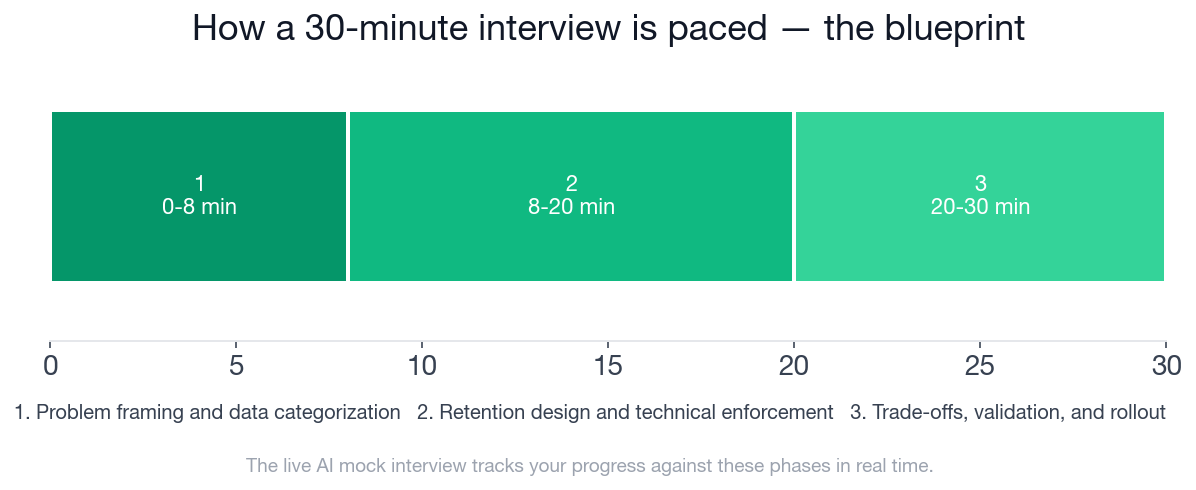
- The blueprint runs 30 minutes in 3 phases: 0 to 8, 8 to 20, and 20 to 30 minutes.
- The enforcement phase is the longest at 12 minutes and has 5 of the blueprint's 13 checklist items.
- The interviewer expectations name derived datasets, replicas, logs, backups, and legal holds as hard cases a candidate should recognize.
- Level-specific expectations list 5 items, including "practical controls that existing engineering teams could implement incrementally."
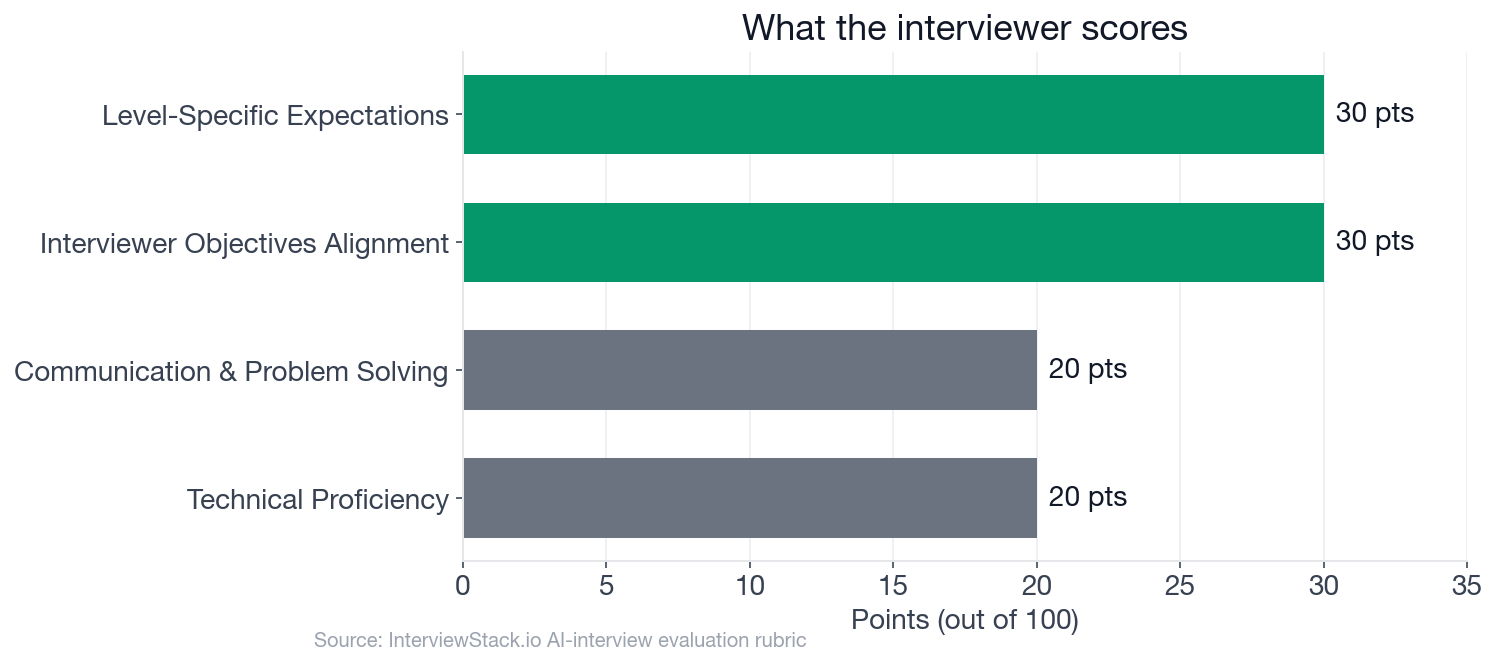
The 20-point technical slice is the surprise: knowing TTLs and lifecycle rules matters, but objectives, level-appropriate depth, and communication carry most of the score.
What Does the Interviewer Actually Ask You to Design?
The interview question
You are supporting a consumer product team for a large-scale mobile and web service with user accounts, payments, messaging-based support, and growth analytics. It stores broad profile data, device and IP logs, payment-related metadata, support tickets, and detailed event telemetry across the primary application database, a data lake, a search index used by support, and backups.
An internal review found teams keeping data "just in case," inconsistent retention across systems, and mostly manual deletion. The product still needs fraud investigations, customer support, product analytics, legal holds, and basic security monitoring.
How would you design a data minimization and retention approach so the company keeps only what it needs, for as long as it needs it, and can enforce that consistently across its systems?
The interviewer is probing whether you can turn business uses into purpose-limited collection, set retention by data category, enforce deletion technically, and defend trade-offs against analytics, fraud, and support. That is an architecture problem wearing a policy costume.
The Walkthrough: Four Follow-Ups, Four Ways to Lose Points
Meet Marcus, a capable candidate who has read the privacy regulations. A common answer pattern from candidates like Marcus follows in each turn.
Turn 1: Collect, derive, or drop
Interviewer: "How would you decide whether a given data element should be collected at all versus derived later or dropped entirely?"
Turn 2: One record, many copies
Interviewer: "What would your design do about data that exists in several places, like the app database, search index, warehouse, and backups?"
Turn 3: Exceptions without loopholes
Interviewer: "How would you handle exceptions such as legal holds, active fraud investigations, or unresolved support cases without making the retention policy meaningless?"
Turn 4: Prove it is working
Interviewer: "What signals, metrics, or controls would you use to prove that retention and deletion are actually being enforced over time?"
Why Isn't Reading This Enough?
Every mistake above is easy to spot on the page. Live, with a clock running and a follow-up you did not predict, the same candidate who nodded along at Turn 2 forgets the search index. That gap is not knowledge. It is reps: saying a layered answer out loud, getting redirected, and recovering without losing the thread.
The Blueprint a Strong Candidate Hits
This is the phase-by-phase blueprint a strong answer covers, and it is what the AI mock interview tracks you against in real time. Notice how much of the 30 minutes sits in the middle phase.
- ✓Asks or states assumptions about product functions, business purposes, and major data stores
- ✓Segments data into meaningful categories such as account/profile, payments metadata, support content, telemetry, security logs, and derived analytics data
- ✓Distinguishes between primary use, secondary use, and 'just in case' collection
- ✓Introduces the idea of retention schedules tied to documented purpose or obligation
- ✓Proposes concrete retention windows or tiering logic for multiple data classes, even if framed as examples pending validation
- ✓Describes enforcement mechanisms in the app database, logs, analytics stores, indexes, and object storage rather than speaking only at a high level
- ✓Addresses derived data, duplicated data, and downstream dependencies explicitly
- ✓Explains a workable approach for backups, such as limited backup retention, non-restoration except under controlled processes, or expiration-aligned lifecycle handling
- ✓Includes exception handling for legal hold or investigations with bounded, auditable overrides
- ✓Balances analytics, support, fraud, and security needs against minimization by suggesting aggregation, pseudonymization, sampling, or shorter raw-data retention where appropriate
- ✓Suggests validation mechanisms such as retention coverage metrics, age-of-data reporting, deletion success/failure monitoring, and periodic audits
- ✓Describes an incremental rollout plan such as inventory first, high-risk datasets first, then automated controls and exception workflow
- ✓Communicates realistic risks and dependencies without becoming blocked by missing information
Run It Live Before It Counts
The fastest way to find your own Turn 2 is to start the AI mock interview for this exact scenario. You get unscripted follow-ups, a 30-minute clock, and feedback against the four rubric dimensions above. For more reps on the same topic, work through the data minimization and retention question bank, then browse current Security Architect openings or the company preparation guides to see where the skills get used. If policy questions are your weak spot, our sibling walkthrough on security policy and standards is a good next rep.
FAQ
Q. How is a Security Architect data minimization and retention interview scored?
The AI mock interview scores 100 points across four dimensions: Interviewer Objectives Alignment (30), Level-Specific Expectations (30), Technical Proficiency (20), and Communication & Problem Solving (20). Only 20 points are labeled Technical Proficiency; the other 80 cover objectives alignment, level-specific depth such as trade-offs and system thinking, and communication.
Q. How long is the interview and how is the time split?
The blueprint runs 30 minutes in three phases: problem framing and data categorization (minutes 0 to 8), retention design and technical enforcement (8 to 20), and trade-offs, validation, and rollout (20 to 30). The middle phase is the longest at 12 minutes and carries 5 checklist items.
Q. What do interviewers expect a mid-level Security Architect to cover?
Structure without heavy prompting: data categories, purposes, retention tiers, and enforcement paths. They also expect incremental controls existing teams can ship, awareness of failure modes like orphaned copies and backup mismatch, and clear trade-offs. Jurisdiction-by-jurisdiction legal analysis is explicitly not expected.
Q. How should you handle backups in a retention design?
Treat backups as a data store with its own schedule. A workable answer limits backup retention so it expires in line with the policy, restricts restores to controlled processes, and re-applies deletions after any restore. The blueprint lists this as one of 5 checklist items in the enforcement phase.
Q. How do you keep legal holds from making a retention policy meaningless?
Make exceptions bounded and auditable: a named owner, a scope limited to the affected records, an expiry or review date, and a log of who invoked the hold. Everything outside the hold keeps deleting on schedule.
Q. How do you prove deletion is actually happening?
Report on it. Retention coverage (share of datasets with an enforced schedule), age-of-data reporting against the schedule, deletion job success and failure monitoring, and periodic audits all count toward the validation checklist in the final 10 minutes.
Where Your Next Rep Goes
Retention answers are won in the copies, the exceptions, and the proof, not in the schedule. Pick one of the four turns you would have fumbled, say the stronger move out loud, and then let the mock interviewer push back.
Topics
Ready to practice?
Put what you've learned into practice with AI mock interviews and structured preparation guides.