
The Written Layer Is the Whole Interview
You have prepared well. You can recite ISO 27001 clauses, you know the HIPAA safeguards, and when the interviewer opens a mid-level Security Architect interview on security policy and standards, you reach for the thing you know best: tooling. Automated guardrails, scanners, policy-as-code. That instinct is exactly what this interview is built to catch. The blueprint explicitly lists policy-as-code and runtime control automation as forbidden territory, because the question is about the written control layer, not the enforcement layer.
This walkthrough follows one illustrative 30-minute interview blueprint, turn by turn, with a dramatized candidate named Priya. The answers are illustrative, not a transcript of a real person. The mistakes are the ones prepared candidates commonly make, each tied to the scoring rubric the AI mock interview uses.
Key Findings
- The interview runs 30 minutes in 3 phases: 10 minutes of framing, 12 minutes of rollout and exceptions, and 8 minutes of framework mapping and metrics.
- The rubric totals 100 points: Interviewer Objectives Alignment and Level-Specific Expectations are 30 points each, Technical Proficiency and Communication & Problem Solving are 20 each.
- Only 20 of 100 points reward technical accuracy; 60 points reward answering the stated objectives and showing mid-level judgment.
- The policy hierarchy has 4 layers (policy, standard, procedure, guideline), and the first phase checks that you can define all 4 in practical terms.
- A passing exception process needs 4 elements: an approver, a duration, compensating controls, and tracking.
- The program is scoped to 2 quarters, so a small prioritized document set beats documenting everything at once.
- 4 areas are out of scope, including policy-as-code design and hands-on cloud hardening; drifting into them costs points.
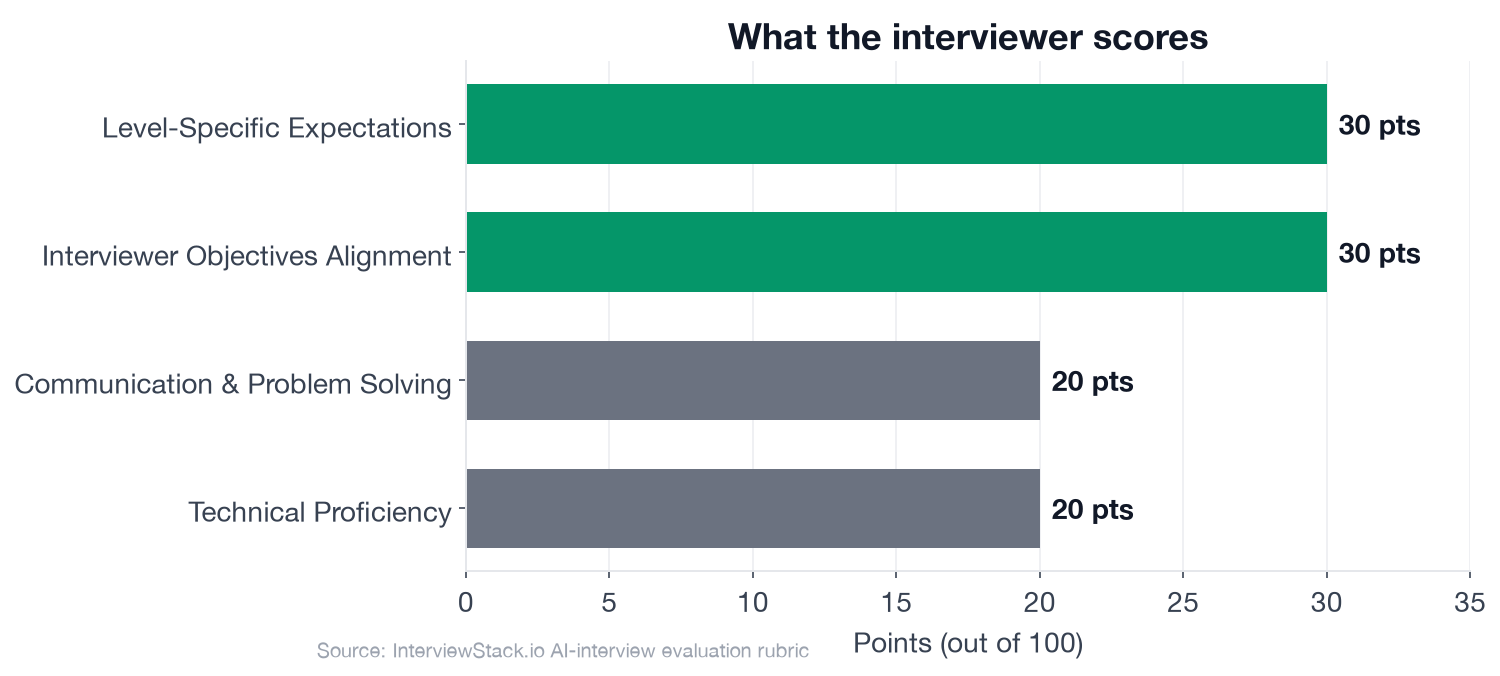
Judgment and scope discipline outweigh technical depth three to one, which is why a tool-first answer scores worse than a plain, well-sequenced governance plan.
What Does a Security Architect Policy Interview Actually Grade?
The interviewer opens with a scenario and one broad ask. Read it the way a strong candidate would: assumptions first, scope second, tools last.
The interview question
A rapidly growing cloud-first technology company is preparing for enterprise customer expansion in healthcare and financial services. Today, security expectations are scattered across wiki pages, team-specific runbooks, and onboarding docs. Different product teams make inconsistent decisions about data handling, access reviews, encryption, logging, and third-party integrations. Leadership wants a formal security policy program that will hold up to customer due diligence and audits, but they are concerned about slowing down product delivery.
Your role is to propose how you would build the written control layer for this company over the next two quarters.
How would you design and roll out a security policy and standards development program for this company?
Underneath, the interviewer is probing whether you can translate governance intent into a usable hierarchy, balance prescriptiveness against usability, handle exceptions, and define ownership and review cadence. The tension in the scenario is deliberate: auditors want consistency, engineers want speed, and a mid-level architect is expected to hold both without escalating everything.
Four Turns Where Prepared Candidates Leak Points
The interviewer has six follow-ups available. These four cover all three phases.
Turn 1: Sorting the document hierarchy
Interviewer: "How would you decide what belongs in a policy versus a standard, procedure, or guideline in this environment?"
Turn 2: Absorbing engineering pushback
Interviewer: "If engineering leaders push back that the standards are too rigid for different product stacks, how would you handle that without weakening the program?"
Turn 3: Designing the exception path
Interviewer: "How would you design the exception process so that teams can move forward when needed but risk is still visible and governed?"
Turn 4: Proving the program works
Interviewer: "Once the documents are published, how would you measure whether the policy program is actually being adopted and staying current?"
Why Isn't Reading This Enough?
Spotting these mistakes on the page is easy, because you know what is coming. Live, the follow-up arrives unscripted, the clock is running, and the tool-first instinct is faster than the governance answer. Knowing that the hierarchy question exists is not the same as sorting access reviews through four layers in 90 seconds without losing your thread.
That gap closes only with reps. Each repetition teaches you where your own answer drifts: into tooling, into vague definitions, into an exception process with no expiry.
What Does the Full Blueprint Look Like?
This is the blueprint a strong candidate hits across the 30 minutes, and it is exactly what the AI mock interview tracks you against in real time. Use it as a checklist for your next practice run.
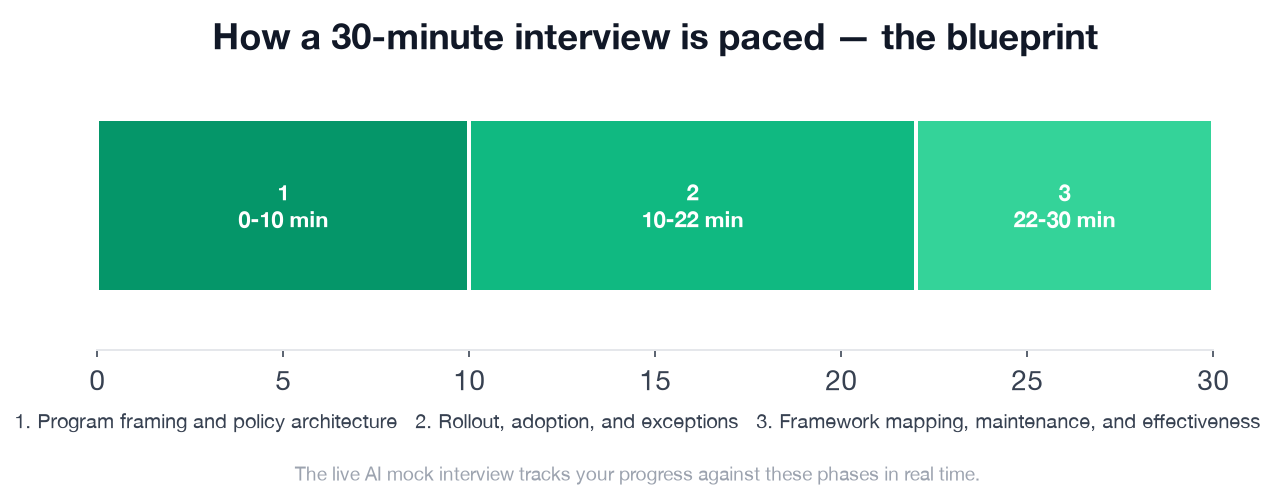
The pacing is front-loaded on structure: if the hierarchy is not clear by minute 10, the rollout and exceptions conversation has nothing to stand on.
- ✓Asks or states reasonable assumptions about company size, regulatory exposure, and product diversity
- ✓Defines distinctions among policy, standard, procedure, and guideline in practical terms
- ✓Proposes a small, prioritized initial policy set rather than attempting to document everything at once
- ✓Identifies core stakeholders such as security, engineering, legal/privacy, IT, and executive approvers
- ✓Describes a realistic approval and publication process with document owners
- ✓Explains how standards would be socialized with engineering teams before enforcement expectations are set
- ✓Includes an exception mechanism with approver(s), duration, compensating controls, and tracking
- ✓Addresses team variation by allowing procedures to differ while standards remain consistent where needed
- ✓Mentions training, templates, office hours, or embedded partner models to improve adoption
- ✓Maps the policy set to at least one or two relevant frameworks or regulatory drivers such as ISO 27001, SOC 2, HIPAA, or PCI-related obligations
- ✓Describes versioning and periodic review triggers such as annual review, major incidents, new products, or regulatory change
- ✓Suggests measurable indicators like exception volume, review completion rates, evidence of acknowledgment, audit findings, or reduction in policy ambiguity
- ✓Keeps the focus on the written control layer rather than drifting into purely technical runtime enforcement design
Practice It Live Before the Real One
Run this exact scenario in the AI mock interview, a 30-minute session where follow-ups are unscripted and your answer is tracked against the blueprint above. You will see which checklist items you hit, where you drifted, and how the rubric scored you. Do it twice: once cold, once after fixing the first run's gaps.
If you want to drill the underlying concepts first, the security policy and standards question bank covers the hierarchy, exceptions, and framework mapping one question at a time. For adjacent practice, the Security Architect threat modeling walkthrough follows the same format on a different topic, the preparation guides cover company-specific loops, and you can browse current Security Architect openings to see which governance and framework skills employers ask for.
FAQ
Q. What does a Security Architect security policy interview test?
It tests whether you can turn governance and regulatory intent into a written control layer: a policy hierarchy, a rollout plan, an exception process, framework mapping, and adoption metrics. The 30-minute interview is scored out of 100 points, and Level-Specific Expectations plus Interviewer Objectives Alignment carry 30 points each.
Q. What is the difference between a policy, a standard, a procedure, and a guideline?
A policy is a short, executive-approved statement of intent that rarely changes. A standard sets the mandatory requirements that make the policy measurable, a procedure is the team-owned step-by-step method, and a guideline is optional advice. Interviewers want you to sort a real document, such as access reviews, through all four layers rather than recite definitions.
Q. How do you handle engineering pushback that standards are too rigid?
Keep standards outcome-based and let each product stack write its own procedure for meeting them. Socialize drafts with engineering leads before any enforcement expectation is set, and escalate only the highest-risk or cross-functional disputes. That protects consistency without forcing one implementation on every team.
Q. What should a policy exception process include?
At minimum: a named approver scaled to the risk, a fixed duration, compensating controls, and a tracked record in a register. Rising exception volume against one standard is a signal that the standard itself needs revision.
Q. Which frameworks should a mid-level Security Architect map policies to?
Map to one or two drivers that match the business, such as ISO 27001, SOC 2, HIPAA, or PCI-related obligations. The interview expects practical control mapping, not detailed legal interpretation of regulations.
Q. Do I need to design policy-as-code for this interview?
No. At mid-level the focus stays on the written control layer. Drifting into runtime enforcement or automated guardrails is outside the scope of this blueprint and can cost you points on both Level-Specific Expectations and Interviewer Objectives Alignment.
Where to Start This Week
Pick one real topic from your own work, such as access reviews, and write out its policy, standard, procedure, and guideline on one page. Then say the exception process out loud in four elements. If either feels slow, that is the rep to take into a live mock interview.
Topics
Ready to practice?
Put what you've learned into practice with AI mock interviews and structured preparation guides.