
One Skill Ties at 39%. Nothing Else Does.
Pull the top skill lists for Systems Administrator and Cloud Engineer side by side and one number jumps out: Monitoring shows up in 38.99% of Systems Administrator postings and 38.93% of Cloud Engineer postings, a gap of six hundredths of a percentage point. That's not a rounding coincidence you'd expect between two roles with such different day jobs. We pulled every active posting on the InterviewStack.io job board that passes the same quality filter shown on the job board itself: 4,263 for Systems Administrator, 3,766 for Cloud Engineer. Like any large-scale title classifier, both samples carry a modest tail of adjacent specializations, ERP/SAP and D365 cloud administrators and security-focused Azure administrators on the Cloud Engineer side, tool-specific admin titles like Jira on the Systems Administrator side, that sit at the edge of the role rather than dead center. The skill and salary patterns below are directionally solid, but treat the sharpest single-point comparisons as a strong signal rather than a precise census.
Past Monitoring, the tie evaporates. AWS and Azure are technically "shared" skills too, both roles clear the 5% threshold, but each skews toward Cloud Engineer, AWS by about 2.8x and Azure by about 2.1x. Automation clears the same threshold but skews more modestly, about 1.6x. Windows skews back toward Systems Administrator by about 2.7x; Linux skews back too, but only by about 1.4x, a noticeably smaller gap than Windows. And the pay gap that opens up once you leave the shared skill set is real: Cloud Engineer's median US base salary runs $31,000 above Systems Administrator's (these are base-only figures; postings don't disclose equity or bonus).
| Systems Administrator | Cloud Engineer | |
|---|---|---|
| Median US base salary | $115,000 | $146,000 |
| Active postings | 4,263 | 3,766 |
| Top skill | Monitoring (39.0%) | AWS (46.9%) |
| Hybrid + remote share | 35.9% | 54.9% |
| Entry-level share | 2.9% | 3.7% |
| Skill overlap (Jaccard) | 36% shared (pairwise) | 36% shared (pairwise) |
Key Findings
- Monitoring is the single closest skill match between any two roles we've compared: 38.99% of Systems Administrator postings vs. 38.93% of Cloud Engineer postings.
- Cloud Engineer's median US base salary is $146,000 vs. $115,000 for Systems Administrator, a $31,000 premium, 27% above the Systems Administrator baseline.
- Systems Administrator has 1.13x the posting volume (4,263 vs. 3,766), but Cloud Engineer offers far more flexibility: 54.9% hybrid or remote vs. 35.9%.
- Skill overlap sits at 36% (Jaccard on each role's top 30 skills); shared skills like AWS, Azure, and Kubernetes are lopsided 2 to 4.5x toward Cloud Engineer.
- Neither role is an easy first job: entry-level share is 2.9% for Systems Administrator and 3.7% for Cloud Engineer.
- Systems Administrator's own defining skills (Active Directory, Windows Server, Technical Support) pay at or below its $115,000 baseline; AWS (+$15,000) and Ansible (+$14,600) are the real premiums.
- Cloud Engineer's most common skills (AWS, Azure, Terraform, CI/CD) sit flat or slightly below its $146,000 baseline; Google Cloud (+$10,000) and Observability (+$11,500) are the exceptions that clear it.
What Does Each Job Actually Involve?
A Systems Administrator keeps an existing IT estate running: patching Windows and Linux servers, managing Active Directory and user access, running backups and disaster-recovery drills, and being the first call when a file share, VPN, or line-of-business app goes down. The work is largely reactive, and a meaningful share of it still happens against on-prem or lightly virtualized infrastructure.
A Cloud Engineer builds the infrastructure other engineers deploy onto: writing Terraform to provision AWS, Azure, or Google Cloud resources, wiring CI/CD pipelines, running Kubernetes clusters, and owning the uptime and scalability of cloud-native systems. The work is closer to software engineering, code-first, proactive, and typically shipped through version control rather than a console click.
What Skills Do Both Roles Actually Share?
Only Monitoring is genuinely balanced. A few other shared skills come close, Disaster Recovery (13.4% vs. 12.9%), SQL (11.9% vs. 10.9%), PowerShell (19.4% vs. 18.4%), but none match Monitoring's near-exact tie. Everything else in the shared-skill list splits by direction: Automation (29.6% vs. 46.0%), Azure (22.2% vs. 46.5%), and AWS (16.8% vs. 46.9%) all lean heavily toward Cloud Engineer, while Windows (35.0% vs. 12.8%) and Linux (35.6% vs. 25.6%) lean back toward Systems Administrator.
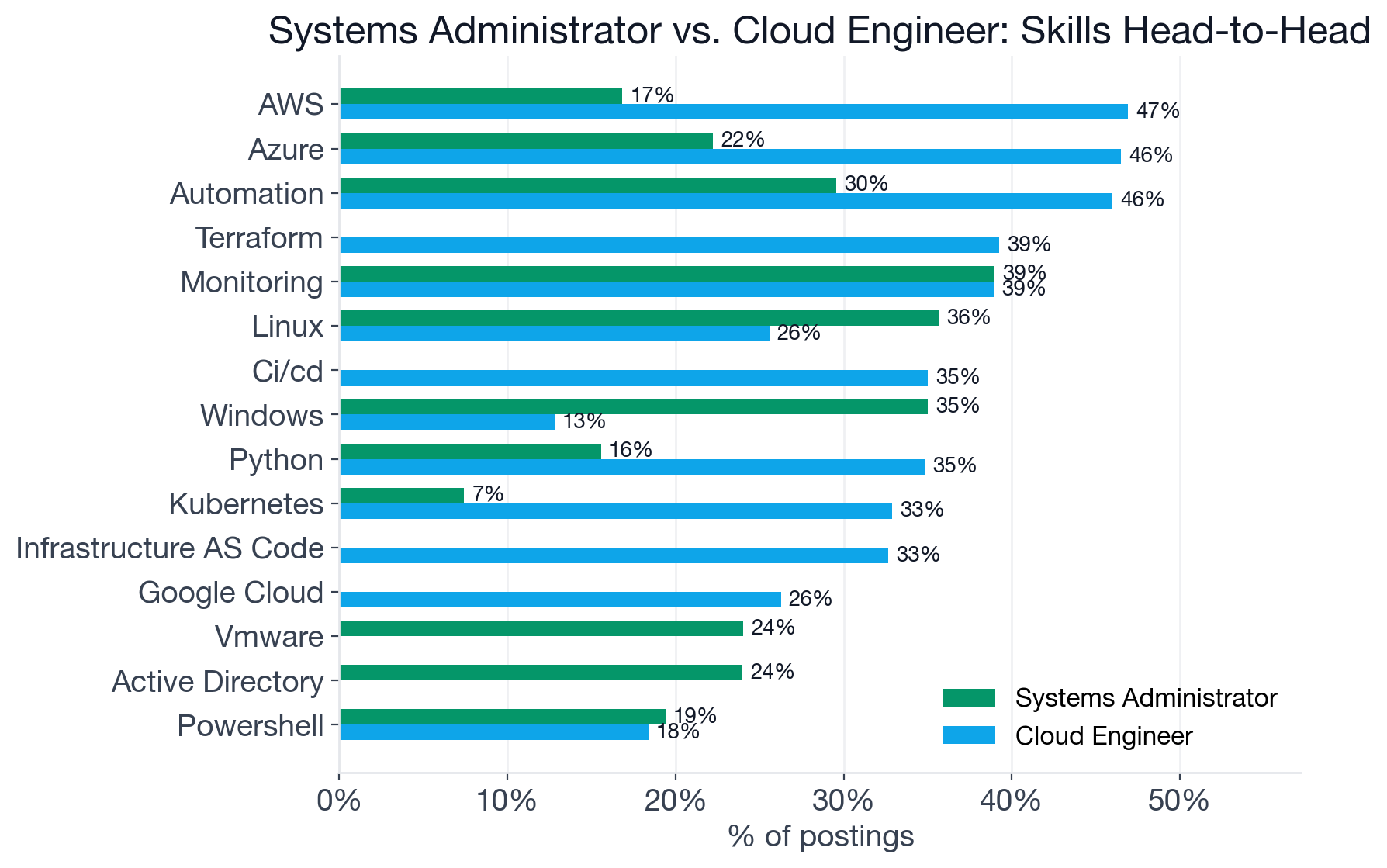 Monitoring is the only bar in this chart that lands at essentially the same height for both roles; every other shared skill tilts one direction or the other.
Kubernetes is the clearest example of "shared" not meaning "balanced." It clears the 5% floor in both roles' postings, so it counts as a shared skill by the analysis threshold, but it appears in 32.9% of Cloud Engineer postings against just 7.4% of Systems Administrator postings, nearly a 4.5x gap hiding inside a category labeled "shared."
Two Different Eras of Infrastructure
Systems Administrator's exclusive skills read like an on-prem, Windows-domain shop: VMware (24.0%), Active Directory (24.0%), Windows Server (16.9%), and Technical Support (15.8%). These are the skills that show up in Systems Administrator postings at meaningful rates and barely register in Cloud Engineer postings.
Cloud Engineer's exclusive skills read like a provisioning pipeline: Terraform (39.3%), CI/CD (35.0%), Infrastructure as Code (32.7%), and Google Cloud (26.3%). Where Systems Administrator manages identity and uptime on infrastructure someone else built, Cloud Engineer builds and versions the infrastructure itself.
Neither role's postings tag an explicit AI or ML skill in the top 30, which reads at first like AI hasn't touched either job. It's more accurate to say job postings are silent on it, not that the work is. The only AI-adjacent line in either salary table is Generative AI for Cloud Engineer, appearing in under 5% of its US salary-disclosing postings (n=36 of 741) with a modest $4,000 premium. Stack Overflow's 2025 Developer Survey found 84% of developers now use or plan to use AI tools (Stack Overflow, 2025), and IT/technology teams report the highest departmental AI adoption of any function measured, ahead of R&D (Atera AI Stats, 2026). The likely split: Systems Administrators lean on AI-assisted monitoring and anomaly detection layered on top of existing dashboards, while Cloud Engineers lean on AI-assisted code generation for Terraform and Kubernetes manifests. Neither posting will say "AI required." Both jobs increasingly assume it.
Which Pays More?
Cloud Engineer, by $31,000, a 27% premium over the Systems Administrator baseline, at the median US base salary, $146,000 versus $115,000. These figures reflect base pay only, drawn from US postings where wage-transparency requirements produce consistent disclosure; equity, bonus, and sign-on aren't in the data.
The more interesting story is what moves each role's pay individually. For Systems Administrator, the role's own defining skills don't carry a premium: Active Directory pays $105,000 ($10,000 below its own baseline, n=350), Windows Server pays $102,500 ($12,500 below, n=215), and Technical Support pays $100,000 ($15,000 below, n=220). The real premium comes from picking up Cloud Engineer-adjacent skills instead: AWS pays $130,000 (+$15,000, n=278) and Ansible pays $129,600 (+$14,600, n=198). A Terraform, Kubernetes, and Python cluster all land at $126,800 (+$11,800 each, n=74 to n=235), a consistent premium for crossing into cloud-native tooling from an on-prem base.
For Cloud Engineer, the pattern partly repeats and partly breaks. AWS, Azure, Terraform, and CI/CD, the role's most-cited skills, sit flat or slightly below its $146,000 baseline (Azure the furthest under at $137,300, -$8,700, n=311). But two of its exclusive skills buck that pattern and pay above baseline: Google Cloud at $156,000 (+$10,000, n=218) and Observability at $157,500 (+$11,500, n=153). The largest individual premiums sit further out, in operational-maturity territory rather than core provisioning: Datadog (+$19,000, n=27), Debugging (+$17,400, n=64), and Distributed Systems (+$16,300, n=54).
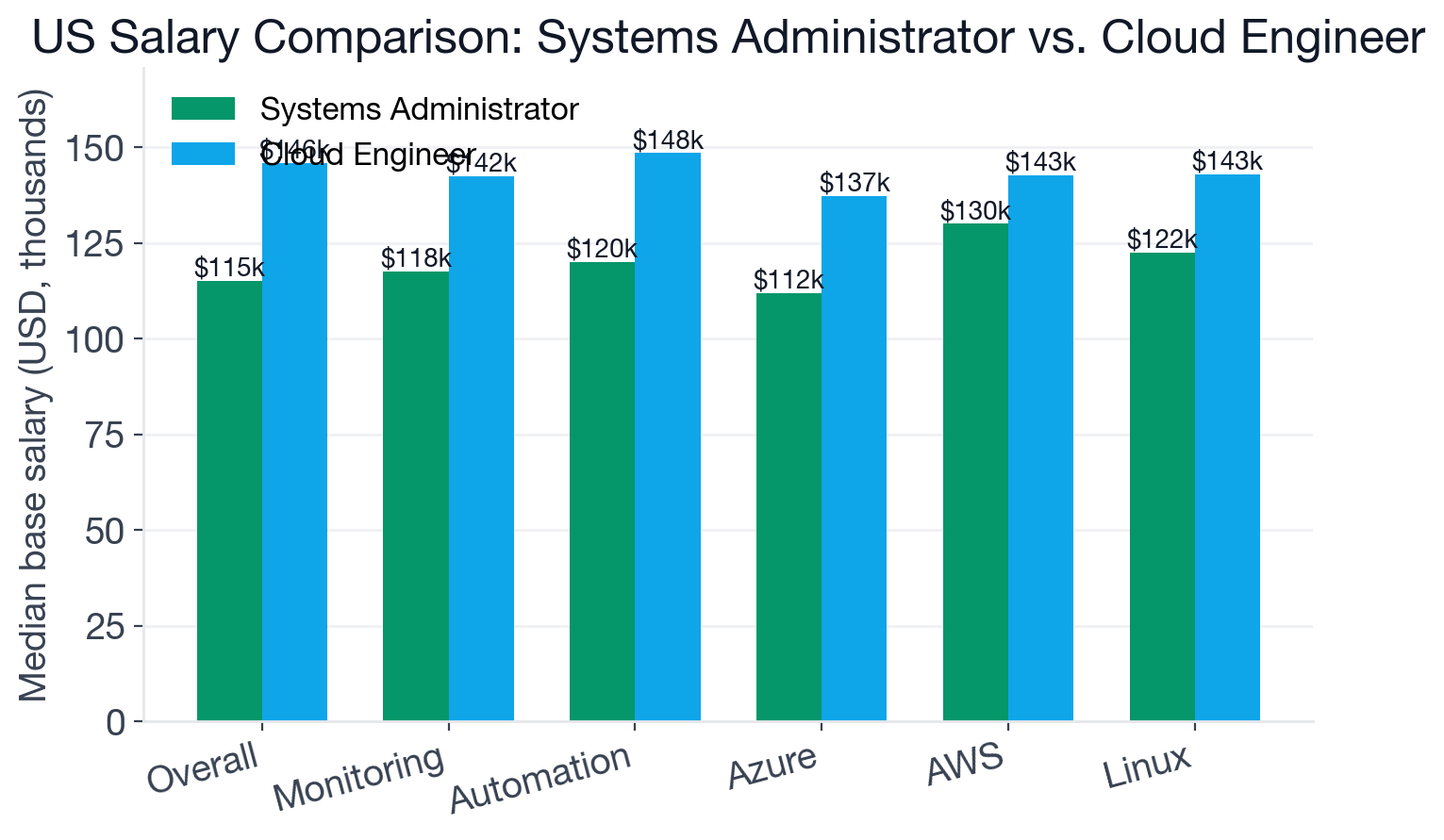 Both roles' headline skills sit near their own baseline; the real pay signal lives one layer down, in cloud/automation depth for Systems Administrator and in operational depth for Cloud Engineer.
Which Has More Job Openings, and Where?
Systems Administrator, by a modest margin: 4,263 active postings versus 3,766 for Cloud Engineer, about 1.13x. That edge in volume comes with less flexibility. Systems Administrator postings are 65.96% onsite, with 27.2% hybrid and 8.6% remote. Cloud Engineer flips that mix: 50.2% onsite, 39.6% hybrid, and 15.3% remote, adding up to 54.9% hybrid-plus-remote against Systems Administrator's 35.9%.
Neither role is a soft landing for a total beginner. Entry-level share is 2.9% for Systems Administrator and 3.7% for Cloud Engineer, both thin. Cloud Engineer's postings also skew more senior overall: 22.8% senior and 11.6% staff, versus 16.9% senior and 4.1% staff for Systems Administrator.
Geography reinforces the gap. Systems Administrator postings are 51.3% US-based with Germany a distant second (9.9%). Cloud Engineer is only 32.7% US-based, with India as its second-largest market (12.6%), consistent with the role's global cloud-consulting footprint.
Which Should You Choose?
Choose Systems Administrator if you:
- Already know Active Directory, Windows Server, and VMware, and would rather deepen that stack than relearn a new one.
- Want the larger current pool of open roles (4,263 vs. 3,766) and can accept that most of it (66%) is still onsite.
- Are looking for the fastest pay lever you control without changing titles: adding AWS (+$15,000) or Ansible (+$14,600) to an existing sysadmin skillset is the largest verified premium available inside the role, even though it's still roughly half of the $31,000 the full jump to Cloud Engineer is worth.
Choose Cloud Engineer if you:
- Want infrastructure-as-code (Terraform, CI/CD, Kubernetes) to be the default part of the job, not an extra you pick up later.
- Value flexibility: 54.9% of postings are hybrid or remote, against 35.9% for Systems Administrator.
- Want the higher salary ceiling now rather than building toward it: the $31,000 gap exists at the median today, not just at the top.
Both paths have a narrow entry door (under 4% of postings), so expect to arrive with some hands-on lab work or help-desk experience either way. For a closer look at how Systems Administrator compares to a more adjacent title, see our Systems Administrator vs. Network Engineer breakdown; for the full skill picture on either role individually, see Systems Administrator Skills Companies Want in 2026 and Cloud Engineer Skills Companies Want in 2026.
If you're weighing the move, practicing infrastructure and cloud-architecture questions in an AI mock interview surfaces gaps in Terraform or Kubernetes fluency faster than reading docs, and the question bank has role-specific drills for both tracks.
FAQ
Q. Which pays more, Systems Administrator or Cloud Engineer?
Cloud Engineer pays more. The median US base salary is $146,000 for Cloud Engineer versus $115,000 for Systems Administrator, a $31,000 premium, 27% above the Systems Administrator baseline. Both figures are base salary only; equity and bonus aren't disclosed in postings.
Q. How much skill overlap is there between Systems Administrator and Cloud Engineer?
The two roles share 36% skill overlap (Jaccard similarity on each role's top 30 skills). Monitoring is the one skill both roles cite at almost exactly the same rate, 38.99% of Systems Administrator postings and 38.93% of Cloud Engineer postings. Most other shared skills skew toward Cloud Engineer: AWS and Azure by roughly 2 to nearly 3 times, Automation more modestly at about 1.6 times.
Q. Is it easier to get hired as a Systems Administrator or a Cloud Engineer?
Neither is an easy entry point. Entry-level share sits at 2.9% for Systems Administrator and 3.7% for Cloud Engineer, both thin. Systems Administrator has more total postings (4,263 vs. 3,766), so raw opportunity volume favors it slightly, but the entry bar itself is comparably narrow for both.
Q. What skills should a Systems Administrator learn to move toward Cloud Engineer pay?
AWS carries the largest verified premium for Systems Administrator postings ($130,000 median, $15,000 above the role's own $115,000 baseline, n=278), followed by Ansible (+$14,600, n=198) and a Terraform/Kubernetes/Python cluster that each land at $126,800 (+$11,800, n=74 to n=235). Active Directory and Windows Server, the role's own defining skills, actually pay below its baseline.
Q. Does Cloud Engineer offer more remote or hybrid work than Systems Administrator?
Yes. 54.9% of Cloud Engineer postings are hybrid or remote versus 35.9% for Systems Administrator, which is 65.96% onsite. Cloud Engineer also has more than 1.7 times the remote-only share (15.3% vs 8.6%).
Q. Do Systems Administrator or Cloud Engineer postings require AI skills?
Almost never explicitly. Neither role's top 30 skill list contains an AI or ML skill. Generative AI appears only in Cloud Engineer's salary data, in under 5% of its US salary-disclosing postings (n=36 of 741). That explicit silence doesn't mean AI is absent from either job: 84% of developers now use or plan to use AI tools (Stack Overflow 2025 Developer Survey), and IT/technology teams report the highest departmental AI adoption of any function measured, ahead of R&D (Atera AI Stats, 2026).
Q. What's the biggest skill difference between Systems Administrator and Cloud Engineer?
Systems Administrator's identity is on-prem and Windows-domain: VMware (24.0%), Active Directory (24.0%), Windows Server (16.9%). Cloud Engineer's identity is infrastructure-as-code: Terraform (39.3%), CI/CD (35.0%), Infrastructure as Code (32.7%). Kubernetes technically counts as a 'shared' skill under the analysis threshold, but it's still nearly 4.5 times more common in Cloud Engineer postings (32.9% vs 7.4%).
The Overlap Stops at Monitoring
Two roles that both watch dashboards for a living share exactly one skill at genuinely equal weight. Past that, the stack, the flexibility, and the paycheck all diverge. Systems Administrator holds more open roles today and a deeper bench of on-prem, Windows-domain skills; Cloud Engineer holds a $31,000 pay edge and a workday that's more than half hybrid or remote. Browse current Systems Administrator openings or Cloud Engineer openings on the InterviewStack.io job board to see where you'd land.
Topics
Ready to practice?
Put what you've learned into practice with AI mock interviews and structured preparation guides.