
Skewing More Senior Doesn't Close Design Researcher's $31,500 Gap
Design Researcher postings skew more senior than Technical Product Manager postings, not less, and the extra seniority buys nothing at the median. We looked at 1,159 active Technical Product Manager and 473 active Design Researcher postings on the InterviewStack.io job board as of September 2026: the role with the less senior title still earns more.
Technical Product Manager pays a median $154,500 US base salary; Design Researcher pays $123,000, a $31,500 gap (25.6%). Both figures are base salary only, equity, bonus, and sign-on aren't disclosed in postings, so total compensation at top employers runs higher on both sides. Meanwhile 34.9% of Design Researcher postings sit at senior or staff level versus 28.8% for Technical Product Manager. If seniority set the price, Design Researcher should command the premium. It doesn't. (Seniority here is inferred from title keywords, and a posting without an explicit level word defaults to mid-level, so both percentages are a floor rather than an exact census. There's no reason that measurement quirk would favor one role's dataset over the other's, so it doesn't explain away the gap.)
| Technical Product Manager | Design Researcher | |
|---|---|---|
| Median US base salary | $154,500 | $123,000 |
| Active postings | 1,159 | 473 |
| Most common skill | Product Management (52.6%) | Instructional Design (40.8%) |
| Senior + staff share | 28.8% | 34.9% |
| Remote share | 35.8% | 36.6% |
| Skill overlap (Jaccard) | 18% shared | n/a |
Key Findings
- Median US base salary: $154,500 for Technical Product Manager vs. $123,000 for Design Researcher, a $31,500 (25.6%) gap.
- Design Researcher postings skew more senior (34.9% senior + staff) than Technical Product Manager (28.8%), yet still pay less.
- Skill overlap is a Jaccard similarity of just 0.18: only 18% of the combined skill territory is shared.
- Of the 9 skills both roles require at meaningful rates, only 3, Project Management, Machine Learning, and Generative AI, favor Design Researcher.
- Technical Product Manager's own top skill, Product Management (52.6% of postings), carries only an $8,000 premium; the real premiums (User Experience, Go To Market, Product Strategy) run $12,900 to $13,500 and sit outside its core toolkit.
- Technical Product Manager postings (1,159) outnumber Design Researcher postings (473) by 2.45x.
- Entry-level openings are scarce for both: 1.9% for Technical Product Manager, 2.7% for Design Researcher.
- A large share of "Design Researcher" postings are actually instructional-design/corporate-training roles: Instructional Design alone is the dataset's single most common skill (40.8% of postings), ahead of every core research skill. That mix drags the blended salary median down; the genuine UX-research track prices above Technical Product Manager (see below).
The Day-to-Day Behind Each Title
A Technical Product Manager sits between engineering and the roadmap: writing specs that read like API contracts, negotiating scalability and monitoring requirements with engineers, and translating platform constraints into a plan the rest of the business can execute. The role's exclusive skills, APIs, Monitoring, Product Roadmap, Automation, and SQL, read like a systems inventory, not a stakeholder deck. A spot-check of sampled titles also turned up a handful of "Technical Designer" and "Technical Product Developer" postings, apparel- and interiors-industry roles that share the word "Technical" but have nothing to do with product management; the job board's role classifier isn't perfectly clean at the edges, so treat postings counts as approximate rather than exact.
Design Researcher's postings split along a line the job title doesn't disclose, and the split isn't a minor footnote. Instructional Design is the single most common skill in the dataset at 40.8% of postings, ahead of every core research skill, including User Research (15.4%) and Usability Testing (12.5%). One track runs interviews, usability tests, and synthesis that shapes what gets built (User Research, Usability Testing, Accessibility). The other, judging by how often Instructional Design, eLearning, Blended Learning, Andragogy, and Virtual Training show up, all classic corporate-training/L&D terms, is closer to an instructional-design or L&D role wearing a research title than to UX research. Both get filed under the same posting, and both feed into the same blended salary and seniority numbers used throughout this post.
Which Skills Show Up on Both Job Descriptions?
Nine skills clear the 5% bar in both roles' postings, but the direction of the gap flips depending on the skill.
| Skill | Technical Product Manager | Design Researcher |
|---|---|---|
| Product Management | 52.6% | 5.9% |
| Agile | 23.2% | 9.1% |
| Product Strategy | 21.1% | 8.0% |
| User Experience | 22.2% | 17.1% |
| LLMs | 18.1% | 12.7% |
| Data Science | 7.0% | 5.7% |
| Project Management | 7.7% | 14.2% |
| Machine Learning | 8.3% | 14.6% |
| Generative AI | 5.8% | 18.2% |
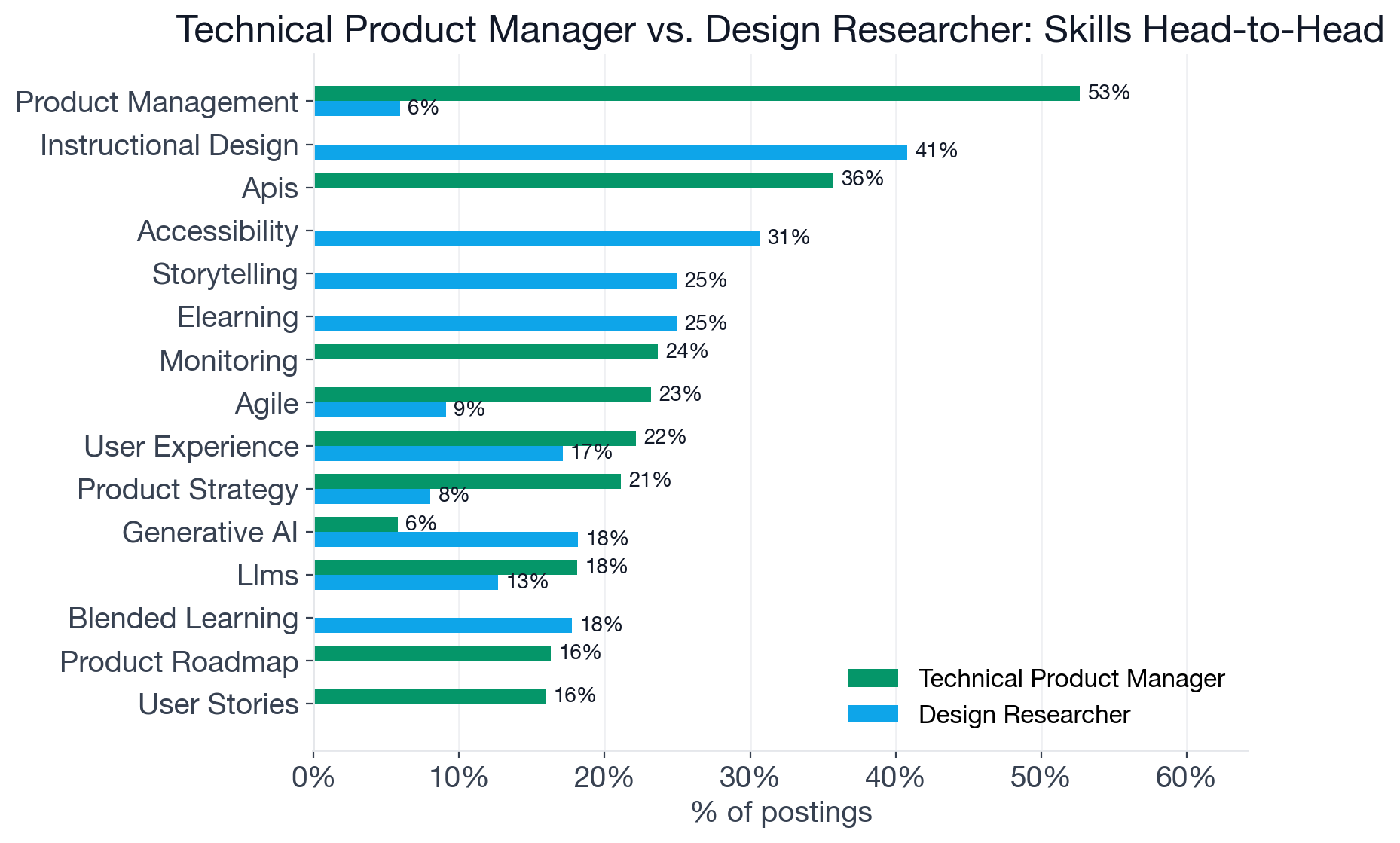 Outside Product Management, User Experience, and LLMs, the two roles barely touch the same skills.
Product Management itself carries the widest gap on the list: nearly nine times as many Technical Product Manager postings name it as Design Researcher postings do. The only three skills that run the other way, where Design Researcher out-indexes Technical Product Manager, are Project Management, Machine Learning, and Generative AI, two of them AI-adjacent.
Taken at face value, Design Researcher looks like the more AI-native role: Generative AI shows up in 18.2% of its postings against 5.8% for Technical Product Manager, and Machine Learning follows the same pattern (14.6% vs 8.3%), despite "Technical" sitting in the other title. But an explicit mention measures who is hired to build or research AI-specific features, not who uses AI at their desk. Separate industry surveys put daily-or-often AI tool use at 94% for product managers (n=379), per Productboard's State of AI in Product Management, and around 69% for UX researchers, with AI-assisted synthesis rated the single most impactful 2026 trend by 88% of researchers surveyed, per CleverX. The posting language for both jobs is behind what practitioners already do day to day.
The Exclusive Skills Don't Overlap With Each Other At All
Technical Product Manager's top five exclusive skills, APIs (35.7%), Monitoring (23.6%), Product Roadmap (16.3%), User Stories (16.0%), and Automation (14.4%), are all build-and-ship, engineering-facing signals. Design Researcher's top five, Instructional Design (40.8%), Accessibility (30.7%), eLearning (25.0%), Storytelling (25.0%), and Blended Learning (17.8%), don't share a single entry with that list, and lean heavily toward the L&D/training track rather than pure UX research. For a full breakdown of that split, see our Design Researcher skills deep dive. With almost no shared exclusive territory, the 18% overall overlap checks out: these are two different jobs that happen to sit near each other on the product org chart.
Which Role Pays More, and Why Doesn't Seniority Explain It?
Technical Product Manager pays $154,500 at the median US base salary; Design Researcher pays $123,000, a $31,500 (25.6%) gap that favors Technical Product Manager. The obvious explanation, that Technical Product Manager postings skew more senior, doesn't hold: Design Researcher actually runs 6.1 points higher on combined senior-and-staff share (34.9% vs 28.8%). The premium tracks scope and title, not tenure.
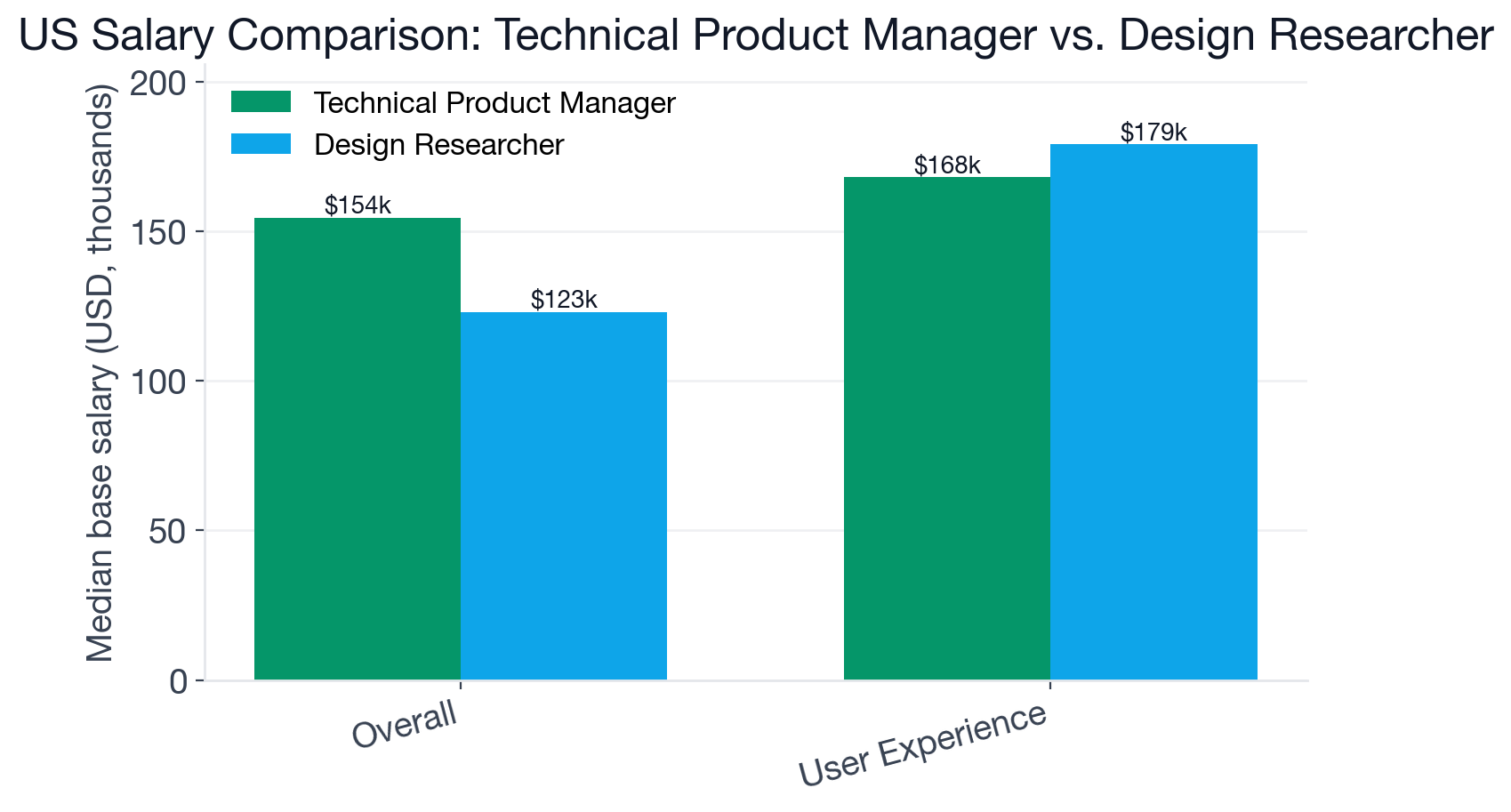 Technical Product Manager's base-salary lead holds even though Design Researcher's postings skew more senior.
On Technical Product Manager's own data, the role's single most common skill, Product Management (52.6% of postings), carries only a modest $8,000 premium over baseline (n=189). The real premiums sit outside the core toolkit: User Experience and Go To Market both add $13,500 (n=47, n=34), and Product Strategy adds $12,900 (n=77). Meanwhile LLMs actually prices $19,000 below baseline (n=26); an explicit AI mention here doesn't buy a premium, likely because at this frequency it signals lighter prompting work rather than technical AI-system ownership.
Design Researcher's own salary table splits sharply along the track its exclusive skills already hinted at. User Experience ($179,100, n=35) and User Research ($166,200, n=29), the genuine research-facing skills, price $56,100 and $43,200 above the role's $123,000 median. Instructional Design and eLearning price $36,800 below it (n=57, n=27). If you're evaluating Design Researcher as a research career rather than an instructional-design one, the higher figures are the realistic benchmark, not the blended median.
That split cuts against this post's own headline. $166,200-$179,100 is above Technical Product Manager's $154,500 median, so a genuine UX-research-track Design Researcher likely out-earns a Technical Product Manager, even though the blended $123,000 median, dragged down by the instructional-design side of the same dataset, says the opposite. Which comparison is the right one for you depends entirely on which track a specific posting actually is, not on the job title alone.
Which Role Has More Openings, and Is Either Easier to Break Into?
Technical Product Manager postings (1,159) outnumber Design Researcher postings (473) by 2.45x, a real gap but not an extreme one; Design Researcher is a genuine niche, not a vanishingly rare title. Both lean US-heavy (44.8% for Technical Product Manager, 46.5% for Design Researcher), with the UK, Canada, Germany, and India rounding out both top-market lists, and remote share is close too (35.8% vs 36.6%).
Neither role is a realistic first job. Entry-level postings are just 1.9% of Technical Product Manager openings and 2.7% of Design Researcher openings; both are overwhelmingly filled by non-entry-level roles (98.1% and 97.3% respectively).
Match Your Strengths to the Role That Pays for Them
Choose Technical Product Manager if you:
- Want to work at the interface of engineering and business, writing specs that hold up against real API and scalability constraints
- Come from a technical or engineering-adjacent background and want to keep that fluency without writing code full time
- Want the larger job pool and the higher pay ceiling, and don't mind that the premium sits in strategy and go-to-market skills rather than the role's own core toolkit
Choose Design Researcher if you:
- Want to specialize in structured user inquiry, interviews, usability testing, and synthesis, over owning roadmap decisions
- Come from a research, psychology, or instructional-design background
- Are comfortable with a smaller job pool and a lower median, and will verify which track (UX research or L&D) a specific posting actually is before applying, since the two price tens of thousands of dollars apart
Turning This Into Your Next Move
If you're deciding between these two paths, remember the overlap is just 18%: most of what you'd need to learn is new, not transferable. Start by pressure-testing your instincts with a mock interview scoped to whichever role you're leaning toward; a Technical Product Manager round will probe API and system-design tradeoffs, while a Design Researcher round will probe study design and synthesis. Our interview question bank covers both tracks separately, and our interactive courses can help close the specific gap skills: system-design fluency for Technical Product Manager, research methodology for Design Researcher. When you're ready, browse live Technical Product Manager or Design Researcher openings, or narrow further to Product Strategy-heavy Technical Product Manager roles or User Research-heavy Design Researcher roles.
For the single-role deep dives behind these numbers, see Technical Product Manager Skills Companies Want in 2026 and Design Researcher Skills Companies Want in 2026. If the broader Product Manager title, not the technical variant, is also on your shortlist, Product Manager vs Design Researcher covers that comparison separately.
FAQ
Q. What is the salary difference between Technical Product Manager and Design Researcher?
Technical Product Managers earn a median US base salary of $154,500 (n=305 postings with US salary disclosed) versus $123,000 for Design Researchers (n=147), a $31,500 gap (25.6%). Equity and bonus are not disclosed in job postings and are excluded from both figures, so total compensation at top employers runs higher on both sides.
Q. How many active job openings are there for each role?
There are 1,159 active Technical Product Manager postings versus 473 for Design Researcher, a 2.45x volume difference. Both roles post at a steady, ongoing clip rather than either being extremely rare.
Q. Do Technical Product Manager and Design Researcher share many of the same skills?
Not many. The two roles' top-30 skill sets overlap by a Jaccard similarity of just 0.18, meaning about 18% of the combined skill territory is shared. Nine skills clear the 5% threshold in both roles' postings, but only three, Project Management, Machine Learning, and Generative AI, occur more often in Design Researcher postings than in Technical Product Manager ones.
Q. Why does Design Researcher pay less even though its postings skew more senior?
Design Researcher postings are 34.9% senior-or-staff level versus 28.8% for Technical Product Manager, yet the median base salary is still $31,500 lower. The premium tracks scope and title, not seniority: Technical Product Manager postings command a premium for product-strategy and go-to-market skills regardless of level, while Design Researcher's own top salary skills split sharply between UX-research work (User Experience, User Research) and instructional-design work, which prices tens of thousands of dollars lower.
Q. Is AI a bigger requirement for Technical Product Manager or Design Researcher?
By explicit posting language, Design Researcher: Generative AI appears in 18.2% of Design Researcher postings versus 5.8% for Technical Product Manager, and Machine Learning in 14.6% versus 8.3%. Those numbers measure who is hired to build or research AI features, not who uses AI day to day. Industry surveys put daily-or-often AI tool use at 94% for product managers and around 69% for UX researchers, a floor that applies to both roles regardless of what their job postings say.
Q. Which role is easier to break into as an entry-level candidate?
Neither is a strong first job. Entry-level postings make up just 1.9% of Technical Product Manager openings and 2.7% of Design Researcher openings; both roles are overwhelmingly filled at mid-level or above.
The Premium Is Attached to the Role, Not the Rank
Design Researcher's postings skew more senior, and it still pays $31,500 less than Technical Product Manager at the median. That gap isn't a seniority story, it's a scope story: the market pays for owning the roadmap and the API contract, not for the research that informs it, and it pays even less for the instructional-design work sitting quietly inside a chunk of Design Researcher postings. Whichever side you're on, know which specific track you're pricing before you negotiate.
Topics
Ready to practice?
Put what you've learned into practice with AI mock interviews and structured preparation guides.