
Terraform Demand Is Steady, but the Pay Signal Splits by Role
Terraform (HashiCorp's infrastructure-as-code tool for provisioning cloud resources from declarative config files) is worth learning if you work anywhere near infrastructure. The postings do not support a blanket pay bump, though. In the 90 days to November 9, 2026, 10,756 of 152,952 active postings on the InterviewStack.io job board (7.0%, roughly 1 in 14) asked for it, a share that held between 6.9% and 7.1% across all three 30-day windows. Postings that ask for Terraform advertise US base pay 4.6% higher on average than comparable postings in the same role and seniority, yet 9 of 38 role-and-level comparisons go the other way.
That split is the real story. Terraform is close to standard equipment in DevOps, Cloud, and SRE work, where it mostly travels with higher advertised pay (strongest at mid level and for senior DevOps; senior Cloud and SRE are flat to slightly negative). In software roles it shows up often by raw volume but reads as a side skill, and at senior and staff level those postings advertise slightly less than their Terraform-free peers. Treat it as a role-dependent bet, not a universal upgrade.
Key Findings
- 10,756 of 152,952 active postings (7.0%) ask for Terraform, across 32 of 39 tracked roles.
- The share is flat: 6.9% (61-90 days ago), 7.1% (31-60 days), 7.1% (last 30 days).
- 48.4% of DevOps Engineer postings ask for it, versus 6.1% of Software Engineer postings.
- Of 1,921 mentions with a clear signal, 90.2% are preferred and 9.8% are required (188 postings).
- Same role and seniority, US advertised base pay is 4.6% higher on average for Terraform postings (22 of 38 comparisons up, 9 down).
- Senior Software Engineer postings with Terraform advertise 3.0% less ($174,650 vs $180,000); staff Software Engineer, 4.4% less.
- Only 1.6% of Terraform postings are entry-level, against 6.6% of other postings.
- Ansible has the strongest pairing: 29.6% of Terraform postings, lift 8.8.
Who Hires for Terraform?
The roles that live in infrastructure treat Terraform as standard kit; everyone else treats it as a bonus. DevOps Engineer leads on both measures, but the volume ranking hides a sharp difference in how standard the skill is.
| Role | Postings asking for Terraform | Share of that role's postings | Share of all Terraform postings |
|---|---|---|---|
| DevOps Engineer | 2,341 | 48.4% | 21.8% |
| Software Engineer | 1,925 | 6.1% | 17.9% |
| Cloud Engineer | 1,006 | 37.7% | 9.4% |
| Site Reliability Engineer (SRE) | 798 | 32.0% | 7.4% |
| Data Engineer | 768 | 12.2% | 7.1% |
| Cybersecurity Engineer | 617 | 13.3% | 5.7% |
| Systems Engineer | 551 | 14.0% | 5.1% |
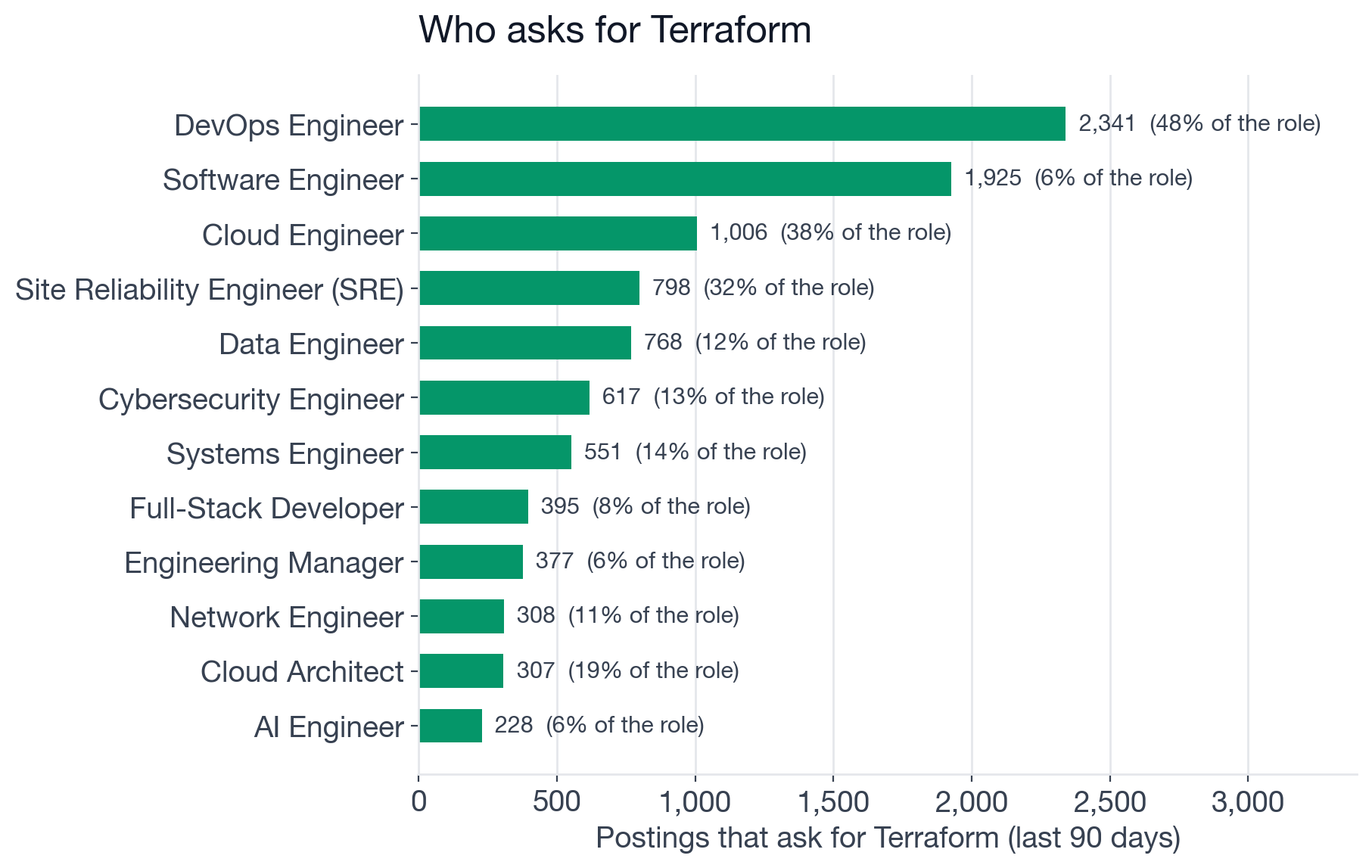
Terraform is standard in DevOps, Cloud, and SRE postings and a side skill in most other roles.
Roughly half of DevOps postings and over a third of Cloud postings name Terraform, so for those two paths it is closer to table stakes than a differentiator. Software Engineer is the surprise: it is the second-largest source of Terraform postings only because the role is huge (31,579 postings), while Terraform appears in about 1 in 16 of them. If you want the fuller skill picture for the three biggest sources, see our posts on DevOps Engineer skills, Cloud Engineer skills, and Software Engineer skills.
Seniority tilts the same way. Senior and staff roles are 53.0% of Terraform postings versus 37.3% of postings without it, and entry-level is only 1.6% versus 6.6%. This is a skill employers expect you to bring, not one they plan to teach a new graduate.
Is Terraform Required or a Nice-to-Have?
Mostly a nice-to-have on paper: of the 1,921 mentions where nearby wording signals a level, 90.2% say preferred and only 9.8% say required (188 postings, about 1 in 10). Most of the 10,756 mentions carry no such wording at all, and a further 1,631 could not be located in the first part of the description, so this split describes a subset rather than every posting. The wording is read from a short window around the first mention and "preferred" wins ties, so the split probably leans toward preferred.
Read that carefully. "Preferred" here is often the tail of a long tools list, and in DevOps and Cloud postings the infrastructure-as-code expectation is also carried by the broader skill: 55.7% of Terraform postings separately list Infrastructure as Code as a skill. Missing Terraform rarely disqualifies an application by itself, but for infrastructure roles you will be competing against people who have it.
Do Terraform Postings Advertise Higher Pay?
Among US postings that disclose pay, the comparison below is within the same role and seniority, so a DevOps Engineer with Terraform is compared only with a DevOps Engineer of the same level without it. The figures are advertised base salary only; equity and bonus are not disclosed in postings, so total compensation at top employers is higher. We use 38 role-and-level cells with at least 15 salaries on each side, covering 9,625 Terraform postings (89.5% of the total). This is a correlation in what employers advertise, not evidence that learning Terraform raises your pay.
The weighted gap is 4.6%, and the whole-corpus gap (7.2%) is larger only because Terraform postings skew senior and infrastructure-heavy, which is job mix rather than tool effect. Across the cells, 22 go up, 9 go down, and 7 are roughly flat.
| Role and level | US base salary with Terraform | Without | Gap |
|---|---|---|---|
| SRE, mid-level | $143,000 | $119,075 | +20.1% |
| Systems Engineer, mid-level | $150,000 | $132,250 | +13.4% |
| DevOps Engineer, senior | $167,500 | $151,475 | +10.6% |
| DevOps Engineer, staff | $192,500 | $179,950 | +7.0% |
| Cloud Engineer, mid-level | $150,000 | $141,022 | +6.4% |
| DevOps Engineer, mid-level | $140,400 | $132,149 | +6.2% |
| Software Engineer, mid-level | $161,300 | $155,000 | +4.1% |
| Software Engineer, senior | $174,650 | $180,000 | -3.0% |
| Cloud Engineer, senior | $152,750 | $158,475 | -3.6% |
| Software Engineer, staff | $201,600 | $210,900 | -4.4% |
| Cybersecurity Engineer, mid-level | $137,250 | $145,440 | -5.6% |
| Full-Stack Developer, senior | $157,500 | $172,500 | -8.7% |
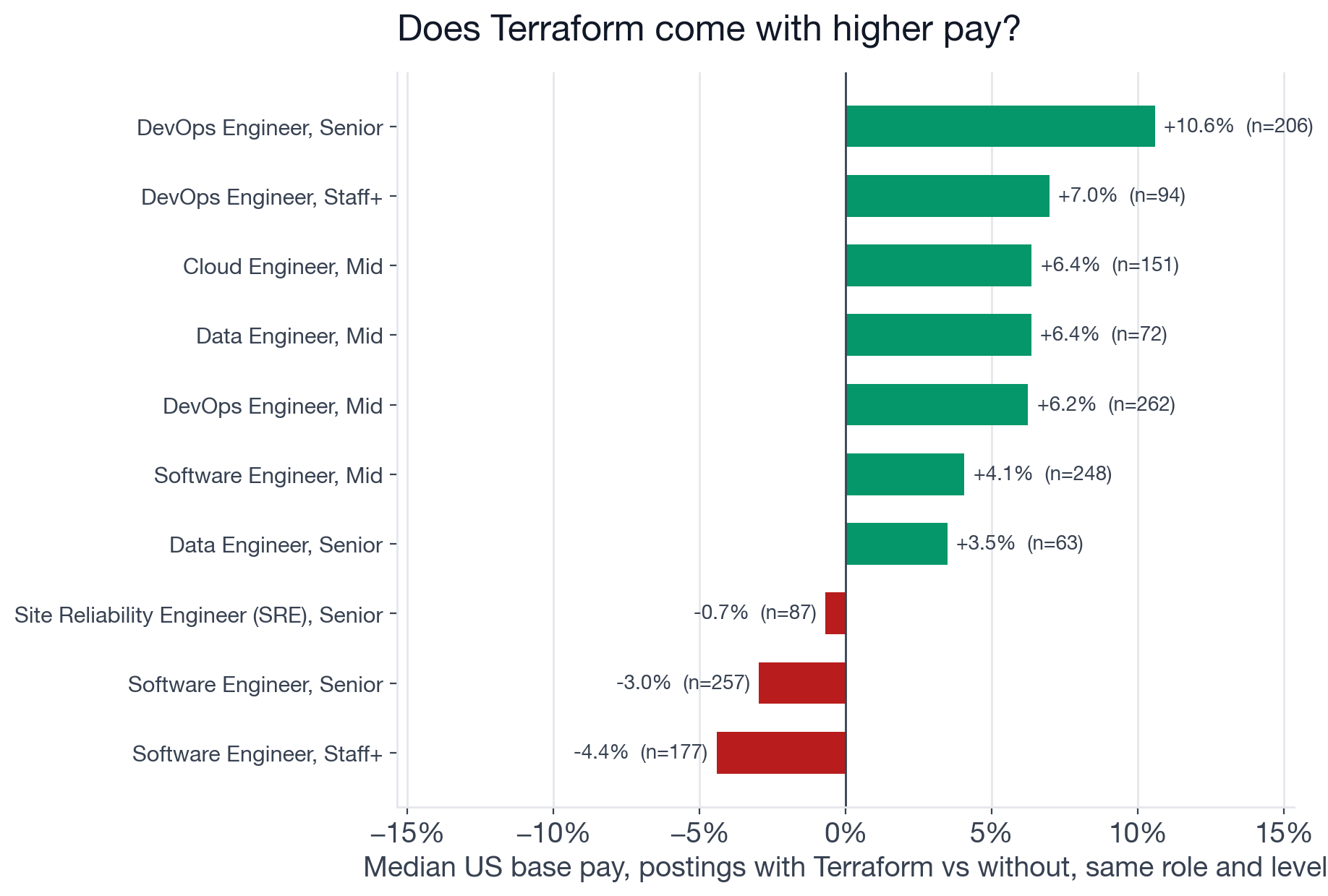
Advertised US base salary gaps for postings with Terraform versus the same role and level without it; the sign flips by role.
The positive cells cluster in mid-level infrastructure work (DevOps, SRE, Systems, Cloud) and senior DevOps, while senior Cloud (-3.6%) and senior SRE (-0.7%) are flat to slightly negative. The negative cells are spread across several roles rather than one corner: senior and staff Software Engineer, senior Full-Stack Developer, mid-level Cybersecurity Engineer, and senior Cloud Engineer are in the table above, and the full set also includes mid-level Cloud Architect (-4.2%), mid-level Engineering Manager (-1.3%), and senior SRE (-0.7%). The data does not tell us why, so we will not guess; the practical reading is that "Terraform comes with higher pay" is true for a DevOps Engineer and false for a senior Software Engineer. Smaller samples sit behind some cells (SRE mid-level has 63 Terraform salaries against 268 without), so treat the largest gaps as direction, not precision.
What Should You Learn With Terraform?
Rank the pairings by lift, not raw share. AWS appears in 68.8% of Terraform postings, but AWS is everywhere in the corpus, so its lift is only 3.4. The tools that genuinely travel with Terraform are the ones that are rare elsewhere.
| Tool | Share of Terraform postings | Lift |
|---|---|---|
| Ansible | 29.6% | 8.8 |
| Grafana | 20.3% | 7.2 |
| GitHub Actions | 20.3% | 6.5 |
| Bash | 23.9% | 5.6 |
| GitLab | 18.6% | 5.1 |
| Kubernetes | 58.7% | 5.0 |
| Docker | 35.6% | 3.9 |
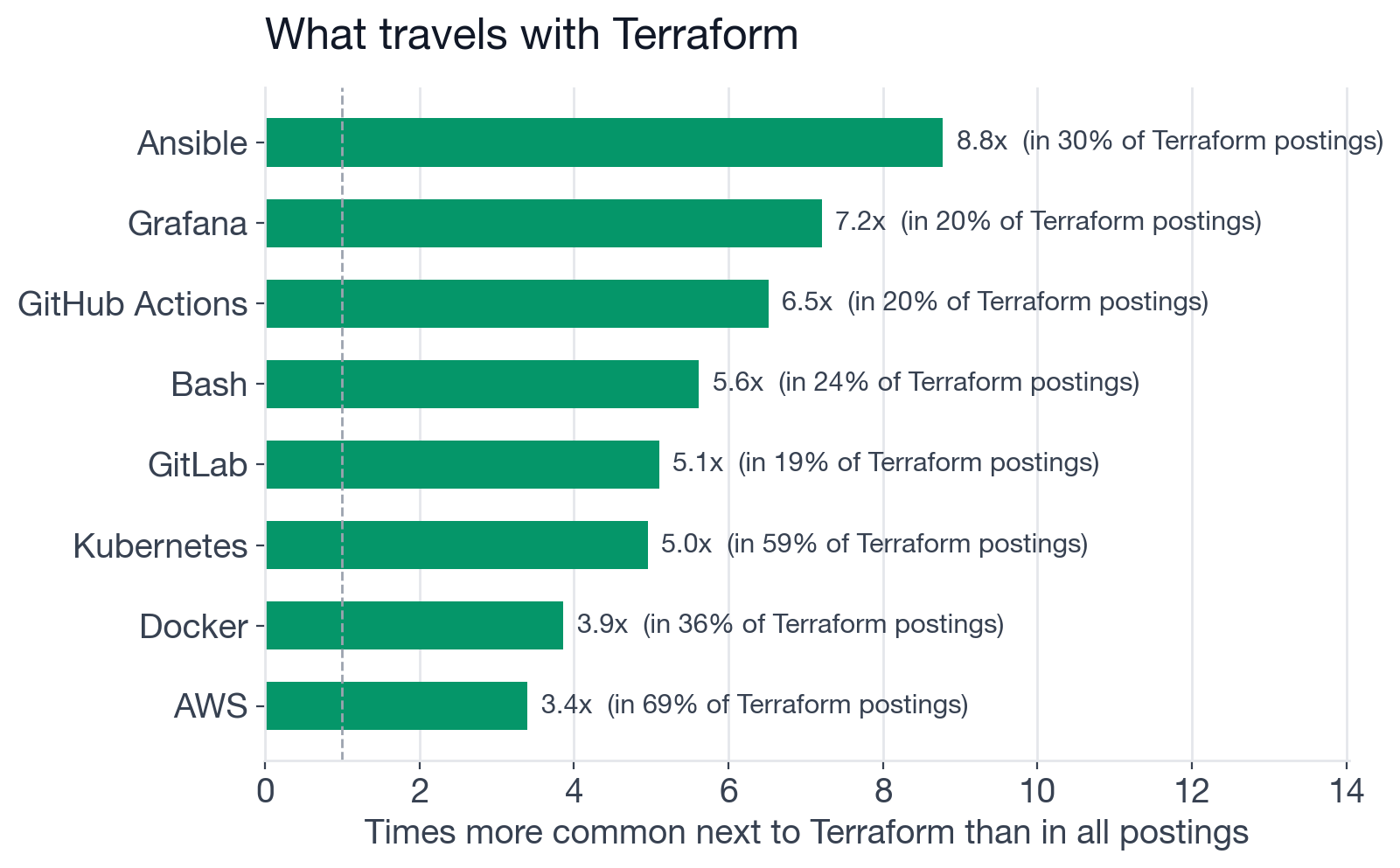
Ranked by lift, the tools that travel with Terraform form a delivery pipeline: configuration, CI/CD, containers, and observability.
The picture is a delivery pipeline: configuration management (Ansible), CI/CD (GitHub Actions, GitLab), containers and orchestration (Docker, Kubernetes), and observability (Grafana). Kubernetes is the standout because it pairs at high lift and is in nearly 3 in 5 Terraform postings. Among concepts, CI/CD (66.8%), Automation (61.4%), Monitoring (50.5%), and Observability (43.3%) all ride along. Python (65.3%) is common but low-lift, so it is a baseline, not a signal. AWS, Azure (45.1%), and Google Cloud (30.2%) each appear often; pick the cloud your target employers use.
Which Employers Post the Most Terraform Openings?
The top of the list is large enterprises and technology vendors, with a visible pocket of defense and federal integrators. Counted by distinct openings (not reposted rows), Cisco is first and Booz Allen Hamilton second, with SpaceX, Oracle, and Thales also in the top ten.
| Employer | Distinct openings |
|---|---|
| Cisco (two labels merged, approximate) | about 121 |
| Booz Allen Hamilton | 92 |
| Accenture and Accenture Federal Services (merged, approximate) | about 77 |
| Leidos | 68 |
| SpaceX | 63 |
| Oracle | 60 |
| Peraton | 53 |
| CACI International | 47 |
| General Dynamics Information Technology | 41 |
| Thales | 41 |
Booz Allen, Leidos, Peraton, CACI, and General Dynamics Information Technology alone account for 301 distinct openings, with Accenture Federal Services adding more. These ten employers are still a small slice of the 10,756 Terraform postings, so this is a notable pocket of demand, not the bulk of it. If you hold or can obtain a security clearance, that pocket is worth targeting; if you do not, most Terraform demand sits in a long tail of employers with fewer openings each. Our data does not show whether contractor pay explains the senior software-role gaps above, so we leave that unclaimed.
How to Use This in Your Job Search
If you are in DevOps, Cloud, SRE, or systems work, build Terraform depth first and pair it with Kubernetes and a CI/CD tool. Practice explaining state, modules, and drift out loud with AI mock interviews, drill infrastructure-as-code topics in the Question Bank, and build the surrounding fundamentals through our interactive courses. To see what employers are asking for right now, browse the job board and read the requirements for your own target role. If you are a software engineer, learn it as a supporting skill and expect it to differentiate you less than it would a DevOps candidate.
FAQ
Q. How many job postings ask for Terraform in 2026?
10,756 of 152,952 active postings (7.0%) on the InterviewStack.io job board asked for Terraform in the 90 days to November 9, 2026, spread across 32 of 39 tracked roles. The share was flat across the three 30-day windows, between 6.9% and 7.1%.
Q. Is Terraform required or just preferred?
Mostly preferred. Of the 1,921 Terraform mentions where nearby wording signals a level, 90.2% were preferred and 9.8% were required (188 postings). Most mentions carry no wording either way, so this split covers a subset.
Q. Do postings that ask for Terraform advertise higher pay?
On average yes, modestly: 4.6% higher US base salary within the same role and seniority, across 38 role-and-level comparisons. But 9 of those comparisons point the other way, including senior Software Engineer (-3.0%) and staff Software Engineer (-4.4%). This is a correlation in advertised pay, not proof that Terraform raises pay.
Q. Which roles ask for Terraform most often?
DevOps Engineer postings ask for it most often (48.4% of DevOps postings), followed by Cloud Engineer (37.7%) and Site Reliability Engineer (32.0%). Software Engineer is the second-largest source of Terraform postings by volume (1,925) but only 6.1% of Software Engineer postings mention it.
Q. What should I learn alongside Terraform?
Rank by lift, not raw share. Ansible (lift 8.8), Grafana (7.2), GitHub Actions (6.5), Bash (5.6), GitLab (5.1) and Kubernetes (5.0) pair with Terraform far more than their corpus share would predict. AWS appears in 68.8% of Terraform postings but its lift is only 3.4 because AWS is common everywhere.
Q. Can I get a Terraform job at entry level?
Rarely. Only 1.6% of Terraform postings are entry-level, against 6.6% of postings that do not mention it. Senior and staff roles make up 53.0% of Terraform postings versus 37.3% of other postings.
Where to Start
Learn Terraform if your next role is in infrastructure, cloud, or reliability: there it is standard, steadily demanded, and tied to higher advertised pay for DevOps and for mid-level cloud, SRE, and systems roles. If you are a senior software engineer, the postings give you no pay reason to prioritize it. Either way, pair it with Kubernetes and a CI/CD tool, because that is what employers actually bundle with it.
Topics
Ready to practice?
Put what you've learned into practice with AI mock interviews and structured preparation guides.